The Nature of Productivity: Lessons learned from the 20th Century Motor Company

The following three videos should be listened to completely—for they contain the secrets to manufacturing success within them.  To understand the effects of positive GDP forecasts, or the growth of a manufacturing sector in a country—the following clips read from the pages of Atlas Shrugged contain the hidden knowledge that is required to comprehend the cause and reasons for any kind of productive growth or decline.  In the fictional 20th Century Motor Company as described in the classic 50+ year novel—an entire company is driven to ruin for some mysterious reason.  That reason would later be confirmed cryptically by the entire  real-life city of Detroit, General Motors, and hundreds of thousands of smaller companies who like the factory in the novel that were once thriving places of industry but soon found their doors closed and overtaken by plant life from abandonment, followed the same path.  The philosophy of productivity for good or bad is contained within these three videos.  Once understood all the books written about modern finance, management, or lean manufacturing techniques will become obsolete as the truth contained is undeniable.  No matter what one’s opinion of Ayn Rand might be—whether or not they agree or disagree with her politics of small government, pure capitalism, and  value based society represented by money—her understanding of economics and business in general is among the greatest minds over the last three hundred years.  Let me explain why.

As a young man I saw on a much smaller scale the same type of things talked about in the 20th Century Motor Company as narrated by a former employee in the presented videos.  One place that I worked at nearly right out of high school while attending college night school was a metal stamping factory full of tough guys born and raised nearly exclusively in unionized households where their parents worked for General Motors or large local paper companies which had gone out of business.  They had deep in their internal workings the same beliefs as the narrator describing the 20th Century Motors situation and I immediately came into direct conflict with them.  Lucky for me, my background included hard-working parents, two sets of grandparents who owned professional farms and my first work experiences where around members of the Chicago Chinese mob.  So I had the opportunity from a very young age without reading Atlas Shrugged to learn about what values money represented about people and learned about the nature of good and evil as related.  My job at the stamping factory was a clash of two worlds, one where a majority of the people thought just like the narrator in the Atlas Shrugged excerpts, and I.  At this factory there was a piece per hour rate that was established by management of 400 parts on average.  The presses had lines of workers who each operated a part of the process in making compressor housings for air conditioners, the first press would press out a rough shape from a sheet of metal, the second would trim the excess away, the third usually involved several workers who had to do a number of punch operations to make connection holes.  Each had a unique challenge to physical labor that had to be done quickly to even think of getting close to 400 parts per hour.

I learned without much time expiring to do well over that 400 part per hour rate and soon found that management put me on the lead at the start of the line to set the pace for everyone else.  Employees downstream on the line when they realized I was pushing to do more than 400 per hour would slow down and let the parts build up on the conveyors leading to their presses.  But having parts backed up would often stress them out forcing them to do more than they wanted anyway so productivity increased and the management was happy.  This of course led to many conflicts and parking lot fights.  However, with my background–some rough characters from my youthful enterprises, and my natural hobby with bullwhips as my primary exercise item, I never had to worry about handling myself against rough-neck employees and their labor union backgrounds.  Through conflict I earned their respect and even though they resented being pushed, came to like me well enough to not resist my wishes.

I never bought into the line of thought that believed workers should only produce 400 parts per hour if they could do more because it seemed wrong to regulate productive enterprise.  I learned quickly that no matter how hard I worked, a majority of the workers would gladly ride my coat tails without putting forth any effort, and if I wanted to produce excess—which to me felt natural, I had to learn to fix the line myself when maintenance issues arose, or other problems presented themselves.  Often I felt that I carried the manufacturing capacity of the place on my back alone by pushing the culture toward productivity. Eventually I would leave that job and they immediately went through a period of struggle.  The next company I went to had very similar manufacturing challenges but instead of metal, it was injection plastic.  Again, it was the same story, a part per hour rate, my desire to exceed it, and a company full of employees who wanted to fight me over it to protect their “rights” against “management.”  In this place I talked the management into letting me work double shifts every day of the week—(16) hours a day, and on the weekends I’d back off only working (8) hour days.  I worked (7) days a week averaging around 96 hours of work per week.  Many in management thought I would keel over but they wanted my efforts which essentially was outpacing around (7) of their hourly workers and I was doing it on 2nd and 3rd shifts which were hard to staff.  This was a big place and my average output alone outpaced much of the totals from their entire first shift because of the amount of time I spent in their building working.

I knew people were mooching off me both in my private life and professional by the droves and my response was to see how much I could carry.  I performed like that for nearly 2 years straight then left there to work at Cincinnati Milacron.  There I ran into extreme levels of the kind of behavior talked about in the 20th Century Motor Company.  There, I was doing a very individually based job which prevented my direct impact on the productive culture.  The jobs perished as a result—not just mine, but everyone’s.  The site where I used to work is now a shopping center.  The large campus of manufacturing at “The Mill” is now gone, and my job with it.  My next place of business to work was a unionized shop doing manufacture for Amazon.com distribution centers.  There I had many conflicts with the employees some of which have been discussed in detail, but I routinely produced 150% efficiencies over the manufacturing rate per day, as opposed to the normal rate of 40% to 60% that the union employees fresh off a strike were producing.  That company like Milacron soon was sold off from a company that was drowning in losses—so I lost that job too along with many others employed there.  The way that the employees were throttling the piece rate was that many of the manufactured units had a 4 to 5 hour time, and most of the union workers would milk out that time to produce one unit per day on an eight-hour shift.  I was routinely producing two which pushed my rate well over 100% on average.  In that shop a forklift had to bring supplies to build with, so I learned that when I was out of material not to trust the forklift operator sitting on his unionized butt to help me achieve my goals, I would grab a forklift on my own and get my own stuff.  Of course this enraged people—but I did it anyway the entire time I worked there.

The long story made short is that there is excessive truth contained in the video clips presented.  The evil talked about is an evil that I have fought without really knowing the definition for years.  I only knew at the time that I wanted to fight that evil, I didn’t understand why until much later.  When I had figured it out, I then read Atlas Shrugged to have that confirmation thought, but that has been within the last decade.  I figured out what made the 20 Century Motor Company fail by experience instead of being told by a book.  I am proud to look back on my life now never yielding to the pressures of the masses to restrict my outputs and thus prevented becoming myself a contributor to that evil described.  I never produced at such levels to get a pat on the back from management, or even to make more money—even though those things did come to me, I did them because there was something inherently right about it.  The culture I grew up with aside from my family, the mob, and the money laundering from a job I had before the metal stamping place (not conducted by me, but discovered), had signed up for the same evil that destroyed the fictional 20th Century Motor Company.  I luckily had learned the value of money from people who naturally possessed great value, and even learned a lot from a criminal class who clearly understood the benefits of capitalism.  Their crimes were against politics, not the morality of money—and this is something I learned very early in my life which was a real gift.  By the time my wife begged me to take up honest hard-working jobs that were clean of criminals, hit men, and money laundering, I had already met the worst that any factory thug could present, and I knew how to deal with them.  In this way I was never beaten down for doing too much, and never stopped from being productive.  And I was able to confirm the validity of Ayn Rand’s work through more than theory.  I saw it firsthand.  The difference between myself and Ayn Rand is that she developed her philosophy around removing her input through a strike—her John Galt quit the world and took the productive with him.  I on the other hand felt the challenge to carry everything on my back the way Hank Reardon did, but without ever breaking.  My life would have been easier if I had done things the way Ayn Rand suggested, but I chose to fight it instead, and I’m glad to this day that I did.  But whatever the position, she was right and the narrator who is speaking her words is spot on.  The thing that is killing our world of productivity is the evil described in these videos.  It is not a fiction; the evil is as real as the sun, stars and moon and cannot be trivialized no matter how much a collective mass of people wishes. Productivity is good when boundaries are pushed beyond their expectations because it is there that creativity resides.  And it is specifically in creativity that production springs forth.  If creativity is embraced, a company flourishes.  If it is stifled even in small ways, the way of the 20th Century Motor Company will spring forth and slowly destroy everything that the company stood for.  Profit isn’t evil; it is the natural by-product of excess achieved through effort, creativity, and honor.  I didn’t work those two years of straight 96 hour work weeks to arrive at any other conclusion—and I didn’t do it for the graces of management.  I did it because it was the right thing to do at the right time because the creativity which put the product before me to make needed that effort to deliver it to a market in need.  And because it was delivered, the owners were paid, and in turn I was rewarded for my efforts—and that is how it is supposed to be.

Rich Hoffman



www.OVERMANWARRIOR.com


‘Adams’ the HBO Miniseries: “Lustrously ostentatious intellectually and overflowing with a visual history”

I’ve been to a lot of Tea Party events and know quite a few people on the inside of the movement and never did anyone bring up the magnificent miniseries done by HBO on John Adams as essential material for studying one of the greatest founding fathers in American history.  I assumed that the HBO produced event would be a typical progressive revisionist history that focused all too much on the hypocrisy of slavery and the general presentation as weak average men riding the coat-tails of history.  I assumed that since Tom Hanks produced the show that it would be laced with progressive references.  But……Laura Linney was in and was playing Abigail Adams—John Adams wife—so I put the series on a “to do” list for later.  I liked Linney in the Mothman Prophesies so thought I’d give the show a shot at some future time when I got around to it.  That time came six years later in 2014 when I saw that HBO was showing all seven parts of their mini-series on July 4th, so I set the DVR to record it which I eventually viewed a few weeks later when time allowed.  It was nothing short of lustrously ostentatious intellectually and overflowing with a visual history into the period which took great pains to be authentic. Without question some will attempt to question the accuracy of the work which is based on the David McCullough books, Adams and 1776 but to compress so much history and character into a relatively short period of time art had to bridge the gaps for the viewer which the series was marvelously successful at.  The set direction was monstrously good, the actors outstanding, but it was the writing that really overflowed with radiance.  The series covered in a scope I had never seen in a film or series of any kind the lifestyles and politics of France, England and the budding United States very accurately with costume design and makeup that I can’t imagine a more truthful attempt ever attempted.

John Adams is a 2008 American television miniseries chronicling most of U.S. President John Adams‘ political life and his role in the founding of the United States. Paul Giamatti portrays John Adams. The miniseries was directed by Tom Hooper. Kirk Ellis wrote the screenplay based on the book John Adams by David McCullough. The biopic of John Adams and the story of the first fifty years of the United States was broadcast in seven parts by HBO between March 16 and April 20, 2008. John Adams received widespread critical acclaim, and many prestigious awards. The show won four Golden Globe awards and thirteen Emmy awards, more than any other miniseries in history.

Part I: Join or Die (1770 A.D. – 1774 A.D.)

The first episode opens with a cold winter in Boston on the night of the Boston Massacre. It portrays John Adams arriving at the scene following the gunshots from British soldiers firing upon a mob of Boston citizens. Adams, a respected lawyer in his mid-30s known for his belief in law and justice, is therefore summoned by the accused Redcoats. Their commander, Captain Thomas Preston asks him to defend them in court. Reluctant at first, he agrees despite knowing this will antagonize his neighbors and friends. Adams is depicted to have taken the case because he believed everyone deserves a fair trial and he wanted to uphold the standard of justice. Adams’ cousin Samuel Adams is one of the main colonists opposed to the actions of the British government. He is one of the executive members of the Sons of Liberty, an anti-British group of agitators. Adams is depicted as a studious man doing his best to defend his clients. The show also illustrates Adams’ appreciation and respect for his wife, Abigail. In one scene, Adams is shown having his wife proofread his summation as he takes her suggestions. After many sessions of court, the jury returns verdicts of not guilty of murder for each defendant. The episode also illustrates the growing tensions over the Coercive Acts (“Intolerable Acts”), and Adams’ election to the First Continental Congress.

Part II: Independence (1774 A.D. – 1776 A.D.)

The second episode covers the disputes among the members of the Second Continental Congress towards declaring independence from Great Britain as well as the final drafting of the Declaration of Independence. At the continental congresses Adams is depicted as the lead advocate for independence. He is in the vanguard in establishing that there is no other option than to break off and declare independence. He is also instrumental in the selection of then-Colonel George Washington as the new head of the Continental Army.

However, in his zeal for immediate action, he manages to alienate many of the other founding fathers, going so far as to insult a peace-loving Quaker member of the Continental Congress, implying that the man suffers from a religiously based moral cowardice, making him a “snake on his belly”. Later, Benjamin Franklin quietly chastens Adams, saying, “It is perfectly acceptable to insult a man in private and he may even thank you for it afterwards but when you do so publicly, it tends to make them think you are serious.” This points out Adams’ primary flaw: his bluntness and lack of gentility toward his political opponents, one that would make him many enemies and which would eventually plague his political career. It would also, eventually, contribute to historians’ disregard for his many achievements. The episode also shows how Abigail innovatively copes with issues at home as her husband was away much of the time participating in the Continental Congress. She employs the use of then pioneer efforts in the field of preventative medicine and vaccination against smallpox for herself and the children.

Part III: Don’t Tread on Me (1777 A.D. – 1781 A.D.)

In Episode 3, Adams travels to Europe with his young son John Quincy during the war seeking alliances with foreign nations, during which the ship transporting them battles a British frigate. It first shows Adams’ embassy with Benjamin Franklin in the court of Louis XVI of France. The old French nobility, who are in the last decade before being consumed by the French Revolution, are portrayed as effete and decadent. They meet cheerfully with Franklin, seeing him as a romantic figure, little noting the democratic infection he brings with him. Adams, on the other hand, is a plain spoken and faithful man, who finds himself out of his depth surrounded by an entertainment- and sex-driven culture among the French elite. Adams finds himself at sharp odds with Benjamin Franklin, who has adapted himself to the French, seeking to obtain by seduction what Adams would gain through histrionics. Franklin sharply rebukes Adams for his lack of diplomatic acumen, describing it as a “direct insult followed by a petulant whine”. Franklin soon has Adams removed from any position of diplomatic authority in Paris. His approach is ultimately successful and was to result in the conclusive Franco-American victory at Yorktown.

Adams, chastened and dismayed but learning from his mistakes, then travels to the Dutch Republic to obtain monetary support for the Revolution. Although the Dutch agree with the American cause, they do not consider the new union a reliable and trustworthy client. Adams ends his time in the Netherlands in a state of progressive illness, having sent his son away as a diplomatic secretary to the Russian Empire.

Part IV: Reunion (1781 A.D. – 1789 A.D.)

The fourth episode shows John Adams being notified of the end of the Revolutionary War and the defeat of the British. He is then sent to Paris to negotiate theTreaty of Paris in 1783. While overseas, he spends time with Benjamin Franklin and Thomas Jefferson and Abigail visits him. Franklin informs John Adams that he was appointed as the first United States Ambassador to the United Kingdom and thus has to relocate to the British Court of St. James’s. John Adams is poorly received by the British during this time—he is the representative for a recently hostile power, and represents in his person what many British at the time regarded as a disastrous end to its early Empire. He meets with his former sovereign, King George III, and while the meeting is not a disaster, he is excoriated in British newspapers. In 1789, he returns to Massachusetts for the first Presidential Election and he and Abigail are reunited with their children, now grown. George Washington is elected the first President of the United States and John Adams as the first Vice President.

Initially, Adams is disappointed and wishes to reject the post of Vice President because he feels there is a disproportionate number of electoral votes in favor of George Washington (Adams number of votes pales in comparison to those garnered by Washington). In addition, John feels the position of Vice President is not a proper reflection of all the years of service he has dedicated to his nation. However, Abigail successfully influences him to accept the nomination.

Part V: Unite or Die (1788 A.D. – 1797 A.D.)

The fifth episode begins with John Adams presiding over the Senate and the debate over what to call the new President. It depicts Adams as frustrated in this role: His opinions are ignored and he has no actual power, except in the case of a tied vote. He’s excluded from George Washington’s inner circle of cabinet members, and his relationships with Thomas Jefferson and Alexander Hamilton are strained. Even Washington himself gently rebukes him for his efforts to “royalize” the office of the Presidency. A key event shown is the struggle to enact the Jay Treaty with Britain, which Adams himself must ratify before a deadlocked Senate (although historically his vote was not required). The episode concludes with his inauguration as the second president—and his subsequent arrival in a plundered executive mansion.

Part VI: Unnecessary War (1798 A.D. – 1802 A.D.)

The sixth episode covers Adams’s term as president and the rift between the Hamilton-led Federalists and Jefferson-led Republicans. Adams’s neutrality pleases neither side and often angers both. His shaky relationship with his vice president, Thomas Jefferson, is intensified after taking defensive actions against the French because of failed diplomatic attempts and the signing of the Alien and Sedition Acts. However, Adams also alienates himself from the anti-French Alexander Hamilton after taking all actions possible to prevent a war with France. Adams disowns his son Charles, who soon dies as an alcoholic vagrant. Late in his Presidency, Adams sees success with his campaign of preventing a war with France, but his success is clouded after losing the presidential election of 1800. After receiving so much bad publicity while in office, Adams lost the election against his Vice-President, Thomas Jefferson, and runner-up Aaron Burr (both from the same party). This election is now known as the Revolution of 1800. Adams leaves the Presidential Palace (now known as The White House), retiring to his personal life in Massachusetts, in March 1801.

Part VII: Peacefield (1803 A.D. – 1826 A.D.)

The final episode covers Adams’s retirement years. His home life is full of pain and sorrow as his daughter, Nabby, dies of breast cancer and Abigail succumbs to typhoid fever. Adams does live to see the election of his son, John Quincy, as president, but is too ill to attend the inauguration. Adams and Jefferson are reconciled through correspondence in their last years, and both die mere hours apart on the 50th anniversary of the Declaration of Independence (July 4th); Jefferson was 83, Adams was 90.

Cast

http://en.wikipedia.org/wiki/John_Adams_(miniseries)

Stephen Dillane as Thomas Jefferson role was particularly well cast.  I have seen many attempts at Jefferson by actors, particularly the Sam Neil portrayal and this one had to be the best of all.  The writers could have focused more on the slavery issues and been all caught up in the temperament of our modern times the way the current employees at Monticello do—focusing on the Sally Hemmings aspect of Jefferson’s life as though the man was a raging sexual lunatic.   But these interpretations of Jefferson are assumptions based on the faults of modern man.  Jefferson was an aristocrat—America’s first—but not in the traditional sense where it was handed to him by his ancestors. Jefferson was just intellectually superior and individually motivated and became an aristocrat by his own choice to be so which is an important distinction.  The John Adams miniseries covers this in great detail.  I thought the scene of Adams, his wife, and Thomas Jefferson in France witnessing one of the first hot air balloons was particularly captivating.  Without the foursome, Adams, Abigail, Jefferson and Franklin there would not be an America today.  Even with all the other characters involved, Washington, Sam Adams, Thomas Paine and all the other heroes of the Revolution—it was in essence the polar opposites John Adams and Thomas Jefferson who philosophically molded America with Franklin and Abigail gently directing the two men with warranted criticism and reality.  If those four people were not a part of the process so profoundly slavery would still be practiced on earth as a common occurrence in developed countries, and America would have never gotten off the ground beyond the musings of an angry mob in Boston.

Even more so, Jefferson and Adams loved their wives.  This I always knew but the HBO series delves into this love in a very mature way that is completely missing from most television dramas.  I have now enormous respect for the way Adams loved his wife and wish with every bit of my own essence that such love and respect could return to our society—as I believe it is a fundamental building block of marital sanity.  Without Abigail, John Adams would have spun into a haughty lawyer too smart for his own good, and without Adams, Abigail might have closed in on herself from introversion.  The two complimented and built a life from friendship that was particularly respectful and free of controversy.  Adams in all his time in France never yielded to their flamboyant sexuality—his intellectual position prevented it—which eventually won them over into supporting America in the war with much needed supplies.

But what was most striking was the love of intelligence which both Jefferson and Adams had their entire lives.  It was their intellectual capacity and love of learning which launched the nation—not so much the acts of laws and men in times of war.  It was the strength of their minds which was evident right up until the time of their deaths that carried America on its back and into the future.  The HBO series never wavered from this and displayed it as honestly as possible without being disrespectful in the least.  One particular scene in the series was when Adams traveled to England to meet with King George III as the first Ambassador to the United Kingdom.  Of course the King was insulted and hostile toward the new nation—it was the first strike against his empire which would eventually crumble away. But when he heard Adams speak, he understood why America had formed and realized that the foundations of intellectual superiority had sprung in the New World and it was because of that—that he lost the Revolutionary War—and he was actually honored.  He clearly expected some barbaric heathen which Adams clearly was not.  It was a beautiful scene.

Adams was a Federalist while Jefferson was clearly not—he formed the first of the Republican Party of extremely small government minded politics.  Adams shared with Hamilton and Washington the notion of much larger government controls which ran contrary to everything they founded the Revolution upon, and the HBO series handles these philosophic conflicts honorably—and honestly.  Many of the same arguments permeate politics today, but the HBO series never picks sides—it just presented the information to the best of their ability—which again was quite good.

My opinion about public education—my anger at much of what we see in the world today is the failure of our governments and institutions to give people a proper understanding of history.  We have failed as a society to study history properly so that we might have more enriched futures.  We have allowed for the eradication and complete revisionism of history in many cases to protect religious belief, and political desire—so work like Adams on HBO are extremely rare, and important.  All I have ever wanted in any debate over public education or politics in general is to have the kind of intelligent discussions that Adams and Jefferson had in their lives for the betterment of our times.  The ignorance so worshipped these days simply retreats to mechanisms of control and manipulation to win an argument and get laws put in place that essentially steal from producers and give to the lazy—which is something both men would be appalled at.  Tom Hanks has done a lot of good work over his many years as an entertainer some of it I enjoy, some I haven’t.  He often takes up progressive causes—such as his work in Philadelphia and most recently Cloud Atlas—but in the end he might best be known as the producer of the HBO series Adams.  Previously, it might have been Saving Private Ryan, or his role in Forrest Gump or for me his portrayal of Jim Lovell in Apollo 13.   The HBO miniseries on Sam Adams will likely be the greatest chapter in the long history of Tom Hanks.  I can’t imagine something so good being done by anybody in Hollywood unless someone of his caliber put a lot of love into the project as a producer securing the $100 million dollar budget to pull it off for a cable station—and then pulling in such great actors that had to live up to the high bar he had already set.  I don’t think there is another producer out there capable of pulling off something like this any other way.  It takes extremely good talent on all sides of the camera to achieve, and Hanks has set the high water mark clearly with this series.

If there is an opportunity to see the HBO series Adams on Netflix or by purchasing it on Amazon—you’d be well suited to do so upon conclusion of this reading.  It is an essential part of our history and how America was formed and why.  Historians can argue the details but really it is picking fly shit out of pepper when such an epic performance is put on display for public consumption with all the love of people who really poured their heart and souls into a project that would have otherwise never happened.  I would go so far to say that not only should every American—child to senior citizen–see this series of movies, but every single member of the world—so that they can see the benefits of minds on fire that wish to only be quenched with freedom from tyranny and all the perils associated with it.

Here, I’ll make it easy for you:

http://www.amazon.com/John-Adams-Paul-Giamatti/dp/B000WGWQG8

http://dvd.netflix.com/Movie/John-Adams/70087091?trkid=163822

Rich Hoffman


www.OVERMANWARRIOR.com


The Decline of Hueston Woods: Capitalism versus statism sponsored conservation

It had been a while since I had been to the Oxford area; the last time was to give an on campus speech last year, so it had been some time since I had made my way into Hueston Woods State Park.  However, for likely the 60th to 70th time in my life red lights were filling my rear view mirror and a patrol officer  was at my window telling me I was driving too fast—as determined by some cry baby, wimpy, leather faced, cheating whore of a politician afraid of riding the Merry-Go-Round at a summer fair.  I was being pulled over for going 40 in a 25 MPH zone.  My answer to the State Officer when asked if I knew how fast I was going was that I had no idea the speed limit was so slow.  For me, it was impossibly slow.  I can ride a bicycle faster than 25 MPH.  That is simply too slow for a long series of roads.  What are they protecting at the park with such a slow speed limit, turtles, rabbits and squirrels?  Worse yet, where I was pulled over was right at the entrance where fisherman and boaters were pulling in for some early morning access to Action Lake which is currently undergoing a $15 million dollar face lift at the damn.  The lake receives roughly 1.8 million visitors per year so Huston Woods still gets a lot of activity after many years but during my recent visit, it was easy to see that there was a lot more that they could do if they only had the right attitude.

I grew up with Hueston Woods so I know its history very well and am in a position to offer some criticisms that are needed if it wants to sustain itself into the future.  As a kid I spent many summers at camp there between Boy Scout groups, my church and in my teen years I was actually part of the chain gang that had to walk the entire park and pick up trash around the entire loop.  That is a long story but the short of it was that I was loaded onto a van from the Hamilton jail and driven with all the other juvenile convicts to the lake to spend the day performing “community service.”  I learned to hate the pompous over-weight delinquency officers who rode behind us in the van playing music as we picked up trash around the lake for everyone to gawk at.  I took the point position and walked faster than everyone else on purpose just to drive things along and put pressure on the people behind me.  I was yelled at a lot that day, and I noticed that the state employees seemed very comfortable at the park.  Our chain gang launched from the left side of the lodge and it didn’t take long to realize that one of the two guys in the van was having an affair with a woman who worked in the gift shop who was married.  So I had an opportunity to see the underpinnings of the park at a young age where the seeds of apathy had clearly been placed—which was reflected 30 years later in the visit I had with my family in the middle of a summer week.

I always loved the lodge and wanted to marry my wife there, but her parents talked me out of it in favor of the Becket Ridge Country Club, of which they were members.  For most of my youth up until that event with the chain gang I loved the lodge and used it as a base station for many adventures.  So it was a good pick for a wedding to my wife.  This time returning I was with my grown family and was introducing my grandson to the place—visiting the game room it literally hadn’t changed much since I had been a teenager.  In fact, it looks like the Ms. Pac Man machine was still in the same place.  Instead of the reunion with the lodge being something of reverence, it saddened me to see the place going downhill quick.  It was still nice, but had the tired look of a place uncared for.

Elsewhere in the park the marina looked wore out and the wildlife exhibit was in disrepair.  They still had a nice mountain lion on display and some large birds including an eagle, but the passion had obviously left the management of the area.  Hueston Woods has plenty of opportunity for revenue not directly related to tax payers; they of course have the lodge traffic year round which attracts many lodging dollars for people taking in-state vacations.  There are also cabin rentals, horseback riding opportunities, boat rentals on the lake and other similar activity—so the park should not look like it did—run down and tired.

Granted, since I was a kid my worldly vision had dramatically opened.  The lake used to look really big to me and it seemed impossibly large to walk the entire route around it as a member of the chain gang.  Now it looked small, I have walked a lot further for a lot less reason, and have seen places much, much nicer than the lodge in far away locations around the world.  As I played many video games from that lodge I used to wonder what kind of adventures I’d experience in life, but none of them seemed to have the capability to surpass Hueston Woods. But within a few years of my chain gang experience I quickly learned that just about everywhere was nicer which was sad, because there were opportunities in Hueston Woods that other State Parks simply didn’t have—particularly the proximity of Miami University nearby.  Students use the Hueston Woods beach as a natural sun bathing destination and place to play volleyball and study away from their congested dorm rooms.

So you’d think that the State Officer pulling me over would understand that sitting on the side of the road pulling people over for going 40 MPH under the guise of safety would understand how negative his presence was to financial investment into the area—which it badly needed.  The guy literally had nothing better to do than to sit in his squad car and pull people over all day so that their speeding cars might not run over some ducks.  In fact, elsewhere around the park are the typical greenie weenie messages that come straight out of the Al Gore handbook of progressive political discourse such as having people clean seeds off their shows before walking into a forest to minimize the transference of hostile plants that crowd out the sunlight to more delicate vegetation.  I took my grandson and daughter to the fishing pier which was a long walk for his little feet, but was perplexed by the message on the trail signs.  If state officials could make such statements about plant life then why couldn’t they make the same judgments about human beings—there are certain groups of human beings who behave just as aggressively as the plants they were talking about at the ODNR advisory board?  The same mentality could be declared in neighborhoods where welfare recipients’ crowd out private investment because they tend to present themselves as unkempt and destructive pushing out people who wash their cars, care for their lawns and generally try to improve their surroundings.  And as that thought crossed my mind it appeared that those same types of people were at Hueston Woods.  The lady in front of us at the nature walk was with a group of kids who looked like they climbed out of the trunk of a car covered in garage sale items.  She was a beat up woman who had a cheap shoulder-blade tattoo of some kind of flower and a bleeding heart.  It was hard to tell because she was about my age and the ink had smeared over time all running together.  As I looked around there were a lot of people like her there and a lot fewer of the type of people I remembered as a kid who had boats at the marina who would come to the park to go sailing on the weekends.  It appeared that the parasitic humans were crowding out the contributing humans and the park was suffering.  Yet the park rangers could make that distinction with plant life, but not with their human visitors—very interesting and much to their own detriment.

As I waited for the State Officer to return with my driver’s license and insurance card I couldn’t help but think of all the lost opportunities at Hueston Woods compared to a place like Disney World.  Both parks are roughly the same age but one looks as new as the day it was built and the other looks like it is a few years away from decaying away into nothing.  The difference really is the people, at Disney World the employees look happy to have a job and be working.  At Hueston Woods the employees give off the impression that they’d rather be watching afternoon tabloid television or sitting in a patrol car giving tickets so they could save some tree frog that might jump into the road—just because they have nothing better to do.  At Disney World there is plenty of wildlife and they reproduce robustly, and there are not unfriendly park rangers running around trying to issue tickets every five feet—because they want visitors in Disney World.  But at Hueston Woods the general impression is that humans are intruding on a natural habitat and that they aren’t welcome unless they follow certain parameters of rules.

High quality people look to have left the park or have gotten old and died off leaving behind the dregs.  The dregs were part of the Hueston Woods experience of my youth but with them were people who had new cars, boats, and were business professionals in their private life who enjoyed the recreation at the lake.  So both types of people were there, but these days, it appears that one type of person is coming far less than the other which is driving down the quality of the park.

Growing up I saw both types of people on a regular basis.  The criminals that I had to do community service with likely all grew up to be the dregs of society now.  It was easy to see them then, and now they were like that girl with a thirty year old tattoo on her shoulder which had sagged and become distorted with age.  And I went to Hueston Woods with my church groups and Boy Scout organizations where suburbanite parents at least attempted to care about the value of things.  Clearly one group was missing and the other had multiplied over the years—and Hueston Woods was suffering for it.  Making it worse was the patrol car discouraging me from bringing my family to Hueston Woods for the day because they guy had nothing else to do but sit in the grassy area off the side of the road by the mountain bike parking lot and pull people over.

My reaction to the State Officer was that I wanted out of the park as quickly as possible.  When we were done with each other I took the nearest road out and left.  Our day at Hueston Woods had concluded and it’s likely that I won’t return for another dozen or more years.  25 MPH is simply too slow for a car of any kind, and is not friendly to visitors.  The park and its employees gave off the impression that visitors were lucky to be there and that is simply the wrong attitude.  In response quality people are not visiting the park in the kind of numbers that can sustain it as the dregs are continuing to come because they have access to a free beach.  That problem is one of management where the effort into saving trees from hostile plants failed to take the same measures to preserve their internal economy leaving the place to devolve into a sad state of disrepair only to be devoured by the dregs of society and their parasitic nature.

Rich Hoffman

www.OVERMANWARRIOR.com


Sane in a Crazy World: The importance of mental health during times of war

A number of readers here are naturally on the fringe of sanity because of the strategies being used against them to perpetuate evil—evil in this case is using the definition of collectivism versus individual value recognition.  Lately I have received email feedback from consistent readers who believe that the times mandate complete attention to the task at hand and that they expect to see my usual hard-hitting opinions and observations about current events and nothing else.  Yet it should be noted that at least once or twice a week for over four years now I have taken the time to write about things that appear completely irrelevant and a bit fun.  I will explain the reason here today.  The article most in question was one recently about the board game Arkham Horror which can be seen by CLICKING HERE.  The belief that came back to me by more than one reader was general bewilderment—that currently World War III was happening right under our feet, the IRS is corrupt and an abusive arm of a vile government, and the forces of doom are lining up now to march all of us to concentration camps to have our lives eradicated in a similar way that the Germans did to the Jews during the Holocaust.  There is a persistent belief that the bankers of Europe are going to call in their loans and the only payment people will have as currency will be their lives and a massive purge will take place across the entire planet.

Those who know me best would do well to remember that in my life I have seen the worst that human beings can do to each other.  Generally I have lived my entire life prepared to meet each day on my own terms.  I am generally polite to strangers, sympathetic to the stupid, and respectful of wisdom—particularly the elderly.  But I have never been afraid of force either institutional force or individual.  I have resisted the designs that others have attempted to impose on me and this has caused much bizarrely placed animosity toward me that has unleashed the absolutely worst behavior that human beings can conger up in their minds.  I have had a lifetime of enemies not from my provocation but from their desire to rule me in some fashion or another and I have not let them.  When I was younger this seemed unfair and I did not have definitions to explain it, but at the stage of life I’m at now I understand all too well the motivations of why people and institutions do the things they do and my desire here at Overmanwarrior’s Wisdom is to share those with others of similar mind so that a kind of road map out of the wilderness can be provided so that future allies in these wars of living can be utilized.

The strategy of the modern passive-aggressive personalities so common as a result of the education institutions that constructed their thought processes desire to drive their enemies insane with insult and overwhelming force so to break the will of resistance to their policies.  Enemies of humanity no longer show up on our doorsteps with swords of force to execute a strategy; they hide behind institutional policy and faceless provocateurs to let the dirty work of peer pressure do most of their bidding.  When those things don’t work, they call upon supernatural assistance.  Now before I say what I’m going to next consider what the primary tension between the Jews and Muslims are in the Middle East—particularly the Dome of the Rock issue in Jerusalem where religious differences between God’s pact with Abraham has resulted in conflict and tension emerging around every form of politics essentially centering on the location of the Holy of Holies as well as the sacrificial site of Abraham offering up his son Isaac—where in the last moment God offered up a ram instead.  People believe a lot of really dumb things for a lot of dumb reasons.  With that said when enemies cannot beat you with strategy, skill, or any form of merit, they turn to what they think are gods and pray against you.  More than once I have had enemies consult Ouija boards to ask for black help from beyond the grave, conducted seances against my name, sought voodoo priests to cast spells against me and my family, and locked themselves in upstairs bedrooms chanting incantations against my health and well-being.  People believe these things, so they are something that must be dealt with.  Whether or not the sought after spiritual aid can be considered Biblical or even demonic is not the purpose of pointing it out at this point.  Science is still mapping out the effect of multi-dimensional realities and the concept of a multiverse so at this point spirit aid likely comes from some life form living in those realities.  It doesn’t make them magical any more than a modern human can use an airplane to fly.  They are just beings that can use tools human beings can’t to utilize attributes which might help the one who summons those forces.  I wouldn’t bring it up if it wasn’t something I’ve had to deal with.  The motivating factor is as simple as a football player wishing for a bit of luck to get a touchdown in the closing seconds of a game, or one country praying to god for a victory over another—the desire to summons supernatural aid is a factor even if the nature of that aid is still in question.  My name has been frequently abused in this fashion—“please help me get Rich Hoffman out of the way—I’ll sacrifice a goat, a lamb, or my eternal soul if only I can have success today in the land of the living.”  Whether the supernatural aid played a part, science will have to explain it to me, because dark forces have entered my life from every direction many, many times and tried to undermine everything I have stood for.  More than once I have literally lost everything in my life on a Biblical scale and know very well what it means to wake up with nothing in the world but what could not be taken within one’s own mind.  And each time I have overcome whatever obstacles were placed in my path.  The threats were not always supernatural, but more often translated out into human intention—and I have seen the vilest of those intentions.  The result is that after 20 straight years of that really every day, if you survive you learn an art form of living that is unique and a strategy of implementation that is far superior to what an adversary can claim.  I take that experience and share it with others so that they may learn to do the same.

There is a point where all the points connect and make sense and you realize that any ill intentions that paper warriors heading banking clans are actually powerless if their ability to rupture their enemy’s sanity through fear is taken from their arsenal.  The reality of sinister motivations is that intention is one thing, but even evil spirits fail—they fall from grace like everything else and they become easily frustrated when immediate satisfaction is not provided to them. Whether the enemy is conjured from religious assistance or a financial payoff, they falter due to competency levels and only have fear as a weapon.  In this way The Synagogue of Satan and all the Zionist conspiracy theories are a strategy not of true threat, but of an illusion meant through passive aggressive institutional force to overwhelm the sanity of their adversaries.  The merit of their claims is as stupid as the dumb rock they believe Abraham wanted to kill his son Isaac upon—but instead killed a lamb—which is why Muslims around the beginning of October will practice Eid al-Abha to appease Allah.  The killing of an animal which takes place over the three-day celebration is a reminder that sacrifice is important if one wishes to stay on the right path in life.  But people who think like this are not a threat—millions of them are no match for a single mind who thinks outside of collectivism.  Sure they have physical power, but that power erodes away quickly under the hands of incompetency.  Their next move 100% of the time, before the world realizes their charade is just smoke and mirrors, is to call upon spiritual aid which sometimes comes as a shadowy figure that enters the side of your vision, or haunts a dream, or even a loved one’s dream.  One might find a complete re-occurrence of bad luck inundating them for days, or weeks—perhaps years for no other reason than unseen forces seem hell-bent on destroying their lives.  But in the end whether the thugs are spiritual or material, they are still collectivists who have very little power but to walk around and look menacing.  The paper they put their laws upon mean nothing because the philosophy they are built upon crumbles as soon as people see the truth of their merit.  So their only hope to maintain their charade is to drive good minds insane with worry, or too much information.

Over the years I have been able to bounce back to report these observations to the level I am now exclusively from sanity maintenance.  When I brought up the Arkham Horror game there is a good reason—when I was playing it with my family there was one card in it that struck me with a realization that had been perceived, but not completely understood.  In the game sanity points are issued against the characters you play to reflect the abuses of a battered mind.  From what I have described, I understand what the strategy of a battered mind can do to a person.  I have seen people lose their minds and there were times where the pressure was so great upon me where I thought my mind might pop from the weight.   People can take, or threaten to take everything you have at any time.  The Zionists may want to control the world through finance and the Muslims may want to convert the entire world to a tribal society that wants to sacrifice lambs at the beginning of October because Abraham did it four thousand years ago on a spot that David would build his eventual temple, and his son Soloman would place the Ark of the Covenant on a site called the Holy of Holies which no person except those deemed fit by God may enter—but in the end all they really have is a belief system that will crumble about them the moment they are forced to deal with contrary ideals.  To avoid those ideals they will ask for spirit aid, or hire hit men to kill and destroy the evidence of their own heresy—but they can never be right—and they know it.

There were many times where it would have been easier to just jump off a bridge to escape the pain of living—where the forces amassed seemed too overwhelming.  In those times I took the only possessions I had which were a few books and sat in Waffle House until 5 AM reading with the rest of society’s rejects to learn that as the world slept so too does the forces of evil who wish to rule the world through fear.  Once that is taken from them, those enemies can be obliterated easily no matter how many in number they present themselves as.  And it is under that realization that I function from and seek to teach others how to destroy their enemies.

The enemy out there means to drive their targets toward insanity with that constant pressure of always looking over their shoulder for that bullet chambered in the barrel of a sniper hidden carefully in the woods, or across a field.  Or to send you to church on Sunday praying to God for protection that only you can really only give yourself.  They mean to take your mind from that lucky rabbit’s foot on your key chain that you carry hoping for some spiritual aid when that bullet is shot or that co-worker wishes to harm you at your job, or those terrible spirits enter your dreams delivering nightmares.  It is possible to be in complete control of these things and those forces once you understand their motivations.  For me, that information was hard won—and I share it openly with my readers so that maybe they might use a fraction of the boon for their own needs.

Equally important to knowing all the bad things that are out there in the world is learning how to comprehend the overwhelming evidence without it crushing your mind.  That card I referred to from Arkham Horror came into play during the game when my character uncovered the source of mankind’s origin and went insane with the overwhelming knowledge. He lost his way and had to go to the Asylum to get his mental health back.  This reminded me of the old Quiet Riot song, “Mama We’re All Crazy Now” which seemed like an appropriate metaphor for our modern existence.  It could be argued that it is crazy to sacrifice a lamb to appease Allah, or to fight over a dirty rock in the Middle East just so that a temple can be rebuilt when much grander structures have been built in Las Vegas and elsewhere by the minds of modern man, or that grown men would lock themselves in their bedrooms chanting against a rival co-worker who is showing them up by being a better person and thus preventing the invocation summons advocate from getting that needed raise.    The world’s antagonists—which are voluminous have only one way that they can rule a superior mind—it’s not by force, it’s not by intellect, it’s by diminishing that mind.   If that ability is taken from them, they fall under the pressure which they are seeking constant escape.

There was a reason that I have lived the way I have, with the loud music, particularly from Quiet Riot’s “Bang Your Head” screaming from my car speakers, and there is a reason that I play games and talk about other things besides the war at hand.  The goal of war is the suppression of the enemy—and for our enemies, they require a destruction of our minds and they expect those minds to go crazy with frustration by coming up against a wall of apathy which never provides justice.  Our enemy in this modern war cannot win with bank notes, or pieces of paper in a vault in England—they have to destroy our minds and sense of right and wrong.  This must be deprived from them—otherwise sanity does come into question no matter what the source of provocation may be.  The goal is a loss of sanity and therefore an opponent to their schemes.  The best rebellion I know of is the one I learned to conduct—which is a flagrant display of sanity in the face of irrational collectivism designed essentially to sacrifice lives upon an altar of superstition for the religious beliefs of a people who are as privy to the secrets of the universe as a bird landing in a tree looking for a worm to eat.  And it is good to flaunt logic in their face and turn the tables against their strategy letting them know with audacity that good minds cannot be broken no matter what the enterprise.  World War III is not about weapons and territory.  Boundaries are only marks on a map—this war is for the mind of mankind—and in that war, we must protect those minds with nurturing—and respect—and pride.

Sometimes, not all the time, it is good to drive 120 MPH down the road with the Quiet Riot song “Bang Your Head” playing as loud as the speakers will take the music.  It is good to play Arkham Horror for 8 hours on a Friday night and it is good to thumb your nose at authority in general—because sometimes that’s what it takes to preserve your sanity when the forces of the world wish to take it.  The counter to their force is audacity on behalf of mental health and the preservation of sanity so that the victors of World War III are those who still have sanity over those who lost it long ago and are still sacrificing sheep and worshiping rocks with their lips perked against the dirt hoping that rival ideals will perish by supernatural aid before the stupidity of their beliefs is revealed as crazy as it really always has been.  This requires big, sane minds to deal with big difficult problems.  To  perform that task it requires a mind in top form and full of love for life–which means care must be given to it even if the means is sometimes outside of social importance.   Many minds are wasted chanting for supernatural aid when the answer was always in front of it, but insanity prevented the revelation.   And it is insane  to pray to a wall and the history there when most of history is still before us.

Rich Hoffman www.OVERMANWARRIOR.com


What Are The Chances: An IRS cover-up and a 3.3% raise for federal employees

Remy from Reason TV certainly has it right in his new video about the IRS titled, “What are the Chances.”  It is beyond refute that the IRS has not only committed crimes, but is currently committing them and our legal enforcers absolutely have no stomach to address the rampant problem.  I have said that Lois Lerner does not only need to go to jail, and be publicly tarred and feathered—but there are many, many others as well who are equally guilty in need of punishment.  What we are dealing with is a criminal culture at the IRS that looks to extend into virtually every government office cubical in some form or another by the basic practice of evasive responsibility.  The unionized workers at the IRS do not have their service directed toward any form of individual justice—but toward collective preservation of the system they serve—and this is how they can justify the destruction of the multiple hard drives containing Lois Lerner’s guilt.  The workers who are underlings to the fiasco are equally complicit because they have not stepped forward to stop the corruption but instead play along to preserve their order.  Have a look at Remy’s take in this song.

http://personalliberty.com/irs-reveals-crashed-computers-least-one-thing-common-lois-lerner/

There are better chances that there is life on the Moon right now than there is regarding the innocence of the IRS in evidence destruction for their targeting of conservative groups.  And as for there not being a “smidgen of corruption” as indicated by President Obama—he is also being revealed as a liar.  An operation as large as the IRS does not go unnoticed by even a President who is deliberately operating with a mandate to maintain his deniability.  The evidence is pointing straight into his White House through the union president Colleen Kelly.  The NTEU, (National Treasury Employees Union) was in fact at the White House on March 31st 2010 but of course they deny any direct contact with Obama on the day before the IRS began targeting conservative groups.  “What are the Chances?”

Ironically Colleen in March of 2014 was on Federal News Radio 1500 AM (Yes there is such a thing—and it is dreadfully boring) bragging about a congressional bill introduced by Representative Gerry Connolly and Jim Moran that would provide federal employees with a 3.3. percent across-the-board pay raise in fiscal year 2015.  The mode of operation has been by the NTEU to throw out statements and ignore the implication then operate as normal, which is the same thing the President in the White House is doing, and it’s what has been going on at the IRS with the multiple destruction of hard drives in a direct desire to destroy evidence.  Then Colleen Kelly had the gall to testify that federal workers should get a 3.3% raise for all their good hard work?  It is beyond sickening.

There is no respect for congress to enforce anything upon anybody because like the members of the NTEU they are also part of the fraternity of government workers and when push comes to shove, will not go against their comrades in the Belt Way.  The Justice Department is corrupt and in direct control of the same White House who is connected through Colleen Kelly to all the members of the NTEU who then behave like ants protecting the queen when their nest is under assault.    Ultimately President Obama has the power of pardon so long as he is president and all the guilty parties involved know that they can just deny, deny, and deny protecting the president so that they can have access to his pardon power should they need it later.  This is how the corruption in the federal government is allowed to boil to such a level without being regulated back into reason.

There is no respect for the tax payers, no care for how the bills get paid, and no desire to seek the truth of any corruption—because all the people involved can’t afford to know.  To maintain their illusion of worth for some ridiculous 3.3% raise for their services in fiscal year 2015—they have to destroy evidence and look the other way when the evidence is practically dropped in their lap.  And those media insiders operating as correspondence within the Beltway are more in love with the culture of Washington D.C. than they are of unraveling the truth, so they sit on their hands and do little to no investigating.  Most of the hard-hitting reporting coming out on this IRS story has been from new media journalism—not the traditional types who make their weekend rounds to Beltway parties and rub elbows with those they perceive to be the mighty and powerful of Washington politicians.

The entire culture of Washington D.C. is dreadfully corrupt and the IRS is the embodiment of that characterization.  The belief is that the federal workers in D.C. have one purpose in life and that is to roll out of bed—and get paid for their existence.  In trade they put up, shut up, and look the other way when crimes are committed making each and every one of them guilty of not only this recent IRS crime, but all the others which have been hidden over the years.  Remy’s song, “What are the Chances” is a much-needed satirical look into the ridiculousness of the premise that the IRS is actually functioning from a position of merit but what we are seeing is the degeneration of mankind on an epic level more reminiscent of a fire and brimstone catastrophe when so many people are functioning so improperly and think nothing of the enterprise.  All we can do is laugh because the audaciousness of their social position of innocence is absolutely intolerably insulting—because the chances are that the coincidence is impossible.  Remy’s song hits the issue square on the head, there is no chance that the IRS is not guilty of document destruction and an epic cover-up larger than any scandal in our modern lifetimes—and the expectation is that we should all just walk away and keep quite.  If we do that there is a promise of a 3.3% raise out there just to keep everyone’s mouth shut—and those employees will, because they won’t get money like that anywhere else for doing absolutely nothing—and they know it.

Rich Hoffman

www.OVERMANWARRIOR.com


A New X-Wing: Capitalism helps a ‘Force for Change’ benefit the world

Charity is only a bad thing when the altruism involved masks other behavior designed to win social favor instead of genuinely using productive excess to help those suffering from stifled freedom.  The Star Wars: Force for Change initiative, linked below, is one of the good ones.  The intent is to bring the benefits of capitalism to the far reaches of planet earth, and that is wonderful.  There are many children suffering under countries with poor political philosophies or economic systems that do not capture the natural innovation of their inhabitants—but instead stifles them needlessly.  Force for Change is intended to use the excess of capitalism created by the mythology of Star Wars into actually making people’s lives better which is something everyone should emphatically support.  And as usual, J.J. Abrams has provided a teaser of the new movie, Episode VII in a final week push to drive up the numbers.


http://forceforchange.starwars.com/

The new ship looks like a classic Z-95 Headhunter from the pre-years of the X-Wing fighter seen in the original trilogy.  But the claims are that it is a new kind of updated X-Wing—whatever the case it looks fantastic and is proof that the crew working on the new Star Wars film is going to extraordinary measures to produce something wonderful.   The clever presentation of the Force for Change material during the production of Star Wars hints at the level of creativity emerging from the endeavor and is truly something to be excited about.

It will be hard to avoid this new Star Wars movie once it is released—so news from it is important to everyone, even those who are not dedicated fans of the series.  Star Wars is a direct creation of capitalism and without it there would not be a Force for Change initiative and a number of other charities which trickle off the mythology that takes place “a long time ago in a galaxy far, far away.”  Certainly under no socialist government could Star Wars have been made, and it is particularly under socialist style governments that many of the children the Force for Change is attempting to help.  England is hardly a bastion of capitalism, but they are also directly benefiting from the production of Star Wars being shot in their country—in England over a billion pounds of wealth was created by production companies filming in and around London—Star Wars among the most notable and Abu Dhabi has seen an increase by 19% in hotel reservations from fans all over the world traveling to the left behind film sites to visit the location of the Episode VII props.  Without a story nothing would be shot in London or Abu Dhabi and without that story meaning anything to anybody, there would be no desire to pay money to buy plane tickets to fly to such places just to take pictures of what was left behind during the creation process.

And that is what J.J. Abrams is doing in his Force for Change videos; he is using the props created for the film—which will be seen by hundreds of millions of people the world over.  The film may generate $1 billion in global revenue just in the first two weeks—which is astonishing.  It will likely go on to make several billion more dollars dwarfing anything previously done by any film anywhere, because the buildup is so intense.  But on top of that Walmart, Target, and anywhere Star Wars toys are sold will see sharp increases in profit.  Fast-food tie-ins will dramatically increase their sales with promotional campaigns.  And the Disney Parks will also see spikes in attendance and interest in their new property from t-shirts to DVD sales.  J.J. Abrams knowing all this is using the props from the film already used to tell the story as a way to help some kids suffering from the lack of creativity their economies have imprisoned them to—and that is a wonderful thing.

Star Wars is capitalism at its best and is something worthy of support not just of the product itself—but the spillover it has which helps feed and clothe many millions who otherwise would not have the opportunity.  Because of Star Wars, there is a Force for Change—and the nature of that change is one of depravity to fulfillment through investment driven by passion for the subject matter.  And in that regard it is very exciting to see a new ship from a future Star Wars film.  I’m sure Fantasy Flight Games is already making plans to have it in their miniatures game which is so much fun.

Rich Hoffman

www.OVERMANWARRIOR.com


Arkham Horror: How to play the game and why!

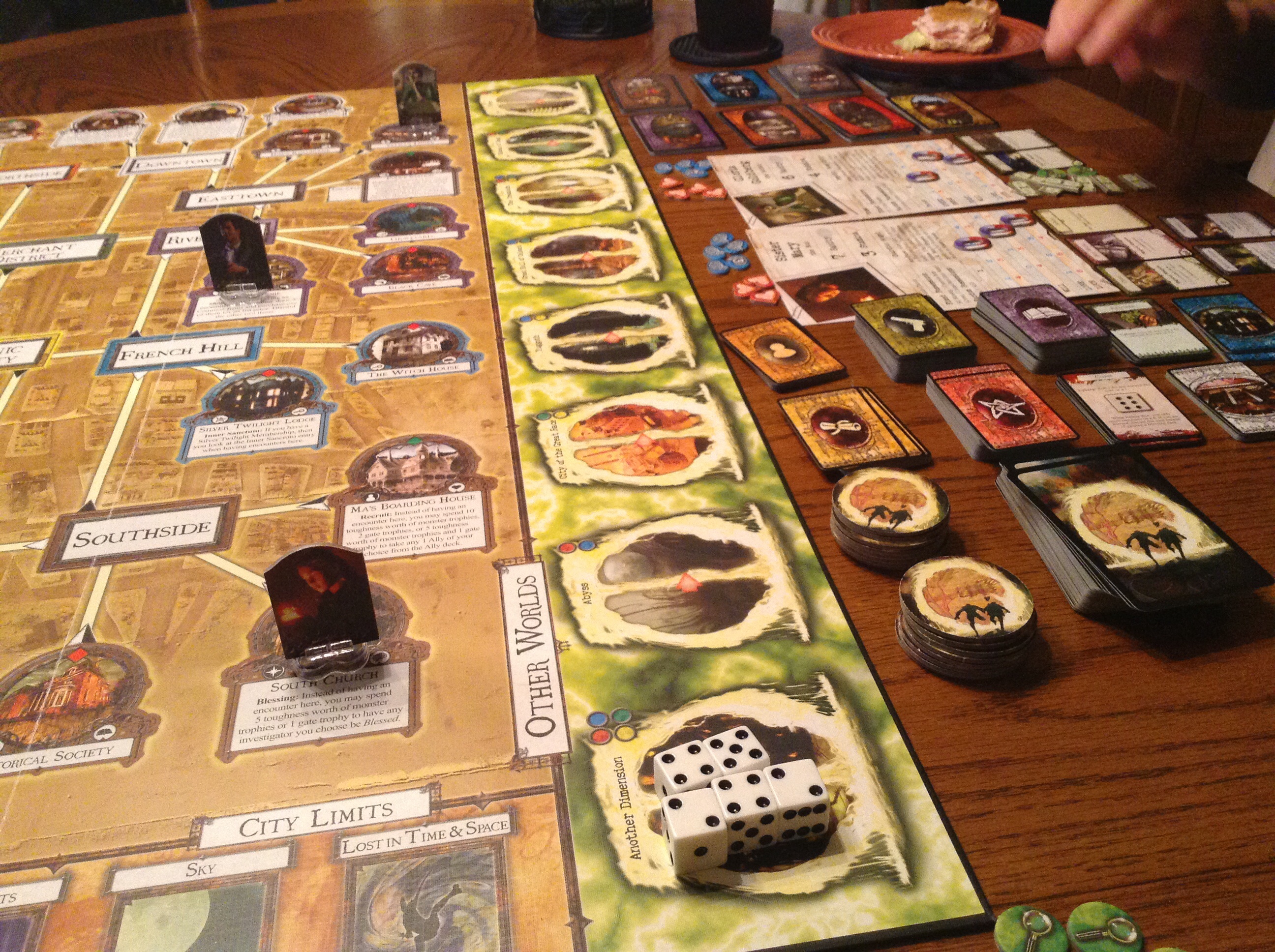
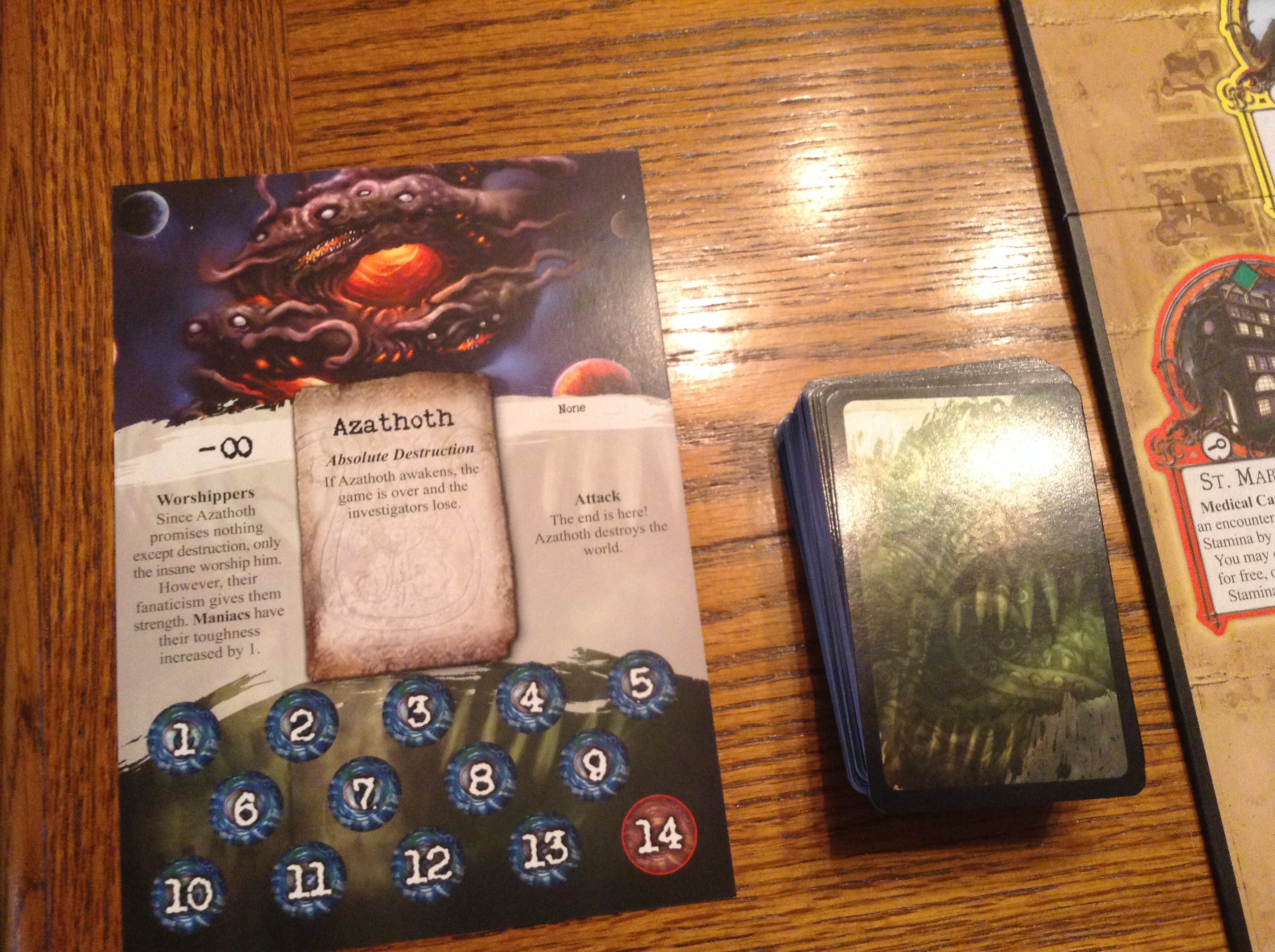
Dear reader, it should be by now well documented that the things I write about here seldom have anything less than monumental significance to the stage play of life.  For my regular readers you will find the expected observed truths about the rest of the world laced within this article so it should not be expected that this is purely for entertainment or instruction on how to play a difficult, rules heavy role-playing game called Arkham Horror.  The things that excite me are often categorized this way.  Even the things I consider leisure fall into this summation.  When I get a sense that something has some sort of metaphorical significance I become obsessed with plunging into its depths—and this holds true if the target is the literary works of James Joyce or some phantom relic from the past lost to time and space.  CLICK HERE to review.  In that regard I have made my affection for Fantasy Flight Games well known—it is a gaming company that was brought to my life through family members bridging my love of mythology with a need for adventure—and I have found with them a wealth of creativity and new ways of modern storytelling.  One game in particular is of the type that I have to thank the owner of Nostalgic Ink and my grandson for putting before me.  It was just the kind of thing I was searching for and has brought to my life a joy in discovery that nurtures my imagination and for that I am extremely grateful.  Also of note I am placing throughout this article the instructional videos of Ricky Royal from the YouTube channel Box of Delights who poured an extreme amount of love into the creation of the following “how to” videos.  By watching these videos he explains many of the rules and way to play Arkham Horror.image  I used these videos to get started and to make the decision to purchase the game.  They are long, but very complete and well worth watching.  The result is that my wife and I bought Arkham Horror on a Friday afternoon and did not stop playing it until midnight on the following Sunday.   We were one turn away from closing the final gate when one of the characters I was playing was plunged into Time and Space letting the monster Azathoth loose to destroy the world.  I was so frustrated that I wanted to put my fist through our kitchen table because we had worked very hard to position the game for a victory.  But circumstances being what they were—time ran out—as it often does even when the best of hopes are the fuel behind endeavor.

We had played several games over the weekend and most of them ended with losses—the game is far from easy.  In fact, it could be said to reflect life all too accurately even though the subject matter is about monsters and attacks upon mankind from other dimensions.  I find the subject matter to be more accurate than a daily read of USA Today and ultimately more rewarding for the soul even in disappointing losses where all the best layed plans fall apart in the end. For a game it reminds me of Jumanji the old game from the Robin Williams movie—Arkham Horror not only takes place in the streets of the classic horror writer H.P. Lovecraft, it carries players into other dimensional planes of reality such as the City of the Great Race, the Great Hall of Celeano, R’lyeh, the Plateau of Leng and Yuggoth.  It is often there that terrible things happen if players forget to adjust their lore or luck rating to deal with the type of things that typically happen during the “Other World Encounters” phase.  Sometimes even if players do adjust their settings terrible things will happen anyway—just as they often do in real life so it is the task of the players to adjust and recover attempting to suppress obstacles with tenacity even when the situation feels hopeless.

The terror of the game comes not so much from the monsters which flood the game constantly throughout from each round as the Doom Track edges ever closer to the end where the Mythos Monsters present themselves from centuries of slumber to destroy the world and everyone in it, it comes from the lack of certainty that one has about what happens next—the constant feeling that the floor could drop out from under everyone at any moment.  imageIn this way Arkham Horror is like walking through a commercial haunted house that is dark and smoke-filled not knowing what might happen around the next corner.  Visitors know that the monsters cannot harm them—but the terror comes from not knowing what’s coming next.  In Arkham Horror the game designers obviously took great pleasure in making every stack of cards and every move a potential failure with very little rewards given to players.

The rules of the game are vast.  On its surface all things about Arkham Horror look simple, the game board looks not so much different from a Monopoly board, but this is very misleading.  The game is layered with meaning and small printed text that takes the level of game play very detailed destinations.  There is no way to just pick up the rule book and begin playing even for experienced Dungeon and Dragon players.  The mechanics are very similar, but the depth must be understood before proper game play is even possible.  For instance, particularly helpful items that will help win the game are Elder Signs which can be purchased from the Curiositie Shoppe as a “unique item.”  Those cards are the most powerful in the game because they not only seal gates without having to spend clue tokens, but they take their seal off the Doom Track for the Ancient One holding off its arrival as a destroyer of the world.  Other very helpful tips are alleys which can be recruited down at the boarding house, blessings which can be found at the church and Magick spells which can be purchased at Ye Olde Magick Shoppe that can hold off terrible Mythos cards revealing rituals.  Combat weapons are purchased at the General Store as common items.  It helps to have a couple of pistols to increase combat points up over +6 to +7 with buffed applications above and beyond the amount of fight on the character sheets.  The reason is that each time a player encounters a monster—which is unavoidable—a horror check must be performed with “will” and will is connected directly to “fight.”  So in order to have a high will typically it will cost fight and to beat a monster, both are needed. So the fight needs to come from weapons, not the skill bar as much as possible.

I think for me the most compelling, and terrifying aspect of the game is the “sanity” cost of certain tasks whether it be losing a horror check, casting spells—which often cost sanity—or random things that happen to characters that scare them into losing their mind.  I am used to health points, and Arkham Horror has a standard health measure which is called “stamina” but balancing that out with the general mental health of the players is something unique.  When the mind gets too beat up during the game sanity can be restored at the asylum—two dollars will completely restore mental capacity or a swig of a whiskey bottle will give a +1 boost.  But the game takes place during prohibition so there are times that the police come and arrest anybody caught with whiskey in their possession—so it is dangerous to have such things.

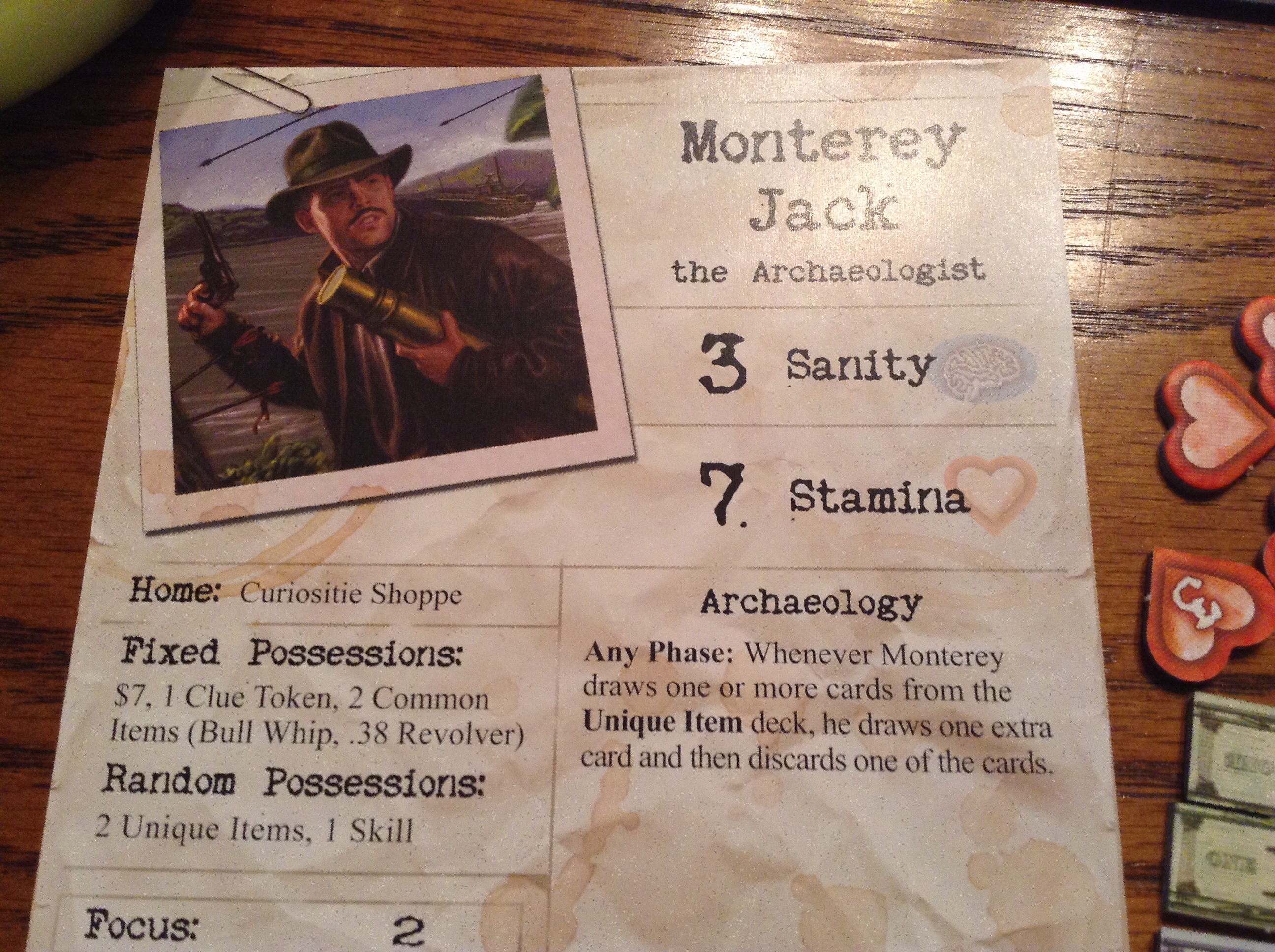
Hearing all this it might be wondered why anybody would want to play the game at all.  That is where things get interesting in a very satisfying way.  In spite of the horror nature of the game, it is actually an adventure game nicely mixing genres in a way that Poltergeist the movie did.  As I was going through the characters I was very pleased to find a card named Monterey Jack who happens to be an archaeologist and has the fixed possessions of a bull whip and a .38 revolver—identical to Indiana Jones the film character.  The game makers at Fantasy Flight know what makes a good adventure story and no matter how great Indiana Jones was, he still ended up tied to a pole during the opening of the Lost Ark, he was cursed by poisoned blood, burnt, tortured, and had spells of voodoo cast against him.  He was captured many times and jailed and designated for execution by the Nazis and all this happened in just three classic movies. image Arkham Horror is the kind of terror that was found in an Indiana Jones film and the best way to play the game is to roll with the punches and just keep getting back up and trying to win.  Some of the best moments in Arkham Horror come from the characters running into clues from ancient secrets or stealing treasure away from terrible creatures deep in a slumber from some dimensional rift.  Needless to say, my favorite character is Monterey Jack, the bull whip gives a plus one to a combat check but if you miss, you can use the whip to role again.   So of course I have to play that character!  It seems Monterey Jack was made by Fantasy Flight Games just for me.

The Indiana Jones films were inspired by old Saturday morning serials from the 30s, and 40s and those serials were inspired by the kind of publications that H.P. Lovecraft wrote for—the pulp magazines so popular in the 1920s and 30s.  Indiana Jones was not original in the sense that he sprang from the mind of George Lucas but was rather a tribute to the kind of movies and stories he enjoyed as a kid. So it is only fitting that the makers of Arkham Horror paid tribute to Indiana Jones who was a product of the original H.P. Lovecraft stories.  The game we see today started in the 80s as a different version of role-playing game similar to Dungeons and Dragons designed by Richard Launius called Call of Cthulhu.  By 2005 Fantasy Flight Games purchased the rights and brought the game up to a level seen presently.  There is a lot of love poured into the presentation that would have taken many hundreds of hours of game development and input by people who simply love all these genres, Indiana Jones, the literary works of H.P. Lovecraft and movies like Poltergeist.  Arkham Horror is a very story driven game that looks like players lose more than they win.  What is most intriguing is that you do not play against other players so much as you play against the Ancient One’s reemergence with the world from an awakened slumber.  Players work together to fight the Ancient One and all its minions—and up to eight players can participate.  The best way to perform this task is to trade items that other players might need like spells, or weapons in the streets of Arkham.  To do this, items can be passed to other players as long as both players are in a street location and they are not in a combat phase with a monster.

About the Ancient One, there isn’t just one, but many.  Of course the primary is Cthulhu but others include the Nyarlathotep, the Yig, Hastur and the Yog-Sothoth.  To make matters even worse each mythos monster has its own worshippers among the land of the living.  For instance, the Yog-Sothoth worshippers have powerful magical abilities giving cultists a combat rating of -1.  Or the Sub-Niggurath worshippers have babies that roam the game board and all are given the “Endless” ability when fighting in combat.  This means that players who kill these creatures cannot collect their hides to sell for money or items as a trophy—but are returned to the monster pool only to be drawn again when a gate opens.  Reading through some of the text reminded me of the many real life attempts by Alistair Crowley and the Masonic rituals particularly on display at the Denver International Airport to appease unseen spirits to invoke supernatural benefit to their attempts at success in life.  Many people are willing to trade their souls for successful help by spiritual aid and in Arkham Horror this is reflected in the sanity meter.  There are many in the real world that clearly do trade away their sanity for a chance at victory even if it calls for the invocation of unseen forces.   Arkham Horror deals with these types of things making it all too reflective or a reality we all know too much about—making this game even scarier because it dares to name an avoided truth.

It has been a long time since my wife and I played a board game all weekend long, but with Arkham Horror the depth was such that it was not hard.  Before we knew it, 14 hours flew by on a Saturday and the sun had set.  We resumed on a Sunday only to see the day fly by as well and midnight was indicated by the hands on a clock.  Arkham Horror is like reading a great novel that you share with other people.  Afterwards win or lose there is a feeling of an adventure that had just been embarked upon.  Other players have complained that Arkham Horror feels too much like a hopeless enterprise because it is difficult to win and like the H.P. Lovecraft stories, bad things happen to the characters and no matter how smart or good you are at playing the game—there is a sense of fate that must fall in your favor to even have a chance at victory.  But that too is reflective of life—all you can really do is position yourself for success and if bad things happen, you have to get up and try again even if you are cursed or find yourself driven insane or even lost between planes of reality.  The adventure of life must trudge on or the world will be consumed by the evil, vile, intentions of an Ancient One striving to claim its hold on all of existence and everyone in it.

Arkham Horror is a fabulous game that is not just mere entertainment meant to pass time away, it is an experience that gives back much just by playing.   It is well designed and certainly does what it set out to do—which is provoke thought.  The random mechanics are not so overpowering that victory is impossible, it is just treacherously difficult like climbing a tall mountain, or running in a marathon.  Playing Arkham Horror will never be the same game twice, but it will always be something that requires attention and care to detail.  It is something that I’d call remarkable for what it does just like the game itself—working on many different levels.image  I am very pleased that my buddy at Nostalgic Ink pointed me to the game.  I have spoken on more than one occasion about these gaming stores and how they are palaces of mythology with only one purpose in mind—feeding the mind of the curious.  Stupid people do not wonder into stores like Nostalgic Ink to buy games like Arkham Horror.  Lazy people would avoid the place like a plague. But in that store are treasures of really previously unimagined consequences, and they are popular enough to have a store of their own now instead of being an underground fad like Call of Cthulhu was for so many years previously.  I have often looked at wonder at the games on the shelf in places like Nostalgic Ink and Yottaquest in Mt. Healthy, Ohio and wondered how or why those games are so popular with this newer generation.  Granted, Arkham Horror even among hard-core gamers is a difficult game—but after playing it, I clearly see the appeal and am a fan.

Rich Hoffman www.OVERMANWARRIOR.com


A Temple of Hope: The Ghost Ship photographic journey

My family had a good laugh when the lunatic feminists in my home school district addicted to tax money accused me of being sexist.  The terminology clearly didn’t fit.   I raised two daughters and never gave them the indication of submission to anybody for any reason under any circumstances.  They are more technically liberated women than even the most rabid progressive feminist and it is quite a joy to watch them grow up and flower into everything that they feel inclined to develop about themselves.   However, it was very rewarding to see how one of them who is a professional photographer viewed a day we recently spent together.  She is pictured below on the bow of the Cincinnati Ghost Ship and can read her point of view at the following link.

http://adventuringphotographer.wordpress.com/2014/07/16/the-cincinnati-ghost-ship/img_7006

She has been an adult for long enough now to display her skills many times over and I haven’t been disappointed.  She is first and foremost an artist that wishes to embody all the elements I introduced to her as a child and it is wonderful to see all those elements come together into the person she is.  As I was raising her I never directly tried to shape her personality into something I would approve of, but simply removed the social shackles that often prevent the development of a mind properly.  My interest has never been social roles as society defined them, but as an individual does—so my parenting style was always focused on allowing my children to be exactly who they uniquely are—even in spite of my wishes—which I always made sure to contain.  When someone decides to become an artist of some type they leave themselves vulnerable to interpretation as their efforts are impossible to disguise.  What an artist produces becomes the culmination of their internal philosophy, which in my daughter’s case can be seen in the video below.


The day was not intended to be so monumental.  She and I have done that kind of thing many times.  As a little girl she trudged through many denser places, caves, trees, lakes and even confronted sometimes hostile inhabitants.  The standard equipment has always been a part of our life, satchels, loose clothing for easy climbing, hats to keep spiders and small rodents out of our hair, and my whips for climbing and diverting away hostile encounters.  Oddly enough on this trip to the Cincinnati Ghost Ship as an artist her natural focus was on most of those things which I take for granted as just part of everyday life.  As a photographer she brought them to the surface in a way that told me much of how she sees me—which is more beneficial to me than her.

Videography is a new skill she is adding to her arsenal.  She has been to film festivals with me several times and has met professionals who make movies—and has seen many artistic efforts from behind a lens.  So she has seen all the tricks and knows that there isn’t any way to hide her soul.  The way a camera operator and video director lights their subject, the focal point, the movement of the camera, and the way a piece is edited together ultimately reveals everything that there is to know about the artist behind the effort.  So her shot selection and ability to tell a story with moving pictures was very revealing regarding the kind of young woman she has become, and was a real treasure.  I didn’t know that at the beginning of our little adventure that I would come away with more than she did.img_6972

As the video was shot, we typically did not stop and pose for pictures.  We just did our thing and turned on the camera to capture footage as we were doing it.  The adventure always comes first; the attempt to document it is second which makes the job of a filmmaker more difficult.  Some things that show up in the video that were actually not filmed was the nice lunch she and I had at McDonald’s just prior to visiting the Ghost Ship.  Usually when she and I get together the rest of the family is with us, so she has been deprived of craved personal time with me.  Upon hitting the exit that would take us to the Ghost Ship off the highway the fuel light came on indicating that we were about to run out of gas.  So I turned around and got some gas down in Lawrenceburg before getting back into the hills of Northern Kentucky on an empty tank.   We were in the right area so I felt confident that time was on our side.  Getting gas was a little bit of an adventure so we decided to go ahead and grab a bite to eat before getting back into the woods.  The two of us had a Sausage McMuffin with Egg each—which the last time she had breakfast at McDonald’s with me was during a trip back from Florida the previous year so that breakfast tasted much better on the cusp of such an adventure.

As we sat and ate, and caught up on all the things we typically talk about, we looked over topographical maps of the area and contemplated strategies for getting there.  It turned out to be much easier than I anticipated which was nice considering that we had some really expensive camera equipment.  We were dressed to wade into the water and board the vessel if need be.  I typically carry with me a 12’ bull whip for those types of occasions.  I also typically have my rope bag that has 150’ of rope along with climbing gear, but that wouldn’t be needed for this.  The whip will get a person up small climbs most effectively.  I always have on my hip a whip holster that my friend Gery Deer designed especially for me.  I use it each year in the bull whip fast draw competition and when I walk around the house practicing.  It is designed for smaller whips but the 12’ whip can fit in it.  So that is what appeared in the video.  I didn’t know my daughter focused some of her shots on things like my whip and satchel, but they were nice bits of context from the adventure that surprised me.

When she was old enough to sit still I raised her on Indiana Jones and the Temple of Doom and each night when she went to sleep, she played the Raiders of the Lost Ark soundtrack and let it go on repeat throughout the night.  She had a healthy childhood filled with the yearning for adventure, likely due to the kind of material she had from her first conscious moments.  Our interest didn’t stop there; we actually expected to live that life to a certain degree and she has so far her entire life.  So our outing to the Ghost Ship was simply a reflection of who we were.  But watching her video of it, it was clear that there was some Indiana Jones in there—which makes sense.  Indiana Jones to me is one of the most wonderful characters ever created for film.  He can get dirty with the best of them then turn around and be among the most scholarly.  He reads, he’s smart, and he’s fearless—but better yet, he’s tenacious.  I knew what I wanted to be as a man when I saw Indiana Jones swing into the Temple of Doom and steal the Shankara Stones from the skull on the sacrificial altar.  To a large degree I do live that life as a man.  The film was a fun movie filled with comic book antics, but the substance of the story is something that both my daughter and I have carried with us every day of my life and hers.img_6977

After we explored the vessel, dripping with sweet, I was pulling bugs off my hat and we decided to go back to McDonald’s for lunch to cool off.  We looked at our footage and talked about what we saw and as we were sitting there I thought about the many times that I had shown her the Temple of Doom movie and realized that we were living that life.  One moment we were knee-deep in adventure, the next integrating the boon of our discoveries with the civilized world—sitting in the corner with my cut up cloths and sweat soaked shirt, with cobwebs still hanging from my hat.  More than a few people looked my way wondering what we had been doing.  Most of them had no idea that just across the river was a treasure that had been there for many years right under their noses yet they were blissfully ignorant.  The only trace of anything out of the ordinary was my daughter and I who had just stepped out of some story book adventure sitting in the corner eating ice cream.  But that was part of the fun for us.

It was those little moments from the adventure that filled her mind which ended up in her cut of the video and framed the way she photographed the day’s events.  It made me very happy and confirmed why I raised her the way I did—it was to nurture that spark of hopeful optimism that can always be present—even when the circumstances are quite scary.  There is a hope in the way my daughter photographs that is a liberating pleasure unmatched by anything else for me.  As an artist, the mind of the creator cannot hide so cynicism shows behind every attempt if it is present.  Adventure isn’t always about things “out there” but what’s really inside–the adventure of a Ghost Ship in our back yard, or a simple trip to McDonald’s, or running out of gas at a highway interchange with no stations in sight.  Adventure starts in the heart, not in the extraordinary and the best of those events happen  when a parent and their child get together for the fun of it—and joy, and lack of pretense just to live life and capture what comes as future memories.   A temple is a place of worship and our lives come together driven by mutual interest.  It is not the Temple of Doom that we share as a lifelong focus–but a Temple of Hope captured by photos for time to benefit.img_7024

Rich Hoffman   www.OVERMANWARRIOR.com


Kingdom of the Cthulhu: The Lovecraftian horror of an ultraterrestrial universe built on sacrifice

Horror to be relevant as an art form must have some hook of reality to it before it can be considered effective.  The best horror writers avoid topics that are so fantastic that they extend beyond belief.  Among the best of the horror writers was a creation that John Keel would later term more scientifically as “ultraterrestrials” and that would be H.P. Lovecraft’s Cthulhu.  This is a dominating creature that lives outside of human time and space pushing against a cosmicism of projected reality driven by limited human senses to manipulate the actions of the technically defined living being.  In theory those who attempt to reach beyond their senses into that world of Cthulhu run the extremely high possibility of insanity as minds often fold over on themselves once they leave the boundaries of four dimensions.  Cthulhu was a fictional creation by a writer who lost both of his parents to an insane asylum and had himself suffered tormenting dreams by strange creatures from a very young child.  But like all great horror writers, Lovecraft’s Cthulhu has its roots into a reality we all understand—but fear to comprehend for many reasons.  The mythology of Cthulhu allows human beings to explore those strange possibilities from the safety of their senses without plummeting over the edge of sanity into a realm they clearly are not ready for.  It is in that realm however that my own eyes have always looked as the cause of much misery and defaults in living as the primary source of superstition and religion—and a barrier to the truth.

When talking about such things I prefer the term ultraterrestrial to reference the type of creatures that Lovecraft wrote about in his Cthulhu mythos which has taken on a life of its own since his death in 1937.  The stories Lovecraft wrote were well ahead of their time as it has only recently been proven that there are more than 10 dimensional realities known to mathematics—and probably more.  Lovecraft’s stories explored the possibilities of beings from those other dimensions visiting from their realms in ways humans could not—which was a terrifying prospect.  It still is, and is why even nearly a century after his death there is a cult following of H.P. Lovecraft.  The reporter John Keel seemed particularly obsessed with this type of reality and reported about it in The Mothman Prophesies.  In that book Keel was very level-headed and factually based even though the subject matter was extraordinary—UFOs interacting with people, strange monsters appearing out of nowhere, Men in Black walking about dressed as government agents not quite appearing human—being slightly off to those who spoke to them.  Keel in that book was knocking on the door to Lovecraft’s Cthulhu and it could be said that the Mothman of Point Pleasant, West Virginia, or the “Bird Man” of ancient Cahokia or the many thousands of gargoyles poised from the buildings of gothic structures—particularly the Budweiser brewery in St Louis—were there to appease the demons who come into our world to terrorize and manipulate our reality.  Keel’s other books, Strange Creatures From Time and Space, Our Haunted Planet, Operation Trojan Horse, The Eighth Tower, The Cosmic Question, and Disneyland of the Gods are all works obsessed with this realm of Lovecraft’s Cthulhu.  Keel had been opened to the possibilities before his investigations into the strange creature in Point Pleasant during 1967 and once there had everything confirmed as though it was tailor-made for him by what he would later call ultraterrestrials—or tricksters.  Because of their power and influence he would spend much of the rest of his life all the way to age 79 when he died in 2009 avoiding any kind of electronic device such as computers, phones, televisions etc., because Keel believed that the “tricksters” used those devices to control and manipulate the world of human beings with impunity to counteraction.

As time went on Keel’s books became more and more paranoid, and his subjectivity diminished for a time as he appeared to have gone too far down the rabbit hole of sanity for a time.  Perhaps not as far as Lovecraft’s parents did—but the rope to reality which Keel held on to was slipping.  Toward the end of his life he regained some of his grip on reality.  The 2002 film adaptation of his book The Mothman Prophecies appears to have helped him and he spent the rest of his days giving lectures as the film brought his ultraterrestrials with the help of Richard Gere into the mainstream.

I have personally noticed this manipulation of these ultraterrestrials by Keel’s definition for a long time.  The lazy relegate their definition of ultraterrestrials as angels and demons but that has never suited me.  I have never been comfortable handing over my fate to beings that just flash in and out of my life with some advice—or appear in a dream to leave an imprint of instruction for me to execute.  If I had been Noah and God appeared to me in a dream telling me to build an Ark, I would have woke up the next morning and told him—“dude, I don’t have the time to build you a stupid boat.” And I would have ignored the command.  When the floods came, I would have survived somehow regardless of the advice.  My opinion is that unless the motives of such individuals from other worlds is known, there is no way to attribute value to them leaving you to play the part of a pawn.  Without knowing those beings personally there is no way to validate if the sources are good or evil.  My assumption is that they are almost always evil posing as good.  So to properly serve the good in the context of universal merit, those beings should be ignored.  In this way for years I have poked and prodded into their world without the usual fear of insanity because I simply don’t trust any of them even though they have constantly tried to throw me off the trail.

One night on New Year’s Eve my family was playing a late night game of Pirates the Constructable Strategy Game.  We were between rounds so as everyone got up and stretched I resumed to my living room chair to read another quick chapter of The Mothman Prophecies which I had taken an interest in after seeing the movie.  In the book there was a surprising amount of coverage of UFO lore and as I was reading it I couldn’t help but wonder if Steven Spielberg had read this very same book to inspire him to write Close Encounters of the Third Kind and Poltergeist because this was the subject matter by the very fact based reporting of John Keel.  I found the book terrifying refreshing and a key piece into a lifetime puzzle I had been assembling most of my life which attempted to define the world of Lovecraft’s Cthulhu.  As I had conceived that very thought outside my front window clearly over the golf course was a UFO floating freely over the tree line.  My first rational thought was that it was a helicopter picking up a crash victim, or maybe even some kind of pyrotechnic display celebrating the New Year.  But it was just floating there enticing me like a seductive siren attempting to lure me into the hidden rocks in the choppy waters of the ocean.  My children were in the kitchen so I calmly grabbed their attention and directed their sight asking them to identity what was there.  They went through the same process I did, helicopter, fireworks—UFO.  Once we realized that the strobe displays on the vessel did not look like anything Wright Patterson Air Force Base nearby could have put out—it was too large for a drone—and too lit up to be stealthy we put on our shoes to rush out and meet it. We piled into our car and raced down the road to intercept it as it was now moving slowly.  We turned left onto a road about a hundred yards north of our home and saw the vessel floating over a home valued near a million dollars and the strobe lights flashed down upon it.  I blinked to make sure my vision was not faulty and when I opened my eyes it was gone.  I stopped the car, got out and looked to the north.  The entire sky was filled with a blacked out vessel roaming northeast.  The moonlight had been showing the outlines of clouds, but this vessel concealed them all.  My kids saw it too and we watched as it was there moving toward downtown Trenton one moment covering the entire sky from our home, over the Miller Brewery all the way to Trenton.  It appeared to be about 7 or 8 miles wide.  Then within the blink of an eye, it too was gone.  If my kids hadn’t seen it with me, I would have thought it to be an illusion, but it was actually much more sophisticated as other minds witnessed it simultaneously.  Within 30 seconds of the encounter we were left wondering if we actually saw what we saw.  I got out of the car and walked up to the house where the vessel had loomed over and they had lost power.  Nobody appeared to be home at the time, but their internal lights had flicked back on and a computer in the living room that had been on was in a reboot phase.   So something material had been there and it caused the power to drop then come back on.

We had seen our first UFO as a family and it was exciting—it certainly wasn’t our imagination.  However, I was skeptical and not so sure that little green men came down from E.T.’s home planet to pick some flowers.  Rather, I was thinking of Keel’s ultraterrestrials—or even more cynically something like Lovecraft’s Cthulhu.  It was more than a coincidence that I was studying The Mothman Prophecies and reading about those exact occurrences at that particular moment.  And out of all the years I had been alive I had never seen a UFO until that moment.  I didn’t even have to leave my home to see it, the thing practically landed in my front yard to get my attention. But as soon as we could chase it down for confirmation and get our cameras turned on and toward the object—it was gone.  My intentions as it was happening was to find a way to get on the vessel and pull one of the pilots off and capture it so I could conduct a proper investigation.  I doubt that was the intention by the perpetrators—but that’s what was going to happen.

I did the same thing as I spent some time hunting for a Mothman one summer in the regions where sightings had occurred.  I was determined to capture the creature and put it in a zoo dispelling any folklore about it with scientific fact.   But the more I looked, the more obvious it was that I was not going to find it—it would have to find me because those things only appear in our dimensional plane of reality when they want to.  Over time I concluded that the UFO at our home, like the Mothman hunting, was a creation by ultraterrestrials to bait me into insanity by feeding my curiosity and thus directing my thoughts on the matter into a direction they desired.  The circumstances were just too perfect to be real in the context presented.  After that event I had a lot more respect for John Keel—he was certainly on to something.  And without question H.P. Lovecraft was as well.  The reason his Cthulhu mythos is so terrifying and is still very much alive after a century of development is that deep down inside we know there is some truth to it.  The fictional creation of Cthulhu is an attempt to put into mythology a reality that is difficult to otherwise deal with.

To a writer like Lovecraft who had been tormented by ultraterrestrial monsters in his dreams from a child to an adult constantly and lost both parents to insanity his philosophy of cosmicism is understandable.  The philosophy of cosmicism states that there is no recognizable divine presence, such as a god, in the universe, and that humans are particularly insignificant in the larger scheme of intergalactic existence, and perhaps are just a small species projecting their own mental idolatries onto the vast cosmos, ever susceptible to being wiped from existence at any moment. This also suggested that the majority of undiscerning humanity are creatures with the same significance as insects and plants, who, in their small, visionless and unimportant nature, do not recognize a much greater struggle between greater forces.

http://en.wikipedia.org/wiki/Cosmicism

John Keel had come to many of the same conclusions as Lovecraft when he said at the end of his book The Complete Guide to Mysterious Beings, “there are entities on this planet, and around it, that are far beyond all efforts to translate them into understandable cellular creatures.  They are not real in the sense that we are animals motivated by sex and emotions.  They are part of the energies that were scattered into space billions of years ago.  Their intelligence is so vast and so ruthlessly inhuman there is no way for us to comprehend it or communicate with it as we talk to dolphins.”  Keel would then propose twice in that same book, “Someone within two hundred miles of your home, no matter where you live on this earth, has had a direct, often terrifying, personal confrontation with a shape-shifting, unbelievable. (ultraterrestrial)  Our world has always been occupied by these things.  We are just passing through.  Belief or disbelief will come onto you from another direction.”  What Keel was talking about was essentially Lovecraft’s Cthulhu.

Charles Fort said in his 1931 book Lo! during the time of Lovecraft, “There may be occult things, beings and events, and there may be something of the nature of an occult police force, which operates to divert human suspicions, and to supply explanations that are good enough, for whatever (minds) human beings have—or that, if there be occult mishiefmakers and occult ravagers, they may be of a world also of other beings that are acting to check them, and to explain them not benevolently, but to divert suspicion from themselves because they, too, may be exploiting life upon this earth, but in ways more subtle, and orderly or organized fashion.  In “The Call of Cthulhu”, H. P. Lovecraft describes the fictional Cthulhu as “A monster of vaguely anthropoid outline, but with an octopus-like head whose face was a mass of feelers, a scaly, rubbery-looking body, prodigious claws on hind and fore feet, and long, narrow wings behind.”[5] Cthulhu has been described as a mix between a giant human, an octopus, and a dragon, and is depicted as being hundreds of meters tall, with human-looking arms and legs and a pair of rudimentary wings on its back.[5]Cthulhu’s head is depicted as similar to the entirety of a giant octopus, with an unknown number of tentacles surrounding its supposed mouth. Cthulhu is described as being able to change the shape of its body at will, extending and retracting limbs and tentacles as it sees fit.”  This description is remarkably like the Mothman and is a creature of imagination brought to life through the reality of some ultraterrestrial shape shifter which is a trick as old as time.

http://en.wikipedia.org/wiki/Cthulhu

Many of the cultures of times past as in the present which call for sacrifice to bring about something desired must point their superstitions toward these creatures.  Not surprising those who attempt to map out that realm of the ultraterrestricals even in a fictional sense—such as the Cthulhu end up dead.  Lovecraft died by the age of 46 and many who go down a similar path end up in the same state.  Looking into that other world brings upon the cells of the human body an undoing which prevents living.  I too have seen this as most notably reflected in my personal UFO story.  There have been many times when shape shifting entities made their entrance onto the stages of existence and did just as Charles Fort stated—“policed” the explanations of reality to suit their desires.  But if an inquiry into the other realms goes too deeply, then death is soon to follow.  Sometimes it’s not even by deliberate attempt.  Every year, roughly 15,000 people vanish under the most incredible circumstances, again according to John Keel’s studies into the matter.  “A family man steps into his backyard to mow the lawn. He is never seen again.  A waitress steps out of a restaurant to put a dime in the parking meter and disappears forever.  A family of five in a suburb melt into nothingness, leaving behind all their cloths, bank accounts, the family car.  We have dozens of puzzling cases in our files.” (Keel’s files)   These Cthulhu stories by Lovecraft are terrifying—because they are grounded in a reality we are aware of but dare not probe.

Most people are happy to carry a lucky rabbit’s foot, avoid unlucky associations, or pray to a deity to navigate through the minefield of the ultraterrestrial traps.  I have seen the attempt firsthand to divert my own attention obviously when doing an investigation by having those same beings throw me a bone as a UFO flew outside my front window to take me in a direction of inquiry they approved of—a classic case of misdirection.  Entire societies have adopted the notion of sacrifice in substitution for productivity to essentially satisfy their unconscious appeasement of these metaphorical Cthulhu’s which loom like gargoyles over charity events and suck off the vanity of opulent socialites and the perfume bathed on to cover the smell of their decaying flesh.  From the darkness of other dimensional realities our world is observed and manipulated to suit the needs of the ultraterrestrial, not our own as the strings of many living marionettes are tied to the fingers of an actual Cthulhu.

But unlike Keel and Lovecraft I do not believe the human race is destined to be meager insects in comparison to the cosmos.   I believe in the thin veil of cosmicism but do not believe that the Cthulhu type creatures residing there are superior to the human being.  If they were, there would not be all these elaborate tricks, like UFO’s landing in our front yards, or strange stories to captivate the tabloid lover in all of us—to keep us distracted and thus sacrificing to these gods of the unseen.  Their tricks only have power of the one way mirror for if they enter our reality with us, they discover they have no real strength—only the ability to scheme for their own ends as a competing organism.  And that goes for any entity in the universe—if they were so bold and audacious, they would not avoid direct contact and hide behind curtains of dimensional reality.  So there is nothing really to fear from them once it is understood that they gain all their power and terror from dwelling in the unknown.  But science is taking human beings into their realm whether they like it or not—and once we are there—there won’t be anywhere for them to hide any longer.  They are not to be feared, but to be conquered and the way to beat them is to remove the concept of sacrifice from the human landscape.  They obtain their sustenance off the emotional energy of the human race by a means not yet discovered and require misery, fear, and death to fuel their own existence.

Good horror touches these known truths—these deep suspicions we all have that just walking out to the mailbox may be the last time our bodies inhabit the earth.  We all know someone who has suffered from paranormal experiences yet nobody discusses it because we feel the breath of the Cthulhu on the back of our necks.  We try to counsel ourselves that the breath we feel is God and we seek to appease him with more sacrifice at churches, or financial donations and our prayers, but deep down inside we suspect that God is really a Lovecraftian monster ready to yank our lives from our bodies and consume it like a snack on Superbowl Sunday.  So we don’t name the evil for fear that it has power over us, we don’t talk about it with others for fear that we might be discovered betraying our overlords.  But those beasts have no real power—only the ability to operate from concealment.  Cellular attacks can be countered, diseases overcome, and mental breakdowns—alleviated by a strong—well-read mind.  If one is playing the Arkham Horror game which is a Lovecraftian journey I said weeks ago that I would take because of the nature of it, the characters of Harvey Walters and Sister Mary who both have a sanity of 7 would be the type of examples I’m refereeing to.  I like Harvey and would like to teach everyone to be more like him so that they could have a proper defense against the Cthulhu terrorists of inter-dimensional sacrifice.  But man’s fate is not destined to yield to these creatures, rather the other way around—which is the big secret they don’t want you to know about dear reader.  The human mind has the power to create these Cthulhu monsters—but it can also destroy them.  The reality of the horror of the Cthulhu is that they cannot match the productive enterprise of human imagination and effort.  With those efforts the driving force of humanity, the Cthulhu has no defense leaving the ultraterrestrial empire without armament in a war that is as old as time.  It would be my position to teach people how to make those Cthulhu into pets instead of Gods and the horror of their imprint into a children’s story.

Rich Hoffman


www.OVERMANWARRIOR.com


“The Serpent Mound Disturbance”: A giant hole opens in Siberia–again

For those living near Cincinnati, Ohio they would likely know of the strange archaeological remains of Serpent Mound off to the east—a mound built by an ancient people several thousand years ago clearly displaying a serpent design visible to the air which has astronomical calculations built into certain points of the large site. The people who built it went to incredible trouble for reasons that are even more mysterious. Thickening the plot the site sits on a significant portion of a crypto explosion which took place over 300 million years ago. There was no way that the ancient people could have at the time known of the explosion as erosion had removed most of the sight references visible without advanced scientific equipment.   Yet out of all the locations that Serpent Mound could have been built—it was on the edge of this gigantic 4 mile wide crater that looks to have come from inside the earth as opposed to a traditional meteor impact from space. The reason this is significant is that modern scientists are mystified–a helicopter spotted a large mysterious hole in Siberia Tuesday July 15th, 2014—and it has left scientists largely perplexed thus far. The first explanation rationed was that gas from deep in the earth exploded due to the mystical global warming phenomena perpetuated by paper-thin intellectuals—a falsehood designed to disguise their ignorance.

The massive hole, about 260 feet wide, is located in the Yamal peninsula and can easily fit several helicopters inside the entrance, according to the U.K.’s Independent. It is believed to be about two years old, RT.com reported.

The area’s name, Yamal, translates to “end of the world” and is home to some of Russia’s largest gas reserves.

http://www.theblaze.com/stories/2014/07/18/a-giant-mysterious-hole-has-opened-up-at-the-end-of-the-world-in-siberia-and-its-left-scientists-baffled/

Yet this wasn’t the first such hole to appear in Siberia.

On June 30,1908, a giant fireball exploded in Siberia’s remote Tunguska region, leveling trees for more than 20 miles around and causing atmospheric shock waves that were detected round the world. At the time, scientists thought that a giant meteorite had crashed into the earth. Later, when they failed to find a major crater or clearly identifiable meteorite fragments at the site, they began to question their earlier theory.

Many scientists have since attributed the phenomenon to a comet head that exploded in the air before hitting the earth. Others suggest that a stray clump of antimatter from elsewhere in the universe was the cause through some dimensional portal—a fold of space and time which is concealing the evidence.

http://content.time.com/time/magazine/article/0,9171,908001,00.html

971521_574480222593899_774166430_nBack at Serpent Mound just outside of Cincinnati, hardly a location at the “end of the world” the same type of thing occurred long ago. The valley beneath the effigy is really the western rim of a mysterious, four-mile-wide, circular crater – the eroded remains of a huge, catastrophic event geologists call “The Serpent Mound Disturbance.” About 300 million years ago, either an asteroid collision or an underground explosion blew apart more than seven cubic miles of rock. The central area was uplifted more than 1000 feet, while an outer rim dropped more than 400 feet.

What we see today results from eons of erosion, although the shattered fragments of the “Central Uplift” remain among the hills above Serpent Mound. The distant ridge tops, visible from the overlooks, stand high today because they are the much harder Ordovician bedrock that was offset by the event.

The strange geology of this spot was first noticed in modern times by Dr. John Locke of Cincinnati, who named it “Sunken Mountain” in 1838. Yet, it’s not hard to imagine that the ancient effigy builders could have recognized the unusual land forms. The serpent looks out from the edge of the Central Uplift zone.

http://mobile.ancientohiotrail.org/sp-5.html

This little recent hole in Siberia is much smaller than the four mile wide one that occurred at Serpent Mound but one thing is for sure about the Serpent Mound crater—it wasn’t caused by global warming and much stronger forces were at work.   At this time the two craters may have been caused by entirely different forces but what is clear is that even with all of our modern equipment and satellite analysis the hole in Siberia wasn’t even noticed for two years.   This confirms that there is very little that modern science really knows about anything as our study into nature is still infantile. The cause and effects of forces known and yet to be discovered are not complete, so static conclusions are impossible at this time.

But what is most mysterious of all is that a so-called primitive people knew enough about the geology of the Ohio area which had filled back in after hundreds of millions of years of erosion to build a tribute to it as if they knew that their monument in the shape of a serpent might appease the forces that created the impact.

Many societies could have risen and fallen over several hundred million years and not all of them may have been terrestrial. Yet by some word of mouth or written documentation which is no longer seen, the ancient people who constructed Serpent Mound likely knew about the strange ancient events that took place on that site. And in our modern times similar holes are opening up right under our feet and we have no explanation for them but to blame the occurrences on our own development and science. That only goes to prove how feeble our modern grasp on reality truly is. The mysteries of the earth are alive and well, and mankind looks upon them with fear of the unknown for which they lack the courage to probe with honesty to an origin that does not reside on this planet—but out into the Milky Way toward one of NASA’s recent proclamations—that within 25 years life will be discovered afar and the answers to some of these mysteries will then become known—and we may not like the answer as it will disturb our religions, mythologies and basic concept of existence.   If history is to be followed when matched up against a superior intellect and culture—it is likely that we might want to build a monument to appease them in the same way that a weak-willed politician licks the boots of those they perceive to be their superiors. In that future time the real answer to the mysterious crypto explosions on earth will then be provided by documents that left long ago only to return by the minds responsible.

The term cryptoexplosion structure (or cryptovolcanic structure) means an explosion of unknown cause. The term is now largely obsolete. It was once commonly used to describe sites where there was geological evidence of a large-scale explosion within the Earth’s crust, but no definitive evidence for the cause such as normal volcanic rocks. These sites are usually circular with signs of anomalous rock deformation contrasting with the surrounding region, and often showing evidence that crustal material had been uplifted and/or blown outwards. The assumption was that some unusual form of volcanism, or a gas explosion originating within the crust, was the cause. The use of the term went away with the rise of the science of impact crater recognition in the late 20th Century. Most structures described as cryptoexplosions turned out to be eroded impact craters, caused by the impact of meteorites. Today geologists discount former cryptoexplosion theories.[1]

http://en.wikipedia.org/wiki/CryptoexplosionSerpent_mound_Crater

Yet, geologists have yet to explain what caused “The Serpent Mound Disturbance” and have relegated their investigation to the back of their desk drawers and left investigations to theorists who must resurrect the term, “cryptoexplosion” once again to properly term the classification.  And such explosions are not regulated to the distant past, but still occur right under the nose of science who believed that just because they stopped using a term, that the need would cease to call attention to itself.  By the evidence of the new hole that has opened in Russia–“cryptoexplosion” would appear to be much more appropriate as a term than “global warming.”

http://magnetic.me/Serpent/crater.htm

Rich Hoffman

www.OVERMANWARRIOR.com