There are more little children wearing cowboy hats today after watching Loop Rawlins on America’s Got Talent than there was a week ago. Loop and his wife were invited to the quarter finals at Radio City Studio in New York to perform the next phase of his AGT journey. Prior acts for AGT by Loop were flaming lassos with some acrobatic stunt work and gun spinning. But airing for millions of Americans on Tuesday August 5, 2014 Loop Rawlins lit the stage on fire and performed with firewhips in what turned out to be a spectacular event that captured the imagination of America. It was quite an exhibition of imagination and talent.
As I was watching I couldn’t help but think of Chris Camp’s 2010 run which was as great as his stage show usually is. But Chris didn’t make it as far along as Loop has, and that is largely due to the fact that Rawlins has managed to perfect a number of western arts and mix up his act from one night to the next—and he has modernized the performance in a way that isn’t a reoccurrence of the old vaudeville acts that look stuffy on a national stage. Loop’s act is a perfect blend of tradition, mixed with modern innovation. Loop’s firewhips were notably from Riz, they are the same ones that I have used many times, but the new element was in lighting the stage on fire—it was very dramatic and infinitely cool. In one evening Loop won more fans for the western arts than several decades of similar work by many other performers just because the size of the stage was so large, and Loop had the ability to make it so far along with possessing so much variety in his skill sets.
A few weeks ago I didn’t pay much attention to Loop because I know more than a few western art performers who have done big shows like AGT. But, their performances have often been out of politeness—out of a show business respect for the acts of old. As good as Chris Camp and his wife are, they weren’t invited to go nearly as far as Loop has. Loop has managed to play his cards just right using social media to maximum effect during his run, being complimentary to the production of AGT while really putting on a variety of acts on stage when it counted most. Leading up to the Tuesday show, I watched with curiosity as Loop and his wife handled their life in the big city with style and grace for a couple of young people looming on fate. Loop presented himself in a traditional way without being exclusionary to the trends of the present with a sincerity that everyone could admire.
I enjoy hearing stories about young people who marry young and dream hard—and I love it even more when they actually scratch at success from such an early age. It was refreshing to see that Loop’s wife supports his endeavors with vigor and that the two of them are working at this whole thing as a nice team. They represent the hope I have of subsequent generations and the kind of people who the western arts produce. Just the practice of those arts help bring out character traits that are beneficial, and respectful to America in general. They should be presented without apology—and Loop does this without coming across as arrogant.
Increasingly, after my own experiences with entertainment, politics, and the innocent joy of the Western Arts, Loop Rawlins has the ability to reach more people with genuine patriotism than all the current talk radio hosts put together. Because of that, I would think the hill of success at AGT for Loop to climb would have been much steeper—due to the resistance there is out there to promote westerns or cowboys in a positive way by modern entertainment producers. Part of Loop’s skill has been to overcome that opposition with genuine wonder even by the most skeptical. Watching some of Loop’s work it is his gun act that he has left up his sleeve and can be exploited for most dramatic effect—but overcoming a New York culture that is rabidly anti-gun may be detrimental to his quest. It is a tough line to walk and so far Loop has walked it well. It will be hard to overcome his Tuesday performance with anything short of a live horse on stage—so I will be eager to see what he comes up with. But the fun is that he actually has a shot to take—and it is his skills off stage that give him that ability as much as what he does on stage.
There is a chance to reach many more people in a positive way with venues like America’s Got Talent than hundreds of hours of talk radio and meetings of restoration in American spirit. Loop speaks to the heart of all Americans no matter what their political backgrounds and embodies all the things that little kids hope to grow up to become. That is why there are more kids today wearing cowboy hats because they saw Loop on AGT and they fantasize about doing something similar in their own life.
I said the other day that I was proud of Loop Rawlins—he is the next progression of an art form that means something very dear to me—and its exciting to see it develop in a world that has become so cynical of goodness—and clean fun. Loop’s act is everything that Mark Allen hoped for when he founded the Wild West Arts Club several decades ago and he is the brightest current star in that endeavor. It is in him that I see a hope that has been vacant for such a long time and it was a real privilege to see him ignite those firewhips on such a large stage and show metaphorically the plight of a western arts performer standing in the middle of all the fire society can launch and handle it with the grace and valor that destiny often imposes
Eight years ago I performed the below firewhip act at a film festival during a stunt demonstration for the World Stunt Association. From that one performance it led producers to make a number of attempts to put firewhips into movies like the Immortals, the recent Hercules, and films in development by A list stars. Review it now and consider the implications of Loop’s firewhip act on a much larger stage–then it will become evident why I am excited. Back then nobody had ever seen a firewhip–but now, millions of people have and the evolution of such an art can take place with vigor.
One thing that is different from my view of bullwhip work and many of my friends who spend a lot of time working on technique with an emphasis on dance like choreography is that I find the whip most useful as a melee weapon in martial arts. In my novel The Symposium of Justice, the main character Cliffhanger uses bullwhips exclusively as his primary weapon to fight the forces of evil. Even when firearms and modern technology present options that might otherwise be considered more attractive—Cliffhanger uses two bullwhips to slice up and dominate his rivals with blistering effectiveness. My friend Gery Deer runs the only bullwhip instructional studio in the world, and his emphasis has always been non-combative instruction. So when the two of us get together we politely avoid the subject. Most bullwhip artists feel the same way that Gery does—and for good reason. There is a stigma that bullwhips are naturally violent weapons, so to promote the sport, they put emphasis on the non combative aspects of it. But, bullwhips by their nature are very violent, and are among the most flexible and versatile weapons ever created by a human being. And a guy who has made quite an extensive living teaching bullwhip combat techniques is Anthony De Longis.
Anthony has a long history with bullwhips and has done a good job of promoting them within Hollywood. Once while I was doing a short picture in Glendale, California which is Anthony’s hometown his name came up often by the stunt people and stunt coordinators. He is well-known within the Hollywood community as the go-to guy for bullwhips in film and he has worked with great passion to create interest in his spare time.
As a published writer, De Longis has contributed articles on the sword and the bullwhip to both martial arts and stage combat publications. These include articles on the Spanish Mysterious Circle, published in Fight Master, Inside Karate and Martial Arts Insider, and on sabre in Black Belt. Articles on the bullwhip have appeared in Inside Karate, Black Belt and Inside Stunts.
Off-camera, De Longis was Fight Director for the Los Angeles Music Center Opera from 1985 to 2003. He was Swordmaster / Stunt Coordinator for episodes 1-6 of The Queen Of Swords, and Swordmaster for Secondhand Lions.
He is also a professional stage movement and combat instructor, teaching in academic (UCLA Theatre Arts Dept. 1974-1993), small group and private settings seminars. He was inducted into the Black Belt Hall of Fame as 2008 Weapons Instructor of the Year and into the International Knife Throwers Hall of Fame in 2009,
He shares with many of the people I most associate with a love of these kinds of skills—these western arts–and his impact to the industry deserves respect. He and I share specifically a love for Terry Jacka made bullwhips from Australia as most of the rest of the industry leans toward Joe Strain. There are others, but those two names are among the highest in the business. Samples of both their work can be found at Western Stage Props. However, both whip makers can be found at their individual sites.
But when it comes to combat and the bullwhip, I can think of no better weapon in the world to deal with an armed thug in melee combat. There isn’t a martial artist that I’ve met, or a weapon used in those arts which surpasses the ability of a bullwhip. They can be coiled up for easy transportation and stuffed into a bag for concealment, but can become a projector of danger as lethal as knives from a safe distance of 8’ to 10’. They can disarm a foe, or tie up their feet if they are trying to run away from a treacherous act, or bullwhips can choke an assailant to within inches of their life with the leverage needed to cut off the oxygen and blood to their brain with much more effectiveness than bare hands even among the strongest man.
Years ago I sold cars and spent a lot of time on the car lot waiting for customers to visit so I could sell them something. To kill time, I often practiced with my bullwhip in the back lot, which attracted the attention of the various lot techs and mechanics. On one particular occasion a couple of strong guys who thought they were particularly tough wanted to spar with me, their knives and baseball bats from the trunk of their car against my whip. Three of them against me and my bullwhip. It wasn’t even close. I was able to get the 12’ whip around me so quick that they couldn’t attack without getting hit. When they tried to come all at the same time I was easily able to go after the head of one of them to break their line and step out behind it keeping them from trapping me. If they elected to take the hit, it would have hurt them catastrophically—which was the intention because we were playing that kind of game. One of them finally got smart and stepped on the end my whip as it was so long, it took a lot longer to move around than some of the smaller 6’ whips. Once he had the end of the whip trapped, he thought he and his friends had me defenseless. But what they didn’t know was that I could then close ranks and wrap the whip around their necks and use the handle as a club—very similar to a blackjack.
My grandfather used to carry a police style blackjack in his pocket and considered this adequate to knock away most foes he met around town in times of crises. I used it a few times, but retired it quickly realizing that it was best to get distance away from your opponents as opposed to being close enough to use a small club. I replaced the blackjack with a bullwhip and have never since stopped. If an opponent has control of the end of the whip it essentially takes their hands out of the fight. This gives the bullwhip wielder the advantage in a conflict because they can then use the handle as a club against an unarmed victim.
I could tell many stories about bullwhips, and when it comes to combat work with bullwhips, Anthony De Longis is the current spokesman at the entertainment level. What he has been preaching is real, and really just begins to touch on the possibilities. But those possibilities are infinitely exciting when it comes to weapons and their effectiveness. In my opinion learning any other skill for any other weapon is pointless and a waste of time. There is nothing that I’d choose to use for self-defense than a bullwhip and that includes a firearm. Most firearms are shot at a close range and often miss their mark the first time—just because of the implication of what it means to shoot another person—death—long jail times, that kind of thing. The bullwhip will put an end to such threats within 1.5 seconds which is often the time it takes to decide to pull a trigger. The legal impact to such a self-defense measure is far less, and much more beneficial to staying out of court in the aftermath. Anybody who has been thinking of learning such a skill might want to visit Anthony out at his ranch to learn a thing or two about combat bullwhip techniques. That skill will likely save the life of you and those who mean you harm with the most effective way to remove threats under circumstances of coercion. His site can be reached by the link above.
I remember well when a bunch of us as young men—Gery Deer, Chris Camp, and of course myself were watching the work of Mark Allen and Alex Green out in Las Vegas and trying to improve on the western arts that they were putting on for America. And we became faster, more accurate and more exciting as a result. Gery Deer and Chris Camp have in fact really elevated the western arts act to new levels throughout the last two decades and I have done some work in Hollywood and literature that we all hoped would ignite the next generation. And while we are far from done, the seeds of all that hard work are finally paying off. Last year I spoke about the “Rise of Adam Winrich” who came out of the Ohio WWAC class of 2005, CLICK HERE TO REVIEW, and even as the national WWAC (Wild West Arts Club) ran by Mark Allen which I was a member of for many years finally died out in the late 2000s,it looks like the legacy is living on in the young man named Loop Rawlins. Loop is just a few years older than my oldest son-in-law and is of around the same age as Adam—and like those vigorous, hungry youth who want to surpass the efforts of their elders—in this case—us, Loop has taken the various western arts, gun spinning, whip work, and particularly the lasso and really moved them to a new level as a recent member of America’s Got Talent during the month of July 2014.
Loop did a fabulous job on America’s Got Talent and even though he is very good with bullwhips, he chose to do an act with the lasso. His musical selection was wonderful and his on stage presence was energetic proving that there is quite a dramatic hunger for this art form that is uniquely American. Gery has appeared on that show and so has Chris, but Loop has taken the energy to a new level. Loop had in fact met at an early age many of the same people I call friends, he was at the 2002 Wild West Arts Convention conducted by Mark Allen and it is there that he won five international awards as a young burgeoning talent. He has since worked for Cirque Du Soleil and shot some commercials for McDonald’s, MTV and an award-winning Western film.
For people who still look at western arts performers and wonder why they do it, there is a purity to them that simply isn’t found anywhere else in any other professional venue. Loop represents the best of what America has to offer the world and it is for people like him that programs like America’s Got Talent are designed. It should be noticed that many of the young men performing regularly in Wild West Arts today have beautiful young women on their arms—particularly Adam and Loop. They are today’s “rock stars.” When I was their age, heavy metal band members attracted the type of women that are now flocking to see Adam and Loop perform. But what’s different about these young Wild West Performers is that they are straight-laced and dedicated. With the same energy they put into the thousands of hours of practice it takes to become good at these art forms, they are able to maintain long-standing relationships with attractive women.
For women with limited options these days, where 9 ½ out of 10 men in the world from the ages 16 to 60 are just absolute douches—low ambition slugs who struggle to wake up every morning with a positive thought—they know that people like Loop Rawlins is a wonderful catch. Even with all his success so far, it is hard to make a living with the Western Arts—it is hard to do what you love to do, because there aren’t many people willing to pay for it. The reason is that there just aren’t very many people in show business who know how to write about the Western Arts in an exciting way that modern audiences find attractive. In many ways, I have dedicated my efforts at resolving that end of the business—by writing content that producers might want to hire people like Loop and Adam for. My friend Gery Deer was brought in as a whip consultant for the movie The Rundown. His whip holstering system worked great, and we still use them to this day primarily because of his experience working on films like that. But the amount of motion pictures produced that calls for those skills is just dismal. Television is even worse—ironically. As I’ve reported, this is largely due to the perseverance of progressive politics which has entered show business. One of the founders of the Wild West Arts Club, Alex Green appeared in thousands of television shows and movies because in his day, Hollywood produced them and needed a Western Arts performer. These days, Anthony DeLongis is the only whip coach in Hollywood—primarily—because there just isn’t enough production going on to justify more. But in spite of the cool reception among popular culture, the new rebellion for attractive young women hoping to land a real man who thinks, loves, and lives life with traditional passion—Western Arts performers are their ticket to a good husband—feminism has left most women with few options that their biological clocks can be set by—and for them, they know Loop is the catch of a century.
When my own son-in-law was young and was attending the Ohio WWAC conventions, he had the ambition to do all the things that Loop is doing now. He wanted to learn roping, knife throwing, gun spinning, but he managed to get pretty good with a bullwhip. He even managed to win for several years the bullwhip fast draw. But he had to make a living and it is hard to get really good at what you love and still make a living that doesn’t involve that passion. I’ve managed in unique ways. I wear my whip holster with me everywhere I go, the one that Gery made for me after his experiences at The Rundown set—to remind me of what’s important. Everyone who deals with me knows about my real passion and it’s not unusual for me to pull my whips out in a parking lot of an expensive restaurant dressed in a suit and tie and crack targets out of the mouth of the curious. Like Loop, I have a family and the choices I made during my child raising years was to not take the hard life of a performer and enter business so I could make the kind of money needed to care for them. Recently I was with Chris Camp as he was unloading his “show” from the back of his van. Chris Camp is one of the best Western Acts around—he is the current high mark—but even after all his years and passion, he works hard to make ends meet. It’s not easy to say the least and he has traveled all over the world to do shows—much the way Loop is currently. Chris’s van likely has over 200,000 miles on it and it’s hardly new. But he approaches every show with enthusiasm and love no matter if the audience is several thousand to just twenty-five. When Loop said at the beginning of his America’s Got Talent presentation that he wanted to make a living for his family doing what he loved, it hit even Howard Stern hard—because like anybody who has been around knows—that is the real trick. The real dream we all have in life is to do what we love—not just work to make money. It is best to have those values aligned.
So it was nice to see Loop pushing the limits of those set before him and taking Western Arts to new levels. I wish America was filled with millions of young men just like Loop, and if I have it my way, they will be. The best thing that could happen in America is that the ratio of good men might evolve from 9 ½ out of 10 bad ones to something like 6 out of 10. Women who want good husbands deserve that opportunity if they want it, and right now—even those that want it can’t have one–because they don’t exist. But Loop is one of the good ones and it is good to see that he is pushing to break through barriers which are quite thick, and that he is determined, hopeful, and resolute to keep trying, to keep practicing, and to find that secret treasure in life defined by aligning what we do as a living with our passions. Loop’s energy at America’s Got Talent is derived from that hope and the promise that people might see the need for his art in the quest we all share toward creating a productive society built by values rooted in American culture.
From the culture of young people taught to not have any values or a code of ethics I’m sure a lot of the things I do seem to them the way they were presented in that video—they cited a Midwestern lifestyle, a grandfather’s bullwhip, and the desire to save America by using it in their plot. They are products of public school peer pressure shaped by the politics of our day—which is crumbling in virtually every social category. Of course they hold the belief that America doesn’t need a bullwhip wielding superhero from the Midwest—because they don’t yet see the crises before them.
After I wrote The Symposium of Justice I didn’t feel comfortable performing the normal role of author. Scholarly pursuits centered on philosophy were a pretty new concept for me and wasn’t exactly the direction I thought my life should go. I was used to performing actual physical feats, and doing things that were actually very dangerous. So it felt strange to write about things as opposed to doing things. In my neighborhood—bad things were happening—and the lag period between books was just too great to solve problems in real-time. When presented with those kinds of problems a person should use every skill they have to solve problems. The results often mean the revelation at the ending of Kick-Ass 2—that the world needs real people to do extraordinary things and to do it without the concealment of a mask.
As an author of a couple of books now and using this blog site to tackle problems in real-time instead of the long publication periods it takes to move a novel through the normal process of going to print most of what I have written can be confirmed by some real life experience. I have never been satisfied telling stories or providing content without experience lending perspective to my work. And to get experience you have to do things—as a person. Watching that satirical video I can’t help but feel sorry for those kids—like most young people they are finishing a long career of public school education shaped by a statist government and they believe they have the tools of assessment needed to enter the world. But they don’t—instead they will travel through the normal cycle that most people go through, they will start their lives voting for people like Barack Obama and Hillary Clinton (if they vote at all). They will then support all the liberal causes, “Global Warming,” economic socialism, gay rights over traditional marriage, and collective value over individual merit. By the time they hit their late 20s and early 30s they’ll discover that to have children of their own—they’ll become more conservative. At that time they will often support a presidential candidate like Mitt Romney (soft Republican), they’ll start becoming frustrated with larger government once they see their taxes increase once they purchase a home, and they’ll start thinking like a Republican after cutting grass in their own yards each week. They’ll spend their lives trying to make their bosses happy, will stare at their high school senior yearbooks wondering where all their friends went and will discover that they now have resentful teenagers who do not show respect for them during their 40s and 50s. The kids of course will be angry at their parents for not providing a good role model as their parents will spend most of their lives as social boot-lickers instead of admirable parents, and homeowners. During their late fifties their children will reconcile with them as those young people then realize that their liberal educations and salty outlook on life has not prepared them for the needs of their individual lives—and the parent and child will likely sit in a restaurant embracing each other on how mysterious life is and how screwed up their preparation for it was. In their 60s the parent will likely then become a real conservative who will want to see the world they are leaving behind restored in some fashion to what it was when they were children because they see how detrimental everything has become during their lifespan—and they will at that point regret it—hoping to improve that life while they still live. During their 70s and 80s those parents will find themselves abandoned by their children, overlooked by their grandchildren, and completely despondent to their great-grandchildren. They’ll watch in frustration as the world of politics spirals out of control in spite of all their efforts and the last days of their lives will shrivel away into oblivion. Not long after, nobody will visit their grave sites and history will forget them.
That cycle is a standard one for anybody who follows the shaped life of a statist government where the service and attention of that entity takes precedence over individuality. There is no other ending for most of the people in our society—who follow that path. My hope has been to maybe change the lives of a few so that such a miserable existence could be avoided and I use the skills I have in all their capacity to perform that task. The kids who made that video have no other path in their life but the one described above they will live it nearly word for word and there is nothing I or anybody else can do to help them. They are simply too far gone. Even in comedy, much about reality is revealed. Nothing is just a joke—everything has a cost associated with it—and you can’t cheat life without cheating yourself in some fashion.
Recently I told a bit of the story of the movie Bronco Billy by Clint Eastwood and for me, it taught me early on that people only get one chance to live their unique life the way they see fit. That choice may run counter to the culture of society—but the goal is to be authentic to your individuality—and to not yield to the social pressure of conformity. I made my choice long ago to live an authentically personal life in spite of the social pressures to serve a bind system led by sightless bureaucrats. I have lent my support to many causes of the day in real life, a spokesman against taxes, Tea Party groups, talk radio, business, and countless other endeavors—but I have never stopped being who I uniquely am even as those movements have ebbed and flowed. And it always comes back around to the term “Justice Comes from the Crack of a Whip” from The Symposium of Justice. In that novel the justice that most of us seek does not come from the laws of politicians, it comes from our own personal authenticity and those destinations can only be found by living life honestly even when the currents of civilization seem opposed to the task. To be the last living things left on a receding beach, you have to stand against the current because then and only then—will you discover what was always hidden from view. I communicated what I saw in my novel but felt I needed to dig deeper and to do that—it required real physical action instead of just observation to discover the concealment that holds many of life’s real answers. And a tool for getting at those answers can be obtained with a bullwhip if you know how to use them. A mask isn’t required.
Even though those kids thought they were making a satire of Kick-Ass at my expense, they obviously missed the point of the movie. But that doesn’t surprise me. It won’t hit them for another 25 years but eventually they will look at how they saw the world now and regret it. They’ll also learn that they were woefully wrong—America does need such a hero and that even though they changed the title to avoid direct slander “The Crack of Justice” the proper way to always frame the situation is that “JUSTICE COMES WITH THE CRACK OF A WHIP”—because it does.
Because of his work over the Veterans Affairs scandal and trying to rectify the errors of management directly on the doorstep of Washington politics, Senator Bernie Sanders from Vermont has been receiving a lot of press—even being featured on the O’Reilly Factor. Noticeably he is listed as one of the rare “Independents” in the Senate as he doesn’t recognize himself as neither a Republican nor a Democrat. Many who do not know the real story might think that Sanders is an Independent in the way that a Tea Party candidate might be—but they would be woefully mistaken. Instead, Sanders is the exact opposite, he is so radically to the left that he doesn’t even call himself a Democrat, or a Progressive to hide his real intentions. Instead, he is a devoted Socialist, but lists his party affiliation as an “I” instead of an “S.” His interest in the VA issue is one to defend the role that government can play in managing social needs—to protect the brand of socialism he supports most, Scandinavian socialism—which unknown to most of America—is all the rage in the Beltway of Washington.
Scandinavian socialism is a mix of high taxes to support cradle to grave welfare mixed with lower regulations against business to churn growth. These types of socialists have learned that to generate tax money for government to loot off of, they must have businesses that can generate things to tax. So they lowered barriers for businesses to start so that they could tax them to support their welfare state. Their primary focus is to eliminate the gap between the “rich and the poor” so to provide an equalitarian society under the managed care of government. But what Sanders and his fellow socialists in the Democratic Party and Progressive caucuses refuse to learn is that the success of such societies are far from being equalitarian, but have more to do with their Viking past and low immigrant population—which will be explored at the end of this article. But first let us learn more about Bernie Sanders and the tremendous push from the progressive invasion that is intent on insurgency in the United States starting in such bastions of liberalism like Vermont, Massachusetts, and New York. The following information is from none other than the New York Times in 2007. After the election of Sanders they were very happy and produced a very long and glowing story on Sanders as they felt their kind of candidate had just been elected into the Senate—an open and honest Socialist who refused to run from the designation—unlike Chuck Schumer and at the time Barney Frank.
Sanders has always been an easier fit in Vermont than in Washington. Being a Socialist in the seat of two-party orthodoxy will do that. While he has generally championed liberal Democratic positions over the years — and the Democratic Senatorial Campaign Committee endorsed his Senate campaign — Sanders has strenuously resisted calling himself a Democrat. And he has clung to a mantle — socialism — that brings considerable stigma, in large part for its association with authoritarian communist regimes (which Sanders is quick to disavow).
But he does little to airbrush the red “S” from his political profile. On the wall of his Congressional office hangs a portrait of Eugene V. Debs, the Socialist Party presidential candidate of the early 20th century. A poster in a conference room marks Burlington’s sister-city relationship with Puerto Cabeza, Nicaragua — one of a few such alliances he forged with cities in Marxist states during his 10-year stint as mayor of Vermont’s biggest city in the 1980s.
Socialism brings Sanders instant novelty in Washington and, in many circles, instant dismissal as a freak. But Sanders’s outcast status in Washington probably owes as much to his jackhammer style as to any stubborn ideology. It is a town filled with student body president types — and Sanders, for his part, finished a distant third when he ran to be president of his class at James Madison High School in Brooklyn.
“I’m not afraid of being called a troublemaker,” Sanders says, something he’s been called many times, in many different ways, many of them unprintable. “But you have to be smart. And being smart means not creating needless enemies for yourself.”
In this regard, Sanders has not always been smart, especially when he was first elected to the House in 1990. He called Congress “impotent” and dismissed the two major parties as indistinguishable tools of the wealthy. He said it wouldn’t bother him if 80 percent of his colleagues lost re-election — not the best way to win friends in a new workplace.
“Bernie alienates his natural allies,” Representative Barney Frank, the Massachusetts Democrat, said at the time. “His holier-than-thou attitude — saying in a very loud voice he is smarter than everyone else and purer than everyone else — really undercuts his effectiveness.” The late Joe Moakley, another Massachusetts Democrat, waxed almost poetic in his derision for Sanders. “He is out there wailing on his own,” Moakley said. “He screams and hollers, but he is all alone.”
Frank says he came to like and work well with Sanders, with whom he served on the House Financial Services Committee. His early objections were over Sanders’s railing against both parties as if they were the same. “I think when he first got here, Bernie underestimated the degree that Republicans had moved to the right,” Frank told me. “I get sick of people saying ‘a curse on both your houses.’ When you point out to them that you agree with them on most things, they’ll say, ‘Yeah, well, I hold my friends up to a higher standard.’ Well, O.K., but remember that we’re your friends.”
Among his House colleagues, “Bernie’s not a bad guy,” is something I heard a lot of. “You appreciate Bernie the more you see him in action,” says Senator Chuck Schumer, the head of the Democratic Senatorial Campaign Committee, who served with him for several years in the House. A fellow Brooklynite who is nine years younger, Schumer attended the same elementary school as Sanders (P.S. 197) and the same high school (James Madison, which also graduated a third United States senator, Norm Coleman, Republican of Minnesota). “Bernie does tend to grow on people, whether it’s in the House or in Vermont,” Schumer says.
But again: Could Sanders be elected to the Senate anywhere else?
No, not as a Socialist, Schumer says. “Even in New York State it would be hard.”
Massachusetts? “Maybe this year he could,” Frank says, meaning 2006. “But if he were running in any other state, he probably would have to comb his hair.”
Leahy says that just any Socialist probably couldn’t get elected in Vermont, either. But Sanders has made himself known in a state small enough — physically and in terms of population — for someone, particularly a tireless someone, to insinuate himself into neighborly dialogues and build a following that skirts ideological pigeonholes. Indeed, there are no shortages of war veterans or struggling farmers in Vermont who would seemingly have no use for a humorless aging hippie peacenik Socialist from Brooklyn, except that Sanders has dealt with many of them personally, and it’s a good bet his office has helped them procure some government benefit.
“People have gotten to know him as Bernie,” Leahy says. “Not as the Socialist.”
Sanders calls himself as a “democratic Socialist.” When I asked him what this meant, as a practical matter, in capitalist America circa 2007, he did what he often does: he donned his rhetorical Viking’s helmet and waxed lovingly about the Socialist governments of Scandinavia. He mentioned that Scandinavian countries have nearly wiped out poverty in children — as opposed to the United States, where 18 to 20 percent of kids live in poverty. The Finnish government provides free day care to all children; Norwegian workers get 42 weeks of maternity leave at full pay.
But would Americans ever accept the kinds of taxes that finance the Scandinavian welfare state? And would Sanders himself trade in the United States government for the Finnish one? He is curiously, frustratingly non-responsive to questions like this. “I think there is a great deal we can learn from Scandinavia,” he said after a long pause. And then he returns to railing about economic justice and the rising gap between rich and poor, things he speaks of with a sense of outrage that always seems freshly summoned.
Economic inequality is caused because some people don’t wish to do things productively that others do. The ratio of those who have versus those who have not is not manageable by comparing their social or economic output which is typical of socialism. The value of initiative is always ignored—but it is because of initiative that some have wealth and others don’t in a capitalist society. Some show up to invent, create, and do productive work while others wait for the products of that enterprise to enhance their lives. But in their quest for equality—they hope to be labeled with sameness with the productive through socialism.
In Scandinavian socialism the big secret of their success is that they are a series of small countries that have not had massive quantities of immigration—due to their regional location largely. They also benefit from their heritage of a hardy people who descended from the enterprising—and war like Vikings. Scandinavians are not lazy, but are used to tribal rule, which is why their collective socialism works somewhat for them. They aren’t producing massive new inventions carrying mankind into space, or developing new medical breakthroughs, but they are producing enough economic activity to support their welfare culture—to some extent that can be viewed as not catastrophic. They get this from their heritage as Vikings who served kings and other nobles in spite of their independence—and they did it willingly. Their culture has not changed demographically a great deal because of their lack of an immigrant population. To a large degree, the people of Scandinavia are the same hard-working Vikings they were in the past. For more proof of this the following captions from Frontpage Magazine will further illustrate the point:
Because the US, Canada, UK, France and Germany are large countries, the absolute numbers of their immigrants are also very high, not just in percentages.
So is poverty low in Scandinavian countries because their “socialism” works, or because they have relatively few poor immigrants entering? And if poverty is low because Scandinavian “socialism” works, should it not be working for migrants in those countries as well?
Separate poverty data for the migrant populations in Scandinavian countries are available and there are numerous indications that these are quite high. According to one study, “While first and second generation immigrants constituted 44% of the poor children in 1997, they were 65% of all poor children in Sweden in 2008. Only 5% of native Swedish children live in poverty. For immigrant children with both parents born outside of the Sweden, the child poverty rate is 39%.” Poverty rates have also been shown to be high for immigrants in Denmark. According to a recent study of poverty rates among immigrants in all Scandinavian countries, “While native children face yearly poverty risks of less than 10 percent in all three countries and for all years investigated the increasing proportion of immigrant children with an origin in middle and low-income countries have poverty risks that varies from 38 and up to as much as 58 percent.”
So Scandinavian “socialism” is doing a remarkably poor job in eliminating poverty among non-Scandinavians living in those Scandinavian utopias.
The conclusion can only be one thing. The low poverty rate among Scandinavians in Scandinavian countries is thanks to the fact that Scandinavians work. It is NOT because socialism works!
For a guy who has a portrait of the extreme socialist Eugene V. Debs and maintained a relationship with Puerto Cabeza, Nicaragua during his stint as a mayor, the intentions of Bernie Sanders political affiliation is evident. The difference between him and Chuck Schumer or those like him in the Democratic Party is that Sanders is honest about his intentions while the others feel they must deceive and change the names of things to avoid the backlash of an American society built by capitalism. Sanders and the Democrats who work with him through progressive caucuses desire socialism—specifically Scandinavian socialism—and they know what they are doing.
In America, the people are not like Scandinavia—the people who have settled North America are uniquely from every corner of the world. Their heritage is not built by a Viking past but by pasts that caused them to flee wherever they came from in favor of the opportunity to work and produce without government intrusion. The secret behind the open boarder policy that many Democrats support is they hope to create a more equalitarian world by bringing immigrants in from Marxist countries, like Nicaragua and Honduras—and integrating them into American society to water down the immigrants who have come to North America with a hard-driving work ethic. Democrats achieve two things with this method, they destroy the work ethic that is making most immigrants desirable hires for a society built by capitalism, but they also bring with them the conditioned socialism which has impoverished their native lands. Slowly over time, these new immigrants from socialist sources will change America from a capitalist country into a socialist one paving the way for people like Bernie Sanders to initiate his version of Scandinavian socialism.
Not even Fox News will put the “S” next to Bernie’s name and call him what he really is, or talk about what he truly stands for. They allow the charade of politics to continue because as part of the New York culture, they see this push for Scandinavian socialism coming from virtually every politician, from Mitt Romney to Chuck Schumer—so they ignore the stereotypes against socialism that persists all across the flyover states. Bernie hopes to repair the relationship that the government has with the VA so that other government programs will not receive scandalous appraisal in the future as the Democratic immigration assault performs their strategic effect. But now, for those who didn’t know it, you know dear reader what Bernie Sanders really is. He’s not an “Independent.” He’s a socialist, and the media does not put an “S” next to his name because they hope to deceive viewers from the real intentions of the Democratic Party. Since Bernie is so unapologetically “socialist” the media helps him by changing the “S” to an “I” so not to scare voters. And the deception is so great that it was even perpetrated on the O’Reilly Factor—which shows just how deep socialism has already penetrated American culture for a destination of full-fledged Marxism which is supported so fervently by the New York Times and every other political figure in entertainment or public office that calls themselves “progressives.” The crime in this case is that a willing deception has taken place and virtually everyone is playing along—even Bill O’Reilly.
People’s political opinions largely are formed by the kind of work they do, so it is not unusual within the Beltway of Washington to find people who think the way Lois Lerner does about “radical right-wingers.” For them, anybody who is not willing to throw endless amounts of money at government jobs and altruistic causes progressives support—is a “dangerous right-winger.” The same mentality caught by the Lois Lerner emails can be found in virtually any public school, or where government workers have unrealistic expectations about wage rates and quality of living under the umbrella of government. The desire for government to always expand is to bring in more employees who will thus protect it from insurgency. It is that concern of rejection that people like Lois Lerner fear—a rejection of their lifestyle and beliefs which is frightening to them.
One of the reasons I have spent the last week talking about the Annie Oakley Festival that I recently attended was because the entire region around Darke County, Ohio where it’s held is so wonderfully free of the type of people who work for government. There are of course police who sit like parasites on the side of the road looking to give out tickets to meet their revenue quotas—there are school teachers, and Post Office workers around town, but a vast majority of the people were farmers or people who have fled the urban life for the rural countryside to get away from government in some form or another. Nobody I met during my visit were radicals, but there were a lot of people who were to the political right of my position who have Don’t Tread on Me flags hanging from their porches, and gun racks in the windows of their trucks and they didn’t vote for Obama—that is for sure. They are the mainstream of rural America which makes up most of the country—and in those lands, they are filed with the kind of people who Lois Lerner fears most—those scary people who call in to talk radio shows and express anti-government opinions.
Lois Lerner and Barack Obama gladly put on blinders to the outside world of the Beltway. Their entire life and culture of their occupations centers around government employment which is not performance based, but measured by kiss-ass ability. Schmoozing, brown-nosing, and boot licking to gain promotions are particularly prevalent in government occupations if they want to accelerate faster than their annual merit increases. The fear that those government employees have of the “radical right” are essentially of those who have value, who likely attend church on Sundays, who are engaged in long marriages to the same spouse, who prefer straight sex over anal sex—in essence people who care about things over those who don’t.
I tend to judge cultures based on the McDonald’s matrix. Since McDonald’s restaurants essentially are the same everywhere—the food is the same, costs are the same and is of the same quality, the only differences from one to another is in the people who generally attend. For instance, if a McDonald’s is attended in Finneytown, Ohio it is common to see women wearing hoochy mama heels looking like they are Vegas prostitutes because the welfare culture in and around the area produces those types of people. I actually had this experience last week during a lunch rush. The people were discombobulated and behaved as if they were perpetually intoxicated. The people in front and behind the counter were fragmented—the static patterns of their lives had major holes that were filled by chaos. The best way to attribute their behavior was that they were the result of government employment—in one way or another they were victims of government employment. They either worked for the government in some way, or they were welfare families mooching off the tax payer for their sustenance. Just days later my wife and I stopped at a very nice McDonald’s in downtown Eaton, Ohio—in the middle of a very rural community. Sitting in the seats were old men reading newspapers and talking to their neighbors, groups of women planning yard sales, and families bringing their kids to play on the vast indoor playground they have there. Behind the counter the young women were very nice, and seemed engaged with life. It looked like the town McDonald’s was a major employer in that remote country town, so people treated the job with care—like it was something to cherish. A truck drove by me outside with a Confederate Flag in the back window and had a sticker of the church they attended on the bumper. This was the land that people like Lois Lerner fears most from the vantage point of the Beltway.
Using the McDonald’s matrix it is easy to determine the quality of people from region to region. Most of the time the root cause of degradation of a population can be determined by properly measuring the amount of government influence there is on a community. In places where welfare checks are more frequent than privately employed citizens, the quality of people goes down dramatically by way of personal values and taste. In places where getting a job at McDonald’s is a coveted occupation the value for the type of clothing one wears, the way they speak, the kind of things they put in their heads goes up dramatically. My trip to the Eaton McDonald’s was in itself a vacation because it was nice to be around people who had value. Beltway types and big government employees would say that such places are racist or “extreme” in their political views simply because they themselves fear such places the way that a demon might fear Holy Water. They ridicule the people in such towns because they don’t have control of them. They don’t fear the people who live in Finnytown.
Lois Lerner is reflective of a Beltway culture from both Republicans and Democrats who live in a bubble of their own making constructed by their social mooching and rampant looting of those who do have value. Since they are fleeing from judgment for their social crimes they have no other recourse but to hate and slander. The very existence of some people is too much for typical government workers to handle. During my entire trip to the Annie Oakley Festival from the time I left my driveway to the show itself, the interaction with the people was wonderfully American in that they were self-motivated and lacking that haze over their eyes that you often get when dealing with government employees—where the light is on, but nobody is home upstairs.
It is this culture of having somebody home who can think with their minds that Lois Lerner and her type of government worker fears so emphatically. They slander it, they tax it, they try with everything they have to destroy it—but when they can’t they hide from it in their Beltway offices and their expensive homes hoping to change the world into their image by other means. And when they can’t, they complain about it. I’ve been to D.C. and have traveled all around the area. I covered enough ground on my trip to the Annie Oakley Festival to eat the land mass of Washington D.C., New York City, and Los Angeles put together. The people who live in that vast summation of land won’t be opening their doors to the type of government interference that has corrupted Finneytown, and the other suburbs of Cincinnati where former glorious homes now rot under the care of the lazy, the addicted, and the minds with nobody home.
To illustrate the point let’s look at some census data between the two regions, Finnytown then Eaton.
In Finnytown the population was 12,741 at the U.S. 2010 census, in 5,294 housing units.[2] However, as of the 2000 census,[3] formerly there had been 13,492 people, 5,194 households, and 3,807 families residing in the CDP. The population density had been 3,382.8 people per square mile (1,305.6/km²). There had been 5,336 housing units in 2000. The racial makeup of the CDP in 2010 was 61.7% White, 33.7% Black, 1.9% Hispanic, with others 1% or less. However, the racial makeup in 2000 had been 72.95% White, 23.83% African American, 0.16% Native American, 1.10% Asian, 0.01% Pacific Islander, 0.45% from other races, and 1.48% from two or more races. Hispanic or Latino of any race had been 0.80% of the population in 2000.
There had been 5,194 households, out of which 34.6% had children under the age of 18 living with them, 55.7% were married couples living together, 14.6% had a female householder with no husband present, and 26.7% were non-families. 23.9% of all households were made up of individuals and 10.7% had someone living alone who was 65 years of age or older. The average household size was 2.57 and the average family size was 3.04.
In the CDP in 2000, the population was spread out, with 27.6% under the age of 18, 6.1% from 18 to 24, 26.3% from 25 to 44, 22.9% from 45 to 64, and 17.1% who were 65 years of age or older. The median age was 38 years. For every 100 females there were 87.9 males. For every 100 females age 18 and over, there were 80.3 males.
The median income for a household in the CDP in 2000 had been $52,219, and the median income for a family had been $58,393. Males had a median income of $41,932 versus $31,250 for females. The per capita income for the CDP was $25,355. About 4.3% of families and 5.9% of the population were below the poverty line, including 7.5% of those under age 18 and 4.1% of those age 65 or over.
In Eaton as of the census[2] of 2010, there were 8,407 people, 3,486 households, and 2,181 families residing in the city. The population density was 1,358.2 inhabitants per square mile (524.4 /km2). There were 3,903 housing units at an average density of 630.5 per square mile (243.4 /km2). The racial makeup of the city was 96.3% White, 0.6% African-American, 0.2% Native American, 1.0% Asian, 0.5% from other races, and 1.5% from two or more races. Hispanic or Latino of any race were 0.8% of the population.
There were 3,486 households of which 30.3% had children under the age of 18 living with them, 44.2% were married couples living together, 13.7% had a female householder with no husband present, 4.6% had a male householder with no wife present, and 37.4% were non-families. 32.7% of all households were made up of individuals and 15.5% had someone living alone who was 65 years of age or older. The average household size was 2.33 and the average family size was 2.90.
The median age in the city was 40.4 years. 23.3% of residents were under the age of 18; 8% were between the ages of 18 and 24; 23.7% were from 25 to 44; 25.7% were from 45 to 64; and 19.1% were 65 years of age or older. The gender makeup of the city was 47.2% male and 52.8% female.
There were 3,274 households out of which 30.3% had children under the age of 18 living with them, 51.3% were married couples living together, 11.2% had a female householder with no husband present, and 33.3% were non-families. 29.1% of all households were made up of individuals and 14.0% had someone living alone who was 65 years of age or older. The average household size was 2.37 and the average family size was 2.89.
In the city the population was spread out with 24.0% under the age of 18, 8.7% from 18 to 24, 27.5% from 25 to 44, 21.6% from 45 to 64, and 18.1% who were 65 years of age or older. The median age was 38 years. For every 100 females there were 89.6 males. For every 100 females age 18 and over, there were 85.6 males.
The median income for a household in the city was $37,231, and the median income for a family was $42,241. Males had a median income of $32,404 versus $24,006 for females. The per capita income for the city was $16,771. About 5.8% of families and 8.7% of the population were below the poverty line, including 10.0% of those under age 18 and 9.5% of those age 65 or over.
Statically, they look very similar they have similar numbers of family size, similar numbers of female lead homes with no husband present and median incomes that are close. The big difference is that Eaton has nearly 9 more males per 100 females than Finnytown. The other statistic that doesn’t show up in this a case like this is the number of those married homes that are from first marriages. Obviously Eaton has a much higher success rate of first marriages than Finnytown leading to fewer fragmented homes and less dependency on government subsidy. One town has a greater welfare culture than the other and produces a mentality in one group that is vastly different from the other.
It is this nasty little secret that Lois Lerner’s type hope to hide from public knowledge and the reason she campaigned against those same groups using the power of the IRS to alter elections and suppress the opinions of those people outside of the Beltway which she felt so comfortable protecting. Just because they are scared doesn’t make government worker reality valid, it just means they have a frame of mind that is weaker due to their dependency on government than the hardier types who live outside the reach of Lois Lerner and her government employees contributing to the daily erosion that takes place with a government issued check in whatever form.
I was impressed by how his whip sprang into action from about the 11:00 position over his head and jumped toward the target like a rubber band. It moved differently than my whip which could be seen in the slow motion breakdown. Crain’s nylon whip launched toward the target and got there quick. The effect was impressive and demonstrated that the “roo” hide whips from Australia were not the only ones capable of winning at the Ohio Bullwhip Fast Draw.
I have used Crain’s whips often and can testify to their quickness, my grandson has three of them. They are great for two-handed vollies and general technique. But after seeing them perform at this year’s Annie Oakley event in Greenville I am convinced that they perform excellently in competitions as well. David Crain’s whips are well made and unique featuring finely finished wooden handles making them easy to manipulate and excellent to look at. But in the hands of an expert, they are proving to be as quick as whips like the ones I use which cost $600 to $800 dollars. Crain’s whips typically cost a third of that but are every bit as accurate and many times are faster cutting through the air.
For me the elation of life is in the moments of time when a judge announces “draw” and when the whip hits the target. I find bullwhips more fascinating than firearms because all of the movement of the whip is done by a human being transferring the power of momentum through several strips of leather brought together by a whip maker to provide a focused force at the point of impact. By watching the coil of my whip strike its target in slow motion it is easy to see the world the way I do—first in the fast form, then slowed down the way it works in my mind. I live for those fractions of moments in time—those moments between seconds where decisions and momentum come together to define an objective. The same skills are used when driving a car, or making decisions that might affect millions of dollars in profitability—often we are only given a fraction of a second to make a decision and to act. The beauty of the bullwhip quick draw is all the decisions that have to be made in far less than a second, the uncoiling of the whip, the calculation of where the end is in space and time, the rotation of the handle to get the lay of the whip pointed in the right direction on the upswing from the coiled position—because if you go against it, the whip will push-off its mark during the strike, then finally the projection of the target cut with the whip in the air and pointed in the right direction, the flip of the wrist to get the coil started and finally the pop of the whip hitting the target squarely.
It was easy to see how I pulled off my side of the target cut, but David’s shot was a bit different. I looks like in slow motion that he was able to skip a few steps in the process. His whip being made of nylon didn’t have to be rotated in his hand to prevent working against the natural direction of the belly inside the whip that is formed to the coiled direction of a leather whip. From the extended position above his head it looks that he was able to launch the whip toward the target with a sling shot type of effect which can be seen the way the end of the whip turns into waves after it meets the target. What is easy to see in the very slow motion of the bullwhip fast draw above is that the nylon whip and kangaroo whip behaved very differently during the bullwhip fast draw but the goal is to reach the target first. In slow motion it looks like there is great advantage in using a nylon whip in the bullwhip fast draw.
For those who want to win the bullwhip fast draw in the future, a David Crain whip might be very wise. As it can easily be seen in the video, a lot happens in the span of time that two whip experts attack a target in the moments fragmented by such occasions. And like regular life that often feels slow and mundane it is those fragments of time that dictate the direction of success or failure—so the bullwhip fast draw is an excellent way to train the mind into the types of decisions that accompany such moments.
When people wonder how I do some of the things that I do in regular life whether it is under the guise of a suit and tie, or torn cloths hunting ghost ships in the back woods of river tributaries, the secret is not in a book, or a college, or any institutional influence. It is in the lessons learned in the fragments of time seen in the Ohio Bullwhip Fast Draw and how those lessons can be applied to problems others might find overwhelming and impossible. Even with all my years of experience I still see new things and learn from them as I did from David Crain this year—lessons that I will carry with me that will prove very valuable. But for others contemplating such a thing in the future consider that last year David didn’t think he had the experience or skill to perform such a feat—but only one year later, he has proven himself to be a contender of great repute. And part of his journey in getting there was in building a whip that would do supernatural things under great pressure and as it can be seen by the video, he was successful.
Every year I look forward to the whip contests at the Annie Oakley Festival because for me it is a measurement that I take to determine my personal efficiencies. Whip work and what it takes to strike 10 targets in 12 seconds or less possesses the same skills that make forward leaning philosophy so cutting edge or management strategies fluidly clear. When you step up to the line to begin those contests, all the same emotions rush through your mind, push too hard or fast and you will miss targets. Take things too casually, and your stopwatch time will be bad, and physical timing is everything—maintaining a nice even pace that accomplishes the task is of utmost importance. Many might think that it is the desire to beat the other competitors that drives a person like me in these competitions—but its not. I happen to think the world of all the people who participate in the Annie Oakley events and I rejoice when they do well—even if it is at my expense. The real challenge as it is in most competitions—it is always yourself that you must compete against. The optimal thing is to show up, do your best measured against your values, and relish the results for the sake of them happening. I had a rough start in the competitions this year; I had a couple of penalties which added 10 seconds to my time on the Speed and Accuracy. It bothered me that things didn’t go as well as they should, so on the next competition I performed much better on the Speed Switch, seen below.
On that one, the speed was perfect, the rhythm was there, and the strikes were wonderful even with both hands. Upon completing that run, it felt good to strike that final crack because I felt I had my mind and body centered from the task which is exactly the feeling I was looking for. I really didn’t care what the time was, and I would have been happy to see someone come up with a better time. What mattered to me was the feeling of having everything working in perfect harmony controlled by me and my effort for a positive conclusion. It is primarily because of that exercise that I have worked with whips for well over three decades now.
When you have to compete against others it is different from setting up the same course in your backyard, which I do have. Other people push you to be better, so when I discovered that my Speed Switch time was just over 11 seconds, I was proud. If I were doing the same exercise alone in my back yard, the time would have likely been a second or two slower, but because of the competition it pushes you to do better. So it was a better time because of the competitive environment.
In the scheme of things the time doesn’t matter much. Next year it will be forgotten just like last year’s Superbowl champions are often lost in time. But the thrill of the moment is in pushing yourself to achieve something you might not otherwise strive to do—and it makes you sharper, stronger, and generally better. After pushing your mind and body in these kinds of events, hot dogs taste better, soft drinks at a concession stand are sweeter, and the sun is always more brilliant. If the level of competition is of a better quality, it makes a win even better—not because the other guy lost but because you know they are good and the meaning has proportional value based on the strength of their talents.
Politically, when rules created through legislation, take away competition from any process, they help destroy it. When labor unions prevent such competition to the process of making a job better, they are destroying those jobs. Without competition, minds rot away and the thrill of becoming better is robbed from an otherwise curious mind. For me, a guy closer to age 50 than 40 there aren’t many chances to challenge myself. At this age, you are at the top of your game. If you have done things well in your life, you should be the father who knows best, you should be the top performer in your career, you should be a shining citizen in your community, your lawn should be beautiful, you should make good decisions because you have learned how to be the best possible person that you can be through years of trial and tribulation. But if the competition is taken away from you, then your mind starts to go and with it comes the edge that your maturity brings to the table of innovation and success.
Organizations where competition is removed from their processes are filled with corruption and apathy. When trophies are given for victory without a competition taking place the way collective bargaining agreements provide for union workers, sluggish behavior permeates the endeavor with a less than satisfactory resolution. In my life, I still look for ways to compete the way I did when I was young and still test myself not for my competitors but to keep myself in shape, and sharp and to feel that thrill of life of a task well done on a Saturday afternoon. It’s not about the other competitors only in that they tend to push you to be better just by their presence. Without that competition in our lives, human beings decay and wither away into complacency.
It is also important for those who are currently the best to help others become better by giving them a target to pursue. This is essentially the secret to parenting, but it is more broadly termed as “mentoring.” It is good for young people to chase after old people to become better than they are, because through competition, everyone becomes better. One generation should surpass the older one so innovation occurs. Young people always want to feel they did better than those who came before them, but for them to do that, it is the responsibility of the old to make it hard for the young.
During the Bullwhip Fast Draw contest this year David Crain won against me and when he did I couldn’t help but be happy for him. He was fast and when he discovered that he had hit the target first, he rejoiced not so much for the win, but because he thought it would be hard to beat me. So for him, a hot dog tasted better on Saturday because he won a hard-fought battle. It is my task to make it hard for other competitors, but it is also my job to be happy for those who win because innovation has taken place, and everything has become better.
If competition is not present, innovation stops and minds die. Anywhere that competition is lacking, this is the result—poor performance occurs. And when you get to an older age where opportunities for competition are no longer constantly on your radar—there is a tendency to decay. This is why I look forward to the bullwhip competitions each year at Annie Oakley. Bullwhips mean more to me than other things in my life, so there is something at risk when I compete lending gravity to the situation that might otherwise not be present.
In that regard I was very happy to get such a good time on the Speed Switch. It is hard, and when everything comes together like that, pride is the only emotion. I could have been down on myself for not doing very well on the Speed and Accuracy event, but instead I was able to get it together and come back like I do most things in my life. But the reason I learned to overcome things in other parts of my life are because I know I can—because through competition I have learned how and applied those same skills to solving sometimes ridiculously difficult problems. Before you can do that consistently it helps tremendously to push yourself on ground that you are familiar with—whether it is baking a pie, shooting a rifle, or cracking a whip—competition makes you a better person in virtually every category. You may not always win, but you will always become better—especially if you learn from those who do win often. There is a reason they do—and the way to achieve that same boon is to surpass them through innovation and technique.
After a few days of rest I am already looking forward to next year. It is one of those events that never fail to restore in me a hope for humanity because of the people involved and the nature of the competition and what everyone gets from it. I remember what the bullwhip competitions were like when they were done in Las Vegas with the Wild West Arts Club, but Gery Deer, who runs the Annie Oakley event wanted to improve on those, and he has. The Bullwhip Fast Draw was born out of that desire and new to this year was the Indiana Jones Quick Draw which was a lot of fun and very entertaining. The need to always get better is at the heart of innovation and those needs cannot be measured until competition draws them to the surface. I am happy with my performance in 2014 but already have my eye on 2015 and will change some of my approach to get better. And during that process everything else in my life will improve just as a by-product. It is for that reason that I am so happy for the Annie Oakley bullwhip competitions and all the wonderful experiences that have come from them over the years. There is contained within their simplicity a secret to youth which often dies in grown adults not because of age—but a lack of competition and a laziness to push themselves once they have mastered their own fates.
At an annual dinner conducted by the participants of the Annie Oakley Western Arts Showcase there was much discussion about the new location in 2014 at York Woods in Ansonia, Ohio—just north of Greenville. The reviews of this new site were very favorable, but I wasn’t so sure when we were driving there for the first time. York Woods was founded in the mid 1800s and today is the site of the Greenville Steam Thrashers—a group dedicated to maintaining antique farm equipment. Once we arrived I said to my wife that this country was so much God’s that you felt like you could reach up and scratch his beard. It was amazingly remote and full of character. It was the first location of our annual Western Arts Showcase which has now been going on for well more than a decade that could justify a circus tent for our shows. Here is a video of the event:
We had the idea by seeing what kind of tent the drama group had up and for the first time considered that we should hold our future shows in just such a tent. In previous years our shows were in the Coliseum at the Darke County Fairgrounds about 10 miles to the south. Several times during the day weather threatened to alter our outdoor show, so it put in our minds the need for adjustments in the future if the York Woods site continued to be the destination.
We hoped that it would because there are things we could likely do at York Woods that we would never be allowed to do at the Fairgrounds, such as using firewhips and live ammunition for portions of our shows. I typically don’t perform for the exhibitions due to the many restrictions and my lack of interest in living within too many boundaries. I admire those who do, but I’ve always thought that our shows should incorporate more live fire—as was seen in one of my favorite movies, Bronco Billy. At York Woods the Annie Oakley Committee actually had shooting contests on site which greatly enhanced the event for the crowd. The Fairgrounds was in a fairly dense population area, but out in York Woods, there wasn’t much by way of residential living for at least a mile—maybe two. The farmland was vast and very open giving a truly ideal location for improvements to the Western Showcase.
We could continue to do the shows outside as we have for years, and just work around the weather, but it may well be time to have our own circus tent. Where space was always in short supply at the Fairgrounds, there was no shortage of space at York Woods giving our group for the first time some creative ability not seen before—so a small circus tent is something that we should pursue in the upcoming year.
To do this we are looking for corporate sponsorship that could pay for some of the costs and would be proud to feature all benefactors prominently. There are opportunities here that are unexplored for both parties, the Western Showcase participants and advertisers—so discussion would have to take place to make sure everyone gets what they want.
Interested parties should contact my friend Gery at:
As for my the movie Bronco Billy, it has always been a dream of mine to do for kids what the Clint Eastwood character in that film wanted to achieve. In that film Bronco Billy was operating his life upstream of the current in society and was functioning by a traditional set of rules that were grossly outdated even by the 1970s standards. It has always been a dream of mine to step into a circus tent like the one shown at the end of that movie made of American flags.
Americans for too many years have felt guilty for their history, their art, and their success. The tent at the end of Bronco Billy was a kind of statement of honor in preserving all those things. But it wasn’t real. Bronco Billy was just a movie character and the story was fictional. When the shooting was done, the tent was scrapped, and packed away forever forgotten, except on film. Well, 35 years after that film became a favorite of mine, I’m in the strange position of knowing really the only people left in America who have the ability to put on a show like what Bronco Billy did in that film. Gery Deer is the closest thing alive to Clint Eastwood’s fictional character in that movie and is the reason he and I have had a friendship that has went on for over a decade now.
The people in Gery’s shows are some of the most genuinely good people I have ever met and the gifts they have to offer the world extend well beyond the yearly shows at Annie Oakley’s festival each year in Greenville. But you have to start somewhere and it would appear that the York Woods location is the perfect spot for such an audaciously American fantasy. There were enough crowds at York Woods to fill the stands of a small circus tent and resurrect not in Las Vegas, Pigeon Forge, Tennessee, or Orlando, Florida the lost arts of the cowboy, but Ansonia, Ohio the literal birthplace of Annie Oakley herself–one of the best trick shooters anywhere and a person all women should think of as a role model. Annie Oakley used to say, “Aim at a high mark and you’ll hit it. No, not the first time, or the second and maybe not the third. But keep on aiming and keep on shooting for only practice will make you perfect. Finally, you’ll hit the bull’s eye of success.”
I read those words on the back of the brochure the Annie Oakley Committee passed out to visitors of their festival as I watched our group perform their knife throwing exhibitions, and whip tricks and thought of the possibilities if firearms and other—more audacious elements could be added to the show in York Woods in the future. And I couldn’t help but think of that Bronco Billy circus tent which has been bouncing around in my head for more than three decades now. There is no reason to aim high in this case because we have the firepower at many levels of hitting this target—a new target that was presented through a change that could very well be for the better.
These days it doesn’t matter if a show is ten miles outside of a town that is already many, many miles away from the rest of civilization. This is actually a plus, especially when the performers also have the ability of bringing the show to the rest of the world through “media.” Gery is a television producer—and he is also the producer of the only real Wild West Show left in the world. There are a few theme park types of acts out there, but nobody has the ability to pull the most talented people in the industry in for a real honest to goodness Wild West Show like Gery. All he needs to pull off the chance of a lifetime is a circus tent and a few sponsors.
I said many times during the day which was absolutely perfect for July weather with mild temperatures and occasional rain bursts erupting just to the north and south painting a menacing sky at times across the vast plains of farmland extending out into Indiana—that my love of this event was yearly maintenance; it restored my faith in humanity. The people who attend are some of the few people left in the entire world who do these kinds of things which used to be common place during Annie Oakley’s time. A few are in long-term marriages which are inspiring, and most have spouses that they bring with them where they enjoy each other in a healthy way and it is just good to associate with people of that character. I’ve said it before, but it is applicable, the people in our group are nearly identical to the characters shown in the Clint Eastwood film Bronco Billy—which is a favorite of mine. They are a small group of people who are all that is keeping a way of life in America alive for the next generation.
There are many in the world who might say good riddance to classic American arts—particularly those residing around large metropolitan areas—which is why attending each year restores my faith in humanity. It is so refreshing to spend time around genuine people who truly love something rooted in classic Americana. But to lose these values, the whip cracking, the gun spinning, roping, and knife throwing—with vaudeville type shows conducted from corn fields in the middle of nowhere—U.S.A would be treacherous. The heart of what it means to be an American is in those shows, I have now known the ring master of the Annie Oakley event—Gery Deer for over ten years and each year he finds new ways to change-up the show to always keep it interesting. At first there were concerns over moving the Annie Oakley Festival to the outskirts of Greenville—but quickly those worries proved pointless. Large crowds attended and the celebration was nothing short of inspiring.
It took me a while to get warmed up but by the time we got to the Speed Switch contest which allows bullwhip artists to strike at ten targets as fast as they could–first with one hand then with the other on the way back up the target row, I had hit my stride. This year it was obvious that everyone was a bit smoother and had been practicing. The times were faster generally for everyone which made for an exciting show for the people watching from the bleachers. I had my fastest time ever on the Speed Switch—just a bit over 11 seconds which is fast for even the Speed and Accuracy contest so well-known to seasoned veterans. I enjoyed the location, the vast open spaces all around the touring bus of the Brother’s and Company set up as a backdrop for the stage as a generator provided all the power needed for the show. The crowd sat in the beginnings of the York Woods where shade gave them shelter from the sun which peaked out often around menacing storm clouds. If anything pushed my speed a bit it was a combination of those elements.
Many of the same people who came last year came this time around again traveling from far away destinations to arrive. Some couldn’t make it, but the beauty of the event is that each year there are opportunities to do it again and recharge their batteries from a punishing year. It is punishing to stand behind these classic American art forms when the current trend is to run away. Often the skeptics will stand on the outskirts of the roped off area and watch with curiosity as most of their thoughts were created by pop culture—but after a few moments, they can’t help but smile at the cheesy jokes and purity of the type of Western Showcase that Gery routinely puts on. There is a playful innocence in it that is unmistakable and it doesn’t take long to reach into the inner child of the typical viewer to touch that part of themselves which has long ago been ignored—and suppressed.
I saw some of that at the end of the day when my wife and I went to the restaurant we normally gather at in Greenville to make reservations for the back half of the dining room. The rest of our group was on the tour bus coming down from the York Woods location so we wanted to have everything set up for when they arrived. As the manager arranged tables I saw some of that modern cynicism in the bar where my wife and I waited. A corner contained a group of young twenty-somethings watching a baseball game and as I stood silhouetted in the doorway between the bar and dining room a young kid with his date looked my way and started texting his friends sitting next to him murmuring—it’s “Crocodile Dundee.” I stared at the kid just to make him feel uncomfortable and to let him know that I could hear him, which he hadn’t expected. He wanted anonymity from the security of his reality among his friends so I made a point to not give it to him. This isn’t the first time this has happened and it won’t be the last. On more than one occasion in that same bar we’ve encountered worse but quickly converted them over into fans. One year Chris Camp took a skeptical woman outside and made her into a whip target stand in the parking lot in front of her husband cracking straws from her outstretched hands. Moments before she had been similar to the kids in the corner, but after about five minutes was gushing all over herself at the coolness of having a weapon break the sound barrier right next to her face. The only references modern people have toward such things outside of the type of events that Gery puts on, is music, movies, and television which has turned dramatically against the American Western, or any form of rugged individualism.
The clash of cultures is one where the values of two groups of people crash in places like that bar. At the Annie Oakley Festival the context is already presented. It is not unusual for members of the Western Arts Showcase to roam around the event in costume. I typically wear my whips with me, and nobody bats an eye—they expect it because of the context of the show. When our members used to attend the Fairlawn restaurant in years prior the strip of road separating it from the Darke County Fairgrounds was filled with people attending the festival. This year there was no late night activity in town, because the Annie Oakley event had moved far to the north—so the Fairlawn was filled with regular people living their regular lives watching baseball games and trying to show how well they fit into the modern world of the big nearby cities like Dayton, Columbus and Cincinnati to the south. So for the kids in the bar they had no idea there was an Annie Oakley event in town as it had moved. The boy who made the Crocodile Dundee comment likely hoped that his girl friend would be impressed by his remark and the laughs and giggles among his friends would earn him an honor of some kind, to prove that he was just as much of a douche bag as the next guy. What kids like that don’t know, because it’s not part of their experience, is that the heroes of old, which the Ohio Western Arts group is dedicated to preserving are people like Lash LaRue, Douglas Fairbanks, and of course Annie Oakley—people they have no experience with. If they did, they’d have a much more fulfilled life—their marriages would last longer, their lives would be richer, and they’d be generally happy people. Some of the members of our group travel in trucks and vans that are twenty years old filled with stage props. Often they sleep in a cramped back seat traveling from gig to gig in a hope that their sheer charisma might improve the lives of just one person with the kind of hopes and dreams born from the mind of America. Most of the time they get paid decently, but are drained from the experience only to dust off the feeling and do it again weekend after weekend year after year.
I have never seen a young girl who didn’t melt away into butter when a confident whip handler removed a target from her lips. If the kid wanted to impress his date—and I wanted to tell him this—the best thing he could do for himself is to learn the skills our group brought to the Annie Oakley Festival. As our group arrived and filled the back of the room, the kid stood in the doorway wondering who all those people were sitting with that same guy in the Australian style outback hat. His perplexed look was one of realizing that there was a group of people in the world functioning around him who were different from the patterns he had learned—that certain music was popular, certain modes of dress acceptable, and that there were people out there who considered non-conformity to be far superior to social conformity. It is that trait that the Annual Annie Oakley Festival in Darke County, Ohio appeals to best, and the primary reason that so many make the yearly pilgrimage.
I certainly have a lot of experience with such things measuring public temperament. Unlike the other attendees I have chosen a more controversial roll using my desire to preserve the Western Arts in a way that I think the real Lash LaRue would have done in his day—I have made it part of my political discourse. I have fought higher taxes and known political corruption using the skills nurtured along over the years with the bullwhip to have the same effect the young guy in the bar experienced. When it comes to traditional American art, I feel that the best ground to defend it is outside of the shows where viewers can watch comfortably from behind a roped off area. I take great pleasure in bringing the show to the safety of the herd because it is there that they need to see it most.
At the end of the night there were jokes about how out-of-fashion we were as a group and pride was taken in being so out of style. I remarked that all we needed to do was wait another 50 years and there will be hordes of people desiring deeply the traditional American arts displayed yearly at the Annie Oakley Festival—it will at that time become fashionable again. But right now, especially with the failure of the Lone Ranger at the box office last year, nobody in movies or television is going to produce a film like Zorro or Lash LaRue in the jaded culture we have now. But for those who still desire such things, the way we do who perform them, the yearly event of Annie Oakley is a real treat. It recharges my batteries with meaning after a year of typical cynicism in a way nothing else does. I typically wear my hat year round everywhere from Michigan to Florida and in every possible venue from wealthy to poor—so it is routine to get the kind of reaction I received from the kid in the bar. But what is unique is that a horde of people dressed similarly who share my values don’t often come walking in behind me. And while I might want to take Lash LaRue off the silver screen and plop him down into America in 2014 with my real life antics, it is the one and only time a year that I get more from everyone else than I typically give leaving me feeling uncharacteristically fulfilled. In that regard, I hope that Gery gets the circus tent next year that he’s talking about—because that would be absolutely grand and a good next step to the new venue at York Woods marking of the start of a second decade in a long march toward eternity.


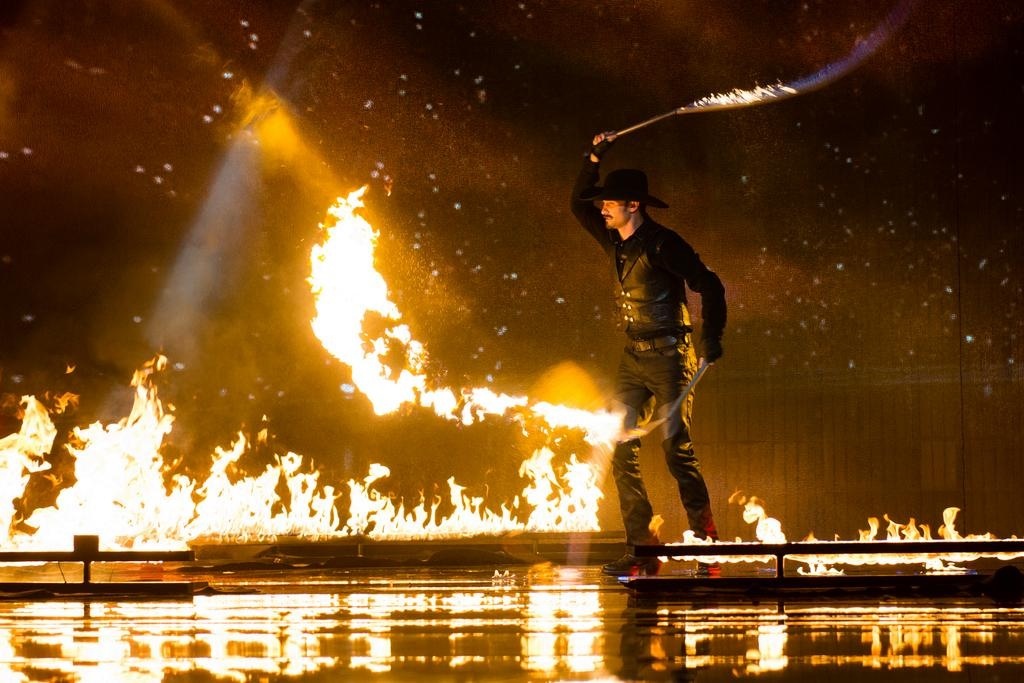 There are more little children wearing cowboy hats today after watching Loop Rawlins on America’s Got Talent than there was a week ago. Loop and his wife were invited to the quarter finals at Radio City Studio in New York to perform the next phase of his AGT journey. Prior acts for AGT by Loop were flaming lassos with some acrobatic stunt work and gun spinning. But airing for millions of Americans on Tuesday August 5, 2014 Loop Rawlins lit the stage on fire and performed with firewhips in what turned out to be a spectacular event that captured the imagination of America. It was quite an exhibition of imagination and talent.