Capitalism as a Weapon: The peaceful conquest of our enemies without firing a shot

The Wall Street Journal had a wonderful little essay in their Saturday review section that sounded like something one might find at this site every day. The author Hernando De Soto wrote a nice little article titled The Capitalist Cure for Terrorism: Military might alone won’t defeat Islamic State and its ilk. The U.S. needs to promote economic empowerment. It was such a good article I place a portion of it below along with a link to the whole article for further review. In it Hernando talks about his experiences in Peru as communism was moving through South America and Central America during the 80s and 90s and how it was defeated with economic prosperity. He suggests that if the same strategy were employed in the Middle East, that it would be a lot more powerful than airstrikes and “troops on the ground.” The way to beat communism which is always floating around in between the sentences of progressive thought is to advocate capitalism. There is a lot more strength in that economic policy than in any military occupation by force of a people in a remote land. Here is some of Hernando’s article.

By 1990, a Marxist-Leninist terrorist organization called Sendero Luminoso, or Shining Path, had seized control of most of my home country, Peru, where I served as the president’s principal adviser. Fashionable opinion held that the people rebelling were the impoverished or underemployed wage slaves of Latin America, that capitalism couldn’t work outside the West and that Latin cultures didn’t really understand market economics.

The conventional wisdom proved to be wrong, however. Reforms in Peru gave indigenous entrepreneurs and farmers control over their assets and a new, more accessible legal framework in which to run businesses, make contracts and borrow—spurring an unprecedented rise in living standards.

Between 1980 and 1993, Peru won the only victory against a terrorist movement since the fall of communism without the intervention of foreign troops or significant outside financial support for its military. Over the next two decades, Peru’s gross national product per capita grew twice as fast as the average in the rest of Latin America, with its middle class growing four times faster.

Today we hear the same economic and cultural pessimism about the Arab world that we did about Peru in the 1980s. But we know better. Just as Shining Path was beaten in Peru, so can terrorists be defeated by reforms that create an unstoppable constituency for rising living standards in the Middle East and North Africa.

To make this agenda a reality, the only requirements are a little imagination, a hefty dose of capital (injected from the bottom up) and government leadership to build, streamline and fortify the laws and structures that let capitalism flourish. As anyone who’s walked the streets of Lima, Tunis and Cairo knows, capital isn’t the problem—it is the solution.

Here’s the Peru story in brief: Shining Path, led by a former professor named Abimael Guzmán, attempted to overthrow the Peruvian government in the 1980s. The group initially appealed to some desperately poor farmers in the countryside, who shared their profound distrust of Peru’s elites. Mr. Guzmán cast himself as the savior of proletarians who had languished for too long under Peru’s abusive capitalists.

What changed the debate, and ultimately the government’s response, was proof that the poor in Peru weren’t unemployed or underemployed laborers or farmers, as the conventional wisdom held at the time. Instead, most of them were small entrepreneurs, operating off the books in Peru’s “informal” economy. They accounted for 62% of Peru’s population and generated 34% of its gross domestic product—and they had accumulated some $70 billion worth of real-estate assets.

This new way of seeing economic reality led to major constitutional and legal reforms. Peru reduced by 75% the red tape blocking access to economic activity, provided ombudsmen and mechanisms for filing complaints against government agencies and recognized the property rights of the majority. One legislative package alone gave official recognition to 380,000 informal businesses, thus bringing above board, from 1990 to 1994, some 500,000 jobs and $8 billion in tax revenue.


http://online.wsj.com/articles/the-capitalist-cure-for-terrorism-1412973796

Of course President Obama would never consider the types of reforms which took place in Peru because as a progressive—his underlying philosophy is that of Karl Marx communism—the same brand that is behind the Muslim Brotherhood, the tyrants of South and Central America and in general the labor unions of the world. As enemies of capitalism, they are in paralysis to utilize it as a military objective and are thus forced to commit the type of imperialism that America is often criticized for. But that is entirely unnecessary—as capitalism is the best strategic mode of military conquest. Free people to their own economic success and they will have no need for a dictator. Make people wealthy in the Middle East, and they will have no desire to feed the resources of ISIS.

It is wonderful to see such strategic thinking coming out of the Wall Street Journal. New York, even though it was built by capitalism is a hard place these days comprehend such an economic philosophy. Progressivism is the ruler of that city these days. Yes capitalism still speaks loudly in Times Square, but the underpinnings of progressive philosophy are slowly destroying everything that city has meant to America which is a military objective coming from the other direction—from antagonists like ISIS and other Muslim radicals. They wish communism upon the earth and they use religion to hide it. So it is only fair to utilize the strength of the West—capitalism—to crush the enemies of our nation without firing a shot.

You’d think that Obama being the peace-loving old hippie follower that he was and is would love the idea of a peaceful solution to the world’s problems. But Obama is an enemy of capitalism, so he cannot use it to save the world, which is a shame, because it is the most effective weapon that America has against its enemies. And America has enemies not because of what it does to other nations through imperialism, but because it is always a threat to tyrannical control they wish to impose on the world. America because of its capitalism is an example to the world that tyrants hope to extinguish so that promises of a better life do not come from economic freedom, but through the support of the next rulers of a Karl Marx economy where each takes from confiscated wealth according to their need.

The solution to many of the world’s anxieties could be accomplished through the simple embrace of capitalism as an economic force. The continued desire to find the next subtle way to deliver world-wide communism is the root of much trouble that can be seen today whether it is the ISIS terrorism, or the border troubles with Mexico. At the heart of most third world economies and their hatred for America is the old relic of thought started by Karl Marx, the great destroyer. And the best counter measure to Marx and his communism is the fine essence of self-empowerment through glorious capitalism.

Rich Hoffman
www.OVERMANWARRIOR.com

Christian Slaves, Muslim Masters: White Slavery in the Mediterranean and why justice comes from a bullwhip

A recent comment about my site here, Overmanwarrior’s Wisdom contemplated my use of bullwhips and attempted to associate it with slavery in the typical progressive fashion. Of course I’ve heard all this before and each time I hear it only inspires me more to expose progressivism for the destructive force that it is more intensely. One of the reasons that bullwhip work is degraded as sadomasochism and instruments of slavery is due to this progressive marketing campaign that wants to divide up everything into just a few categories, fairness for women, fairness for people of color, fairness for the poor, and fairness for other countries. Of course that fairness is always defined by a political class of elites hungry for power and inspired by the communist movement of the 20th century. But that is always ignored. Instead this is the kind of intelligence we are to contend with:

‘Justice comes with the crack of the whip,” is the tag line. And he wields bullwhips as a hobby. Naw, he’s no overseer. What connotations could I even imply?


The implication there of course is that as an “overman” I want to be a slave owner ruling over a flock of black slaves. The bullwhip is part of the slave master tradition to the thinking of these political marionettes. But they would be wrong, in fact, they are part of a massive cover-up which seeks to highlight the effects of slavery in America—inherited from Europe—and the type of slavery that Thomas Jefferson himself attacked when he could—which was the start of the United States Marines. That slavery started it all in the modern world and involved Muslims in North Africa. The information and statistics are staggering of how many white people were enslaved by Muslims of color and were articulated in the 2004 book Christian Slaves, Muslim Masters: White Slavery in the Mediterranean. Read about the study conducted in that book below:

COLUMBUS, Ohio – A new study suggests that a million or more European Christians were enslaved by Muslims in North Africa between 1530 and 1780 – a far greater number than had ever been estimated before.


Robert Davis, professor of history at Ohio State University, developed a unique methodology to calculate the number of white Christians who were enslaved along Africa’s Barbary Coast, arriving at much higher slave population estimates than any previous studies had found.


Most other accounts of slavery along the Barbary Coast didn’t try to estimate the number of slaves, or only looked at the number of slaves in particular cities, Davis said. Most previously estimated slave counts have thus tended to be in the thousands, or at most in the tens of thousands. Davis, by contrast, has calculated that between 1 million and 1.25 million European Christians were captured and forced to work in North Africa from the 16th to 18th centuries.


Davis’s new estimates appear in the book Christian Slaves, Muslim Masters: White Slavery in the Mediterranean, the Barbary Coast, and Italy, 1500-1800 (Palgrave Macmillan).

“Much of what has been written gives the impression that there were not many slaves and minimizes the impact that slavery had on Europe,” Davis said. “Most accounts only look at slavery in one place, or only for a short period of time. But when you take a broader, longer view, the massive scope of this slavery and its powerful impact become clear.”

Davis said it is useful to compare this Mediterranean slavery to the Atlantic slave trade that brought black Africans to the Americas. Over the course of four centuries, the Atlantic slave trade was much larger – about 10 to 12 million black Africans were brought to the Americas. But from 1500 to 1650, when trans-Atlantic slaving was still in its infancy, more white Christian slaves were probably taken to Barbary than black African slaves to the Americas, according to Davis.

“One of the things that both the public and many scholars have tended to take as given is that slavery was always racial in nature – that only blacks have been slaves. But that is not true,” Davis said. “We cannot think of slavery as something that only white people did to black people.”

During the time period Davis studied, it was religion and ethnicity, as much as race, that determined who became slaves.

“Enslavement was a very real possibility for anyone who traveled in the Mediterranean, or who lived along the shores in places like Italy, France, Spain and Portugal, and even as far north as England and Iceland,” he said.

Pirates (called corsairs) from cities along the Barbary Coast in north Africa – cities such as Tunis and Algiers – would raid ships in the Mediterranean and Atlantic, as well as seaside villages to capture men, women and children. The impact of these attacks were devastating – France, England, and Spain each lost thousands of ships, and long stretches of the Spanish and Italian coasts were almost completely abandoned by their inhabitants. At its peak, the destruction and depopulation of some areas probably exceeded what European slavers would later inflict on the African interior.

Although hundreds of thousands of Christian slaves were taken from Mediterranean countries, Davis noted, the effects of Muslim slave raids was felt much further away: it appears, for example, that through most of the 17th century the English lost at least 400 sailors a year to the slavers.

Even Americans were not immune. For example, one American slave reported that 130 other American seamen had been enslaved by the Algerians in the Mediterranean and Atlantic just between 1785 and 1793.

Davis said the vast scope of slavery in North Africa has been ignored and minimized, in large part because it is on no one’s agenda to discuss what happened.

The enslavement of Europeans doesn’t fit the general theme of European world conquest and colonialism that is central to scholarship on the early modern era, he said. Many of the countries that were victims of slavery, such as France and Spain, would later conquer and colonize the areas of North Africa where their citizens were once held as slaves. Maybe because of this history, Western scholars have thought of the Europeans primarily as “evil colonialists” and not as the victims they sometimes were, Davis said.

Davis said another reason that Mediterranean slavery has been ignored or minimized has been that there have not been good estimates of the total number of people enslaved. People of the time – both Europeans and the Barbary Coast slave owners – did not keep detailed, trustworthy records of the number of slaves. In contrast, there are extensive records that document the number of Africans brought to the Americas as slaves.

So Davis developed a new methodology to come up with reasonable estimates of the number of slaves along the Barbary Coast. Davis found the best records available indicating how many slaves were at a particular location at a single time. He then estimated how many new slaves it would take to replace slaves as they died, escaped or were ransomed.

“The only way I could come up with hard numbers is to turn the whole problem upside down – figure out how many slaves they would have to capture to maintain a certain level,” he said. “It is not the best way to make population estimates, but it is the only way with the limited records available.”

Putting together such sources of attrition as deaths, escapes, ransoming, and conversions, Davis calculated that about one-fourth of slaves had to be replaced each year to keep the slave population stable, as it apparently was between 1580 and 1680. That meant about 8,500 new slaves had to be captured each year. Overall, this suggests nearly a million slaves would have been taken captive during this period. Using the same methodology, Davis has estimated as many as 475,000 additional slaves were taken in the previous and following centuries.

The result is that between 1530 AD and 1780 AD there were almost certainly 1 million and quite possibly as many as 1.25 million white, European Christians enslaved by the Muslims of the Barbary Coast.


http://researchnews.osu.edu/archive/whtslav.htm

Of course nobody ever hears about this because under the re-education so fashionable under progressive interpretation, the slavery of whites doesn’t fit the communist motivated, anti-American imperialism that is the real target of the attack by those who want to destroy America and the capitalism that drives its economic power. So the slavery argument has been captured to only discuss the practice in America. What is ignored is that once America had freed itself during the Revolution it immediately went to work to free all men which started the Civil War. After the Civil War was a period of westward expansion which highlights the era typically rendered by the cinematic western. It is from this time that the bullwhip came into play not as a plantation guardian, but of individuals facing down the vast open spaces of the American West.


The tag line I use at this site is a quote from my own 2004 novel The Symposium of Justice where the main character Cliffhanger fights off modern slavery by destroying a mind control device designed to interfere with the thinking of a town’s citizens and guide them in the proper political direction. The use of bullwhips in the story has nothing to do with slavery or standing over other people—it is about freeing people so that they can think. The use of the bullwhip is to use force to punish bad guys for attempting to enslave civilization. My use of the bullwhip in that story context is to free people, not to enslave them.

Those who chose to revise history are far more dangerous than the perceived slave master who uses a bullwhip to control the black slaves at their southern plantation. The minds of these critics shown at the beginning of this article are made by modern progressives who make movies like Dajango Unchained and the ignorant masses believe wholeheartedly that the filmmaker Tarentino is a scholar who knows much about the slavery argument. But he doesn’t. For those who do know, slavery wasn’t a black or white condition, it was a product of the times, and white people were just as vulnerable to enslavement as blacks were—yet this is never discussed even though the evidence is quite extensive.


For my own lessons in history it is my proposal that it takes an “overman” to see past the limitations imposed on mankind through thousands of years motivated exclusively by ignorance. It takes such a position to understand why a 2004 book written about white slavery in North Africa by a professor of history at Ohio State was ignored—because it didn’t fit the progressive definitions meant to attack American imperialism. It is also meant to ignore the role that Muslims played in that slavery—as Islam is a religion that progressives are advocating as a volatile assailant against the bourgeoisie of world power, the North American continent. Those progressive definitions come straight out of the books of Karl Marx and have no other grounding in reality. To see such contradictions not only takes a student of history, but someone willing to step outside of the current human limitations of personal sensitivity and political concern to see the truth. And the truth is, America freed their slaves, but the rest of the world didn’t. Of those other places in the world that promoted slavery so intensely, it was the Muslims who then as they do now, seek to rule over mankind with an iron fist. For me, the bullwhip is a symbol of the American West and the only time in world history that a nation freed itself from a tyrannical past. That symbol needs to be propped up for the world to see so that they too can rise up against their slave masters with a projection of strength that can metaphorically come only from a bullwhip.

Rich Hoffman

www.OVERMANWARRIOR.com

The Reach Out Lakota Charity Dinner: Invasion of the “Latte Sipping Prostitutes”

When you want to know what’s wrong with politics all you have to do is pull off the masks of events like the recent Reach Out Lakota charity event to know what it is. Sponsored by the progressive oriented Chamber members it was a dinner pitched in the following manner:

Imagine having a wonderful evening out with friends including cocktails, dinner and entertainment. For dinner, you and your friends will be seated at your table of ten, decorated in the theme or motif of your choice. And, you’ll be waited on by a TV news anchor or a morning drive DJ or the Police Chief or other celebrity! Now imagine having this much fun as you raise money for Reach Out Lakota and your community! No need to imagine…it will happen on Thursday, October 9, 2014 and you can be a part of this fabulous evening at the Savannah Center in West Chester.

I know most of the “celebrities” listed below who were the waiters at the event and can report to them that this is exactly why I don’t do many public appearances any more. Just as in the past when it comes time to rise up to fight against an issue, these types of crossing of the swords events prevent clear articulation of the crises at hand—which I’ll explain in a moment.

  • Justin Jeffre – 98 Degrees

  • Adam Marshall – WCPO 9 reporter

  • Karin Johnson – WLWT 5 reporter

  • Perry Schaible – WKRC Local 12 reporter

  • Kristen Bitonte – Liberty Township Administrator

  • Judi Boyko – West Chester Township Administrator

  • Margie Conditt – State Representative (District 52)

  • Joe Hinson – President/CEO at West Chester • Liberty Chamber Alliance

  • Ben Dibble – Lakota Board of Education Member

  • Lynda O’Connor – Lakota Board of Education Member

  • Julie Shaffer – Lakota Board of Education Member

  • Tom Ferrell – Liberty Township Trustee

  • Joel Herzog – Assistant Chief of West Chester Police Department

  • Rick Prinz – Assistant Chief of West Chester Fire Department

  • TC Rogers – Butler County Commissioner

  • Roger Reynolds – Butler County Auditor

  • Nancy Nix – Butler County Treasurer

  • Mary Swain – Butler County Clerk of Courts

  • Steve Mayhugh – Director of West Chester Library/MidPointe

  • Kevin Joseph – CEO at West Chester Hospital

  • Tony Pike – Former UC Bearcats and NFL quarterback

  • Paul Heintz – MOJO Running

  • David Armbruster – ‘Id Man’ from 700 WLW Reds pregame

  • Becky Wilber – CTI Restaurants

  • Todd Wilber – CTI Restaurants

http://reachoutlakota.org/celebritydinner.html

What the Reach Out Lakota people are doing is a good thing, and many of the names on that list—many whom I personally like—people like Karin Johnston, T.C. Rogers, Roger Reynolds, and Todd Wilber truly mean well. Such events are nice occasions where you put your political differences away from people like Lynda O’Conner, Julie Schafer, and Ben Dibble—all from the Lakota school board, along with Joe Hinson of the Chamber Alliance and break bread with them for a good cause. However, and this is true of many people on that list—when it comes time to stand against those people and fight them on an issue, the resolve is not there later to perform the task because of these events.

Many hearing the news reports from the event would think that the Lakota school system was raising money for itself. It wasn’t well reported that the Lakota Reach Out program has nothing to do with the government school itself, but was started by a group of Lakota moms who wanted to help some of the down and out within the community with charity. But, when such events of a high-profile such as this are performed, Lakota gets the credit which is why the school board members were there—to mooch as second handers off the positive public relations generated.

During the last four tax increase attempts and of course all future attempts–the first coming in the 2016/2017 time frame–events like this take the edge away from those who don’t want tax increases imposed on them. People like Julie Schafer who ride the coat tails of success by attending such events and feel privileged to hang out with people like Todd Wilber sipping wine and eating fine food will be the first to rally her tax fanatical supporters into boycotts against Wilber’s businesses if he doesn’t come out in favor of a levy attempt. I know it, because I’ve seen it first hand. People like Wilber have no choice but to play nicely because at events like the Lakota Reach Out program charity dinners break down the barriers of differences by their very nature, which is why all the usual villains of progressive influence are at the head of the organization. The goal for them is to take the edge off those who would otherwise fight their desires.

I often make reference to these types of people—the progressive manipulators at the front of these social orders as “latte sipping prostitutes” and here’s why—because there is much evil conducted at these types of dinners hidden behind the mask of goodness which translates out into a general degradation of our political, economic, and moral social manifestation. The organizers often prostitute themselves to progressive causes in trade for second handed appeal by way of social recognition. What gets traded away is the ethical position to stand against progressive tax increases and corrosive social policies proposed through organizations like the Chamber Alliance. Just as a prostitute losses the ability to stand for moral causes because they sell their bodies for money, the latte sipping prostitutes of such events lose their moral ground when Lakota schools proposes their future tax increases because the public has seen people like Wilber, Reynolds, and Rogers breaking bread with Schafer, Dibble, and O’Conner. And how did they see it, because Karin Johnston, and Adam Marshall brought it straight to their eyes and it will always be remembered. Just as it is uncomfortable for a prostitute to see one of their customers at a shopping center with their family after the dirty act is done and payment was accepted, the realization comes often too late at how paralyzed the prostitute is in such moments. They can’t go up to the spouse of their customer and report the moral depravity of the marriage, because they have no moral ground to do so—as they were the advocates of such an illicit act from the start. What might have been an enjoyable experience turns out to be a vice later when a moral position is required. At that time the names on the above list will be in paralysis. They might give money to someone like me as a mercenary to fight on their behalf—but they will also seek to keep the whores quiet when they start demanding more money through means of extortion. When the latte sipping prostitutes howl out in anger for more money, more attention, and more respect, those who use those whores are unable to stand against them because they crossed the line and lost the ability to cast moral judgment against such social disgraces.

It is for that reason that I have not been to social functions much in 2014. It is easy to see what is going on and what the strategy of the other side desires to accomplish. What is more important than the immediate gratification of wine banging and laughs shared for the benefit of the misfortunate in our community is the ability to stand on a moral principle when all the other vagrants have been hushed into silence by the latte sipping prostitutes. Lakota the school system is one of those whore houses—and most of the people who support it are the whores. They attach themselves to good groups like Lakota Out Reach just as a whore couples with a successful customer for all the reasons one can think of—but most prominently to gain emotional leverage at a latter date that will prevent action against evil when it matters most

It is important to remember that what makes us are not the friendships we maintain through fake smiles and forced acceptance of values that are compromises at best. It is in our ability to stand for something—otherwise society will fall for anything. The reason that politics in our society is such a disgrace is that it is filled with these kinds of events populated by these types of people. Strong candidates newly elected soon find after a few years of this type of sword crossing that they lose their ability to stand against the whores who come into their life nearly by force and plop themselves into their laps with offerings of delight and friendship. But at the end of the day what is learned always too late is that there is a price for that friendship—and at that point the ability to stand against injustice is long gone—pissed away like the fine wine drank at events like the Lakota Out Reach dinner.

Rich Hoffman

www.OVERMANWARRIOR.com

Life Under a Blood Moon: Zombies of exsistance and shadows of illusion

What a treat it was to be on a motorcycle in the cool morning air on October 8, 2014 to see a “blood moon” setting through patches of intense flog as the sun was rising. A lunar eclipse occurred on that day which is a rare event. I happen to live in a time zone where the sun was rising as the moon was setting at the highest point of the eclipse leaving the phenomena known as a blood moon. It was a Halloween oriented sensation accentuated by the motorcycle ride. I felt lucky enough to be up at that hour to see such a rare thing, but to also be on a motorcycle exposed to the various elements made it more memorable.

A blood moon is caused by the moon being on the exact opposite end of the earth in relation to the sun. The blood color is caused by the shadow of the earth cast against the surface of the moon. It’s infrequent that the position of the moon is in that particular location at the same time that the earth is positioned around the sun to cast such a shadow through space. It’s a fairly epic event if the science is considered. When that sensation is included to the man-made machinery of a motorcycle and the natural low-hovering dense fog coming from the thick cool air—it is an overwhelming sensation. Just days prior a massive storm came through my area saturating the ground with heavy rain that was still trying to escape back into the sky through the evaporation process. But with the weak rays of the sun during these fall months, there wasn’t enough energy to pull that moisture back into the formation of clouds. That leaves all those escapees of water molecules stuck in limbo in the form of fog until the next sunrise can finish the job on the following day. Because of all these elements together, it was a picturesque morning to ride a motorcycle that even the best Hollywood cinematographer couldn’t have conceived.

Yet in the cars sitting in traffic with me an additional element was present that was even more Halloween-like—the drivers were oblivious to these miracles. They sat stiff armed to their steering wheels zoned into their present condition of selling their day to employment like zombies seeking the blood of their next victim. Not a soul seemed inclined to view the blood moon through their windows as the fog hazed lazily on the horizon. Their minds were otherwise consumed.

Riding motorcycles has a way of heightening all the senses, so noticing such a thing had a more dramatic effect. But it had been a long time since I had been in the presence of so many people who were clearly tuned-out to the miracles of life. I was as alone as though I were on a deserted island in the middle of the Pacific Ocean without another person close by for hundreds of miles.

That suited me just fine. The blood moon seemed to understand as it hovered above the fog like a ghost that had once lived but was otherwise obscure, maintaining the ability to view the world while being invisible to the daily happenings of existence. But it isn’t we who are the ghosts, and brain-dead zombies. It is those moving about under the light of the blood moon, and the fog in the cool morning air that are unaware of the world around them in the same fashion that insects have no ideal that a human being is sitting nearby aware of their every move.

I thought of all the times I fished insects out of my swimming pool during the summer. From the perspective of the drowning insects, it must seem like a miracle to them to have a strange mass pull their bodies out of the water to the safety of a pool edge. To them, my saving them was a miracle—I gave them another day or two of life and they were probably grateful for about a fraction of a second. The same consciousness was apparent in the morning traffic of the blood moon. Like the insects, the people were unaware of the world above them, only that they had to get to work, to drop off their children at school, at the day care, and what radio station they wanted to tune in to. They were concerned about their coffee, and the temperature inside their rolled up windows and stared like zombies forward toward their work day and the trading of time for money.

Soon the blood moon was gone and the sun was up and the fog ran for the sky. The world of the night, the fog and the blood moon was gone to history, just as most of our lives rise and fall in the blink of an eye casting illusions to the world that appear to be one thing but are caused by something else. To the insects of the world they look up at such blood moons and think that the surface of the strange orb floating in the sky turned red. But what they don’t know is that the cause of the effect is the earth, not the moon and the change in hue is related directly to the sun which is stationed firmly in its place within the solar system floating around the Milky Way like a clock gear heading for destiny. The cause of the light cast upon our own lives is often obscured by shadows and our appearance often appears to be something that it is not. But for a brief morning in October of 2014 under a blood moon, there was honesty to humanity that cast insight beyond the illusions found in the light of day. That even with all the miracles of science and the scope of activity that made the blood moon, mankind was still insect-like in their perception of reality and curiosity about their environment.

Rich Hoffman

www.OVERMANWARRIOR.com

Nickelback’s Edge of Revolution: Communism hidden behind the Occupy Movement

There is a lot of talk these days about revolution. For those statists who want to pretend that their grip on the old world will remain, they are dreadfully in for some big surprises. There are two revolutions afoot across the world and often they are mixed together in the headlines of news reports. To novice eyes, it all looks the same, but that is not the case. There are moves toward capitalism, like what is going on in modern-day Hong Kong—where the people of that city hope to retain much of the type of government that is taken for granted in the West. Then there is the disguised communist push hidden behind progressivism centering on today’s youth and the Occupy Wall Street types. That is the type of revolution that the rock group Nickelback is presenting with their new 2014 album. The Edge Of A Revolution is the lead single from the rock band’s eighth album due in stores on Republic Records. “Edge of a Revolution” is political protest song sympathetic to radicals against capitalism. Here are the lyrics:

Head high, protest line Freedom scribbled on your spine Headline,New York Times Standing on the edge of a revolution Hey, hey, just obey Your secret’s safe with the NSA In God we trust, or the CIA Standing on the edge of a revolution Yeah, we’re standing on the edge of a revolution Revolution Revolution Revolution No, we won’t give up We won’t go away ‘Cause we’ll never thought to live in this mass delusion No, we don’t wanna hear it, another word that you say ‘Cause we know they’re out depending on mass confusion No, we can’t turn back, we can’t turn away ‘Cause it’s time we all rely on the lost illusion No, we won’t lay down and accept our fate, We’re standing on the edge of a revolution Wall streets, common thief When they get caught, they all go free A brand new yacht, and a finders fee Standing on the edge of a revolution Same shit, different day Can’t keep fed if I can’t get paid We’ll all be dead if this shit don’t change Standing on the edge of a revolution Yeah, we’re standing on the edge of a revolution Revolution Revolution Revolution No, we won’t give up We won’t go away ‘Cause we’ll never thought to live in this mass delusion No, we don’t wanna hear it, another word that you say ‘Cause we know they’re out depending on mass confusion No, we can’t turn back, we can’t turn away ‘Cause it’s time we all rely on the lost illusion No, we won’t lay down and accept our fate, We’re standing on the edge of a revolution


Nickelback is proving to follow their rock music diatribes against capitalism appealing to a life of excess while at the same time preaching against it, like they did in their single, “Rockstar.” The rock band is Canadian in origin and have quite a history making songs about excess sound appealing while sending a strong message to their listeners portraying capitalism as a vile evil. This is the same thing they are doing with their new single “Revolution.” Their suggestion is mixed truth, such the libertarian concerns about the NSA, but then features their focus on Wall Street thieves buying yachts and making livings off finder’s fees. Their appeal is directly communicating to the young people sympathetic to Occupy Wall Street. Whereas “Rockstar” was a self satirized attack against the life of excess that groups like Nickleback live while on the road, this new song paints the rich in America as something to revolutionize against and is a call to action.


The message from Nickleback is to use common anxieties such as the NSA to sell communism through the same type of revolution that the Bolsheviks used in St Petersburg in Russia during 1917 to bring communism to a newly formed Soviet Union. The Wall Street protestors called upon by Nickleback is demanding the same type of thing painting the bourgeoisie of American culture as something that must be overcome. Many of the same youth chanting with upraised hands to the beat of this new song have no idea that much of the political push behind the uprisings of the Middle East is communism using the religion of Islam as a mask for cultural penetration.

They don’t call it out by name but communism is the revolution Nickleback is calling for. The flags waved in their music video shown above are all modern manifestations of communism. There are no American flags waving toward the tyranny of progressive Europe, or support of the Hong Kong capitalists against communist China—the revolution Nickleback is advocating is one supporting communism.


So think about that when you hear the new Nickleback song on the radio and at nightclubs provoking you to dance a bit to the rhythm. Then consider where the voices in favor of capitalism are—they aren’t in the music and movie industry. They are alone and voiceless for the most part. Capitalists do not have advocates at the level of entertainment that Nickleback represents. The music industry certainly doesn’t support such artists, and lyrics that support capitalism against socialism. Pro capitalist messages certainly don’t get played on the radio. But if a group like the Canadian rock stars Nickleback want to sing against capitalism, they’ll get all the weapons of the media on their side to broadcast straight into the ears of America’s youth—so that they will demand change from a capitalist system to a communist one.

Nickleback doesn’t sing about what life will be like after the revolution when all their listeners are sitting around waiting for someone to give them a job. Or nobody is moving money on Wall Street to create new Apple stores in shopping malls to sell those same fans iPhones so that they can listen to Nickleback sing anti-capitalist songs against America. They just preach revolution against the American system of capitalism. They don’t say what comes next. For that, today’s youth only need to look at modern-day Hong Kong and see what happens after a communist revolution. Today’s Nickleback fans will give to their grandchildren a revolution going back the other way—the same as Hong Kong is currently—hoping to take some capitalism from a communist government after the freedoms of today are long gone.

Rich Hoffman

www.OVERMANWARRIOR.com

Corrupt Politics Behind Lakota’s Boys and Girls Club West Chester: The exploitation of children to fulfill fantasies of vanity

The essence of the Boys and Girls Clubs across America is really an excuse for altruistic latté sipping prostitutes to bath themselves in perfume and take selfies at award dinners to celebrate their bailout of failed parenting and offerings of all day babysitting services to families too busy and ignorant to perform the task of mentoring for their own children.   In spite of the hoards of celebrities which participate in commercials for the Boys and Girls Clubs, the basic message of the organization is that parents fail at raising children and that there is a social safety net out there to catch all those lost children who would otherwise fall through the cracks of civilization.  The idiocy of the message is that an alliance with government schools will somehow miraculously overcome bad parenting and make children complete citizens who will then grow up and “serve” their communities.  Needless to say, I think the whole premise is a bad idea.  So it should come as no surprise that I’m against the one that is being built in West Chester, Ohio in partnership with Lakota schools, which can be seen at the two articles below, one from the Journal News, the other from me where I break down the essence and politics of the deal telling the behind the scenes story of how that ridiculous endeavor came to be and who the personalities involved are.

http://www.journal-news.com/news/news/lakota-looking-to-lease-land-to-new-boys-girls-clu/nhSHs/

https://overmanwarrior.wordpress.com/2014/06/26/the-emperor-of-aldersonville-lakota-becomes-the-new-clothes/

However, the focus of this present article should be on the strategy of the Lakota superintendent Karen Mantia—as I am in a unique position to tell the story—which of course she will deny when pressed—but actions always do speak louder than words.  Karen when she was hired and overpaid by Lynda O’Conner, current Vice President of the Lakota school board, came to Lakota to pass school levies.  Up until that point Lakota residents had a strong resistance against tax increases proposed by the school.  So she set to do as she had in Pickerington, Ohio, to unite the business community and get their buy-in to her school system—as school superintendents like to see themselves as CEO’s who run vast corporations.  Coming to Lakota she sought to convert members of the opposition from No Lakota Levy—my group—into her way of thinking but first she had to know the political lay of the land.  She met with us and she and I had a nice conversation about my motorcycle and recent trip to Key West.  She was smooth and unassuming and made my partners believe that she had a head on her shoulders and that she just might approach school business with a mind to savings.

However, what Karen knew and discovered during that meeting, and through subsequent dinners through Lynda O’Conner with members of my No Lakota Levy group was that the builders and developers who were a part of the tax resistance were scorned by the school and not getting any work.  After all, Lakota schools is one of the largest employers in Butler County so it is hard to be in the business of developing things when you are on the shit list of local government employment group, so some of those members of the No Lakota Levy group wanted to repair their relationship with the school because they needed the work and felt vulnerable being on the wrong side of politics.  Mark Sennett was the first to defect out of pressure applied to him, which was revealed during the summer of 2011 when he misspoke to the media that No Lakota Levy would support a 2012 levy under certain conditions.  Of course I corrected that to the media and Mark was pushed out of the No Lakota Levy group.  Other developer types joined Mark, while others stayed with me.  Mark being a former government employee himself didn’t have strong convictions about things and was a member of No Lakota Levy because his affiliation with me saved him a lot of money in taxes—so we agreed on that much.  But on other matters, his reasons for being a part of the group were not as strong as mine.

During her meeting with No Lakota Levy Karen learned who the leaders of the group where and who the moderates were and quickly went back to the drawing board to figure out how to divide and conquer our group.  I warned our guys that this was her intentions and that she wasn’t such a nice old lady as she seemed.  For that particular election, they listened to me, but after the third levy defeat for which we orchestrated again saving local business owners millions of dollars—they began to feel the heat of being on the political out within the community and wanted desperately to repair their inside relationships for the exclusive purpose of gaining work from Lakota.  As developers, they couldn’t afford a sustained resistance to Lakota’s constant tax requests and Karen knew it.  So she attacked them where they all shared common ground—through the local socialite Patti Alderson.

Karen nurtured a friendship with the West Chester version of Lovey Howell from the Gilligan’s Island television show which cut directly to my No Lakota Levy members, because many were involved in the Community Foundation with her.  After discovering that Karen seemed like a reasonable women—a titan of industry much like herself–Alderson formed an alliance that would continue well into the next two years.  The purpose of this alliance was to pull the business oriented support of No Lakota Levy away from the ideological elements—represented by me.  I warned our members that this was what was going on, and told them that Karen planned to ignore the voters by going for another levy attempt in 2012 during a meeting right before Christmas in 2011.  They held tight for as long as they could, but really could not stand up to Alderson who put a lot of social pressure on them to buckle, because in essence they needed her more than she needed them.

On cue, Karen made her moves and positioned Lakota for an early 2012 levy push for either May or August when everyone was thinking about summer break—a tactic she tried in Pickerington.  Patti put pressure on my No Lakota Levy guys to separate from my radicalism and join the political moderates who were under the thumb of Karen Mantia joined together through the Community Foundation. Sensing the separation, Karen then worked the radical elements of her levy supporters to come after me personally and smear my name leading to the now famous Kroger Survey incident.  CLICK HERE TO REVIEW.   Reports of the survey came to me from No Lakota Levy supporters who directed me to the website “Yappi Sports,” which naturally infuriated me.  I agreed to a plan by the other No Lakota Levy members who were direct friends with Alderson to help them with a charity type organization called Yes To Lakota Kids.  Originally, we were planning to join Alderson’s group—but since her real objective was not to help kids, but build alliances against No Lakota Levy in favor of Karen Mantia’s efforts—she couldn’t work with me.  So we started our own group which touched off a firestorm of panic.   Immediately school board member Julie Shafer whom I debated on 700 WLW scoured through my articles and pieced together some of the worst things they could find that I had written to smear me publically—because the Yes To Lakota Kids foundation strategically cut too far into Lakota’s turf—which I knew it would all along.  So they had to take action.  I stood by my comments and felt good about it until the No Lakota Levy guys in direct alliance with Alderson left me stranded at the altar.  I knew the temptation was strong from them to end the levy fight, but I didn’t think they would side with her against me—but in the end, the politics of the deal was stronger than friendships and the rest is history.  Because of the damage on both sides—as I was intensely furious about the incident even more so than what caused me to say the things I had said in the first place—a short cease-fire was agreed upon.  Karen took that time to lick her wounds and try a different approach using a strategy of friendliness to counter all the vile things I had said about them.  Lakota spent many thousands of dollars on publicity to re-invent their image, and tried again for a levy in the fall of 2013 which they won by the slightest of margins.  Karen knew she had to try to get the money during a low year of voter turnout, as there weren’t any big state or national races on the ticket—otherwise she might not get another chance until 2015.  At the rate of spending Lakota already needs to try for another levy in 2017—so her time to take her one and only shot was in the fall of 2013.  My old friends and I joined together once again to resist the levy, but without me in the formal role of spokesmen—the effort failed.  I was better working in front of the scenes than behind and among them they couldn’t find anybody else to do the job the way I had.

I did what I had to do shortly after the levy passage to reduce my tax burden to absorb the cost of the levy, because I simply wasn’t going to spend the extra dollars out of my pocket to pay Lakota.  But for the rest of the members, who sided with Patti, they now have a substantially higher rate of tax to pay because of their wishy-washy behavior and failure to stand for their convictions—which leads us to this whole Boys and Girls Club at the old Union Elementary school.  What’s in the deal for Alderson—she gets to attend more dinners that worship her wealth as spotlights will douse her with attention—which she desperately seeks.  Karen gets a partner to support her in the next levy attempt as Patti pulls a lot of the local Republicans off their small government positions and into her fold just because of the wealth and political influence she commands. The local levy supporters get a free babysitting service so that they can feel the lack of guilt from being such sucky disconnected parents and my best friend from the No Lakota Levy days gets to build the whole thing.  He stood up to them for a while, Lynda, Karen, and of course Patti, but in the end he was locked arm and arm with West Chester’s Lovey Howell after the school board meeting finalizing the deal several months ago.  He was finally, conquered by Karen Mantia’s strategy implemented carefully and patiently.

So when people say about the Boys and Girls Club deal that there is corruption involved, now you know dear reader what they are talking about.  The inside deals are voluminous and run to the deepest cores of politics in Butler County.  Karen came to Lakota paid by O’Conner to do just this kind of divide and conquer tactic—but what all these elements have in common is their exploitation of children to commit the deeds.  Lakota routinely does this to gain money and leverage for their collective bargaining contracts, but in essence the Boys and Girls Club is no different.  They use children and the unfortunate victims of bad parenting to bath themselves in vanity for self recognition that has its roots in their personal religious outlooks.  Children and their misfortunes by all these parties are continuously exploited for the gains of adults who deep down inside want to be adored and loved by the masses for reasons that trace back to their own childhoods and the failures associated there.  That is why when the next levy is attempted by Lakota it won’t be the old cast of characters from No Lakota Levy this time—it will be a much more ideologically driven base that stands in defiance.  I knew what Karen was up to all along, because it takes one to know one, and I am well at work on the next campaign against them and will not again be vulnerable to wavering souls driven only by tax savings and not rooted in firm convictions.

Rich Hoffman   www.OVERMANWARRIOR.com


“Fat Han” in X-wing Miniatures: “I’m in it for the money”

When I participated in my first tournament for X-wing Miniatures I was still learning all the rules—but knew enough to build a squad of ships that would be competitive against even the most seasoned players. However, when I revealed my squad to my opponents, they immediately assumed that my use of Han Solo on the Millennium Falcon which encompassed a point build of 55 points out of 100 meant that I was a rookie player who did not trust my piloting ability. The Falcon fires in a 360 degree arc as most of the other ships fire in a 90 degree arc coming off the front of their ship. Most seasoned tournament players at the time if they did use the YT-1300 were using Chewie or Lando and using two B-wings or some other assortment of support ship to save points. Nobody was using Han, which made no sense to me. He was after all one of the highest pilot rating cards in the game and he has a wonderful re-roll ability that makes him very powerful. His card on the Millennium Falcon looked to my eyes to be one of the most powerful combinations in the game, and I thought it would be crazy not to use him in a tournament.

Well, about three months later some of the best X-wing players in the world used almost the same build at the Nationals played at Gen-Con 2014. In reaction to the new TIE Phantoms released at the end of June 2014 a new type of Rebel build called “Fat Han” emerged in the meta game to deal with the incredible maneuverability and fire power of the new Empire faction ships. In fact Paul Heaver who is the current world champion used nearly the same build as I had to climb into the top four at the nationals.

I never published my build anywhere and Paul and I never spoke—yet to his experienced eyes he picked that particular build to deal with the new elements coming into the X-wing game. And he wasn’t alone at the nationals; there were many other top players who were flying “Fat Hans” in competitive play which changed the game for the better. It is doubtful that Paul Heaver received the same sideways glances that I did when I placed my YT-1300 on the board. I was a newbie, Paul was a seasoned champion. But it made me feel good to see that even in a game where I am not comfortable with all the rules and certainly lack the experience of that kind of competitive play, that I’m able to fairly quickly jump in and identify trends that are out on the edge and not yet fashionable.

This was an important observation as I spend a great deal of time pointing out trends that are coming as opposed to the ones that currently exist. If the ability is gained, it can be applied to virtually everything in life even in areas where others are much more proficient. The “Fat Han” builds are now the complaint of the X-wing Miniatures world because of their extreme effectiveness and they will continue for some time until something else knocks them off in the months to come. But for me the experiment was very telling, and useful.

I left my tournament feeling like I could have done better and that I was close to something big as far as a strategy. The other players were so polished and knew their stuff—citing the rules from top to bottom quickly and were certainly at the top of their game. So I thought there might have been something to their complaints about using Han Solo and the Falcon in such a way as I was. But as it turned out, the best X-wing players in the game soon after turned to the very same strategy because the meta game pointed tactics in that direction. What I’m proud of is in seeing the trend before it occurred. Part of it is that I have a personal preference toward the Millennium Falcon, but when all the cards are looked at, it is beyond refute that the YT-1300 is by far one of the best tactical pieces in the game and that it should be included in any Rebel build.

I know much more about X-wing Miniatures now than I did during my first tournament, and I will know a lot more in a year than I do now. But the trend of seeing strategies and cycles beyond the curve of orthodox thinking is something I have been able to maintain even when others knew a great deal more about something than I did. It’s not some magic act, but simply a confirmation that Robert Pirsig’s Metaphysics of Quality strategies are employable on every level of endeavor, even in gaming. I do pretty well in life staying in front of the curve of social trends in most everything I do—even leisure. So it was fun to feel the scorn of the X-wing community—even though it was friendly jousting at the time—then find just a few months later that the entire meta game is moving in that direction.

I remember what it was like when I was a kid and I was the one who loved Star Wars above all the other social trends that were occurring at the time. It was considered very “uncool” to like the science fiction epic publicly. But I knew at the time—even as a very young kid, that there was something unusual about the stories and that the values conveyed in them had meaning beyond the social trends of the time. Now, 30 plus years later Star Wars fever is everywhere even to the extent that drones have been flying over the filming locations looking for a hint at the storyline. The only people now who think Star Wars is “uncool” are the backwards thinking lost in time souls who can’t identify with the values of the stories. They are people stuck in the past—in the policies of the New Deal, and progressive utterances inspired from the pages of Karl Marx.

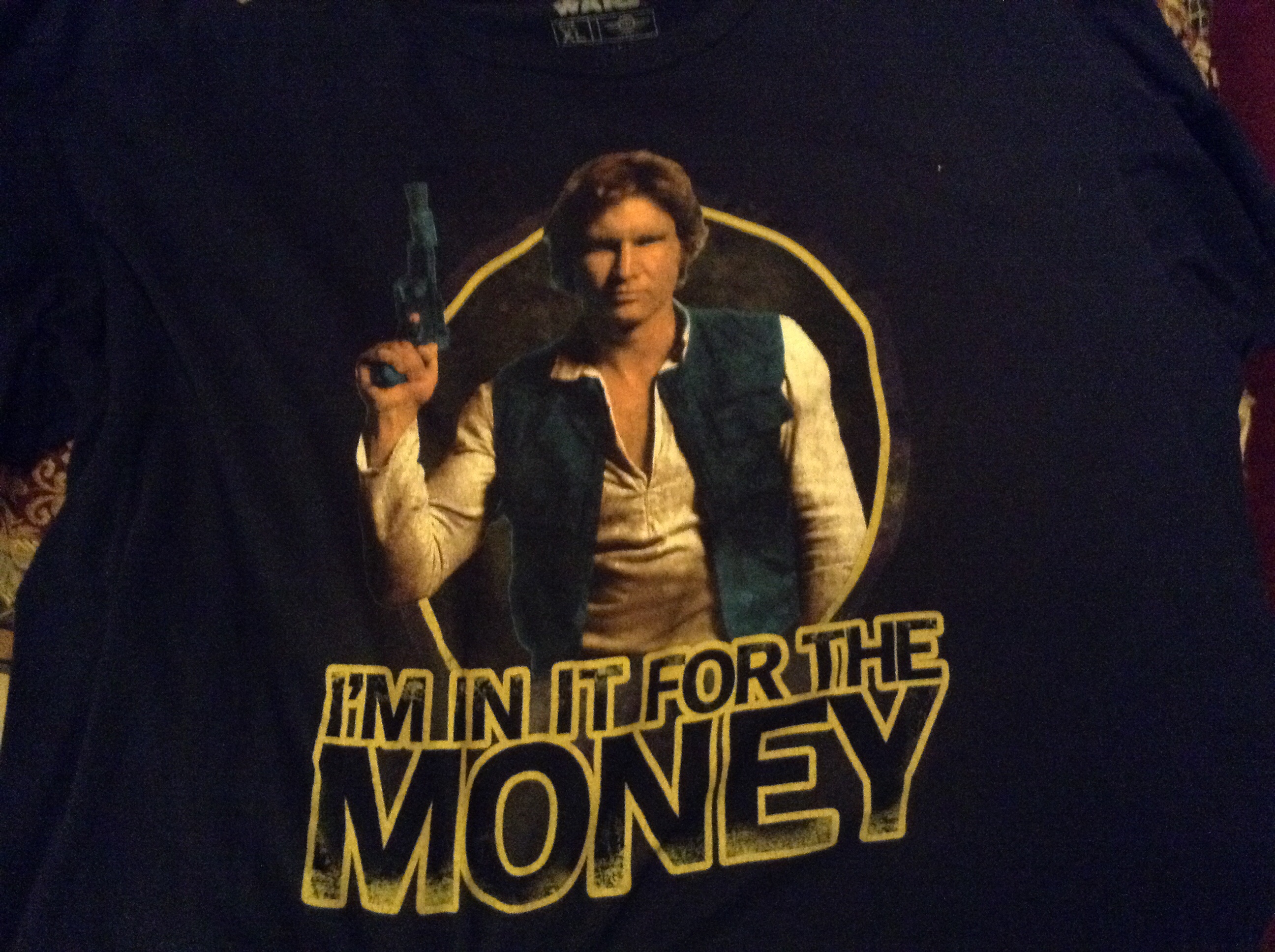
I have a shirt that I like to wear when playing X-wing Miniatures with Han Solo on the front of it—not unlike the kind of shirts I used to wear as a 9-year-old kid that says, “I’m in it for the money.” It is a very capitalist message and I first saw it in Hollywood Studios, Florida while coming off the Star Tours ride. I was surprised that Disney did not filter that pro capitalist message as there are many progressive executives who work for the large entertainment company. But, Han Solo is an unequivocal capitalist—an Ayn Rand type of capitalist in the Star Wars saga and he is one of the most popular characters there is. In fact, while downloading the new Star Wars game Commander onto my iPad I noticed that the characters on their load screen featured Han Solo, not Luke Skywalker because Disney knows where the money comes from in the series. It’s not the altruistic Luke Skywalker that people want to emulate; it is the capitalist Han Solo. This is a trend which will increase now that Star Wars is socially cool—altruism is out, capitalism is in.

That capitalist philosophy has spilled over into the X-wing game as the designers were careful not to weaken the message when designing the Han Solo game card. If played right, a “Fat Han” build can take being shot by opponents while dealing consistent damage during an entire match. It’s a very capitalist build and I think that the hatred for the build early in the game meta can be traced back to the fact that so many people are trained from their educations to hate capitalism. But—the meta of the game has moved by need of competition to utilize “Fat Han” builds just as the new Star Wars films and television shows soon will do the same on an epic level under Disney’s care. They know there in the hallowed halls of “Mouse Town” that capitalism is the key to social order and I could see that emergence as far back as the release of that Han Solo shirt featured at Hollywood Studios. We’re all in it to win, we’re all in it for the money—and that is why “Fat Han” builds have risen to popularity and why capitalism will emerge triumphant from 2020 to 2030 in ways that have never been seen before.image

I’m so sure of it that I’d bet everything I have. With the same assurance that I built a “Fat Han” build in X-wing Miniatures during a time when it was considered too novice-like to even think of bringing it to a tournament—I can see that capitalism will crush socialism under the care of the Disney handling of the Star Wars franchise. Some people may bellyache and complain, but the trend is already emerging. I can see it as plain as a sun in the noon day sky on a cloudless day around the equator. It’s so bright that it burns. Meanwhile, I have to change my tactics to stay competitive. “Fat Han” will no longer work because everyone is using it. So my new build is something I’m called “Dashing Han” which is more akin to how the Falcon actually flew with Han Solo at the controls. It is very difficult to fly, but should provide an advantage that will last a while. Because the name of the game is to always stay out in front of the meta.

Rich Hoffman   www.OVERMANWARRIOR.com


William Schmidt’s Lakota School Intrusion: The outragious expectations of public sector unions

Lately I haven’t written much about my home school district of Lakota and their runaway budgets dictated by collective bargaining agreements and radical union collectivist philosophy—because honestly I have said much of everything that can be said. It’s been a while since reports of teachers seducing students, and pornography driven nut cases trying to turn their elementary school classes into third world brothels occurred. So Lakota has kept their act pretty clean and have actually tried to manage their budget within the limits that the law imposes. So I haven’t written much about them as it is a tired subject.

However, I did receive the below note from a union radical who has taken notice of Lakota’s attempt at some management of their train wreck salary structure. The disaster isn’t in the lack of pay, but in being too highly committed to mediocre employees. It is that salary structure which causes the need for tax increases so Lakota has been trying to make plans going into the future that will avoid becoming too top-heavy in salary obligations. After the last levy passage in 2013 just a few months later raises were handed out like candy just like I always said they would be—and people learned too late who was telling them the truth all along. But to avoid those kinds of criticisms in the future Lakota as a management team has made some meager attempts to get the situation under control as the next projected levy increase is set for 2017. Those financial burdens are caused by unreasonably high salary structures. But for the pro union crowd—even those radicals not even part of the Lakota district they see such attempts as a threat to their state-wide collective bargaining extortion racket leaving one to write the following to me:

Rich,

I am sure you are thrilled with the way that Lakota is systematically freezing out their employees on the vertical advancement on the salary scale.  In fact, why does Lakota even print a vertical scale?  If a teacher was hired in 2011, they would still be at step 1 on the scale.  At this rate, no newly hired teacher will ever achieve the top of the salary chart.  Did YOU write this part of the memorandum of understanding?  It smacks of a teacher bashing slant.


I will be offering my advice to newly hired teachers soon.  Guaranteed that it will include a provision not to make any additional effort to improve instruction beyond what they brought to the district when hired.  To the newly hired teachers, I would advise “work to the contract” as far as hours served until step increases are reestablished.  Unless step increases are reestablished, there is no reason to put forth an extra effort.

William Schmidt

In that letter Schmidt feels entitled just because of his affiliation with a collective bargaining agreement through the state union to impose himself into the local management of tax dollars in the district of Lakota. His intentions are just one example of how such outside people lobby and manipulate the situation to cause local problems due to state-wide collective desire—to see chaos and political ineptitude in regard to public school finance. People like Schmidt want uncontrolled budgets and when they don’t get them they actually encourage teachers to do less.

For every teacher who claims that they are in the profession to help children, people like William Schmidt expose the real desires in the teaching profession. There is no question that there are some who would give their left arm to teach children—but they are rare. Most teachers simply use children as cover fire for their greedy desire for social respect and high wages doing as little as possible to earn them. Most teachers are not worth $60,000 per year to be glorified baby sitters, yet according to William Schmidt if teachers do not reach that high destination within a the union standard time—he is encouraging them to do even less—as if that were possible.

There aren’t many professions these days which allow adults to show up for work at 6:30 or 7:00 AM and leave around 4 PM and make such high salaries. Sure they take home some work to do, which might encompass a few hours per night while they watch television on the couch—but for those who claim to be following their “calling” in helping children, that kind of work shouldn’t be work at all. And here is a union radical openly telling teachers to do less than they already do unless they get paid on a step-increase scale that the state union supports. Such a proposal takes the local management of their district completely out of the equation which is the real desire of William Schmidt.

This is yet another example of how outside radicals inject themselves into the affairs of a government locality to attempt wrecking the budgets tax payers are expected to support. These types of radical correspondences in activism are left undetected by the local media and avoided completely in public dialogue—yet they are one of the most pronounced elements that cause inflated wages in public schools all over the country. The assumption is that all teachers are equal just because they are in the profession instead of graded on performance and that is detrimental because it sets in the minds of children a presumption that the rest of the world operates the way that William Schmidt wishes. Unfortunately they learn too late that the world does not function this way—only government labor unions expect such insanely foolish proposals. And that is what is behind William Schmidt’s grief stricken diatribe against Lakota schools. When it is wondered who is pulling the strings behind the scenes to cause teachers to become radicalized despots—look no further than collectivist radicals like William Schmidt.

Rich Hoffman

www.OVERMANWARRIOR.com


China’s Jack Ma: The Capitalism of Jags Steakhouse

There were a lot of great points made by Rush Limbaugh recently when he noted that China’s Jack Ma spewed nearly identical Reganomics sentiments regarding the future of his country’s economy as what came out of the American 1980s.  Ma’s company Alibaba was ridiculously successful when it was a public offering on the New York Stock Exchange making the young man the richest man in China.   Now that rich man wants to help other people become rich in his country with a similar pro capitalist message.  Meanwhile, the wealthy in America have allowed themselves to be scorned by the lazy, ignorant and needy into stagnation.  It wasn’t the Hong Kong Stock exchange or the Beijing financial district which made Ma so wealthy—it was the capitalism of America that did it—yet Americans have fallen into a disservice of that economic system through guilt provided by an education system that teaches the opposite of what Jack Ma proclaims.   Listen to that broadcast with Rush Limbaugh below.

There is no other blame than the American education system for the obvious embrace of socialism over capitalism which has led to the current crises.  I realized how bad it was when I became involved in local school levy issues serving as a spokesman for some of the very rich in my school district.  They were very happy to let me go on the news every few days and represent them to the media becoming the target of countless controversies until I decided I wasn’t going to take a lot of back-talk from those parasites who wanted desperately to tarnish my public reputation. Even that assumption was presumptuous in assuming that even I after all that I had said publicly that I would even accept the progressive definition of things in America and cave in to the pressure of a bunch of rabid feminists regarding school taxes and deficient parenting.  Those same supporters quickly went underground hiding from those progressive terrorists even though many of them had a lot more at stake financially than I did.  Yet they didn’t defend themselves, instead they used charities and other social events to cater favor from the political class to leave their capitalist endeavors alone.  I pointed out to them that this was essentially communism—that they didn’t have to yield to the pressure of a bunch of saggy assed despots and that they didn’t owe them their time and attention.  But there was a fear in their eyes that defied reason and it was in those movements that I realized to what extent socialism had taken hold in America.

The guilt about possessing wealth starts in public school.  During those same school levy campaigns the general philosophy of the pro tax advocates was one much more at home in Jack Ma’s home country of communist China than in the United States and several generations of people have now been trained to believe that their wealth creation efforts are bad unless they give more money to schools, charities and the needy.  But what never gets mentioned in those same schools is the reason that people become needy in the first place.  Capitalism is routinely attacked in public education institutions which is as stupid as attacking the nature of a human heart for beating in a chest.  Capitalism is the heartbeat of the American economy and it needs to be defended not avoided.

One of my favorite local restaurants in West Chester is the Jags Steakhouse.  It is one of the most expensive dining experiences in the city of Cincinnati and offers some of the best food around.  Michelle Brown in 2013 was voted with the best chef award and she deserves it.  What she puts on a plate is sheer art and worth the $30 to $50 dollars it costs to eat there.  A typical dinner for two will cost anywhere from $200 dollars per couple to around $1000 depending on what kind of wine is used during dining.  And of all my visits during all times of a day—during lunch, during dinner rush, or even late in the evening after a movie the restaurant is thumping with business.  The dining rooms are divided up nicely allowing customers to space themselves out in relative privacy.  The staff from the front podium, to the valet parking to the floor management is always spot-on attentive.  But it’s not just the food that I love—it’s the honesty.  Inside the Jags restaurant capitalism is embraced without fear and I often think that places like that should be a model the rest of the world copies, not resents.

But outside of the parking lot of that fine establishment comes the utterances of the jealous.  When the word Jags is mentioned to the typical gas station attendant they think of the movers and shakers of society and there is a bit of scorn in their dialogue.   That scorn is the hatred of pure capitalism and the sometimes crony capitalism where business owners take a member of government to dinner at Jags to win them over to their side of an argument to get some regulation approved that otherwise wouldn’t occur.  The capitalist often believes they must do such things to stay in business—and they also believe that they must toe some line of progressive belief to avoid a boycott against their businesses which is a real shame.  The outside of Jags to those who are more socialist in their political beliefs than capitalist looks menacing and uninviting.  Because of the cost of entry, many don’t even attempt to dine there.  But once inside, those who are willing to pay such prices for food are typically capitalists in some regard or another and at least while they are at Jags—are not afraid to flaunt it a bit.  It is that standard that I think I like the best—there is an expectation of excellence the moment you step into the parking lot and I find it refreshing.  That experience is often worth a $500 meal when a similar experience could be had for under $100 in a rival restaurant.  Chef Michelle Brown is worth that extra margin and the management at Jags unapologetically embraces capitalism making it in my opinion to be the finest place to eat in the Midwest including many of the offerings in Chicago.  What puts that restaurant over the top is its embrace of capitalism and trickledown economics—which is now becoming fashionable in communist China of all places by Jack Ma.

Without America Jack Ma would have been just another penniless dreamer, just as every government worker in the United States would be destitute if not for the taxes looted off American enterprise for jobs created to further the grips of bureaucracy.  The people who make those American enterprises in the Midwest can often be found dining at Jags on any given night and are a cut above the rest in the way they think.  It is good to sit around such people who at least during dinner service are not afraid to flaunt their wealth and excess.  At Jags they are not afraid of reporters quoting them with a socialist slant to their articles and can relax a bit and be themselves.  But it shouldn’t take a nice restaurant to bring this out in them, they should possess that honesty at the grocery, at public meetings, and at the gas station because capitalism is a standard everyone else in the world should be measured against.  It is a bar that people should rise up to meet, not to chastise because they are too lazy to reach up to the challenge.

Capitalism is mostly an invention of America and it needs its protectors.  Limbaugh is right; Jack Ma should not be the most vocal defender in the world of trickledown economics.  Government parasites don’t create jobs that actually make wealth; they only make jobs that confiscate the wealth that others make.  The people who routinely eat at Jags actually create the jobs that drive an economy and they should not feel that they must hide in a darkened dining room just to be among their own kind.  It is not their fault that most people want to be slugs—and they should not feel guilty to show their excesses.  Expensive dresses, watches, and cars are signs that a person has been more productive than what they personally consume as people—which means their efforts have a trickledown effect to all sectors of the economic spectrum from the poor and needy to the young and hungry.  Without the efforts of the capitalist, nothing happens.  This is a concept refined in America.  It doesn’t need a Chinese guy to explain it to the world—and it doesn’t require the endorsement of the official communist country of China.  It is they who are late to the party and it’s about time that America defend itself once and for all, and stop hiding in the shadows.  Bring Jags to the world, not the world to Jags.  Chef Michelle Brown is already busy enough.

Rich Hoffman

www.OVERMANWARRIOR.com


An Oasis of Mythology: Great treasures in founding my own education

I once had a philosophy professor in college that infuriated me so much that I took a radical right turn into the oblivion of hidden knowledge—which I am grateful for.  Because of that occurrence, I am today able to think at a high level above all competition and connect the dots to topics that might seem totally unrelated.  Much of my own education could be attributed to Joseph Campbell, which partially caused the fight with that college professor—who was a complete idiot.  Because of Campbell I had already moved beyond the philosophy class and into a realm of my own making following the basic advice from Joseph Campbell listed below.  Today I am still affiliated with the foundation which stands in tribute to the late professor of mythology studies from Sarah Lawrence College.   I am passing along some important information from that foundation to my readers here so that they can have access to some of this same material which is a real treasure to me.

My education began actually right out of high school—literally within months and ended about 20 years later.  It started with Joseph Campbell’s own published works—which are extensive.  He was a prolific writer and some of his style can be noticed undeniably by my own to this day, the long paragraphs, the extensive use of commas—the type of writing that comes out sounding like a lecturer talking.  Much of his Masks of God series was written like this—and it irrevocably entered my consciousness in how I present material—both on a written page, and during public speeches.  Like Campbell, I do not use notes when I talk.  Even when I do radio broadcasts it is all from memory because the challenge is to gain that knowledge so that you interact with it, not simply regurgitate it to sound smart.  Because of Campbell I see magic in the toy aisles of Wal-Mart and deep literary sophistication on a restaurant menu—at times.

I spent a solid 10 years from age 18 to 28 reading Campbell’s work incessantly.  I often stayed out all night in 24 hour restaurants eating hamburgers, drinking Cokes and reading Joseph Campbell’s books until the sun appeared in the sky once again from the previous day.  When I finished with those, I read the authors that he always talked about, thinkers like Thomas Mann, James Joyce, and Friedrich Nietzsche.  The list is really too voluminous to include here—but it took me nearly 20 years.   The last ten of that twenty my reading rate had increased to where I could read some of those large and involved books within a few weeks as opposed to months so the speed of completion increased dramatically.  But it all started with Campbell.  Once I completed all of those works—much of it framed the progressive arguments to this very age—and was misread, or not understood by people who simply took college classes and were too lazy to absorb the material properly.  Eventually I was ready for Ayn Rand.  Without Campbell, I may not have enjoyed Rand so much, but because of him, I felt I could properly appreciate the anti institutional stance articulated so strongly in her writing with the follow your bliss teachings Campbell always possessed.  Campbell, even as an intellectual elite from the turn of the 20th century would have been aghast by the proposal of Common Core today—because of its presupposition against the individual needs of a child.

So for those who want to take a similar journey, I am pointing you in the right direction with the information below.  If you are over 50 years of age, fear not. I have friends who are in their 70s and they still read every day.  It keeps their minds sharp and they behave physically like much younger people.  So taking a twenty year journey should not stop you from starting now—even late in life.  For young people cheated out of a proper education by institutionalized public schools and colleges—feel free to start at the sources listed below.  It will point you in the right direction one way or another—just by going through the process of reading.  You can’t go wrong—but must reach those destinations on your own terms.  When it comes to Campbell, he is one of the most preeminent thinkers and scholars of the 20th century and because of the Joseph Campbell Foundation his work lives on to fill the huge gaps left by modern education.  Filling those gaps is the task I am most concerned with—so feel free to begin that journey at the links below from the press release by the JCF—a group I am very grateful to and support with immense enthusiasm.

Reading About Myth

Joseph Campbell observed that one of the best ways to delve deep into any subject is to find an author whose work touches you and read the books that writer read. But, as noted in a recent email to JCF, for those moved by Campbell’s own work it’s a tedious task to search through the footnotes and bibliographies of every book he’s written.

Other correspondents ask about the state of mythology in the post-Campbell era: who are the scholars and authors contributing to the field today, and where can their work be found?

One place to seek the answers is JCF’s online bookstore. Here you’ll find not only all of Joseph Campbell’s titles, but also books by scholars who influenced Campbell, authors Campbell cited, contemporary contributions to the field of mythology aimed at general and academic audiences, and much more.

JCF has added sections on Islamic Studies and Native American Studies under the Contemporary Voices category, and a section on “The Fairy Tale” in the Popular Voices category (you can also find academic studies of folklore and fairy tales under Contemporary Voices). We’ve added several titles to many of the other categories as well.


(“The Fairy Tale” section leads off with Lucy Cooper’s worthy The Element Encyclopedia of Fairies, pictured here. This work, published in the United Kingdom on August 28, will soon be available through to United States residents through the JCF Bookstore—but for now, those who live in England, Scotland, Wales, and the Emerald Isle can click on this image to order Ms. Cooper’s book at Amazon UK).

After clicking on the link to the JCF Bookstore, the menu on the right of each page lists 20 separate categories—”Campbell’s Reading List,” “Sacred Voices,” “Shapers of the Field,” etc.—many with multiple subcategories (e.g. “Ritual Studies,” “Feminine Images in Myth,” “Shamanism,” and more, collected under the broad category of “Contemporary Voices”). This can seem confusing to first-time visitors. Though once you click on a category in the list you’ll find its description at the top of the page, feel free to scroll though the brief rundown below for a sense of what each category contains:

  1. Sacred Voices– collections of myths, folklore, and fairy tales from around the globe (the category at the top of the list will change from time to time).
  2. Campbell’s Published Works
  3. Campbell’s Reading List– titles Campbell assigned in his mythology course at Sarah Lawrence
  4. Edited by Joseph Campbell– includes the brilliant Heinrich Zimmer volumes Campbell completed after Zimmer’s untimely passing
  5. E-Books(those available through Kindle)
  6. Video on Demand(streaming through Amazon)
  7. DVDs– Campbell lectures and interviews, including the Power of Myth
  8. Recorded Lectures– physical CDs now only available through third-party sellers (though all these lectures and more can be downloaded from JCF in our Contributions area)
  9. About Joseph Campbell– books that focus on aspects of Campbell’s personal history, including interviews, journal excerpts, and an extensive biography.
  10. Sources & Inspirations– authors who served as major inspirations in the development of Campbell’s own thought
  11. Shapers of the Field– anthropologists, archaeologists, and classical scholars in the late 19th and early 20th centuries who paved the way for the field of mythological studies.
  12. Campbell References– authors and scholars Campbell frequently cited in his work.
  13. Colleagues, Companions, and Kindred Spirits– writings by colleagues and personal friends of Campbell (18 individuals, from Alan Watts to James Hillman, each with their own section in the drop-down menu when you click on this category)
  14. JCF Fellows– writings and performances of individuals selected by the Foundation who have demonstrated in their work, and in their lives, a commitment to furthering Campbell’s vision
  15. Contemporary Voices– sixty general works by contemporary scholars on mythological studies and related academic fields, plus another hundred titles collected under specific subjects in the drop-down menu when you click on this category.
  16. Popular Voices– works that have broad popular appeal, written with the layperson in mind. Forty-five works of a general nature are on the main pages, with another one hundred twenty volumes divided among specific subjects in the drop-down menu when you click on this category.
  17. Dictionaries of Symbolism & Word Etymology– reference works on symbols and word origins. – invaluable tools for myth scholars.
  18. Mythological Resources– titles that have been nominated by JCF Associates.
  19. RoundTable Selections– volumes in this category have been featured at meetings of one or more of JCF’s 50 different local Mythological RoundTable® groups.
  20. Criticism– academic works that evaluate Campbell’s contributions to the field of comparative mythology.


If you begin your Amazon shopping in our online store (which is powered by Amazon), then JCF receives 5% of everything you place in your Amazon cart that you purchase the next 24 hours—even if not from our store, or not even a book (JCF has received fees on items from lawnmowers to computers—not sure if that’s intentional, but we are grateful!).

However, should you prefer a local brick-and-mortar store, or one of Amazon’s online competitors, browsing the selections in the JCF bookstore first can still be of value in helping you decide what to purchase through other outlets.

Of course, current titles just scratch the surface. More selections will be added over time.


Joseph Campbell Foundation relies on donations to help fulfill its mission of perpetuating Campbell’s ground-breaking work. Joseph Campbell Foundation is a US registered 501c(3) not-for-profit corporation (Federal Tax I.D. #99-0285097); contributions should be fully tax-deductible. Please consult your tax professional regarding deductibility.

Tax-deductible donations can be made online by clicking here, or by sending a check to:

Joseph Campbell Foundation
P.O. Box 36
San Anselmo, CA 94979-0036

Thank you for your support!

Rich Hoffman

www.OVERMANWARRIOR.com