I grew up with a Christian background, which I still find useful. Religion is for the most part good if it helps nurture along values that are positive. But as a tool for historical reverence, religion is all about revising history to match whatever provided text is important to the cult in question—and over time, I have come to realize that much about history has been erased or distorted due to the rise and fall of Christianity. Of particular complaint for me is the North American origins and actual history of the human race. One of the most important books I have ever read was Forbidden Archaeology which chronicled the many relics of excavations that have been repressed from the historical record due to academic revision driven largely by government necessity and religious preservation. To my mind the actions in the Bible are only lily pads of history with many more extending into the distant past, and there is archaeology to confirm it—so needless to say once you read Forbidden Archaeology it forces you to look at everything with a new lens toward reality.
And I’m far from alone. A few years ago I was being criticized for my lack of involvement in a church of which I answered that I considered religion to be like a pair of shoes I wore when I was a child. I’m happy to have had those shoes on my child-like feet. But as an adult, my feet outgrew the shoes and I needed something that fits better—and currently no religion offers a shoe big enough to fit my very large feet. I might keep my old shoes tucked away in a box thankful for the memories, but they would be of no use to me now as a fully grown adult. To say that I’m an atheist would be completely inaccurate—it’s not even a category that applies. Rather, I am part of a movement that is redefining religion and making new shoes for people to wear—intellectually and this is a movement that is picking up a lot of steam.
So it was much to my amazement that I ran across H.P. Lovecraft after falling in love with the board game Arkham Horror. I never planned to like the game that much, but once I discovered that it was about monsters from other dimensional realities trying to come into the world of our own recollections and that it dealt with many different parallel worlds I started thinking more seriously of the writer H.P. Lovecraft who wrote pulp horror stories during the Roaring Twenties and was then considered a crack pot lunatic—a child of two parents who ended their lives in insane asylums. Lovecraft was a young man haunted by terrible monsters in his dreams for his entire life, and he dealt with the beasts through literature.
Coming out of a heavily Christianized turn of the century with do-gooder progressives making their mark against the world of capitalism Lovecraft was way ahead of himself in his writing. He was essentially writing about the types of things that the modern David Icke is saying—that the monsters that haunt us are not of the type seen in Casper the Friendly Ghost. They are ancient beings once considered gods that still haunt us through the mysteries of quantum mechanics. They are like those in Poltergeist who bend dimensional reality to suit their needs, or like the Sumerian terrors in Ghostbusters who were able to come and pillage our planet in whatever form we feared the most. Those films had fun with a subject matter that ultimately points back to the work of H.P. Lovecraft as he was clearly the start of a new way of looking at the things that terrify us from mysterious realms. Most human beings seek to throw those gods into a religion hoping to appease to their sensibilities and give us luck at navigating their perilous objectives—but to those whose feet no longer fit in the confines of religion, something much deeper is needed. For them, Lovecraft is becoming a literary giant a 100 years after his death.
Even before Forbidden Archaeology about a decade before that book was published I learned about the ancient city of Cahokia just outside of St. Louis. I was stunned to learn about it being so large and having pyramids nearly the size of those in Mexico and Egypt and that they had such an advanced culture prior to the settling of America by Europeans. I wrote a screenplay about the place which won some awards, and no matter who ran across that story as I was shopping it around, nobody had ever heard of such a thing, yet the remains are right off the major highway that passes east to west straight into St Louis. If science and politics were able to contain such information that was right out in the open, what were they really hiding, because experience said that they were hiding quite a lot? When I was a kid, 10 to 15 years old I was a subscriber to Biblical Archaeology Review—so I knew quite a lot about various dig going on around the Holy Land. But there was always a layer of haze over the reports that always bothered me. Much of that cleared up as Forbidden Archaeology blew the doors off all the suppressed discoveries of the last century. One of the great gods of worship at Cahokia was a thing called Bird Man. I couldn’t help but wonder if Bird Man was the same thing that people in the town of Point Pleasant, West Virginia—several hundred miles up the Ohio River from Cahokia called the Mothman. After the popular film drove me to read one of the scariest books I’ve ever read in The Mothman Prophesies I realized that something very dark and sinister was going on behind the thin veil of historical documentation. My family actually went on Mothman hunts as I was determined to catch one and discover what it was all about. What I learned was that the Mothman likely was not a creature of four dimensional realities, but something else. That something else is the kind of monster that David Icke has been talking about—and in fictional literature, H.P. Lovecraft. CLICK TO REVIEW.
My wife and I this past week celebrated our 27th wedding anniversary and we enjoyed it by buying two new expansions of the Arkham Horror game and a giant New Annotated H.P. Lovecraft book by Leslie S. Klinger. Yes we had dinner, but the best parts of our evening was in hunting new H.P. Lovecraft material. As crazy as H.P. Lovecraft seemed during his time in the 20s, in hindsight he obviously understood what was going on as the popular show Ancient Aliens and other fresh explorations into our hidden human history are paving the way to validate work that Lovecraft did that seemed like fantastical fiction at the time—but today is perhaps a bit too real. For a family like mine that has spent time chasing UFOs, hunting Mothmen and climbing around in some of the most haunted corridors of our reality—mostly finding nothing literally, but a lot peripherally—Lovecraft is our idea of a great date night. But I can’t help but wonder if his musings were not more historical than fiction. My current leanings say the latter more than the former—and it takes removing the confining shoes of religion to actually wade into those depths.
It isn’t surprising that Lovecraft is making a comeback. I have been shocked by how many people now read his stuff when at the time of his death he was mocked by critics and was penniless at the age of 46. Today, it’s a different story. More and more people are realizing that they have been lied to by their government schools, their political structure, and their religions—and they are dusting off those old books to see what people were saying before the progressive purge of the Twentieth Century wiped everything out and revised history to the sentiments of the radicals vying for power. But that time has come and went now, and H.P. Lovecraft is emerging from the hidden depths of our own thought into history. His musings reflect my own, that somewhere hidden in our mythologies are historical truths long suppressed by the orthodox shaped by modern religion. And in those stories is a key to the gates of knowledge and it is there that humanity must go to discover our next step. But For that next step, we will need new shoes—and that is my current obsession. For those new shoes I will need some of the leather processed by H.P. Lovecraft—and working that leather is proving to be an interesting endeavor to say the least.
A number of readers here are naturally on the fringe of sanity because of the strategies being used against them to perpetuate evil—evil in this case is using the definition of collectivism versus individual value recognition. Lately I have received email feedback from consistent readers who believe that the times mandate complete attention to the task at hand and that they expect to see my usual hard-hitting opinions and observations about current events and nothing else. Yet it should be noted that at least once or twice a week for over four years now I have taken the time to write about things that appear completely irrelevant and a bit fun. I will explain the reason here today. The article most in question was one recently about the board game Arkham Horror which can be seen by CLICKING HERE. The belief that came back to me by more than one reader was general bewilderment—that currently World War III was happening right under our feet, the IRS is corrupt and an abusive arm of a vile government, and the forces of doom are lining up now to march all of us to concentration camps to have our lives eradicated in a similar way that the Germans did to the Jews during the Holocaust. There is a persistent belief that the bankers of Europe are going to call in their loans and the only payment people will have as currency will be their lives and a massive purge will take place across the entire planet.
Those who know me best would do well to remember that in my life I have seen the worst that human beings can do to each other. Generally I have lived my entire life prepared to meet each day on my own terms. I am generally polite to strangers, sympathetic to the stupid, and respectful of wisdom—particularly the elderly. But I have never been afraid of force either institutional force or individual. I have resisted the designs that others have attempted to impose on me and this has caused much bizarrely placed animosity toward me that has unleashed the absolutely worst behavior that human beings can conger up in their minds. I have had a lifetime of enemies not from my provocation but from their desire to rule me in some fashion or another and I have not let them. When I was younger this seemed unfair and I did not have definitions to explain it, but at the stage of life I’m at now I understand all too well the motivations of why people and institutions do the things they do and my desire here at Overmanwarrior’s Wisdom is to share those with others of similar mind so that a kind of road map out of the wilderness can be provided so that future allies in these wars of living can be utilized.
The strategy of the modern passive-aggressive personalities so common as a result of the education institutions that constructed their thought processes desire to drive their enemies insane with insult and overwhelming force so to break the will of resistance to their policies. Enemies of humanity no longer show up on our doorsteps with swords of force to execute a strategy; they hide behind institutional policy and faceless provocateurs to let the dirty work of peer pressure do most of their bidding. When those things don’t work, they call upon supernatural assistance. Now before I say what I’m going to next consider what the primary tension between the Jews and Muslims are in the Middle East—particularly the Dome of the Rock issue in Jerusalem where religious differences between God’s pact with Abraham has resulted in conflict and tension emerging around every form of politics essentially centering on the location of the Holy of Holies as well as the sacrificial site of Abraham offering up his son Isaac—where in the last moment God offered up a ram instead. People believe a lot of really dumb things for a lot of dumb reasons. With that said when enemies cannot beat you with strategy, skill, or any form of merit, they turn to what they think are gods and pray against you. More than once I have had enemies consult Ouija boards to ask for black help from beyond the grave, conducted seances against my name, sought voodoo priests to cast spells against me and my family, and locked themselves in upstairs bedrooms chanting incantations against my health and well-being. People believe these things, so they are something that must be dealt with. Whether or not the sought after spiritual aid can be considered Biblical or even demonic is not the purpose of pointing it out at this point. Science is still mapping out the effect of multi-dimensional realities and the concept of a multiverse so at this point spirit aid likely comes from some life form living in those realities. It doesn’t make them magical any more than a modern human can use an airplane to fly. They are just beings that can use tools human beings can’t to utilize attributes which might help the one who summons those forces. I wouldn’t bring it up if it wasn’t something I’ve had to deal with. The motivating factor is as simple as a football player wishing for a bit of luck to get a touchdown in the closing seconds of a game, or one country praying to god for a victory over another—the desire to summons supernatural aid is a factor even if the nature of that aid is still in question. My name has been frequently abused in this fashion—“please help me get Rich Hoffman out of the way—I’ll sacrifice a goat, a lamb, or my eternal soul if only I can have success today in the land of the living.” Whether the supernatural aid played a part, science will have to explain it to me, because dark forces have entered my life from every direction many, many times and tried to undermine everything I have stood for. More than once I have literally lost everything in my life on a Biblical scale and know very well what it means to wake up with nothing in the world but what could not be taken within one’s own mind. And each time I have overcome whatever obstacles were placed in my path. The threats were not always supernatural, but more often translated out into human intention—and I have seen the vilest of those intentions. The result is that after 20 straight years of that really every day, if you survive you learn an art form of living that is unique and a strategy of implementation that is far superior to what an adversary can claim. I take that experience and share it with others so that they may learn to do the same.
There is a point where all the points connect and make sense and you realize that any ill intentions that paper warriors heading banking clans are actually powerless if their ability to rupture their enemy’s sanity through fear is taken from their arsenal. The reality of sinister motivations is that intention is one thing, but even evil spirits fail—they fall from grace like everything else and they become easily frustrated when immediate satisfaction is not provided to them. Whether the enemy is conjured from religious assistance or a financial payoff, they falter due to competency levels and only have fear as a weapon. In this way The Synagogue of Satan and all the Zionist conspiracy theories are a strategy not of true threat, but of an illusion meant through passive aggressive institutional force to overwhelm the sanity of their adversaries. The merit of their claims is as stupid as the dumb rock they believe Abraham wanted to kill his son Isaac upon—but instead killed a lamb—which is why Muslims around the beginning of October will practice Eid al-Abha to appease Allah. The killing of an animal which takes place over the three-day celebration is a reminder that sacrifice is important if one wishes to stay on the right path in life. But people who think like this are not a threat—millions of them are no match for a single mind who thinks outside of collectivism. Sure they have physical power, but that power erodes away quickly under the hands of incompetency. Their next move 100% of the time, before the world realizes their charade is just smoke and mirrors, is to call upon spiritual aid which sometimes comes as a shadowy figure that enters the side of your vision, or haunts a dream, or even a loved one’s dream. One might find a complete re-occurrence of bad luck inundating them for days, or weeks—perhaps years for no other reason than unseen forces seem hell-bent on destroying their lives. But in the end whether the thugs are spiritual or material, they are still collectivists who have very little power but to walk around and look menacing. The paper they put their laws upon mean nothing because the philosophy they are built upon crumbles as soon as people see the truth of their merit. So their only hope to maintain their charade is to drive good minds insane with worry, or too much information.
Over the years I have been able to bounce back to report these observations to the level I am now exclusively from sanity maintenance. When I brought up the Arkham Horror game there is a good reason—when I was playing it with my family there was one card in it that struck me with a realization that had been perceived, but not completely understood. In the game sanity points are issued against the characters you play to reflect the abuses of a battered mind. From what I have described, I understand what the strategy of a battered mind can do to a person. I have seen people lose their minds and there were times where the pressure was so great upon me where I thought my mind might pop from the weight. People can take, or threaten to take everything you have at any time. The Zionists may want to control the world through finance and the Muslims may want to convert the entire world to a tribal society that wants to sacrifice lambs at the beginning of October because Abraham did it four thousand years ago on a spot that David would build his eventual temple, and his son Soloman would place the Ark of the Covenant on a site called the Holy of Holies which no person except those deemed fit by God may enter—but in the end all they really have is a belief system that will crumble about them the moment they are forced to deal with contrary ideals. To avoid those ideals they will ask for spirit aid, or hire hit men to kill and destroy the evidence of their own heresy—but they can never be right—and they know it.
There were many times where it would have been easier to just jump off a bridge to escape the pain of living—where the forces amassed seemed too overwhelming. In those times I took the only possessions I had which were a few books and sat in Waffle House until 5 AM reading with the rest of society’s rejects to learn that as the world slept so too does the forces of evil who wish to rule the world through fear. Once that is taken from them, those enemies can be obliterated easily no matter how many in number they present themselves as. And it is under that realization that I function from and seek to teach others how to destroy their enemies.
The enemy out there means to drive their targets toward insanity with that constant pressure of always looking over their shoulder for that bullet chambered in the barrel of a sniper hidden carefully in the woods, or across a field. Or to send you to church on Sunday praying to God for protection that only you can really only give yourself. They mean to take your mind from that lucky rabbit’s foot on your key chain that you carry hoping for some spiritual aid when that bullet is shot or that co-worker wishes to harm you at your job, or those terrible spirits enter your dreams delivering nightmares. It is possible to be in complete control of these things and those forces once you understand their motivations. For me, that information was hard won—and I share it openly with my readers so that maybe they might use a fraction of the boon for their own needs.
Equally important to knowing all the bad things that are out there in the world is learning how to comprehend the overwhelming evidence without it crushing your mind. That card I referred to from Arkham Horror came into play during the game when my character uncovered the source of mankind’s origin and went insane with the overwhelming knowledge. He lost his way and had to go to the Asylum to get his mental health back. This reminded me of the old Quiet Riot song, “Mama We’re All Crazy Now” which seemed like an appropriate metaphor for our modern existence. It could be argued that it is crazy to sacrifice a lamb to appease Allah, or to fight over a dirty rock in the Middle East just so that a temple can be rebuilt when much grander structures have been built in Las Vegas and elsewhere by the minds of modern man, or that grown men would lock themselves in their bedrooms chanting against a rival co-worker who is showing them up by being a better person and thus preventing the invocation summons advocate from getting that needed raise. The world’s antagonists—which are voluminous have only one way that they can rule a superior mind—it’s not by force, it’s not by intellect, it’s by diminishing that mind. If that ability is taken from them, they fall under the pressure which they are seeking constant escape.
There was a reason that I have lived the way I have, with the loud music, particularly from Quiet Riot’s “Bang Your Head” screaming from my car speakers, and there is a reason that I play games and talk about other things besides the war at hand. The goal of war is the suppression of the enemy—and for our enemies, they require a destruction of our minds and they expect those minds to go crazy with frustration by coming up against a wall of apathy which never provides justice. Our enemy in this modern war cannot win with bank notes, or pieces of paper in a vault in England—they have to destroy our minds and sense of right and wrong. This must be deprived from them—otherwise sanity does come into question no matter what the source of provocation may be. The goal is a loss of sanity and therefore an opponent to their schemes. The best rebellion I know of is the one I learned to conduct—which is a flagrant display of sanity in the face of irrational collectivism designed essentially to sacrifice lives upon an altar of superstition for the religious beliefs of a people who are as privy to the secrets of the universe as a bird landing in a tree looking for a worm to eat. And it is good to flaunt logic in their face and turn the tables against their strategy letting them know with audacity that good minds cannot be broken no matter what the enterprise. World War III is not about weapons and territory. Boundaries are only marks on a map—this war is for the mind of mankind—and in that war, we must protect those minds with nurturing—and respect—and pride.
Sometimes, not all the time, it is good to drive 120 MPH down the road with the Quiet Riot song “Bang Your Head” playing as loud as the speakers will take the music. It is good to play Arkham Horror for 8 hours on a Friday night and it is good to thumb your nose at authority in general—because sometimes that’s what it takes to preserve your sanity when the forces of the world wish to take it. The counter to their force is audacity on behalf of mental health and the preservation of sanity so that the victors of World War III are those who still have sanity over those who lost it long ago and are still sacrificing sheep and worshiping rocks with their lips perked against the dirt hoping that rival ideals will perish by supernatural aid before the stupidity of their beliefs is revealed as crazy as it really always has been. This requires big, sane minds to deal with big difficult problems. To perform that task it requires a mind in top form and full of love for life–which means care must be given to it even if the means is sometimes outside of social importance. Many minds are wasted chanting for supernatural aid when the answer was always in front of it, but insanity prevented the revelation. And it is insane to pray to a wall and the history there when most of history is still before us.
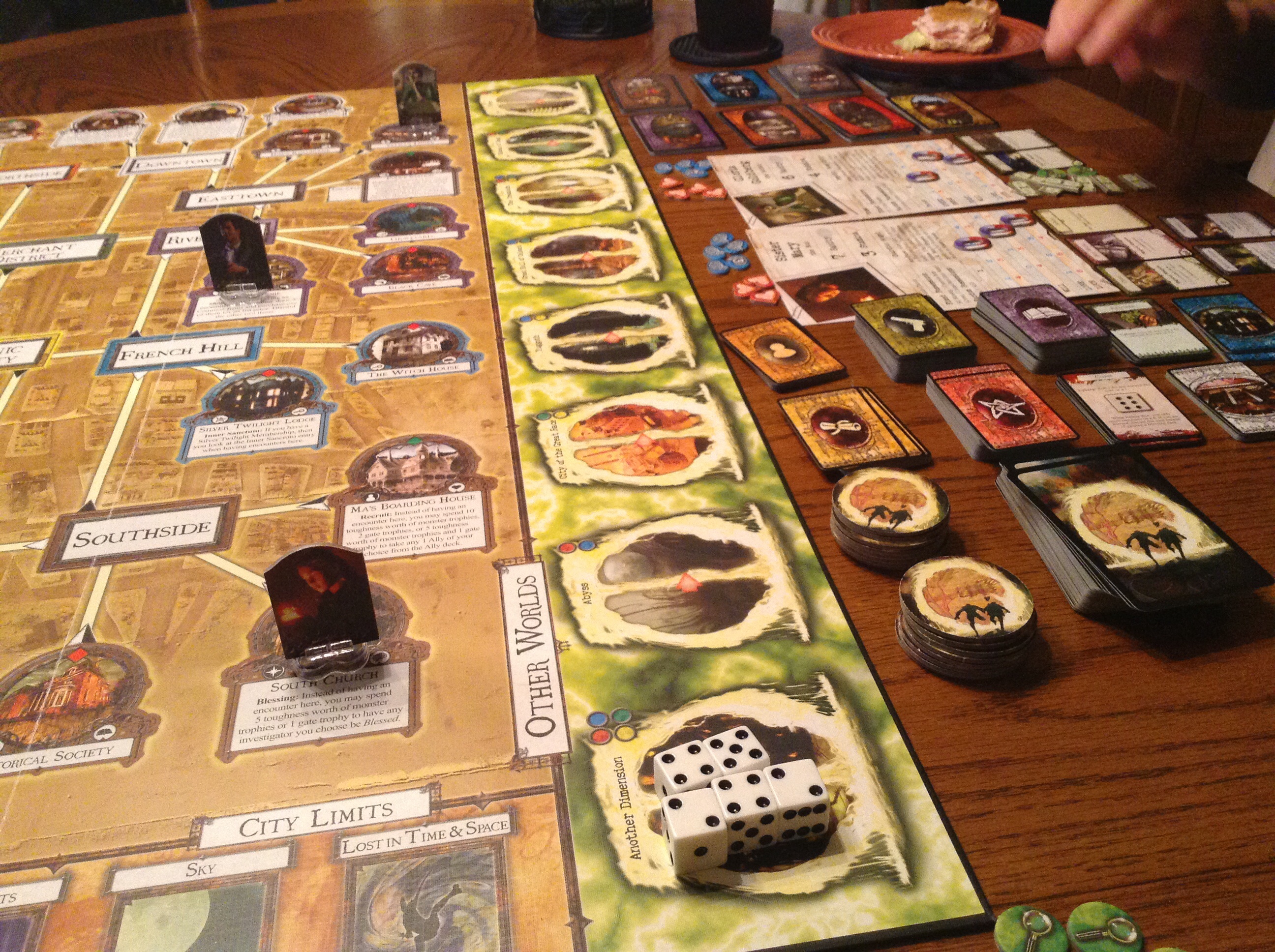
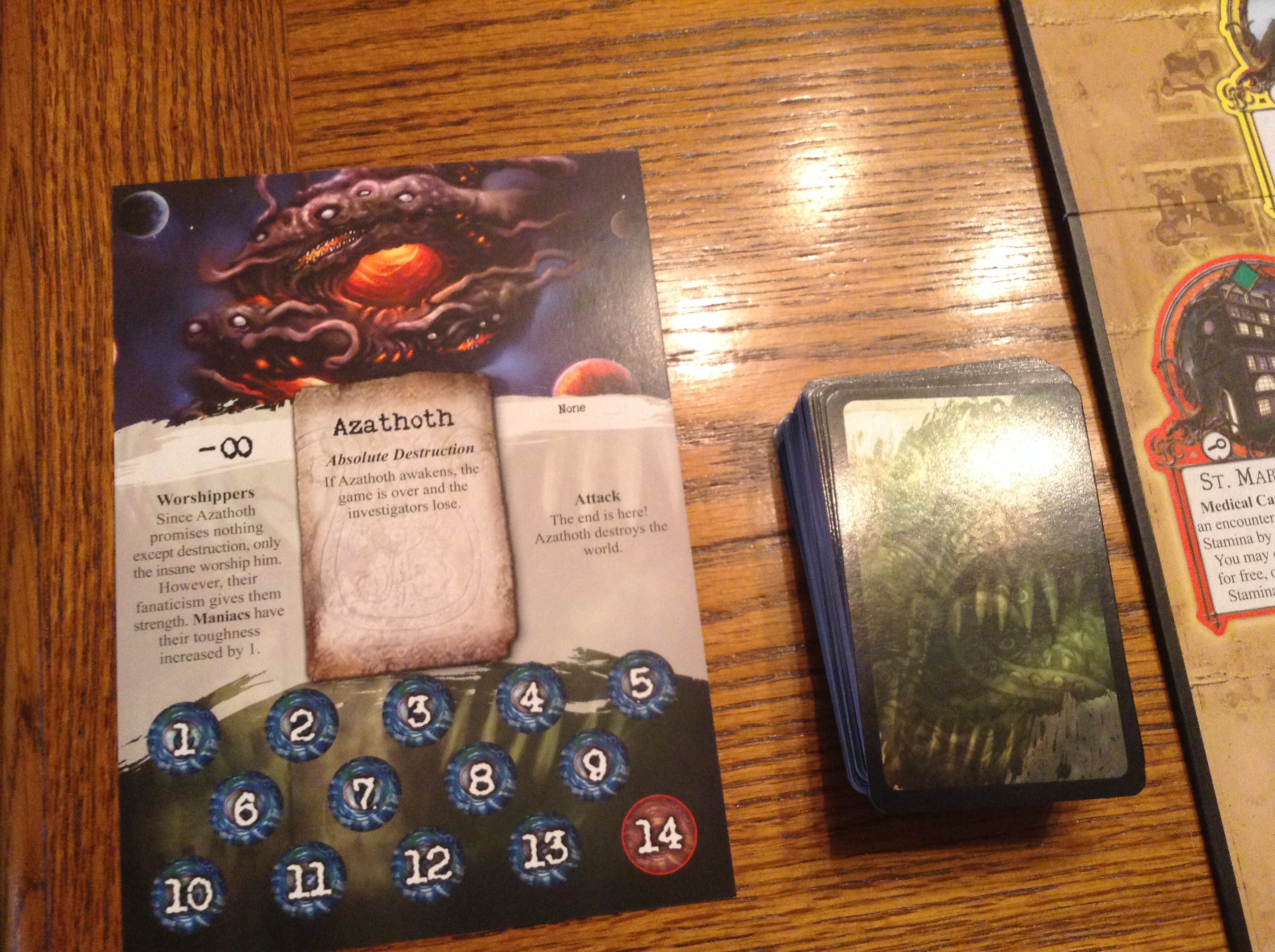
Dear reader, it should be by now well documented that the things I write about here seldom have anything less than monumental significance to the stage play of life. For my regular readers you will find the expected observed truths about the rest of the world laced within this article so it should not be expected that this is purely for entertainment or instruction on how to play a difficult, rules heavy role-playing game called Arkham Horror.The things that excite me are often categorized this way. Even the things I consider leisure fall into this summation. When I get a sense that something has some sort of metaphorical significance I become obsessed with plunging into its depths—and this holds true if the target is the literary works of James Joyce or some phantom relic from the past lost to time and space. CLICK HERE to review. In that regard I have made my affection for Fantasy Flight Games well known—it is a gaming company that was brought to my life through family members bridging my love of mythology with a need for adventure—and I have found with them a wealth of creativity and new ways of modern storytelling. One game in particular is of the type that I have to thank the owner of Nostalgic Ink and my grandson for putting before me. It was just the kind of thing I was searching for and has brought to my life a joy in discovery that nurtures my imagination and for that I am extremely grateful. Also of note I am placing throughout this article the instructional videos of Ricky Royal from the YouTube channel Box of Delights who poured an extreme amount of love into the creation of the following “how to” videos. By watching these videos he explains many of the rules and way to play Arkham Horror. I used these videos to get started and to make the decision to purchase the game. They are long, but very complete and well worth watching. The result is that my wife and I bought Arkham Horror on a Friday afternoon and did not stop playing it until midnight on the following Sunday. We were one turn away from closing the final gate when one of the characters I was playing was plunged into Time and Space letting the monster Azathoth loose to destroy the world. I was so frustrated that I wanted to put my fist through our kitchen table because we had worked very hard to position the game for a victory. But circumstances being what they were—time ran out—as it often does even when the best of hopes are the fuel behind endeavor.
We had played several games over the weekend and most of them ended with losses—the game is far from easy. In fact, it could be said to reflect life all too accurately even though the subject matter is about monsters and attacks upon mankind from other dimensions. I find the subject matter to be more accurate than a daily read of USA Today and ultimately more rewarding for the soul even in disappointing losses where all the best layed plans fall apart in the end. For a game it reminds me of Jumanji the old game from the Robin Williams movie—Arkham Horror not only takes place in the streets of the classic horror writer H.P. Lovecraft, it carries players into other dimensional planes of reality such as the City of the Great Race, the Great Hall of Celeano, R’lyeh, the Plateau of Leng and Yuggoth. It is often there that terrible things happen if players forget to adjust their lore or luck rating to deal with the type of things that typically happen during the “Other World Encounters” phase. Sometimes even if players do adjust their settings terrible things will happen anyway—just as they often do in real life so it is the task of the players to adjust and recover attempting to suppress obstacles with tenacity even when the situation feels hopeless.
The terror of the game comes not so much from the monsters which flood the game constantly throughout from each round as the Doom Track edges ever closer to the end where the Mythos Monsters present themselves from centuries of slumber to destroy the world and everyone in it, it comes from the lack of certainty that one has about what happens next—the constant feeling that the floor could drop out from under everyone at any moment. In this way Arkham Horror is like walking through a commercial haunted house that is dark and smoke-filled not knowing what might happen around the next corner. Visitors know that the monsters cannot harm them—but the terror comes from not knowing what’s coming next. In Arkham Horror the game designers obviously took great pleasure in making every stack of cards and every move a potential failure with very little rewards given to players.
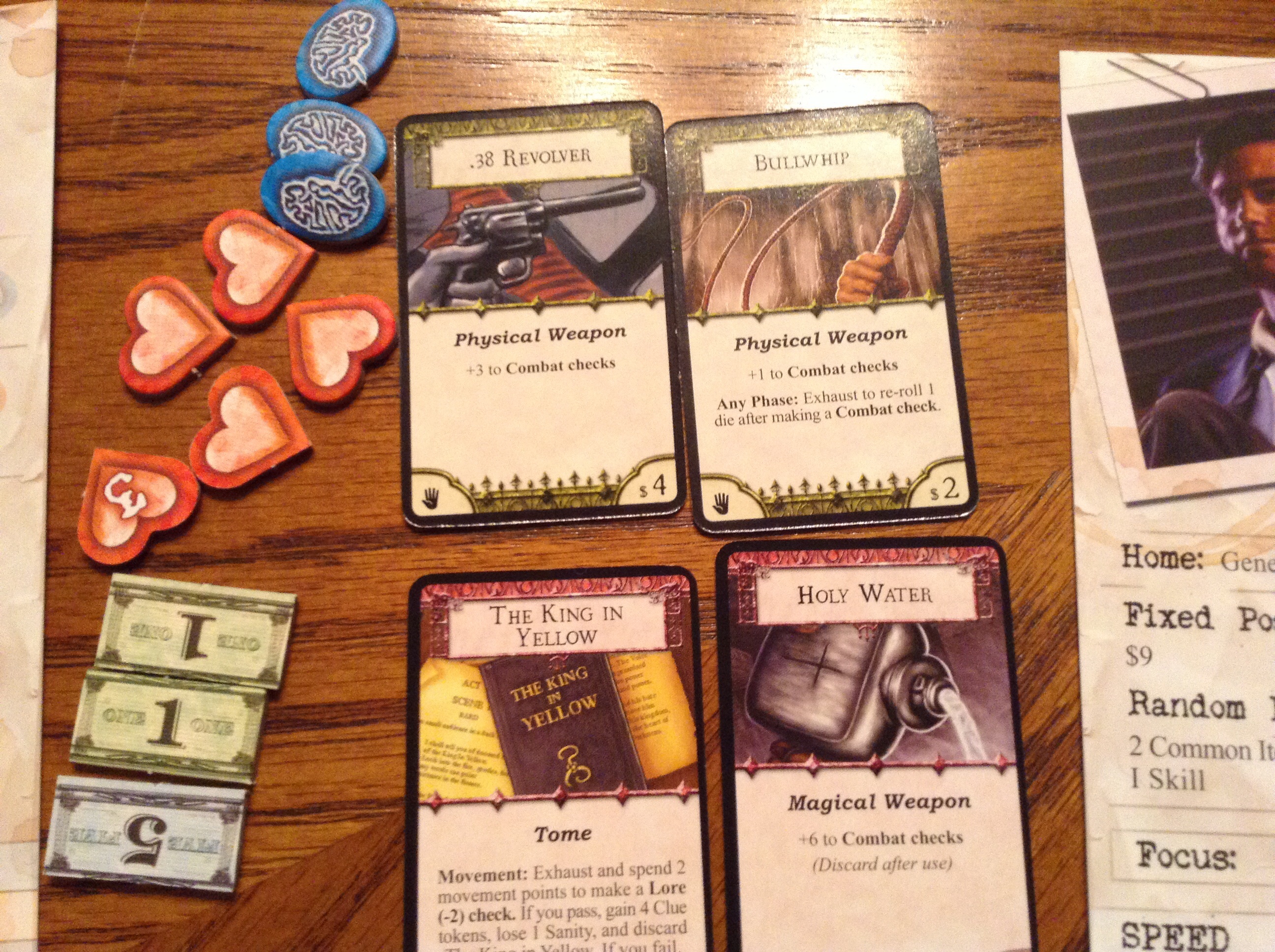
The rules of the game are vast. On its surface all things about Arkham Horror look simple, the game board looks not so much different from a Monopoly board, but this is very misleading. The game is layered with meaning and small printed text that takes the level of game play very detailed destinations. There is no way to just pick up the rule book and begin playing even for experienced Dungeon and Dragon players. The mechanics are very similar, but the depth must be understood before proper game play is even possible. For instance, particularly helpful items that will help win the game are Elder Signs which can be purchased from the Curiositie Shoppe as a “unique item.” Those cards are the most powerful in the game because they not only seal gates without having to spend clue tokens, but they take their seal off the Doom Track for the Ancient One holding off its arrival as a destroyer of the world. Other very helpful tips are alleys which can be recruited down at the boarding house, blessings which can be found at the church and Magick spells which can be purchased at Ye Olde Magick Shoppe that can hold off terrible Mythos cards revealing rituals. Combat weapons are purchased at the General Store as common items. It helps to have a couple of pistols to increase combat points up over +6 to +7 with buffed applications above and beyond the amount of fight on the character sheets. The reason is that each time a player encounters a monster—which is unavoidable—a horror check must be performed with “will” and will is connected directly to “fight.” So in order to have a high will typically it will cost fight and to beat a monster, both are needed. So the fight needs to come from weapons, not the skill bar as much as possible.
I think for me the most compelling, and terrifying aspect of the game is the “sanity” cost of certain tasks whether it be losing a horror check, casting spells—which often cost sanity—or random things that happen to characters that scare them into losing their mind. I am used to health points, and Arkham Horror has a standard health measure which is called “stamina” but balancing that out with the general mental health of the players is something unique. When the mind gets too beat up during the game sanity can be restored at the asylum—two dollars will completely restore mental capacity or a swig of a whiskey bottle will give a +1 boost. But the game takes place during prohibition so there are times that the police come and arrest anybody caught with whiskey in their possession—so it is dangerous to have such things.
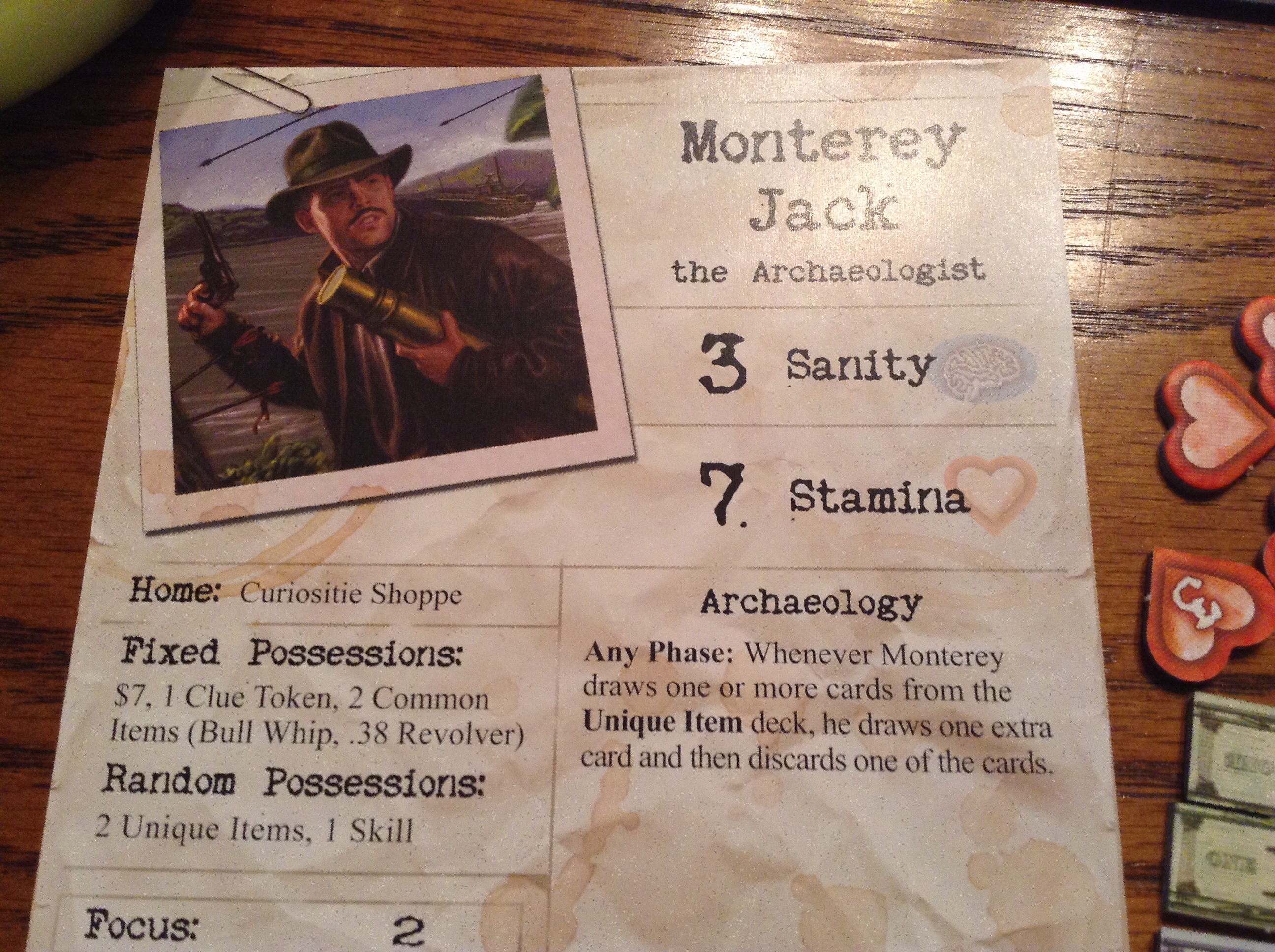
Hearing all this it might be wondered why anybody would want to play the game at all. That is where things get interesting in a very satisfying way. In spite of the horror nature of the game, it is actually an adventure game nicely mixing genres in a way that Poltergeist the movie did. As I was going through the characters I was very pleased to find a card named Monterey Jack who happens to be an archaeologist and has the fixed possessions of a bull whip and a .38 revolver—identical to Indiana Jones the film character. The game makers at Fantasy Flight know what makes a good adventure story and no matter how great Indiana Jones was, he still ended up tied to a pole during the opening of the Lost Ark, he was cursed by poisoned blood, burnt, tortured, and had spells of voodoo cast against him. He was captured many times and jailed and designated for execution by the Nazis and all this happened in just three classic movies. Arkham Horror is the kind of terror that was found in an Indiana Jones film and the best way to play the game is to roll with the punches and just keep getting back up and trying to win. Some of the best moments in Arkham Horror come from the characters running into clues from ancient secrets or stealing treasure away from terrible creatures deep in a slumber from some dimensional rift. Needless to say, my favorite character is Monterey Jack, the bull whip gives a plus one to a combat check but if you miss, you can use the whip to role again. So of course I have to play that character! It seems Monterey Jack was made by Fantasy Flight Games just for me.
The Indiana Jones films were inspired by old Saturday morning serials from the 30s, and 40s and those serials were inspired by the kind of publications that H.P. Lovecraft wrote for—the pulp magazines so popular in the 1920s and 30s. Indiana Jones was not original in the sense that he sprang from the mind of George Lucas but was rather a tribute to the kind of movies and stories he enjoyed as a kid. So it is only fitting that the makers of Arkham Horror paid tribute to Indiana Jones who was a product of the original H.P. Lovecraft stories. The game we see today started in the 80s as a different version of role-playing game similar to Dungeons and Dragons designed by Richard Launius called Call of Cthulhu. By 2005 Fantasy Flight Games purchased the rights and brought the game up to a level seen presently. There is a lot of love poured into the presentation that would have taken many hundreds of hours of game development and input by people who simply love all these genres, Indiana Jones, the literary works of H.P. Lovecraft and movies like Poltergeist. Arkham Horror is a very story driven game that looks like players lose more than they win. What is most intriguing is that you do not play against other players so much as you play against the Ancient One’s reemergence with the world from an awakened slumber. Players work together to fight the Ancient One and all its minions—and up to eight players can participate. The best way to perform this task is to trade items that other players might need like spells, or weapons in the streets of Arkham. To do this, items can be passed to other players as long as both players are in a street location and they are not in a combat phase with a monster.
About the Ancient One, there isn’t just one, but many. Of course the primary is Cthulhu but others include the Nyarlathotep, the Yig, Hastur and the Yog-Sothoth. To make matters even worse each mythos monster has its own worshippers among the land of the living. For instance, the Yog-Sothoth worshippers have powerful magical abilities giving cultists a combat rating of -1. Or the Sub-Niggurath worshippers have babies that roam the game board and all are given the “Endless” ability when fighting in combat. This means that players who kill these creatures cannot collect their hides to sell for money or items as a trophy—but are returned to the monster pool only to be drawn again when a gate opens. Reading through some of the text reminded me of the many real life attempts by Alistair Crowley and the Masonic rituals particularly on display at the Denver International Airport to appease unseen spirits to invoke supernatural benefit to their attempts at success in life. Many people are willing to trade their souls for successful help by spiritual aid and in Arkham Horror this is reflected in the sanity meter. There are many in the real world that clearly do trade away their sanity for a chance at victory even if it calls for the invocation of unseen forces. Arkham Horror deals with these types of things making it all too reflective or a reality we all know too much about—making this game even scarier because it dares to name an avoided truth.
It has been a long time since my wife and I played a board game all weekend long, but with Arkham Horror the depth was such that it was not hard. Before we knew it, 14 hours flew by on a Saturday and the sun had set. We resumed on a Sunday only to see the day fly by as well and midnight was indicated by the hands on a clock. Arkham Horror is like reading a great novel that you share with other people. Afterwards win or lose there is a feeling of an adventure that had just been embarked upon. Other players have complained that Arkham Horror feels too much like a hopeless enterprise because it is difficult to win and like the H.P. Lovecraft stories, bad things happen to the characters and no matter how smart or good you are at playing the game—there is a sense of fate that must fall in your favor to even have a chance at victory. But that too is reflective of life—all you can really do is position yourself for success and if bad things happen, you have to get up and try again even if you are cursed or find yourself driven insane or even lost between planes of reality. The adventure of life must trudge on or the world will be consumed by the evil, vile, intentions of an Ancient One striving to claim its hold on all of existence and everyone in it.
Arkham Horror is a fabulous game that is not just mere entertainment meant to pass time away, it is an experience that gives back much just by playing. It is well designed and certainly does what it set out to do—which is provoke thought. The random mechanics are not so overpowering that victory is impossible, it is just treacherously difficult like climbing a tall mountain, or running in a marathon. Playing Arkham Horror will never be the same game twice, but it will always be something that requires attention and care to detail. It is something that I’d call remarkable for what it does just like the game itself—working on many different levels. I am very pleased that my buddy at Nostalgic Ink pointed me to the game. I have spoken on more than one occasion about these gaming stores and how they are palaces of mythology with only one purpose in mind—feeding the mind of the curious. Stupid people do not wonder into stores like Nostalgic Ink to buy games like Arkham Horror. Lazy people would avoid the place like a plague. But in that store are treasures of really previously unimagined consequences, and they are popular enough to have a store of their own now instead of being an underground fad like Call of Cthulhu was for so many years previously. I have often looked at wonder at the games on the shelf in places like Nostalgic Ink and Yottaquest in Mt. Healthy, Ohio and wondered how or why those games are so popular with this newer generation. Granted, Arkham Horror even among hard-core gamers is a difficult game—but after playing it, I clearly see the appeal and am a fan.
Horror to be relevant as an art form must have some hook of reality to it before it can be considered effective. The best horror writers avoid topics that are so fantastic that they extend beyond belief. Among the best of the horror writers was a creation that John Keel would later term more scientifically as “ultraterrestrials” and that would be H.P. Lovecraft’s Cthulhu. This is a dominating creature that lives outside of human time and space pushing against a cosmicism of projected reality driven by limited human senses to manipulate the actions of the technically defined living being. In theory those who attempt to reach beyond their senses into that world of Cthulhu run the extremely high possibility of insanity as minds often fold over on themselves once they leave the boundaries of four dimensions. Cthulhu was a fictional creation by a writer who lost both of his parents to an insane asylum and had himself suffered tormenting dreams by strange creatures from a very young child. But like all great horror writers, Lovecraft’s Cthulhu has its roots into a reality we all understand—but fear to comprehend for many reasons. The mythology of Cthulhu allows human beings to explore those strange possibilities from the safety of their senses without plummeting over the edge of sanity into a realm they clearly are not ready for. It is in that realm however that my own eyes have always looked as the cause of much misery and defaults in living as the primary source of superstition and religion—and a barrier to the truth.
When talking about such things I prefer the term ultraterrestrial to reference the type of creatures that Lovecraft wrote about in his Cthulhu mythos which has taken on a life of its own since his death in 1937. The stories Lovecraft wrote were well ahead of their time as it has only recently been proven that there are more than 10 dimensional realities known to mathematics—and probably more. Lovecraft’s stories explored the possibilities of beings from those other dimensions visiting from their realms in ways humans could not—which was a terrifying prospect. It still is, and is why even nearly a century after his death there is a cult following of H.P. Lovecraft. The reporter John Keel seemed particularly obsessed with this type of reality and reported about it in The Mothman Prophesies. In that book Keel was very level-headed and factually based even though the subject matter was extraordinary—UFOs interacting with people, strange monsters appearing out of nowhere, Men in Black walking about dressed as government agents not quite appearing human—being slightly off to those who spoke to them. Keel in that book was knocking on the door to Lovecraft’s Cthulhu and it could be said that the Mothman of Point Pleasant, West Virginia, or the “Bird Man” of ancient Cahokia or the many thousands of gargoyles poised from the buildings of gothic structures—particularly the Budweiser brewery in St Louis—were there to appease the demons who come into our world to terrorize and manipulate our reality. Keel’s other books, Strange Creatures From Time and Space, Our Haunted Planet, Operation Trojan Horse, The Eighth Tower, The Cosmic Question, and Disneyland of the Gods are all works obsessed with this realm of Lovecraft’s Cthulhu. Keel had been opened to the possibilities before his investigations into the strange creature in Point Pleasant during 1967 and once there had everything confirmed as though it was tailor-made for him by what he would later call ultraterrestrials—or tricksters. Because of their power and influence he would spend much of the rest of his life all the way to age 79 when he died in 2009 avoiding any kind of electronic device such as computers, phones, televisions etc., because Keel believed that the “tricksters” used those devices to control and manipulate the world of human beings with impunity to counteraction.
As time went on Keel’s books became more and more paranoid, and his subjectivity diminished for a time as he appeared to have gone too far down the rabbit hole of sanity for a time. Perhaps not as far as Lovecraft’s parents did—but the rope to reality which Keel held on to was slipping. Toward the end of his life he regained some of his grip on reality. The 2002 film adaptation of his book The Mothman Prophecies appears to have helped him and he spent the rest of his days giving lectures as the film brought his ultraterrestrials with the help of Richard Gere into the mainstream.
I have personally noticed this manipulation of these ultraterrestrials by Keel’s definition for a long time. The lazy relegate their definition of ultraterrestrials as angels and demons but that has never suited me. I have never been comfortable handing over my fate to beings that just flash in and out of my life with some advice—or appear in a dream to leave an imprint of instruction for me to execute. If I had been Noah and God appeared to me in a dream telling me to build an Ark, I would have woke up the next morning and told him—“dude, I don’t have the time to build you a stupid boat.” And I would have ignored the command. When the floods came, I would have survived somehow regardless of the advice. My opinion is that unless the motives of such individuals from other worlds is known, there is no way to attribute value to them leaving you to play the part of a pawn. Without knowing those beings personally there is no way to validate if the sources are good or evil. My assumption is that they are almost always evil posing as good. So to properly serve the good in the context of universal merit, those beings should be ignored. In this way for years I have poked and prodded into their world without the usual fear of insanity because I simply don’t trust any of them even though they have constantly tried to throw me off the trail.
One night on New Year’s Eve my family was playing a late night game of Piratesthe Constructable Strategy Game. We were between rounds so as everyone got up and stretched I resumed to my living room chair to read another quick chapter of The Mothman Prophecies which I had taken an interest in after seeing the movie. In the book there was a surprising amount of coverage of UFO lore and as I was reading it I couldn’t help but wonder if Steven Spielberg had read this very same book to inspire him to write Close Encounters of the Third Kind and Poltergeist because this was the subject matter by the very fact based reporting of John Keel. I found the book terrifying refreshing and a key piece into a lifetime puzzle I had been assembling most of my life which attempted to define the world of Lovecraft’s Cthulhu. As I had conceived that very thought outside my front window clearly over the golf course was a UFO floating freely over the tree line. My first rational thought was that it was a helicopter picking up a crash victim, or maybe even some kind of pyrotechnic display celebrating the New Year. But it was just floating there enticing me like a seductive siren attempting to lure me into the hidden rocks in the choppy waters of the ocean. My children were in the kitchen so I calmly grabbed their attention and directed their sight asking them to identity what was there. They went through the same process I did, helicopter, fireworks—UFO. Once we realized that the strobe displays on the vessel did not look like anything Wright Patterson Air Force Base nearby could have put out—it was too large for a drone—and too lit up to be stealthy we put on our shoes to rush out and meet it. We piled into our car and raced down the road to intercept it as it was now moving slowly. We turned left onto a road about a hundred yards north of our home and saw the vessel floating over a home valued near a million dollars and the strobe lights flashed down upon it. I blinked to make sure my vision was not faulty and when I opened my eyes it was gone. I stopped the car, got out and looked to the north. The entire sky was filled with a blacked out vessel roaming northeast. The moonlight had been showing the outlines of clouds, but this vessel concealed them all. My kids saw it too and we watched as it was there moving toward downtown Trenton one moment covering the entire sky from our home, over the Miller Brewery all the way to Trenton. It appeared to be about 7 or 8 miles wide. Then within the blink of an eye, it too was gone. If my kids hadn’t seen it with me, I would have thought it to be an illusion, but it was actually much more sophisticated as other minds witnessed it simultaneously. Within 30 seconds of the encounter we were left wondering if we actually saw what we saw. I got out of the car and walked up to the house where the vessel had loomed over and they had lost power. Nobody appeared to be home at the time, but their internal lights had flicked back on and a computer in the living room that had been on was in a reboot phase. So something material had been there and it caused the power to drop then come back on.
We had seen our first UFO as a family and it was exciting—it certainly wasn’t our imagination. However, I was skeptical and not so sure that little green men came down from E.T.’s home planet to pick some flowers. Rather, I was thinking of Keel’s ultraterrestrials—or even more cynically something like Lovecraft’s Cthulhu. It was more than a coincidence that I was studying The Mothman Prophecies and reading about those exact occurrences at that particular moment. And out of all the years I had been alive I had never seen a UFO until that moment. I didn’t even have to leave my home to see it, the thing practically landed in my front yard to get my attention. But as soon as we could chase it down for confirmation and get our cameras turned on and toward the object—it was gone. My intentions as it was happening was to find a way to get on the vessel and pull one of the pilots off and capture it so I could conduct a proper investigation. I doubt that was the intention by the perpetrators—but that’s what was going to happen.
I did the same thing as I spent some time hunting for a Mothman one summer in the regions where sightings had occurred. I was determined to capture the creature and put it in a zoo dispelling any folklore about it with scientific fact. But the more I looked, the more obvious it was that I was not going to find it—it would have to find me because those things only appear in our dimensional plane of reality when they want to. Over time I concluded that the UFO at our home, like the Mothman hunting, was a creation by ultraterrestrials to bait me into insanity by feeding my curiosity and thus directing my thoughts on the matter into a direction they desired. The circumstances were just too perfect to be real in the context presented. After that event I had a lot more respect for John Keel—he was certainly on to something. And without question H.P. Lovecraft was as well. The reason his Cthulhu mythos is so terrifying and is still very much alive after a century of development is that deep down inside we know there is some truth to it. The fictional creation of Cthulhu is an attempt to put into mythology a reality that is difficult to otherwise deal with.
To a writer like Lovecraft who had been tormented by ultraterrestrial monsters in his dreams from a child to an adult constantly and lost both parents to insanity his philosophy of cosmicism is understandable. The philosophy of cosmicism states that there is no recognizable divine presence, such as a god, in the universe, and that humans are particularly insignificant in the larger scheme of intergalactic existence, and perhaps are just a small species projecting their own mental idolatries onto the vast cosmos, ever susceptible to being wiped from existence at any moment. This also suggested that the majority of undiscerning humanity are creatures with the same significance as insects and plants, who, in their small, visionless and unimportant nature, do not recognize a much greater struggle between greater forces.
John Keel had come to many of the same conclusions as Lovecraft when he said at the end of his book The Complete Guide to Mysterious Beings, “there are entities on this planet, and around it, that are far beyond all efforts to translate them into understandable cellular creatures. They are not real in the sense that we are animals motivated by sex and emotions. They are part of the energies that were scattered into space billions of years ago. Their intelligence is so vast and so ruthlessly inhuman there is no way for us to comprehend it or communicate with it as we talk to dolphins.” Keel would then propose twice in that same book, “Someone within two hundred miles of your home, no matter where you live on this earth, has had a direct, often terrifying, personal confrontation with a shape-shifting, unbelievable. (ultraterrestrial) Our world has always been occupied by these things. We are just passing through. Belief or disbelief will come onto you from another direction.” What Keel was talking about was essentially Lovecraft’s Cthulhu.
Charles Fort said in his 1931 book Lo! during the time of Lovecraft, “There may be occult things, beings and events, and there may be something of the nature of an occult police force, which operates to divert human suspicions, and to supply explanations that are good enough, for whatever (minds) human beings have—or that, if there be occult mishiefmakers and occult ravagers, they may be of a world also of other beings that are acting to check them, and to explain them not benevolently, but to divert suspicion from themselves because they, too, may be exploiting life upon this earth, but in ways more subtle, and orderly or organized fashion. In “The Call of Cthulhu”, H. P. Lovecraft describes the fictional Cthulhu as “A monster of vaguely anthropoid outline, but with an octopus-like head whose face was a mass of feelers, a scaly, rubbery-looking body, prodigious claws on hind and fore feet, and long, narrow wings behind.”[5] Cthulhu has been described as a mix between a giant human, an octopus, and a dragon, and is depicted as being hundreds of meters tall, with human-looking arms and legs and a pair of rudimentary wings on its back.[5]Cthulhu’s head is depicted as similar to the entirety of a giant octopus, with an unknown number of tentacles surrounding its supposed mouth. Cthulhu is described as being able to change the shape of its body at will, extending and retracting limbs and tentacles as it sees fit.” This description is remarkably like the Mothman and is a creature of imagination brought to life through the reality of some ultraterrestrial shape shifter which is a trick as old as time.
Many of the cultures of times past as in the present which call for sacrifice to bring about something desired must point their superstitions toward these creatures. Not surprising those who attempt to map out that realm of the ultraterrestricals even in a fictional sense—such as the Cthulhu end up dead. Lovecraft died by the age of 46 and many who go down a similar path end up in the same state. Looking into that other world brings upon the cells of the human body an undoing which prevents living. I too have seen this as most notably reflected in my personal UFO story. There have been many times when shape shifting entities made their entrance onto the stages of existence and did just as Charles Fort stated—“policed” the explanations of reality to suit their desires. But if an inquiry into the other realms goes too deeply, then death is soon to follow. Sometimes it’s not even by deliberate attempt. Every year, roughly 15,000 people vanish under the most incredible circumstances, again according to John Keel’s studies into the matter. “A family man steps into his backyard to mow the lawn. He is never seen again. A waitress steps out of a restaurant to put a dime in the parking meter and disappears forever. A family of five in a suburb melt into nothingness, leaving behind all their cloths, bank accounts, the family car. We have dozens of puzzling cases in our files.” (Keel’s files) These Cthulhu stories by Lovecraft are terrifying—because they are grounded in a reality we are aware of but dare not probe.
Most people are happy to carry a lucky rabbit’s foot, avoid unlucky associations, or pray to a deity to navigate through the minefield of the ultraterrestrial traps. I have seen the attempt firsthand to divert my own attention obviously when doing an investigation by having those same beings throw me a bone as a UFO flew outside my front window to take me in a direction of inquiry they approved of—a classic case of misdirection. Entire societies have adopted the notion of sacrifice in substitution for productivity to essentially satisfy their unconscious appeasement of these metaphorical Cthulhu’s which loom like gargoyles over charity events and suck off the vanity of opulent socialites and the perfume bathed on to cover the smell of their decaying flesh. From the darkness of other dimensional realities our world is observed and manipulated to suit the needs of the ultraterrestrial, not our own as the strings of many living marionettes are tied to the fingers of an actual Cthulhu.
But unlike Keel and Lovecraft I do not believe the human race is destined to be meager insects in comparison to the cosmos. I believe in the thin veil of cosmicism but do not believe that the Cthulhu type creatures residing there are superior to the human being. If they were, there would not be all these elaborate tricks, like UFO’s landing in our front yards, or strange stories to captivate the tabloid lover in all of us—to keep us distracted and thus sacrificing to these gods of the unseen. Their tricks only have power of the one way mirror for if they enter our reality with us, they discover they have no real strength—only the ability to scheme for their own ends as a competing organism. And that goes for any entity in the universe—if they were so bold and audacious, they would not avoid direct contact and hide behind curtains of dimensional reality. So there is nothing really to fear from them once it is understood that they gain all their power and terror from dwelling in the unknown. But science is taking human beings into their realm whether they like it or not—and once we are there—there won’t be anywhere for them to hide any longer. They are not to be feared, but to be conquered and the way to beat them is to remove the concept of sacrifice from the human landscape. They obtain their sustenance off the emotional energy of the human race by a means not yet discovered and require misery, fear, and death to fuel their own existence.
Good horror touches these known truths—these deep suspicions we all have that just walking out to the mailbox may be the last time our bodies inhabit the earth. We all know someone who has suffered from paranormal experiences yet nobody discusses it because we feel the breath of the Cthulhu on the back of our necks. We try to counsel ourselves that the breath we feel is God and we seek to appease him with more sacrifice at churches, or financial donations and our prayers, but deep down inside we suspect that God is really a Lovecraftian monster ready to yank our lives from our bodies and consume it like a snack on Superbowl Sunday. So we don’t name the evil for fear that it has power over us, we don’t talk about it with others for fear that we might be discovered betraying our overlords. But those beasts have no real power—only the ability to operate from concealment. Cellular attacks can be countered, diseases overcome, and mental breakdowns—alleviated by a strong—well-read mind. If one is playing the Arkham Horror game which is a Lovecraftian journey I said weeks ago that I would take because of the nature of it, the characters of Harvey Walters and Sister Mary who both have a sanity of 7 would be the type of examples I’m refereeing to. I like Harvey and would like to teach everyone to be more like him so that they could have a proper defense against the Cthulhu terrorists of inter-dimensional sacrifice. But man’s fate is not destined to yield to these creatures, rather the other way around—which is the big secret they don’t want you to know about dear reader. The human mind has the power to create these Cthulhu monsters—but it can also destroy them. The reality of the horror of the Cthulhu is that they cannot match the productive enterprise of human imagination and effort. With those efforts the driving force of humanity, the Cthulhu has no defense leaving the ultraterrestrial empire without armament in a war that is as old as time. It would be my position to teach people how to make those Cthulhu into pets instead of Gods and the horror of their imprint into a children’s story.
Taking a break from the usual heavy subjects explored at this site I have to say more about a company I have highlighted often in America who I think is having a major impact on world culture. This is not a movie company, a video game developer or even a traditional television broadcaster—it is Fantasy Flight Games who again appear to be at the absolute top of their field. I was at my favorite game store—Nostalgic Ink, in Mason, Ohio buying my son-in-law some expansion ships for our X-Wing Miniatures game which is a Fantasy Flight creation which I have raved about often. I had my grandson with me so he wanted to walk around the store looking at all the other products, which I of course allowed him to do. While looking elsewhere in the store I ran across the Fantasy Flight Game Arkham Horror which looked fabulous and further impressed me with what Fantasy Flight has been doing in the realm of gaming.
These types of games are a participatory mythology—meaning they allow players to jump into a scenario and live the values of a mythology. These games unlike everything else in society are all about recognizing value instead of evading it—so there isn’t any escape from the process of assessment. I wasn’t a fan of these kinds of things until my nephews and son-in-law brought them back into my life last summer while on vacation. While I don’t enjoy traditional board games like Monopoly and most of the games on the Target gaming shelf dealing with contemporary matters, I do love these mythology based games in that they are like novels lived in the field of time and space which have uncertain outcomes.
The Arkham Horror game attracted my attention because it deals with the Roaring Twenties and involves horror, monsters, and ancient secrets. Of course it is this time period I love which featured near perfect capitalism and a wonderful President in Calvin Coolidge, so the time period itself is interesting as a backdrop for such a story. At Nostalgic Ink we were in a time crunch so I didn’t buy the game as of yet, but I will at the next available moment. It plays up to eight people in a cooperative play which would do well in my family. We had a birthday party for that same son-in-law who is very skilled with these games. It’s impressive to watch him. At the party several groups broke off and played games, some in the house, some outside set up around the pool, some out under a shade tree. One of the games was Magic the Gathering which I’ve seen quite a lot, the other was my son-in-law’s new Game of Thrones card game again by Fantasy Flight Games. I watched a bit of that game and again it was another amazing creation by Fantasy Flight with the usual quality in game pieces and such detailed manuals, card design, and even box artwork.
I had been wondering if Fantasy Flight was just freakishly good at game design with their X-Wing series—because it’s Star Wars and thus sells well. But after seeing what they did with the Game of Thrones card game I’m convinced that it is just the nature of the company. Any doubts I had about buying The Arkham Horror game evaporated in that instant. The gaming that night at our house went well into the night well past the time my wife and I went to bed—so my family would love Arkham Horror.
During a typical day when things sometimes seem overwhelmingly difficult—and impossible—I take a minute and visit the Fantasy Flight Games website to see what’s going on new—which every day appears to be something. I enjoy reading the game forums for X-Wing and it actually relaxes my mind. This is distinctively different from the typical escapism, evasion tactics of something like a baseball game, or Fantasy Football—which does similar things for a more mainstream audience. For me, and my love of mythology, these games are just marvelous.
Walking the aisles at Nostalgic Ink the owner does a great job of displaying all his vast collection of games—most of them are like these Arkham Horror, and Game of Throne games. These are different from traditional board games like Life, Candyland, or card games like Uno. They have the added element of plot and story to accentuate the randomness of a dice role—and are quite intriguing. If I had time, I’d like to play one of each kind of game in Nostalgic Ink. My grandson not yet two years of age already understands that there is something special about the place, he enjoys the colors on the boxes displaying all the bizarre artwork and wanted to look at everything. It’s a very stimulating atmosphere much like how book stores used to feel minus the references to popular culture—which is often distracting when you need a break from it.
It cannot be ignored that people who play these types of Fantasy Flight Games enjoy thinking. My son-in-law certainly embodies that trait—he loves to think and in the realm of those games—is a maestro. But what’s better is the plot and advancement of intrigue that makes the experience like a shared novel. In a high-tech age such as what we live in now, it is just wonderful to see such a low tech—creative—and traditional format of storytelling that has emerged as powerfully as Fantasy Flight Games has done over these last few years. I was already a fan because of their X-Wing Miniatures work, but their efforts don’t end there. It is unlikely that I would have ever stepped into Nostalgic Ink if not to purchase my first B-Wing fighter in the September of 2013. Since then, I have been there often and now find myself going there to primarily buy gifts for other people. But for me X-Wing Miniatures has been a gateway to the rest of the Fantasy Flight Games product line. It is what they are doing now that will still have meaning many years from now when I want to play the same games with my future grandchildren and other family members who will grow up to love those games. I remember the kind of things I loved growing up and to a large extent, I still love those things. Video games and tech related entertainment has a dated feel that cheapens those experiences over time as improvements come out in future years. But these Fantasy Flight Games products will still have the magic of their appeal hundreds of years from now because the root of their effort is in the great presentation of their material– the invocation of thought as their mechanism into story telling. And it is in the stories of our society that the truths we all seek reside—whether realistic, or fantasy based, it is the process of thought which the human race most seeks. And Fantasy Flight Games has their pulse on the importance of thought—and that makes them for my money one of the best companies on earth creating one of the most important needs humans have aside from food and clothing—mythology.