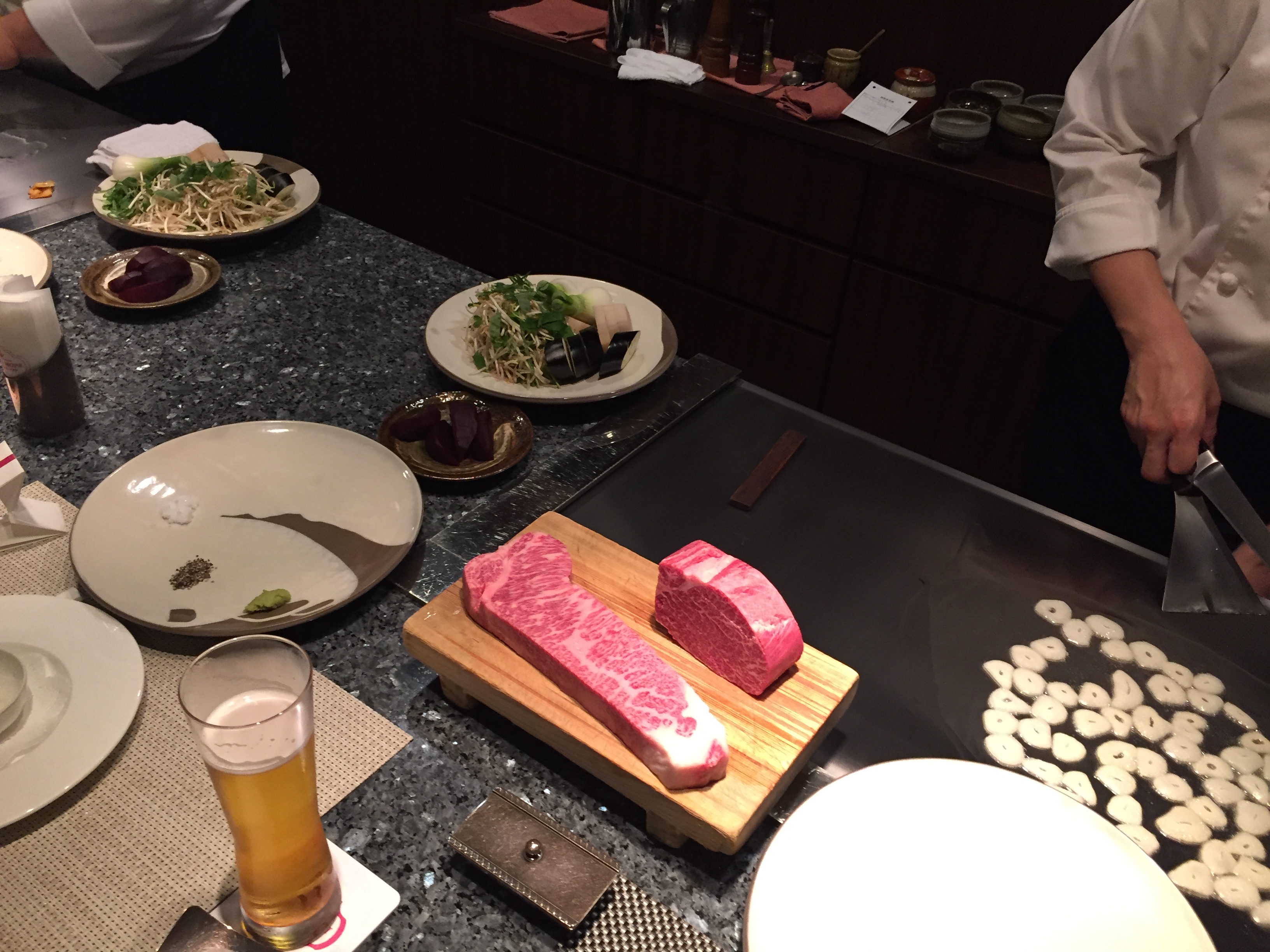
Occasionally, after a lot of hard work I enjoy indulging in a nice steak to sort of put an explanation point at the end of a sentence. It’s kind of like spiking the football after a long drive toward a touchdown. It’s the appropriate thing to do. In the normal course of things that for me involves either Jag’s Steakhouse in West Chester, or the Rodizio Grill at Liberty Center. When at Jags I typically get the Big Oscar Fillet to serve as that ceremonial spike. Executive Chef Michelle Brown at Jags knows just how to do it all right and the food quality is always consistently high, so when you are celebrating a personal victory—that’s the place to do it. But I am open to new experiences and I will give a new place a chance when the occasion provides. It just so happened that I was in the neighborhood of Mouriya Steak in Kobe, Japan as there was a reason to have a good steak so I had dinner with some very hard-working people who all deserved some fine food.
I had been hearing with an ear toward skepticism that Kobe Beef is the finest in the world—and the most expensive. My thoughts then and now were that anywhere that there is a restricted market and a gigantic supply need around the world, of course the price would be high—but that most of the mystic was generated with perception, and not actual quality. So I was impressed with the Mouriya Steak House and their very exquisite detail to the quality of the experience. The bottom line is that I had a very good steak—and I considered it a rare treat. I have had Kobe Beef at other places around the country, but learning more about it, I am convinced that they were all fakes. The real deal was quite extraordinary. The meticulousness under which the beef is purchased by each steak house was something I couldn’t help but admire, but it was the delivery of it to my plate with all the love and care of the finest specimen on earth that captured my respect. If having a steak is equivalent to a much deserved football spike in an important game, this Kobe steak was equal to scoring a touchdown, with no time on the clock, on fourth down, in the Superbowl. It was a treat to say the least.
Kobe beef is also called Kobe niku (神戸肉?, “Kobe meat”), Kobe-gyu (神戸牛?) or Kobe-ushi (神戸牛?, “Kobe cattle”) in Japanese.[1]
Cattle were introduced in Japan in the second century as work animals used for rice cultivation. Because of Japan’s “difficult terrain and sparse arable land” due in part to its mountainous topography,[2] cattle were bred in small, isolated regions, yielding herds with unique qualities in their meat.[3]
After the Meiji Restoration, beef consumption remained low, but it has steadily increased since the end of World War II. Kobe beef grew in popularity and extended its global reach in the 1980s and 1990s.[4]
In the late 19th century, native Japanese cattle were interbred with European breeds, including Brown Swiss, Shorthorn, and Devon.[citation needed] The cattle originally recognized in 1943 as “Kobe beef” were cattle from herds in the Kobe area of Japan, and could be any of four breeds of Wagyu cattle—Akaushi (Japanese Red/Brown),Kuroushi (Japanese Black), Japanese Polled, and Japanese Shorthorn.[5] Tajima is a strain of the Japanese Black, the most populous breed (around 90% of the four breeds).[6][7]
In 1983, the Kobe Beef Marketing and Distribution Promotion Association was formed to define and promote the Kobe trademark. It sets standards for animals to be labeled as Kobe beef.[8]
In 2009, the USDA placed a ban on the import of Kobe beef to prevent the Japan foot-and-mouth outbreak from reaching US shores. The ban was eventually relaxed in August, 2012 to allow limited amounts of Kobe Beef into the country but regular shipments didn’t resume until March, 2013.[9]
The increase in popularity of Japanese beef in the United States has led to the creation of “Kobe-style” beef, taken from domestically raised Wagyu crossbred with Angus cattle, to meet the demand. Farms in the United States and Britain have attempted to replicate the Kobe traditions.[18] From the first Wagyu cattle imported in the 1970s, 150 US ranches now raise “tens of thousands of Wagyu cattle”.[19]
The meat produced by these cross-breeds is different from the “authentic” Kobe beef, though this is “often by design”, due to the perception that American palates do not actually want the richness of Japanese beef and would prefer a more familiar flavor profile.[6] Some US meat producers claim any differences between their less expensive “Kobe-style” beef and true Kobe beef are largely cosmetic.[20] Cuts of US “Kobe-style” beef tend to have darker meat and a bolder flavor.[21]
In Europe, UK grocery retailer Asda, owned by Wal-Mart, introduced Wagyu beef at the end of 2011 under its Butcher’s Selection line using meat from a herd in Yorkshire, “bred from Holsteindairy cows impregnated with Wagyu semen“. This not only made the beef more affordable, but it also resulted in less marbled meat more familiar to UK consumers.[2] In June 2014, the German discounter Aldi announced that it was going to introduce Wagyu beef steaks, “with every store receiving a limited number of 50 steaks, priced at a very competitive £6.99 for an 8-oz (225-g) sirloin and rib eye“. However, Aldi’s Wagyu beef was sourced from New Zealand, where the exclusively grass-fed cattle are allowed to roam, more in keeping with changing norms around animal welfare (in Japan cattle are “confined in small pens and given much more energy-dense feed”).[2]
The proliferation of beef outside Japan marketed as Kobe beef is an issue for Kobe beef farmers. Due to a lack of legal recognition of the Kobe beef trademark in some countries, it is possible to sell meat that is incorrectly labeled as Kobe beef.[22][23] The Kobe Beef Marketing and Distribution Promotion Association planned to publish pamphlets about Kobe beef in foreign languages.[24]
Mouriya’s Steak House Special Selection was the superior quality beef less than 32 months old. They have never given birth, and come from the bloodline of Tajima Cow that is the original family of Kobe Cow. They have been steadily reproduced without close-cross and they grow up in the Mouriya’s contractual ranch in Yabu City, Tajima Cow’s hometown, eating the same fodder that the pure blood Tajima cows eat in the same cowshed; and the taste and relish of the meat are as wonderful as the Kobe Beef. Needless to say, the taste of Kobe Beef is marvelous, but the shortcoming is high price. (Recently, the price has risen again.)
Tajima Cow is the ancestor of Kobe Cow. The name “Kobe Cow” does not mean species or category, but is the name of the brand. Original Tajima Cows that have passed the standard, i.e. those raised by the registered cattle farmers in the list of the Kobe Meat Promotion Association, those slaughtered at the specified Meat Center in Hyogo Prefecture, and those that are ranked A and B, and the BMS value (numerical value that shows marble condition of the beef) is more than 6 are called Kobe Cow.
To start with, Tajima Cow used to live in the country of Tajima (presently northern part of Hyogo Prefecture) as shown by the name eating the wild grass that grew in abundance with clear water in the clear air. The meat of Tajima Cow has been originally good quality, and has become the wonderful brand through cattle farmers’ zeal in raising them as the beef cow. Moreover, the obvious difference comparing to the brand cows in other prefectures is keeping blood line inside Hyogo Prefecture avoiding hybridizing with other ones. This system of maintaining the pure bloodline has been employed only by Hyogo Prefecture’s cattle farmers in Japan. The Kobe Cow and Tajima Cow are basically small, so the beef is fine and not fatty, as well as the relish and flavor are delicious.
While eating the Kobe Steak I couldn’t help but think of the cow and the way the beef was created. In the United States PETA would have had a fit, but they’d be unjustified. These cows were born and raised to be served to people of thought, to make hard-fought victories of economic expansion taste just a little bit better. That type of activity is far superior to just having a cow standing in a field eating grass. It reminded me yet again of how too much emphasis on the wrong type of regulation can stifle a business, whereas part of what made the Kobe Beef so good was the excessive yearning for quality that the farmers pushed for—to satisfy that market demand.
It had been a hard week so the steak was the best way to cap it off. Sometimes it’s the little things in life, sometimes it’s the big ones. And sometimes it’s just good to be surrounded by wonderful quality for a few hours and take a deep breath. Mouriya Steak House is the kind of place that gives you all three experiences at the same time, and it was certainly worth the expense. But then again, life is too valuable to waste it on nonsense—and Mouriya Steak can’t be accused of that.
There were times when Glenn Beck was on Fox News from 5 to 6 PM where I thought he was doing his shows directly off my blog material or that he and I were intellectually tied to some cosmic root. But he was a fighter back then obviously ahead of the curve. He’s not held up well over the last five years. The constant beatings it takes to be at the front have harmed his health and eroded his intellect. I have heard him say some really dumb things over the last few weeks as it has become obvious that Donald Trump is going to remain the front-runner of the GOP. Beck has lost a lot of ground over the last year, starting with his declarations of being done with the GOP, and the NRA over endorsements, then lately turning around and saying at a Ted Cruz event that he’d rather support the socialist Bernie Sanders over Trump. I used to listen to The Blaze everyday so that I could hear my buddy Doc Thompson each morning. I’d stick around and listen to Beck afterwards sometimes, but with all the Trump hatred as the months have went on it has just turned me off to Beck. I think the hatred Beck has toward Trump runs far deeper than anybody knows and for reasons nobody would suspect. But Beck has done this to himself. It makes me sad to see, but he clearly has put himself on the wrong side of history. Here’s a little what Beck said earlier this past week in regard to Trump and Bernie Sanders while endorsing Ted Cruz for president.
BECK SAID HE HAD NEVER ENDORSED A PRESIDENTIAL CANDIDATE IN HIS 40 YEARS OF BROADCASTING, BUT HE MADE AN EXCEPTION BECAUSE OF THE URGENCY OF THE MOMENT…
…HE SAID HE EVEN PREFERS SEN. BERNIE SANDERS (I-VT.), A SELF-PROCLAIMED “DEMOCRATIC SOCIALIST” RUNNING IN THE DEMOCRATIC PRESIDENTIAL PRIMARY, TO TRUMP.
“HONESTY, FAITH AND TRUTH ARE BASIC REQUIREMENTS. AND QUITE HONESTLY, I HAVE TO TELL YOU, THIS PROBABLY ISN’T GOING TO GO OVER VERY WELL, THAT’S WHY I LIKE BERNIE SANDERS,” HE SAID. “BERNIE SANDERS IS LIKE, ‘YEP, I’M A SOCIALIST.’
“I CAN ACTUALLY SIT AT A TABLE WITH A MAN WHO SAYS, ‘YES, I’M A SOCIALIST, AND YES, I DON’T LIKE WHAT WE ARE DOING, WE SHOULD BE MORE LIKE DENMARK,’ ” HE ADDED
Going back to Beck and I, there have been many times over the last five years where our paths have crossed a bit but either my reluctance or his prevented the next step. My friend Doc Thompson works for Glenn Beck. I have promoted Doc for several years now and The Blaze when it first announced its radio programming—which I think is good, especially in the beginning because I wanted Beck to find success. There were even a few phone calls about going to Dallas and working some projects at Beck’s studio there. This is all before Trump announced his presidency of course. There was something about Beck that was making me weary—almost like he was comparable to the Jim Jones cult with him as the central figure. I’d listen to Doc talk about working at The Blaze, which he loves, but something just seemed wrong about it, so I never took the next steps of discussion.
I think it’s fair to say that I have extraordinary judgment. I can read body language extremely well. I can detect tonal inflections and get to a truth behind words, and I can see way out in front of the train if you know what I mean. So I tend to trust my instincts on all things. There is a reason that I peeled back my support of The Blaze over the last six months. I listened to their Trump bashing for several months every morning and gradually I realized they were off the mark. All this Christian stuff has gone to Beck’s head and ruined his mind—likely a byproduct of his serious illnesses that he has been dealing with until last year. It has changed him and taken the fight out of him. He’s not the same person he was when he had a dominant Fox News audience that was ruffling the feathers of Bill O’Reilly. Beck was pumping out New York Times bestsellers every few months and everything was great.
I thought it was good that when he was fired from Fox, essentially for going after George Soros, that he got back on the horse and started his own network and movie studio in Dallas. But there was something missing in him that was noticeable. He had lost his will to fight, which was obvious. He had been beat down and was living off his earnings. But he wasn’t the same guy. He evolved from an Ayn Rand type of advocate to just another religious type leading a congregation. He didn’t impose his beliefs on other employees of his at The Blaze, but he certainly set a standard. What is certain is that he stopped fighting and become much more reconcilable toward the enemy.
I think the reason he and I never hit it off in spite of our mutual connections is that he’s a pacifist and I’m not. I’m all about conquering the enemy and using The Art of War to do it. I love to fight, I love aggression, and I get bored with peace. I don’t want his Christian nation. I like the values, but I love conflict and I would be bored to death in Glenn Beck’s America. I don’t want Abraham Lincoln as president, and I think George Washington was too middle of the road. I personally love people like George Patton as opposed to George Washington. I could have worked with Beck, but I don’t think he could have worked with me. He has become used to being the center of attention and that’s impossible to do around me, so I and he went in very different directions. Doc Thompson tried more than once to reconcile that, but knowing Beck was involved just robbed my ambition for an opportunity. I determined through observation that Beck was on a sinking ship. I hoped to be wrong, but of course I’m usually not because I do read situations with great clarity—no matter how controversial.
Along comes Trump and he’s all about fighting so naturally I support people like him over pacifists and obviously this has effected Beck. His audience has been split in two, some were happy to follow him and others moved in my direction for similar reasons. Beck used to do the work Trump is doing now-but the New York billionaire swept in and took that audience quickly, and maintained it since. The same type of people who showed up to Beck’s rally in 2010 in Washington has gravitated to Trump. People who loved the religious aspects of Beck’s work have stayed with him, but a lot of former Beck people have moved to Trump because they want a fighter, not a crier.
What I hear in Glenn Beck is a man jealous of Donald Trump. Beck lost a large portion of his audience to Trump and now he’s throwing a fit. When Beck was in his prime, 2010 to 2011 a lot of people were willing to overlook his past with drugs to hear the message he was speaking at that moment—and those same people are willing to give Trump the benefit of the doubt. But Beck was showing the signs of wear even in Wilmington, Ohio where I was in the cold of winter just shy of Christmas. I went there to meet Beck and to post video of the event up on The Blaze website with Scott Baker. What I saw was a man running out of gas. I didn’t want him to of course, but he did a few years later. He couldn’t handle having his family harassed in New York City, he let Soros run him out-of-town and he hid among Texans hoping to recapture his former glory. I am grateful that Beck hired my friend Doc Thompson and that he started The Blaze Radio. But it is obvious that Beck lost his will to fight in the middle of a major battle, and that just isn’t forgivable. As nice as it is to think that Beck is doing the work of God—the Devil has just as soothing of a voice in the middle of a nightly dream of divine inspiration. You can’t know who to trust especially when it comes to spiritual matters, and I don’t trust a pacifist who puts down their arms in the middle of a fight–I don’t care if God gives specific instructions through revelation in a dream. I would question God 100% of the time—and Beck is instead on his knees asking for guidance. That is not my kind of guy. A warrior must be decisive and ruthless when it comes to the enemy—and be willing to use all tools available to destroy the opposition. Screw all this brotherhood crap, and understanding. The enemy must be identified and destroyed. End of story.
Trump knows what he’s doing and where he’s going. A lot of what Beck is criticizing Trump over; there were plenty of people accusing Glenn of the same kind of stuff when he was at the front of the fight. Now that Beck is doing that against Trump it comes out sounding like a jealous has-been instead of someone who is capable of winning the fight at hand. In the end, I trust my own judgment and before Trump came along I could see that Beck was in trouble over something in his head. I still like the guy, but he’s just not the kind of fighter I can support—so I felt sorry for him putting himself on the line like he did with his Cruz support. He’s just not seeing the real fight—and I really thought he was smarter than that. A lot of people think that Trump is going to turn out to be a gigantic Trojan horse of progressivism and that he’s like Emperor Palpatine from the Star Wars movies. People, I’m smarter than that. I don’t fall for false prophets and spiritual utterances that come from who knows where. I can see things way out in front and I’m right most of the time, and I’m sure I understand Trump. Abraham Lincoln and George Washington are not enough for me—I want better and I don’t see many people with their hand up. Especially not Glenn Beck. Ted Cruz is a good guy, but he’s not right for this job at this point in time. As I’ve said before, I think Ted would be great in 2024 but not in 2016. For this election, we need a fighter—a vicious one. We need a George Patton not a pacifist who nearly lost the fight of the Revolution in Valley Forge during a hard winter looking for luck to come as divine providence. That makes a nice child’s story and it may happen from time to time by default. But my money goes on the guy who is willing to take on anybody at anytime and never wears down. I don’t wear down and I expect people I elect to office to reflect my work ethic. Beck is functioning from the wrong values. And it has cost him dearly. He is hiding his jealousy of Trump behind divine conviction—which is a ruse that his immediate supporters may not see—but to me it’s as plain as day at noon against a cloudless sky.
The Socialist Agenda is the multi-platform communication project of the Socialist Central Committee, Ltd. The project opposes the ultra-conservative political insurgency. The project reintroduces socialism to America’s mainstream voters.
CITIZENS UNITED V. FEDERAL ELECTION COMMISSION
Argued on March 24, 2009 and Decided on January 21, 2010, the United States Supreme Court held that the First Amendment prohibited the government from restricting independent political expenditures by a nonprofit corporation, more specifically – by a Political Action Committees.
SOCIALIST CENTRAL COMMITTEE, LTD. WAS ESTABLISHED.
Anticipating the outcome of the Court’s decision, a select group of socialists in Indianapolis established the SCC as a political action committee (PAC) to promote socialist political issues in January 2010. The original committee consisted of a member of the Socialist Party USA, a member of the Democratic Socialists of America, and two independent socialists.
IGNORANCE ATTACKS THE UNKNOWN
Immediately upon the Central Committee’s initial public efforts in March 2010, poorly educated members of the Socialist Party USA, which included its National Secretary – Greg Pason, began to disparage the Central Committee’s promotional efforts of socialist issues by inflicting the SCC with a constant barrage of false rumors, innuendo and outright lies.
ADMINISTRATIVE DEACTIVATION
Because of the continued disparagement by Socialist Party USA members, the committee decided to allow the SCC to be administratively deactivated in 2014. This move permitted individual committee members to pursue electioneering efforts outside the legal confines of the Federal Elections Commission.
Little things matter to me quite a lot. I notice everything and of my many careers over a lifetime, one of them will be a cultural expert where psychology, art, religion, economics and all other forms of unnamed human ambition find their way into every created thing on earth. I grew up for as long as I can remember wanting to be a film director—but not being a very collaborative person—relegated that desire for more inward pursuits. Because of all that I can say with great provocation that the world is in a severe cultural decline. America obviously leads the world in culture—even though many academics might dispute it. The evidence is in our movie houses and our music with great audacious display. So rather than slide my predilections into the direction of the current pendulum swinging culture of global unification I am focusing much more these days on American westerns as a foundation philosophy that stands in contrast to the world currently presented to us.
I was born in 1968 and a few months after my birth one of the greatest films ever made was released—it was a Sergio Leone western called Once Upon a Time in the West. Leone was an Italian director interpreting American westerns for a country trying to fight its way back from cultural decay after World War II. CLICK HERE TO REVIEW. Leone at the time was best known for his “Dollars” trilogy which made Clint Eastwood into a star. Those films are and have always been fantastic. But for the director Leone they gained him the opportunity to make the western of his dreams off the success of the previous Eastwood films. Paramount Pictures tossed the world to him along with a host of first class stars and Sergio Leone along with his musical collaborator Ennio Morricone spun a masterpiece called Once Upon a Time in the West.
Some of my very first television memories were these spaghetti westerns by Sergio Leone replaying on Channel 19 in Cincinnati. My grandfather loved westerns and whenever I was at his farm-house he had them on, so my mother also watched them all the time as well because it reminded her of her dad. Of them the Sergio Leone westerns reflected my own observations about people even when I was very young—and I soaked them up. Before I was ever in the kindergarten I was a fan of Once Upon a Time in the West. I often confused all Leone’s westerns together until I was just shy of ten and it was then when I began to appreciate Once Upon a Time in the West as something of its own. The Leone films had hard-wired themselves into my consciousness. My very first time in front of a television camera was when I was sixteen during “tough guy” week on Channel 19. “Tough guy week” was a ratings grab at Channel 19 so they ran Steve McQueen movies along with a lot of Clint Eastwood to bump up their winter numbers. At a young age I had evolved into having a “reputation” and I was sitting at the dinner table of a prominent Sharonville judge, his wife and the biggest criminal of Northern Cincinnati at the time. The event was a Chinese New Year advertisement for a restaurant that I worked at. One of the owner’s sons was a guy who liked to dip his feet into that type of world where justice sits at dinner tables with known criminals and he used me even at that young age as one of his “heavies.” I enjoyed the experience because I was essentially living the life of the protagonists in Sergio Leone’s westerns and I discovered by living those characters in real life that one of my favorite film directors was in fact a genius. As I sat at that table during that day long commercial recording talking to the judge and the crime lord obviously working together with me in the middle and being told by that same judge that when I got into trouble—he’d take care of it–I knew for me there was no going back. At too young of an age I knew way too much about the way the world worked. I was then and still am about 60 years ahead of myself and it does really go back to Leone’s westerns and my young introduction to them. When the commercial aired on television my family was one of the first people back then to have a VCR so I was able to tape it. My television appearance aired with the judge and the criminal seated on either side of me during a showing of For a Few Dollars More. During that same Channel 19 “tough guy” week Once Upon a Time in the West was shown again and I was able to see it as a 16-year-old actually doing in real life much of what the Charles Bronson character was doing in that film and I watched it with new understanding for the first time. It was as real and honest of any motion picture I had ever seen—it was to my eyes much better than The Godfather which was still making cultural waves in that year of 1985. A month later I was involved in a fight with a bunch of people which led to a tragic situation and if I had not been sitting at that table with that judge on that particular day for that commercial, I’d probably have a much different life than I do now and my freedoms would likely be greatly restricted.
I felt it was important for my wife to be to watch Once Upon a Time in the West to understand more about me, so I tried to show it to her early in our relationship. At the time she was a country club girl so she wasn’t ready for movies like that—where the opening was so strange and dramatic. She made fun of it heavily after the first seven minutes and I never tried again to show it to her until January of 2016. I had meant to show the movie to my children at some point so given all my history with it I felt that they should see the movie. I bought the cut of the film that had been restored to 165 minutes as opposed to the version I had seen as a kid, the 145 minute version which was a bit more confusing, and relished being able to finally show it to my wife and at least some of my kids. It was a great experience. The music from Ennio Morricone was so good in that movie that I have used it often to raise my mind above times of incredible stress. Even though my wife didn’t like Once Upon a Time in the West at first I still loved it and thought of it often to carry me through tough times. I was 25-years old and in deep trouble. I had more legal problems and had law suits directed at me from several directions and I had to tap into that raw, primal civility that I had refined when I was 16, where I could walk into any situation and just take care of things no matter how bad the guys on the other side of the table were—or who hid in the shadows where you parked your car. I had for the first time a CD collection of Ennio Morricone’s music which featured a scene on the front from Once Upon a Time in the West. By the 1990s the film was considered an obscure classic and nobody remembered it much except for filmmakers and people who were particularly fascinated with cultural phenomenon. In the hardest days of my life I listened to the music from Once Upon a Time in the West to serve as my moral compass—and it has always worked for me. I sat in my office back then with the world coming down around me and would listen to those Morricone soundtracks and think of “The Man with the Harmonica”—that haunting melody which spoke of revenge, perseverance, and the growth of a human into an Übermensch (German for “Overman, Overhuman, Above-Human, Superman, Superhuman, Ultraman, Ultrahuman, Beyond-Man”; German pronunciation: [ˈˀyːbɐmɛnʃ]) As readers here know I think a lot of the concept which is from the philosophy of Friedrich Nietzsche. In his 1883 book Thus Spoke Zarathustra (German: Also Sprach Zarathustra), Nietzsche has his character Zarathustra posit the Übermensch as a goal for humanity to set for itself. It is a work of philosophical allegory, with a structural similarity to the Gathas of Zoroaster/Zarathustra. I learned later that my love of Sergio Leone had more to do with the concept of the Übermensch than of the westerns themselves—but I can say that there is an honesty in Once Upon a Time in the West that is not present in any other form of art and it should be experienced—especially these days.
After directing The Good, the Bad and the Ugly, Leone decided to retire from Westerns and desired to produce his film based on The Hoods, which eventually becameOnce Upon a Time in America. However, Leone accepted an offer from Paramount Pictures to provide access to Henry Fonda and to use a budget to produce another Western film. He recruited Bertolucci and Argento to devise the plot of the film in 1966, researching other Western films in the process. After Clint Eastwood turned down an offer to play the movie’s protagonist, Bronson was offered the role. During production, Leone recruited Donati to rewrite the script due to concerns over time limitations.
The original version by the director was 166 minutes (2 hours and 46 minutes) when it was first released on December 21, 1968. This was the version that was to be shown in European cinemas and was a box office success. For the US release on May 28, 1969, Once Upon a Time in the West was edited down to 145 minutes (2 hours and 25 minutes) by Paramount and was a financial flop. The film is considered by some to be the first installment in Leone’s Once Upon a Time Trilogy, followed by Duck, You Sucker!, called Once Upon a Time… the Revolution in parts of Europe, and Once Upon a Time in America, though the films do not share any characters in common.
The film portrays two conflicts that take place around Flagstone, a fictional town in the American Old West: a land battle related to construction of a railroad, and a mission of vengeance against a cold-blooded killer. A struggle exists for Sweetwater, a piece of land near Flagstone containing the region’s only water source. The land was bought by Brett McBain (Frank Wolff), who foresaw that the railroad would have to pass through that area to provide water for the steam locomotives. When crippled railroad tycoon Morton (Gabriele Ferzetti) learns of this, he sends his hired gun Frank (Henry Fonda) to intimidate McBain to move off the land, but Frank instead kills McBain and his three children, planting evidence to frame the bandit Cheyenne (Jason Robards). It appears the land has no owner; however, a former prostitute (Claudia Cardinale) arrives from New Orleans, revealing she is Jill McBain, Brett’s new wife and the owner of the land.
Meanwhile, a mysterious harmonica-playing gunman (Charles Bronson), whom Cheyenne later dubs “Harmonica”, pursues Frank. In the film’s opening scene, Harmonica kills three men sent by Frank to kill him. In a roadhouse on the way to Sweetwater, he informs Cheyenne that the three gunfighters appeared to be posing as Cheyenne’s men.
Back at Sweetwater, construction materials are delivered to build a railroad station and a small town. Harmonica explains that Jill will lose Sweetwater unless the station is built by the time the track’s construction crews reach that point, so Cheyenne puts his men to work building it.
Frank turns against Morton, who wanted to make a deal with Jill; Morton’s disability makes him unable to fight back. After having sex with Jill, Frank forces her to sell the property in an auction. He tries to buy the farm cheaply by intimidating the other bidders, but Harmonica arrives, holding Cheyenne at gunpoint, and makes a much higher bid based on his reward money for delivering Cheyenne to the authorities. Harmonica rebuffs an offer by Frank to buy the farm from him for one dollar more than he paid at the auction. As Cheyenne is placed on a train bound for the Yuma prison, two members of his gang purchase one-way tickets for the train, intending to help him escape.
Frank’s men betray and ambush him, having been paid by Morton to turn against him, but—much to Jill’s outrage—Harmonica helps Frank kill them, intending to kill Frank himself. Frank returns to Morton, only to find that he and the rest of Frank’s men have been killed in a battle with Cheyenne’s gang. Frank then goes to Sweetwater to confront Harmonica. On two occasions, Frank has asked Harmonica who he is, but both times Harmonica refused to answer him. Instead, he mysteriously quoted names of men Frank has murdered. This time, Harmonica says he will reveal who he is “only at the point of dying”. The two men position themselves for a duel, at which point Harmonica’s motive for revenge is revealed in a flashback:
A younger Frank, already a cruel bandit, is forcing a boy to support on his shoulders his older brother, whose neck is in a noose strung from an arch. As the boy struggles to hold his brother’s weight, Frank stuffs a harmonica into the boy’s mouth and tells him to play. The brother curses Frank and kicks his brother away, and dies.
Harmonica draws first and shoots Frank. As he lies dying, Frank again asks who he is, whereupon the harmonica is placed in Frank’s mouth. Frank nods weakly in recognition and dies. Harmonica and Cheyenne say goodbye to Jill, who is supervising construction of the railway station as the track-laying crews reach Sweetwater. Cheyenne collapses, revealing that he had been fatally shot by Morton during the fight with Frank’s gang. The work train arrives, Jill carrying water to the rail workers, while Harmonica rides away with Cheyenne’s body.
Leone’s intent was to take the stock conventions of the American Westerns of John Ford, Howard Hawks and others, and rework them in an ironic fashion, essentially reversing their intended meaning in their original sources to create a darker connotation.[22] The most obvious example of this is the casting of veteran film good guy Henry Fonda as the villainous Frank, but there are also many other, more subtle reversals throughout the film. According to film critic and historian Christopher Frayling, the film quotes from as many as 30 classic American Westerns.
The major films referenced include:
High Noon(1952): The opening sequence is similar to the opening of High Noon, in which three bad guys (Lee Van Cleef, Sheb Wooley and Robert J. Wilke) are shown waiting for the arrival of their leader (named Frank, played by Ian MacDonald) on the noon train. In the opening of Once Upon a Time in the West, three bad guys (Jack Elam, who appeared in a small part in High Noon, Woody Strode, and Al Mulock) take over and wait at a train station. However, the period of waiting is depicted in a lengthy ten-minute sequence, the train arrives several hours after noon, and its passenger is one of the film’s heroes (Charles Bronson) rather than its villain. The scene is famous for its use of natural sounds: a squeaky windmill, knuckles cracking, and Jack Elam’s character trying to shoo off a fly. According to rumor, Leone offered the parts of the three gunmen to The Good, the Bad and the Ugly stars Clint Eastwood, Lee Van Cleef and Eli Wallach.[23]
3:10 to Yuma(1957): This cult Western by Delmer Daves may have had considerable influence on the film. The most obvious reference is a brief exchange between Keenan Wynn‘s Sheriff and Cheyenne, in which they discuss sending the latter to Yuma In addition, as in West the main villain is played by an actor (Glenn Ford) who normally played good guys. The film also features diegetic music (Ford at one point whistles the film’s theme song just as Harmonica provides music in West). And the scene in which Van Heflin‘s character escorts Ford to the railroad station while avoiding an ambush by his gang may have inspired the ambush of Frank by his own men in Leone’s film.
The Comancheros(1961): The names “McBain” and “Sweetwater” may come from this film. (Contrary to popular belief, the name of the town “Sweetwater” was not taken from Victor Sjöström‘s silent epic dramaThe Wind. Bernardo Bertolucci has stated that he looked at a map of the southwestern United States, found the name of the town in Arizona, and decided to incorporate it into the film. However, both “Sweetwater” and a character named “McBain” appeared in The Comancheros, which Leone admired.[24])
Johnny Guitar(1954): Jill and Vienna have similar backstories (both are former prostitutes who become saloonkeepers), and Harmonica, like Sterling Hayden‘s title character, is a mysterious, gunslinging outsider known by his musical nickname. Some of West’s central plot (Western settlers vs. the railroad company) may be recycled from Nicholas Ray’s film.[24]
The Iron Horse(1924): West may contain several subtle references to this film, including a low angle shot of a shrieking train rushing towards the screen in the opening scene, and the shot of the train pulling into the Sweetwater station at the end.[24]
Shane(1953): The massacre scene in West features young Timmy McBain out hunting with his father, just as Joey does in this movie. The funeral of the McBains is borrowed almost shot-for-shot from Shane.[24]
Vera Cruz(1954): In both films, Charles Bronson’s character plays a harmonica and is known only by a nickname.
The Searchers(1956): Leone admitted that the rustling bushes, the silencing of cicada chirps, and the fluttering pheasants that suggest a menace approaching the farmhouse when the McBain family is massacred were all taken from The Searchers. The ending of the film—where Western nomads Harmonica and Cheyenne move on rather than join modern society—also echoes the famous ending of Ford’s film.[24]
Warlock(1959): At the end of this film, Henry Fonda’s character wears clothing very similar to his costume throughout West. In addition, Warlock features a discussion about mothers between Fonda and Dorothy Malone that is similar to those between Cheyenne and Jill in West. Finally, Warlock contains a sequence in which Fonda’s character kicks a crippled man off his crutches, as he does to Mr. Morton in West.
The Magnificent Seven(1960): In this film, Charles Bronson’s character whittles a piece of wood. In West, he does the same, although in a different context. The Magnificent Seven was based on Seven Samuraiby Akira Kurosawa, whose film Yojimbo (“The Bodyguard”) was the inspiration (and later, litigation) behind Leone’s A Fistful of Dollars.
Winchester ’73(1950): It has been claimed that the scenes in West at the trading post are based on those in Winchester ’73, but the resemblance is slight.[24]
The Man Who Shot Liberty Valance(1962): The dusters (long coats) worn by Cheyenne and his gang (and by Frank and his men while impersonating them) resemble those worn by Liberty Valance (Lee Marvin) and his henchmen when they are introduced in this film. In addition, the auction scene in West was intended to recall the election scene in Liberty Valance.[24]
Duel in the Sun(1946): The character of Morton, the crippled railroad baron in West, was based on the character played by Lionel Barrymore in this film.[24]
Sergeant Rutledge(1960): This John Ford Western, featuring Woody Strode as the title character, has a scene in which Constance Towers falls asleep in a chair with a rifle in her lap, just as Jill McBain does in Leone’s film.
My Darling Clementine(1946): In the trading post scene, Cheyenne slides Harmonica’s gun down the bar to him, challenging him to shoot – much like Morgan Earp (Ward Bond) sliding his weapon to brother Wyatt (Henry Fonda) in the Ford film when the Earps meet Doc Holliday (Victor Mature) for the first time. Also, a deleted scene in West featured Frank getting a shave with perfume in a barber’s shop, much like Fonda’s Wyatt.
Once Upon a Time in the West was itself explicitly referenced in The Quick and the Dead, when John Herod (Gene Hackman), faces Ellen (Sharon Stone), better known as “The Lady,” in a climactic gunfight. Ellen’s identity is a mystery until the end, when the audience sees Ellen’s flashback to Herod lynching her father, a sheriff. The sadistic Herod gives Ellen (then only a little girl) a chance to save her father by shooting through and breaking the rope wrapped around his neck, but Ellen accidentally kills her father by shooting him in the forehead. As with Frank, Herod yells “Who are you?”, and the only response he receives is an artifact from the earlier lynching—in this case, the sheriff’s badge that Ellen has kept all these years. The Quick and the Dead has another connection to Once Upon a Time in the West: It was the final film for Woody Strode, who died before it could be released.
Many other films have paid tribute to Once Upon a Time in the West over the years: Quentin Tarantino‘s Inglourious Basterds opens with a lengthy sequence entitled Once Upon a Time in Nazi-Occupied France (a phrase also used as a tagline for the 2009 film) which introduces the film’s primary villain and features the mass shooting of a family at a farmhouse; Tarantino’s Kill Bill films utilize snatches of Morricone’s harmonica and guitar soundtrack; Back to the Future Part III recreates the station rooftop scene from Once Upon a Time in the West; Baz Luhrmann‘s Australia features several nods to Leone’s film, including a homestead with a squeaky windmill, an almost-identical funeral scene, and an antagonistic relationship between the film’s villains; and Pirates of the Caribbean: At World’s End features a parody of the “Man With a Harmonica” theme on the soundtrack, as the film’s protagonists parley on a sandbar before the final battle.
A lot of people I think have the same reaction my wife had to Once Upon a Time in the West the first time they see it. Let me tell you that 25 years after she laughed at it the first time, she wasn’t laughing any more. Nobody is laughing any more, I can say that. She had grown to appreciate what the film had been saying for decades. She had learned by middle life what I had known as a 16-year-old, and once you know those types of things there is only one place for your mind to go. You either become an Übermensch of some kind or you go insane. There are a lot of characters in the world like Henry Fonda’s “Frank.” And there is only one way to deal with them and Sergio Leone knew how to capture that conflict on-screen like no other person I’ve ever seen in film. A lot of film makers have tried to capture the magic of Once Upon a Time in the West, but they never get it all. Now, nearly five decades later the extremely bright international culture that produced that great film is nearly vanished. It’s not a great film just because it’s a western—but because of the metaphors presented in the seemingly simplistic tapestry of the western—as it was invented in America.
It doesn’t matter that Sergio Leone took an American hero like Henry Fonda and made him into the villain—it’s that Leone knew how to take the strength of his characters whether it be Charles Bronson or Clint Eastwood and turn them into Übermenschs to deal with overwhelming evil captured quite accurately. I always think of that dinner table during that filming of the Chinese New Year commercial and how it reminded me so much of The Good, the Bad, and the Ugly. But even more than that it reminded me of Frank from Once Upon a Time in the West. When Jill gets mad at Harmonica for helping keep Frank alive—it is for the reasons provided that many of the mysteries of our lives go unfulfilled. And yes I’m talking in a bit of a riddle here, but to get the answer watch the movie and remember the line, “time flies.” Knowing what to do with an enemy after you’ve identified them as such is what I have always found valuable about westerns. To understand that you have an enemy is to have a set of values that an enemy fights against and in Once Upon a Time in the West that conflict is poetically displayed in ways that no film has ever mastered as well. Many have tried but nobody has been able to hit it as well as Sergio Leone. Time does fly, whether it’s a 16 year old discovering the truth of how a childhood movie favorite applies to the real world of politics and intrigue and how rivers are often polluted with the remains of politics washed off the parking lot after a strong rain—with the personal stamp of approval from a kindly old judge—or a wife who had grown over the years to see something totally different from her young 20-year-old eyes were ready to appreciate. Some movies reflect culture—others like Sergio Leone’s films make it. And that is why I think so much of him and his films—particularly, Once Upon a Time in the West. If you haven’t seen it, you should. Because “time flies” and so do good ideas—you have to hit them when you get the chance for the motivations only you know about—even if the morality for it only exists outside of time and space in a mythical realm where justice truly does rule—not with blinders—but a six-gun and a lot of tenacity.
It is a small radio station but it is doing some of the best work in talk radio that’s out there. I used to do a lot with WLW radio in Cincinnati, but over time I’ve found WAAM radio in Ann Arbor, Michigan to be much more positioned to do the good work of conservative contemplation. I’d say it is far superior to 55 KRC in Cincinnati largely because WLW and KRC are both Clear Channel stations run by a large corporate board and WAAM is still family owned and managed by good, solid people. Of course I have been complimentary of The Blaze Radio but I have stopped listening to them because of their anti-Trump stance. That has left me guest hosting and serving as a guest on WAAM nearly exclusively, because I like the owners. It’s not so much the initial broadcast that matters these days, it’s the international reach that comes from the podcasts. People are able to listen online months after the original airing, and more people listen that way these days than they do live. So given that as the factor in a changing marketplace, WAAM is a considerable heavy hitter nationally as they carry Glenn Beck in syndication and Alex Jones—but they have legitimate on air talent like Matt Clark and Steve Crowder who are young guns that show great promise for the future. I’ve talked a lot about Matt, but if you’ve never listened to WAAM you should check out a contemporary of his, Steve Crowder. He has a unique comedy conservativism that is very unique and specific to his generation empowering him to do work like he did below in Detroit. Watch this.
Without people like Crowder, and talk radio in general, nobody would really know the truth about what’s really going on. Regarding Detroit—which used to be one of the most successful cities on earth—television used to be a big exporter from that city in the Midwest. Now it looks like the ruins of an ancient Mayan civilization. It is literally a city of an ancient past. Crowder exhibited this fact by driving into the center of the downtown area and driving out into the outer parts of the city to show how quickly things degraded. It truly is a shocking video shown above to see the facts as Steve Crowder presented them. By turning on the camera and just letting it run until they were in the slums and areas so depleted with population that there was already grass growing where there used to be buildings, Steve Crowder proved his point. The modern city of Detroit is already looking like a lost city in need of archaeological discovery. It is truly amazing to see the effects of a bankrupt city and its impact on the world around it.
As vibrant as Chicago looks today—it is headed in the same direction—as is the United States in general. Two decades ago only the most conspiratorial science fiction writers predicted that Detroit would become a bankrupt city hemorrhaging population and selling homes at a price of $100 dollars. Just one mile out of downtown the once great city of Detroit looks like the ruins of Troy or Giza—only a few religious monuments and fortunate homes have survived the vandalism and destruction of a declining population. You can’t operate at a deficit for so many years and expect to hold value for property. The United States at a nearly $19 trillion deficit as of this writing is where Detroit as a city was two decades ago. It wouldn’t take much for the United States at this phase to resemble Detroit within a decade of now. Nobody back in the heyday of Detroit ever believed it would look the way it does today. They assumed that all the prosperity would go on forever—but it didn’t.
I have a fascination with old western towns. At the time of their construction the residents could never imagine that those towns would ever become in decline. Yet most of them did. Residents of Rome and Egypt during the days of their powerful empires felt the same way; they never could imagine that there would ever be a society where their city or country was not the supreme in the world. The same could be said of modern England which only one hundred years ago had an empire across the whole of the world. Now they are a fraction of their former power and teeming with socialism as a changed society with only their roots into history as mere sympathy. Nothing stays the same if bad management is applied to the maintenance of it. In a car, if it is not maintained properly, it will decline in condition rapidly. In a marriage, if care is not given, it will die. Children require love and attention. Companies require good management to maintain their status as job creators. And for cities to survive, they must have good management.
Most of the failing cities around the world are run by liberals, because the demographic circumstances of mass populations make it so through democratic elections. Needy, dependent people tend to migrate toward each other as rugged individualists like elbow room. So cities tend to have people conglomerated into small areas who all share a level of human bonding and collective social services—and they elect people into office who think the way they do. Now that liberalism is a proven intellectual failure regarding proper management of resources and people—there is a track record to identify—whereas a few decades ago, there wasn’t. Detroit is the evidence of that failure—dramatically. But it’s not alone. As Steve Crowder drove the lonely crime ridden streets of Detroit in the above video, where a vast amount of the population was functionally illiterate—in spite of the free education provided to them—liberalism and its effects were on prolific display. Years ago I wrote a screenplay that made several Wilshire Blvd agents very animated with anger called The Lost Cannibals of Cahokia. That script featured a modern horror adventure story about discovering the mysterious reason that the ancient city just outside of St. Louis was suddenly abandoned of its culture and resources. The story was fiction but the premise of the characters was based on my observed opinions. My reason of course was one that certainly went against the Hollywood mentality and just about every academic back then. My proposal was that it was a form of liberalism that destroyed Cahokia and many other ancient cities from Chichen Itza to Ankor Wat. Liberalism centered on self-sacrifice for the greater good in whatever variation of it was presented was my proposal for the destruction of most ancient cities. Detroit is only the modern version of that destruction. Washington D.C. is headed along that path as is all of the state of California. They are on unsustainable paths that are closing in on them rapidly.
Many around the United States however don’t know much about places like Detroit. If they visit, they only see the immediate downtown and not what’s one mile outside the city. So radio guys like Steve Crowder are doing a great service to all of society and their political spectrums. Detroit is a disgrace and people really need to see it, because those problems are coming to a neighborhood near you dear reader. And if you really love something like I think Steve Crowder really loves Detroit—because he was born there—then the best way to save it is to tell the story in a truthful way—not just in tight television shots during a Detroit Lions football game. People need to see what’s just beyond downtown—artificially propped up by federal money and corporate sponsorship to attempt to not make things appear as bad as they really are. That’s the story in Chicago right now. It’s a dead city with only the mask of a living entity on its face. If you want to prevent further casualties from the same fate, it’s time to identify the liberalism that has caused those deaths. And if you want to hear Steve Crowder live on WAAM radio, check him out from 6 am to 9 am on Friday mornings.
I challenge anyone reading this article at any point in the future to give me one example of a liberal society that is successful. And that includes Scandinavia. Give me one example of success. I bet you can’t. They are all future Detroits in the making.
Joaquín Guzmán Loera, the Mexican drug lord known as El Chapo, started out in business not long after turning 6, selling oranges and soft drinks. By 15, he said in an interview conducted in a jungle clearing by the actor and director Sean Penn for Rolling Stone magazine, he had begun to grow marijuana and poppies because there was no other way for his impoverished family to survive.
Now, unapologetically, he said: “I supply more heroin, methamphetamine, cocaine and marijuana than anybody else in the world. I have a fleet of submarines, airplanes, trucks and boats.”
Though his fortune, estimated at $1 billion, has come with a trail of blood, he does not consider himself a violent man. “Look, all I do is defend myself, nothing more,” he told Mr. Penn. “But do I start trouble? Never.”
The seven hours Mr. Guzmán spent with Mr. Penn, and the follow-up interviews by phone and video, which began in October while he was on the run from the Mexican and American authorities, marked another surreal turn in his long-running battle to evade Mexican and American authorities. Mr. Guzmán, one of the world’s most wanted fugitives, who had twice escaped jail, was captured in his home state of Sinaloa in northwest Mexico on Friday after a gun battle with the authorities.
The interview with Rolling Stone, believed to be the first Mr. Guzmán has given in decades, was conducted over several sessions. It was scheduled to be published online Saturday night.
The interviews were held in a jungle clearing atop a mountain at an undisclosed location in Mexico. Surrounded by more than 100 cartel troops, and wearing a silk shirt and pressed black jeans, Mr. Guzmán sat down to dinner with Mr. Penn and Kate del Castillo, an actress who once played a drug kingpin in a soap opera.
Even though Mexican troops attacked his hide-out in the days after the meeting, necessitating a narrow escape, Mr. Guzmán continued the interview by BlackBerry Messenger and in a video delivered by courier to the pair later.
Mr. Penn’s account is likely to deepen the concern among the Mexican authorities already embarrassed by Mr. Guzmán’s multiple escapes, the months required to find him again and his status for some as something of a folk hero. Mr. Penn describes being waved through a military road checkpoint on his way to meet Mr. Guzmán, which Mr. Penn suggested was because the soldiers recognized Mr. Guzmán’s son. Mr. Penn said he was also told, during a leg of the journey taken in a small plane equipped with a scrambling device for ground radar only, that the cartel was informed by an insider when the military deployed a high-altitude surveillance plane that might have spotted their movements.
Mr. Penn and Mr. Guzmán spoke for seven hours, the story reports, at a compound amid dense jungle. The topics of conversation turned in unexpected directions. At one stage, Mr. Penn brought up Donald J. Trump, the Republican presidential candidate; there were some reports that Mr. Guzmán had put a $100 million bounty on Mr. Trump after he made comments offensive to Mexicans. “Ah! Mi amigo!” Mr. Guzmán responded.
He asked Mr. Penn whether people in America were interested in him and laughed when Mr. Penn told him that the Fusion channel was repeating a documentary on him, “Chasing El Chapo.”
It is widely considered to be against the basic principles of journalism to grant a subject such authority over a piece.
Rolling Stone’s journalistic practices have been criticized since its publication of a now discredited gang-rape story at the University of Virginia.
A representative for Rolling Stone did not immediately reply to The Blaze’s request for comment Saturday night.
Guzman was captured by Mexican marines early Friday in a coastal city, and the attorney general says the drug boss was tracked down partly because he was making a biographical movie.
I don’t know who the hell Kate Del Castillos is, nor do I care. I want to see Mexico get Sean Penn and throw him in one of those crappy Mexican prisons. Give him a taste of what Sgt. Andrew Tahmooressi, Sean Penn is scum, and is the face of the progressive liberal Democrat party. Throw the book at him Mexico! Force the US to extradite him. Use the Affluenza kid as bait.
Conchita Alonso — known for her role in “The Running Man” and “Predator 2,” and who once acted in a 1988 film with Penn — had previously written an open letter criticizing him for his support for the Venezuelan dictator. Spotting the actor, who was also waiting for lost luggage, she approached him. When the “Milk” star recognized her, his smile disappeared: He told her he didn’t want to talk to her and accused her brother of trying to assassinate Chavez.
In an interview with WMAL, the actress said she told Penn, “You are in favor of Hugo Chavez and [Iranian President Mahmoud] Ahmadinejad.”
When Penn denied he supports Ahmadinejad and called Conchita Alonso “a pig,” she replied, “And you are a communist, Sean Penn! … You’re a communist asshole!”
WASHINGTON — President Barack Obama’s do-it-himself plan for keeping guns away from those who shouldn’t have them falls far short of what he’d hoped to accomplish through legislation after a massacre at Sandy Hook Elementary School shook the country in 2012.
Yet even the more modest steps Obama will announce Tuesday rely on murky interpretations of existing law that could be easily reversed by his successor.
Obama’s package of executive actions aims to curb what he’s described as a scourge of gun violence in the U.S., punctuated by appalling mass shootings in Newtown, Connecticut; Charleston, South Carolina; and Tucson, Arizona, among many others. After Newtown, Obama sought far-reaching, bipartisan legislation that went beyond background checks.
At that late hour with my gun fixed, talk radio broadcasting interesting debate, I felt wonderful not just for repair job successfully performed, but because the gun as a hobby was a reminder that in America I don’t have to worship at the feet of any aristocrat or noble character of any kind. If the President walked up to my home at that moment there wouldn’t be any bowing or pandering going on. I’d simply look at him like some little girl selling Girl Scout cookies—since he likes to cry so much. I’d listen to what he wanted then decide to help him or not. But I wouldn’t be compelled to do anything—and it is the gun that gives me that freedom and keeps us sanctimonious even as radical politicians create executive orders to make America into something they are more comfortable with—because they were essentially too lazy to embrace our culture and do the work themselves of adopting its values into their lives. That is why Obama’s executive orders are such an insult and why Brownells continues to be one of my favorite companies on planet earth. I just love those guys!
To further illustrate the level of the fight we are facing in 2016 have a look at this 2011 video of the White House Correspondence dinner. The first video is of Barack Obama roasting Donald Trump and the second is of Seth Myers from Saturday Night Live doing the same. The issue of tension was that Trump had been the one to push for Obama to release his birth certificate—which forced the White House to finally do it after stonewalling for over three years. It was quite a mystery and gave rise to the “birther movement.” Trump after a lot of persistence pushed, and pushed, and pushed until a document was produced leading to the victory lap in front of the media at the special 2011 engagement roasting Trump who was forced to sit stone faced in the middle of the action and take it.
Hey, this very nice young lady understands, Linda Lleshaj has found herself in the middle of some vigorous media attention after she was photographed at a Trump rally wearing one of the Alex Jones t-shirts promoting Hillary Clinton for Prison in 2016. As 2015 closes and 2016 opens a new fashion trend is emerging against Hillary Clinton as millions of Americans have watched her on live television snake her way out of the email scandals, and a movie about government incompetency that she is responsible for is at the movie theaters still trying to deal with the Benghazi killings of innocent Americans in Libya. We’ve watched the debt clock continue to tick upward, then we’ve watched the FBI and the White House fight over the definition of terrorism in San Bernardino as two ISIS sympathizers murdered innocent people just as Obama was trying to cover the tracks of his folly in Syria by letting refuges implant themselves in America to avoid violence there that he caused-making lives for all of us far more dangerous. Obama was far more concerned about gun control than the possibility of more ISIS terrorists coming to America on converted UPS shipping planes under his authorization—and we are all just supposed to go back to sleep? Some are asleep, but many more aren’t and that number is growing every day. Some, like this very fine young lady know that we are at war and she’s doing something about it—and that’s good to see. You can get a shirt like the one she’s wearing at the following links and join the fun.
A radio guy got into a bit of a Twitter scuffle with me on Christmas Eve of 2015. When he wanted out of the clash he said to me, “It’s Christmas Eve! Go hug somebody who loves you.” My reply was, that I had those bases covered and to remind him that he was the one who brought up the following subject, which apparently angered him:
It will be impossible for Hillary to be POTUS against Trump. She’s a criminal and he won’t let anybody forget it.
Rich Hoffman added,
Michael Graham @IAMMGraham
Serious Q for Trump fans: If you knew with metaphysical certitude that voting for Trump would make Hillary POTUS, you’d still do it, right?
0 retweets0 likes
More
Upon reading that I thought of George Washington crossing the Delaware on Christmas Eve to gain a surprise attack against British forces for a victory that was badly needed for the revolution. You don’t win wars sitting around eating turkey and ham and praying at church—you take the fight to the enemy and you stay sharp at all hours of the day and night. For perhaps the 80th time in the short week leading up to Christmas Day I actually had to remind people that we were at war in America. That war is raging and that it was because our incompetent government has refused to acknowledge it that few know that we are in it. I have been saying things like that for longer than Trump has been running for President, as proof of these articles will testify to. I’ve been saying the same things that he’s saying now while he was still giving money to Democrats to help with zoning issues in New York and was focused on his hit show The Apprentice. But, because of what he brings to the fight, I welcome him with open arms—because he’s a tremendous asset to the cause of winning this “civil” war.
A few years ago the kind of people I explained this war to would have thought that I was a tin-hatted conspiracy theorist looking for a fight that wasn’t there. But this year at the Christmas parties and dinners celebrating the close of the fourth quarter of our economy rational people are now listening and I explained to them that they better be ready. The only way that there can be a peaceful conclusion to this war is that Trump gets elected president and takes this fight to the legislative process from the people’s house in the Executive Branch. Otherwise, the streets in America will become active as a civil war of chaos and anxiety. It’s not an organized fight the way the Civil War was in the 1860s over a few definitive issues. This civil war is over fundamental ideologies, the sovereignty of the United States as a nation, and the types of people who have tried to internally weaken it to allow the global community to merge with it.
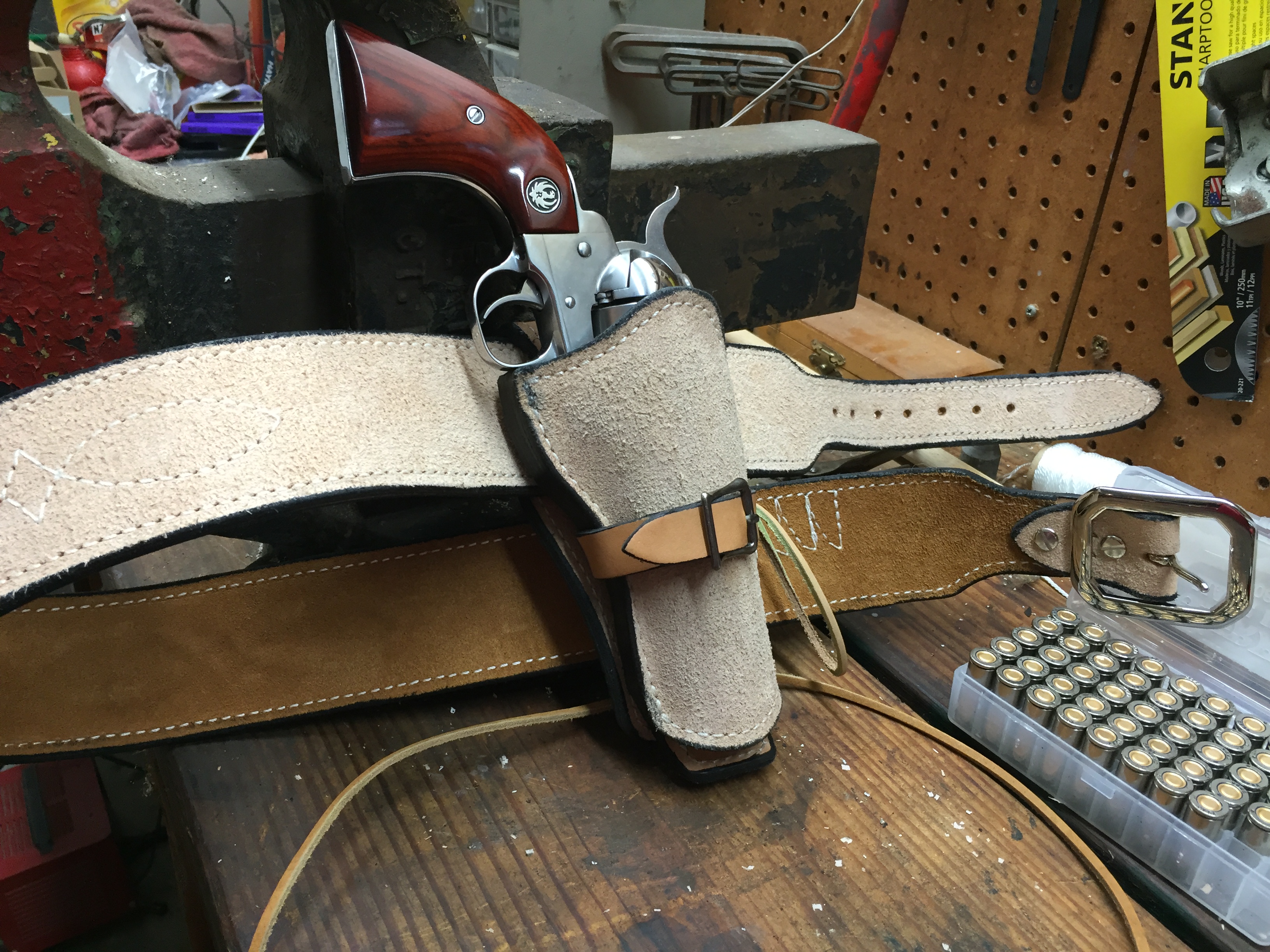
On Christmas Eve my mail lady, who is a government employee, but is individually a very nice person gave me very strange looks as she brought several packages to my garage. It was a beautiful day so I had the door open to enjoy the weather. She was a little shocked to find me at my work bench wearing one of my guns holstered from my practice and working on several others. I had some time to clean and oil them, so I took advantage of the opportunity. She normally drops packages on the front porch and we never talk, but it was Christmas Eve, and she felt a need to make direct contact because my garage was closer than my porch for her. I thanked her, even though I could tell that she was anxious about the guns—which she shouldn’t have been. The packages were not Christmas presents, but were orders from Brownells for the maintenance of my guns. Specifically, I’m performing a trigger job on my Ruger Vaquero and the new springs were among the parts that were in the boxes she brought to me. I have been dusting off my old gunsmithing skills lately. I’m not doing it for money as of now because I don’t want to go through the trouble of obtaining a FFL, as I’ve had before. When you get one of those you have to get fingerprinted and an ATF agent suddenly has access to your premises to check your records. That’s one of the reasons I gave it up years ago. As she walked back to her delivery van I could see by the way she walked that she was still uneasy about me. If this were communist China—as the Obama administration clearly shows an inclination—she would report me to the enforcement police for reconditioning, one government employee reporting the activities of civilian activity to other government employees. They are nice people when you get to know them, but in their role as employees to the kind of system that is allowing Hillary Clinton to flourish as a Democratic candidate, they are the type of people who could be dire enemies tomorrow. I imagine there were some colorful conversations about me when she arrived back at the Post Office.
A few weeks ago I had an arrival from UPS that required hazmat approval, as the material was explosive in nature. The delivery guy expressed concern about the contents. As a fairly young man he had been trained through social conditioning that deliveries like that were “suspicious.” The government considers people like me more dangerous than their Syrian Trojan horses. I told the kid not to worry about it—“It’s not for a bomb,” I told him answering the question that I knew he wanted to ask. “It’s primers for my reloads, nothing bad.” But to young people trained to be nice government employees from their liberalized public schools and social conditioning, guns are bad—in anybody’s hands. So I added, “don’t worry, my mouth is far more dangerous than anything I have around here.” And that’s the truth.
I am aware that everything I do is being watched by the NSA, the FBI, and the CIA. So they know I’m no danger to the United States—because I am the embodiment of what an American truly is, or should be. But I’m not taking any crap from anybody, because I don’t have to. I know what it feels like to be watched, followed, and even have contracts against you, and it’s not a big deal to me. I’ve dealt with all that before, and apparently Trump has as well. What I like about him is that he’s not afraid of anything—which makes him my kind of person-regardless of politics. I like and respect fearless people. My mouth is the thing they fear the most—and when you understand that, you don’t have to use a gun for offense. The guns are for defense—in case some idiot wants to cross that line. Otherwise, my mouth does more work than an army of gun wielding patriots would—and I’m fine to keep it that way. But if someone loses their mind and wants to impose themselves on me or my rights as a free-born human being—they will have big trouble.
But as for offense, my mouth works just fine, because it is that kind of war. And in this kind of war, Donald Trump is as good as boots on the ground. He fights the kind of war the government is imposing well which gives a platform for young people like Linda Lleshaj to function within. That poor radio guy who wants a certain kind of Republican candidate is falsely assuming that we are not a nation at war, and that the 2016 election is just another cycle of idiots and fools who make promises that they never keep once they get into office. We don’t have time for another Paul Ryan type in an important government office. We have to literally capture the flag, because domestic enemies currently posses it under rules of war and only then can we talk about some sanity in politics. Because I’m not changing my life for anybody-I don’t have to. I play by the rules, I pay my taxes, and I work hard every single day. I take care of my family without government help and I give a lot more to the world around me than I take. I am not the problem and I see clearly the mismanagement of the people who have been responsible, so I wear my guns around the house just in case some desperate fool decides to short-cut sanity and take something that belongs to me. Otherwise, I will be happy to fight the war on the terms of modern battle, and that is mostly with my mouth and through potential elected candidates like Trump.
The essence, and cause of that war is Hillary Clinton and her support organizations—the people who keep her as a viable candidate in spite of severe criminal misconduct. I lived through the Clinton White House during the 90s and I’m not about to put up with that garbage again. She belongs in jail, not in the White House, and it’s about time that more people start realizing it. To her credit, Linda Lleshaj is part of a new generation who has to grapple with that reality. And it is great to see that she is awake and is actively trying to get other young people to wake up as well. Welcome to the battlefield Linda. It’s a Christmas present to me to know you’re out there. That is my idea of a good Christmas. So let’s all cross the metaphorical Delaware together and surprise everyone.
Don’t believe we are at war, watch all the videos above, completely. The evidence is quite clear.
This is truly a special day. Just over two months ago I was having lunch with a friend about firearms related subject matter. It was at a decent place, and reading this, he’ll remember instantly the occasion. We were watching the construction of The Streets of West Chester Phase II development from our window and were enjoying the progress of capitalism as it marched toward new destinations. In my own life, I had just accomplished a major technical achievement, something that many thought was impossible and the two and a half years I spent slugging that triumph out had put a new line of thought into my mind forever. To celebrate the moment I put a major investment into a new stage of my own personal development and decided that I would put an emphasis on a career change. Of course nothing is sudden in these kinds of things. The business world like a good marriage dictates that decisions are fast and solid but that movement often takes time—so you often ease into things instead of crashing through the front door. So this new career would entail a phase-in period rather than a sudden change and it all started with something that I had been thinking about for several decades but just couldn’t find the time to commit to it—or the money. However, I had promised myself that if I survived the technical achievement I had been working on that I would treat myself to that long desired intention. Prior to that lunch I had just ordered a new Mernickle gunfighter rig knowing that it would have to be hand crafted and take months to complete. But I was excited that I had finally bought it—along with other items that went with it. All in all it was a sizeable investment for me that signified a definite change of life. One book had literally closed and an entirely new one was starting, and I was very excited about it which my friend can testify to.
It was on December 15, 2015 that my Mernickle holster arrived and it is a thing of extraordinary beauty. Bob Mernickle and his family starting with his wife Sherrie and two daughters Stormie and Shandrianna are in my opinion the best holster manufacturers that are out there, particularly when it comes to Cowboy Fast Draw. To have a Mernickle gun fighting system is to have the Lamborghini of shooting sports. When I get involved with something very specific, like the Western Arts often are I do a lot of research into who I think is the absolute best and I work with them exclusively until I think they have fallen from the top. In my bullwhip work, I bought my whips from Terry Jacka in Australia. With this new phase in my life I am looking to build a new skill set to compliment the old one, and to advance that intention, I needed the best Cowboy Fast Draw rig that I could get, so I ordered one from Bob Mernickle. The day before it arrived one of his daughters, Stormie wrote me to confirm its delivery and I knew that all was right in the world.
As part of the technical achievement that I had worked through and all the pulling teeth it took to get there, no amount of money can give you back the years you lose whenever you do something that takes so much work and effort. There are no banquets in your honor that can justify the personal expense—not for me anyway. Success isn’t measured in the opinions others have of you for bringing them the magic of capitalist enterprise—but it’s in what it does for you personally. This Mernickle holster and the Ruger Vaquero that goes in it represents something much greater to me which was confirmed over quite a long period of time. It is probably the opposite reaction that people in my position would justify for the start of a new book in their lives. The typical reaction might be condos, boats, and more exotic vacations when a plateau of professional achievement is reached, but that’s not enough for me. I need to push myself and to smell battle in the things I’m doing—so complacency and reflection are not enough. I need to go from one impossible thing to another in order to feel alive and entering a very competitive sport that is the fastest individual feat that a human being can perform is precisely what makes my heart swell.
Prior to this epic life-changing event I was happy with my melee weapon work for personal exercise and self-defense. Bullwhips allowed me to practice in my own back yard and compete each year in the Annie Oakley Western Showcase in Darke County, Ohio and be one of the few in the world who could put out flaming candles with those flexible weapons using pin-point accuracy. But that technical work that I had been doing along with my political endeavors here and elsewhere showed me a strategic undercurrent emerging that needed a gunfighter—quite literally. This led me to re-think some of my favorite childhood influences, such as Akira Kurosawa’s Seven Samurai and The Hidden Fortress and gave me an even stronger appreciation for the cowboy arts of America’s foundation.
I have been thinking a lot about the Cowboy Way as defined by America’s evolution and the romance of the Old West mythologies which are much more sanctimonious in hindsight than they ever were in the moment—and it became quite clear to me that the gun represented laissez-faire capitalism in our culture and that was something that needed to be emphasized, and protected. As I look back on the countless westerns that have been produced in America they all have a common thread that revolves around the use of guns to regulate a frontier society which embodies the morality of pure capitalism—which is essentially at the heart of the gun debate in our modern era to remove them from private possession. Guns on the hip of a gunfighter represent the type of individual protection of private property that is very specific to a culture that is operating without the parental oversight of a federal government. America had the unique experience of being able to function in a vacuum of time, when railroads allowed quick travel, guns made the playing field of human domination equal, and the innovation of one’s own endeavors could make them gloriously wealthy, or proportionally poor. The Old West was a very competitive place, and most people ended up dirt poor, diseased, or crippled for life. Gambling and prostitution were everyday occurrences in most frontier towns and to this very modern time still has an appeal to people in American culture because those things no matter how destructive they were personally, represents an extraordinary level of personal freedom that was unique on the world stage—and still is.
The Cowboy Way emerged as a way to self-regulate behavior as government was not all that present in Old West towns such as Deadwood, South Dakota. Each year presently hundreds of thousands of motorcyclists venture to Deadwood for the famous Sturgis Motorcycle Rally essentially to feel the breath of the Old West and laissez-faire capitalism on their faces. If you look beyond the decadence which is also present in Las Vegas and Times Square, New York, or even Key West, Florida—you can see a society of people too tightly cranked up looking to come unhinged for their own psychological balance. Towns like the old Deadwood featured lots of prostitution, and gambling which were hopeful attempts by individuals to acquire private property and live well for themselves. This isn’t at all unlike the world of Henry Morgan—the pirate of Port Royal where indulgence in debauchery was rampant to an extreme. But the reason for it is more fascinating than the cost. Many people died and lost their way in such environments, but those who did succeed brought wonderful treasures to the human race under capitalism. The desire for such recklessness in personal living is that individuals ultimately want to be free of government regulations and they’ll go to extremes to shake them away. In such an environment guns are needed to protect oneself from predators who want to shortcut the work of capitalism to get something for as little effort as possible. In Deadwood specifically are the stories of Wild Bill Hickok who was a lawman, a frequenter of prostitutes, and one of the best known gunfighters from the Old West period. He once killed Davis Tutt in a dual at 75 yards over a dispute of Hickok’s watch. The dual was likely over a woman—not so much the watch, but either way it was over possession of perceived property and the gunfight was emblematic of protecting that property. The gun in most western mythology is an affirmation of economic value, not raw brutality. It was in Deadwood that Wild Bill was shot in the back of the head during a poker game while holding the famous hand, Aces of Eights, which so many references within the motorcycle community refer to presently.
The governing principle of these laissez-faire capitalist societies was the Cowboy Way, or at least the way Hollywood interpreted the brutality of frontier life to find meaning in it all—which there was plenty. A code of conduct enforced by the gun emerged and it was for a time the best answer to America’s morality of capitalism. The political left attacks cowboys and gunfighters specifically because they are quite well aware that there is something unique in the history of Old West towns like Deadwood and the historic mythologies of Wild Bill Hickok that might fuel the fires of capitalism and stop the long global march of socialism that is currently migrating unhinged everywhere in the world except for rural pockets around the United States. For instance, you will NEVER see Barack Obama or Hillary Clinton at the Sturgis Motorcycle Rally in South Dakota lecturing those people about morality and equality. John McCain has attempted to appeal to that demographic class, but has not been very successful—because the Washington Beltway doesn’t understand it. But I see it quite clearly. The strategy to move capitalism in the other direction against the current spread of socialism is through the kind of marketing that gave rise to such mythologies and the real life actions of Wild Bill in the first place. And behind that effort is the magic of the gun and the advantage of a very good fast draw rig.
Yes, it’s very exciting to enter a new book full of stories and adventure that have not yet been experienced. The old one was great, but sometimes sequels are better than the originals. Life should be like that, each and every year should be better than the previous one. While my previous stories were mainly about motorcycles and bullwhips, these new ones will be more akin to Wild Bill Hickok. Not the gambling or the women, but the gun fighting—there is magic in that—and promotion of an economic system that the gun represents–laissez-faire capitalism. After my success at the near impossible the obvious next step is to build on that with a means to expand that capitalist reach. While the intentions may not be obvious at first, it is clear that by wearing that fabulous Mernickle holster the weapons that will be drawn from it have the best chance of re-selling American capitalism to the most people under the best conditions—which of course unlocks prosperity within our national GDP that would have been previously unheard of. And that is why that holster to me is one of the most beautiful things in the world and why I have been so excited to get it. This is going to be a lot of fun.


 Occasionally, after a lot of hard work I enjoy indulging in a nice steak to sort of put an explanation point at the end of a sentence. It’s kind of like spiking the football after a long drive toward a touchdown. It’s the appropriate thing to do. In the normal course of things that for me involves either Jag’s Steakhouse in West Chester, or the Rodizio Grill at Liberty Center. When at Jags I typically get the Big Oscar Fillet to serve as that ceremonial spike. Executive Chef Michelle Brown at Jags knows just how to do it all right and the food quality is always consistently high, so when you are celebrating a personal victory—that’s the place to do it. But I am open to new experiences and I will give a new place a chance when the occasion provides. It just so happened that I was in the neighborhood of Mouriya Steak in Kobe, Japan as there was a reason to have a good steak so I had dinner with some very hard-working people who all deserved some fine food.