Arthur Rosenfeld’s Huffington Post Bashing of ‘Interstellar’: Whales are earth’s most intelligent species?

My biggest complaint against progressives—especially those on the liberal side of politics is that they think so small—that they are so anchored to the earth that they are boldly proud of it. Let me tell you dear reader, when you hear a person like Arthur Rosenfeld seen below—who writes for the Huffington Post—a bastion of progressive thought—run in the opposite direction. Stay away from them as best you can. Their thoughts are like a sickness. I knew it would only be a matter of time before progressive types realized that the latest Christopher Nolan film Interstellar was actually an argument against progressivism—against the Arthur Rosenfeld types and that they are the villains in the story. So when they saw the film, they obviously would not like it. And Arthur Rosenfeld didn’t. I did, read my review by clicking here.

Regarding space travel versus these Taoist monk progressives who are so obsessed with their mind/body dichotomy that they stay all their lives so treacherously grounded to the earth–space to the extent that you can see the curvature of the earth easily is only 22 miles straight up. A bicycle rider could cover that distance in a couple of hours, a car could knock out that travel time in less than 15 minutes. There really isn’t much above us considering the massive amount of space that is beyond those 22 miles of atmosphere.   The International Space Station orbits on average above the earth between 173 miles to 266. That is the usual distance between most major cities in the Midwest and can be covered within a few short hours of car travel time. It’s not that far—at all. Yet people like Arthur Rosenfeld think that the human mind should remain tethered to the ground so that we can align ourselves to our mind and body through Tai Chi exercises.

In college I met tons of these idiots. On the U.C. campus I used to eat breakfast every morning in Coryville at a little place right across from the Kroger store. Inside with me were many of the college professors who had the same habit before reporting to class. I would often do my morning reading which often composed of material well beyond their grasp—some of it Kip Thorne’s work.   They would gather over coffee and omelets and wear their Taoist jewelry under their sport coats and argue with me over the same type of things that Arthur Rosenfeld did after seeing Interstellar, most of it playful banter until they realized they couldn’t change my mind. What I learned from my college experience was that those people in that little breakfast shop were destroying the minds of every American youth who attended their classes. They were not equipped to teach anybody anything regarding spirituality, science, or even politics when their frame of reference was rooted to progressive philosophy in such a way that the answers to life’s difficulties were not explored just 22 miles above our heads—but instead around the other side of the world and down the road in the latest government created slum.

Arthur Rosenfeld is a typical progressive—he is a mind firmly anchored to the ground much like a jealous small-minded parent who fears for their five-year old to ride a bicycle down the driveway without a helmet. He is part of that “safety first” culture when it crushes the natural spirit of adventure. Instead he offers to quiet the mind so that you can hear the voices of the earth and all its animals relegating oneself to its grim limitations like a jealous mother who cannot let go of a treasured son or daughter. After seeing Interstellar Rosenfeld wrote a remarkably small-minded review in the Huffington Post, linked below. But of that article, there were a few paragraphs that stood out as exceptionally ridiculous reminding me so intensely of those nutty U.C. college professors who used to share breakfast over arguments in Coryville and convinced me that progressives could not be helped—that they were not content to just live and let live—but desired with a military-like fervor to put shackles on the mind of mankind so to keep them within their own intellectual comfort zones. Progressives were detrimental to every mind they attempted to teach. Read those excerpts below with my comments following:


Arthur Rosenfeld

Taoist monk, author, speaker

Interstellar Is a Crying Shame

Posted: 11/14/2014 8:29 am EST Updated: 11/14/2014 9:59 am EST


Despite the marvelous special effects and the great lengths gone to by the filmmakers to imaginatively render singularities, Interstellar misses the chance to be either an inspiring or cautionary tale. Instead, the film lionizes precisely those social elements that are most reprehensible and scary, and lauds precisely those psychological traits that we must excoriate if we are truly to save our planet and survive along with it. More, instead of juxtaposing technology and consciousness, science and morality as James Cameron did in Avatar, director Christopher Nolan panders to our primitive urge to resort to fantasy rather than reality when facing the very problems that have put humanity in its current pickle.

Jim Cameron’s film, Avatar was a progressive journey against capitalist endeavor. The corporation in the film was the villain and the heroes were a bunch of natives who were plugged into the consciousness of their planet. With each failed marriage in Cameron’s personal life he moved more and more away from the logic of the truck driver he used to be—which was obvious in his early films, like Terminator, and even the Abyss and started forming his political beliefs around the pick-up lines he used on subsequent love interests. Females, because of their unique ability to have children are sympathetic to the resonance of Mother Earth and the metaphor of their children growing up and leaving them is not lost to the concept the plight of mankind leaving the earth to journey into space. When a human male wants to gain the sexual favor of a female he will often appeal to this “motherhood” aspect of females to lure them into his bed. If he likes them, he might try to marry them, and in James Cameron’s case—he went through this process many times looking for love that never really lived up to his cinematic brilliance. So he has moved toward female view points after many marriages as opposed to finding females that leaned toward him. Avatar was the result of a pick-up line that became a movie. This is why many women vote for Democrats because progressive liberals appeal to this motherhood neurosis.

Mankind is at its adolescence and space is essentially like moving out into one’s own first apartment. It doesn’t mean that we abandoned our parents on earth, but that we have to form a healthy relationship where our destiny is shaped by our own thoughts instead of the home planet. Rosenfeld is proposing that Interstellar had an obligation to accentuate how irresponsible mankind is—like the film Koyaanisqatsi—which Interstellar resembles often. Instead, Interstellar boldly declares that man’s mind is the answer to everything in the universe and this is what Rosenfeld finds so reprehensible.

To sort through the razzle-dazzle and get to what really makes this movie so reprehensible requires some straight talk about who we humans really are and are not, both in the physical and spiritual sense. Physically, we are one species among millions, living an impermanent existence against an ever-changing bio-geological backdrop. If we are unique, it is not because we are the most intelligent species on the planet (that honor likely goes to whales), nor because we are the most enduring (look to cycads and roaches instead) but because, in addition to being stunningly resourceful, creative, potentially loving and deeply spiritual, we are also the most hubristic, self-absorbed, and destructive.

Animals are collectivists; I have not seen a whale build a rocket to the moon, or a new car to speed their transit across the earth. Whales especially are a matriarchal society which is a progressive metaphor for their religion of earth worship, so it is not to be ignored that Rosenfeld uses whales as an example of the type of earthly animal species that deserves inclusion as the earth’s most intelligent species. Give me a break. Whales are wonderful; they are magnificent to look at. I respect their right to live in the ocean and not to have their mating habits infringed upon—but when a whale gains the ability to run a company and produce more than an ocean full of shit—then I might be willing to entertain the notion that whales need to be considered intelligent. But again, Rosenfeld proposes that humans are just one species and that it is our task to slow our minds down to the tiniest insect and to listen to what they have to say as an equal species.

Just yesterday I was conversing with a person and was aware of a Chinese stink bug that was crawling along the side of a table. I was careful not to lean against that table as I was trying not to bring harm to it. Well, the person I was speaking with without any ill intent leaned against the table killing the poor little insect by crushing three of its legs. It fell to the ground for a slow death completely unintentional and I felt bad for it. I tried to save it, but the insect was in a place it didn’t belong and it was crushed by man’s progress just like the millions of bugs that are smashed on the front of our cars and under our feet. To people like Rosenfeld we are supposed to limit this behavior almost to the point of non action, but in the scheme of the universe—of the potential life that is “out there” even the largest whale is of the importance of a bug. Entire species can be killed easily with a simple meteor impact into the ocean or a few degrees of temperature change induced by radiation from the sun. Only human beings have emerged with a mind to so dramatically change their fate as to be simple bugs crawling on the side of a table with life and death timed out so perfectly between revolutions of the earth around the sun. Humans have come to know themselves by how many times the earth circles the sun. To the young women who cries at her waning youth complaining about how many candles are on her birthday cake representing age 40, her crises is that the first forty times she traveled on the earth around the sun provided her with youthful growth, and the next forty will be a gradual decline into death where her body is placed into the earth to be forgotten forever—so she is sad.

There is nothing brilliant about animals when they yield to those in a pecking order who are stronger and faster than they are—or older and more experienced. When humans follow the same patterns they end up worshiping people like Rosenfeld who hope to think of themselves at the top of an intellectual pyramid in a collective based society where he can be the one to teach others to tap into that common fountain of knowledge that we share through the tiniest insect during his Tai Chi exercises. Interstellar is about leaving this corrupting behavior behind and overcoming their restrictions. In the future, it is people like Rosenfeld who have destroyed invention, destroyed education, and destroyed politics leaving mankind to scribble in the dirt waiting to die. Interstellar offers an alternative and that is why Rosenfeld disliked the movie.

Let’s stop making movies like this, or, at least, let’s stop watching them. They freeze our hearts, turn our brains to mush, and delude our children into believing in Scientism, the latest and most dangerous of man’s religions. If we are going to explore, let’s explore our spiritual landscapes in a quest for an antidote to all such fantastical belief systems. Let’s find a mindful, balanced, and harmonious alternative to hating and killing everyone and everything in the name of what we say we believe. Let’s create cinematic masterworks that exhort us to cherish the planet we have, and all the wonders upon it, rather than jettison it in favor of new turf to kill.

http://www.huffingtonpost.com/arthur-rosenfeld/interstellar-is-a-crying_b_6157828.html

Here is likely the most ridiculous statement I have heard in a long time—Rosenfeld actually proposes that movies like Interstellar shouldn’t be made in a free society full of competing ideas. As much as I like Star Wars, I’m not a huge fan of the “Force,” as it reminds me too much of people like Rosenfeld who don’t quite “get it.” I can watch those movies and enjoy them taking what I like and leaving behind what I don’t. But Rosenfeld actually proposes either a boycott of Interstellar, or cutting off the ability to produce such works of art because he doesn’t like the message.

There was no proposal in Interstellar to kill another species while they were in space looking for another earth-like planet to settle on. Rosenfeld suggests that there be a kind of social cinema board who sits around and actually decides the type of content which should be made into a film. In some ways—there already is within the studio system where progressive money often does just this very thing. It is amazing that Christopher Nolan has managed to make his kind of movie in that studio environment—but if you look at a chart of how many counties in America are politically red, it is no wonder that Nolan does so well at the box office—because he makes movies for the type of people who often get ignored by progressives like Rosenfeld. The farmer/hunter from the Midwest doesn’t give a rat’s ass about some urban progressive like Rosenfeld who wants to “feel the earth” while in line at Starbucks. The farmer is in the dirt every day and the content of Interstellar is very appealing to them—“they” get it.

Rosenfeld actually attacks the premise of science which is a ghastly mistake proposing that our “spiritual landscapes” are far more important than the vast blackness just a few miles above our heads. To maintain the type of political order where progressives like Rosenfeld get to be the “leader of the pack” on earth teaching people to honor the defeated Indian tribes and all their superstitions or think that whales are the most intelligent species on earth they cannot have competition to those beliefs, so they attack anything that might disrupt their scam against the human intellect.

Nobody can point at Interstellar and not call it a visually brilliant film. It is a magnificent spectacle of science. But the negative reviews boil down to what the film invokes in those factions who want to maintain a matriarchal society on earth of mother worship instead of allowing mankind to evolve into full-grown adults creating our own destiny in space. The movie does what art is supposed to do, it brings forth discussion and invokes feelings that should be challenged if or intellects are to be massaged. I have watched many progressive films and often I enjoy parts of them. But I do not propose that those voices not be heard as Rosenfeld does. Most of the time I just don’t say anything about it unless the movie is Cloud Atlas, which I found to be absolutely, reprehensibly horrible—but even that movie I encouraged people to make their own opinion. I certainly didn’t do as Rosenfeld did with Interstellar and propose that a very good film was a “crying shame” because it did not support his stilted world view that every species align themselves behind the leadership of the earth’s most intelligent species—whales.

I keep waiting for whales to build a cool shopping mall on the bottom of the ocean, and I eagerly await the next whale feature film about their life and habitat—their latest drama about how upset their matriarchs get when they seek to change mating locations 20 miles north of their birth place instead of the traditional nesting grounds. And I can’t wait until whales send their own into space on a rocket built of sea shells using compressed water as a propulsion system. Maybe if they are really smart, which Rosenfeld believes they are, they’ll use a couple of dolphins to run smaller scout ships into orbit around Mars so they can begin to seek a new ocean planet where natives of the intellect of Rosenfeld fall in nicely to whale worship and are happy to sacrifice goats, cows and other human beings to the Gods of the ocean to keep the whales living prosperously lumbering around in peace for all eternity.

To Rosenfeld progress—the products of man’s mind is the real villain. To his religious fanaticism any attempt to supplant nature as the superior guiding force is reprehensible. If one does not yield to nature, they are harming it—so every shopping mall, every Starbucks, every movie that does not pander to this earthly belief should be attacked and ridiculed. That is the limited mind of the progressive and why I just can’t stand them. I learned to hate them while I was in college and I never yielded to their rhetoric even in small ways—and for that I am infinitely grateful. Over time, those professors found some place else to eat and left me alone—which suited me just fine. The owner of the restaurant was in distress about the many arguments we often had—and when only I was left, it brought him much pain—much like the aforementioned stink bug—a casualty of intellectual competition. The professors took their four tables of left-leaning progressive hippies and started meeting across the street at Perkins and I spent my breakfast periods alone with my books and my omelet each morning happy for the solitude. Within four months, over the summer break, the owner had to close down due to a lack of business. So I moved across the street into Perkins and those same college professors left for someplace else–again. They did not want to sit near me because I would not give them the illusion that they were right about their limited world view. So they did what they always do, they picked up their act and went somewhere among their own kind so that they could live in the illusion of their falsehood. And what happens when people spend their whole lives in that condition—they become people like Arthur Rosenfeld. The appeal for me of Interstellar would be that I could leave the earth to get away from people like that—or—that they might get on a ship and leave for some hippie planet far away—just as the college professors did at our breakfast restaurant—leaving me to enjoy my life in peace—away from their corrupt minds and small perspective.

Rich Hoffman

www.OVERMANWARRIOR.com


‘Interstellar’ Film Review: What ‘2001’ wanted to be and a superior sequal/answer to ‘Koyaanisqatsi’

I was already a fan of Kip Thorne’s work in the book Black Holes and Time Warps so I had a very strong feeling that I would love the new film Christopher Nolan called Interstellar. It was a safe bet to be a great movie originally developed by Steven Spielberg and Nolan’s brother Jonathan beginning nearly a decade ago. So there was considerable thought put into the project which undoubtedly would show up on screen.   I read the reviews that had managed to come out prior to viewing a premier of the film myself, most praising Interstellar in some way or another just for sheer scope, but not giving high marks in other aspects like dialogue or in some cases sound quality as the music sometimes overwhelmed what the characters were saying. Now that I’ve seen it I am convinced that even some of those technical issues were on purpose—deliberately placed into the story to convey the vastness of space and mankind’s role within it. Interstellar is a painting of many impressions splashed upon the screen intending to advance nothing less than the human race to another level of conscious development. It is everything that the classic film 2001: A Space Odyssey should have been—or wanted to be—and even then, much, much, more. It is a triumph and likely the reason that cinema was invented to entertain human minds to begin with. It is as if the entire history of cinema was created to place this one film onto the silver screen.

To get an idea of what the screenwriter was thinking during the development process of Interstellar—before diving too deeply into the contents of the story—read what he said to /Film.com which is a kind of industry insider blog site. Jonathan Nolan spoke openly about his motivations while writing Interstellar. He has brought his writing talents to the Dark Knight series which I have praised heavily because of the content and angle he chooses to provide in those films. In Interstellar his motivations were clear, persuasive, and as bold as anything that has ever been done before in a movie.

/Film question: So that was always the pitch that like it was set in the future where resources are, were our future’s looking bleak?

Nolan: Absolutely. I mean, look the reality is we stopped going to space because we’re too fucking wrapped up in whatever narcissistic bullshit, you know, as a sort of a collective. I mean, look, there’s an awful lot of things that still need to be fixed here on Earth, right? You know, problems that never seem to go away. Poverty, disease and a lot of stuff that we turned our attention to that is a good thing. We’re also just kind of sucked in the bullshit. I was talking downstairs, I grew up in Apollo space travel, we were promised jetpacks and fucking teleportation and instead we got fucking Facebook and Instagram. That’s a bummer.

But we don’t think of it in those terms. We think of ourselves as being the most magnificent, amazing universe ever and if we wanna go back to the Moon, sure, we could. It’s like no, those guys are all dead or retired. We’re not going back to the Moon. And if we wanted to, we’d have to spend billions of dollars and it would take years and years and years. We’re just done. We’re not doing that. We’re out of that business. And so people don’t think in those terms. We had to set the movie in the future in which that was abundantly clear.

http://www.slashfilm.com/jonathan-nolan-interstellar-interview/

Readers of this site will instantly recognize the angle Jonathan Nolan took in setting up the movie Interstellar. At the start he challenges the notion of public education when the government schools are caught lying to students about the Apollo missions—stating that they were only intended as propaganda against Russia. Public education in Interstellar is on Common Core overload as test assessments determine what kind of careers students can pursue as adults in the collective society.

Meanwhile, innovation is down, people are barely able to make food for themselves as a blight fungus similar to the current Ug99 strains that are currently moving across Africa into the Middle East-specifically target wheat and okra. Because the developed world has micromanaged the world’s resources—specifically the minds of their youth—there isn’t anybody anywhere who can stop the fungus as it thrusts the world into hunger slowly killing earth.

http://www.outerplaces.com/universe/technology/item/6654-the-cause-of-the-interstellar-famine-and-why-it-could-happen-in-real-life

It was amazing how many reviewers on their first viewing of the film missed so many of the most important messages—many confused the fungus in the film to environmental recklessness supporting their global warming conspiracies when it is exactly that kind of stupidity which has lunched the world into regression. Interstellar is such an amazing film that people wanted to come away with something they liked in it, even if the premise of the film attacks many of the core beliefs that most of our current civilization holds. So there is some revisionist memory going on in almost every review I read. But it’s not fair to Interstellar because as a movie it is going to places that nobody ever has attempted before. It tackles 5th dimensional space; inter galactic travel, the nature of love, the transitory aspects of time, the foundations of religion, the deep human yearning for adventure, the magnificence of invention and the corrupt nature of politics most epically displayed in forcing NASA underground because public support could not fathom spending money on spaceships when the world needed food. The movie even tackles the premise and existence of poltergeists. There are so many big ideas harnessed in the movie that it really belongs in its own category. It seeks openly to advance the human mind—which is certainly no small feat and it succeeds on every level.

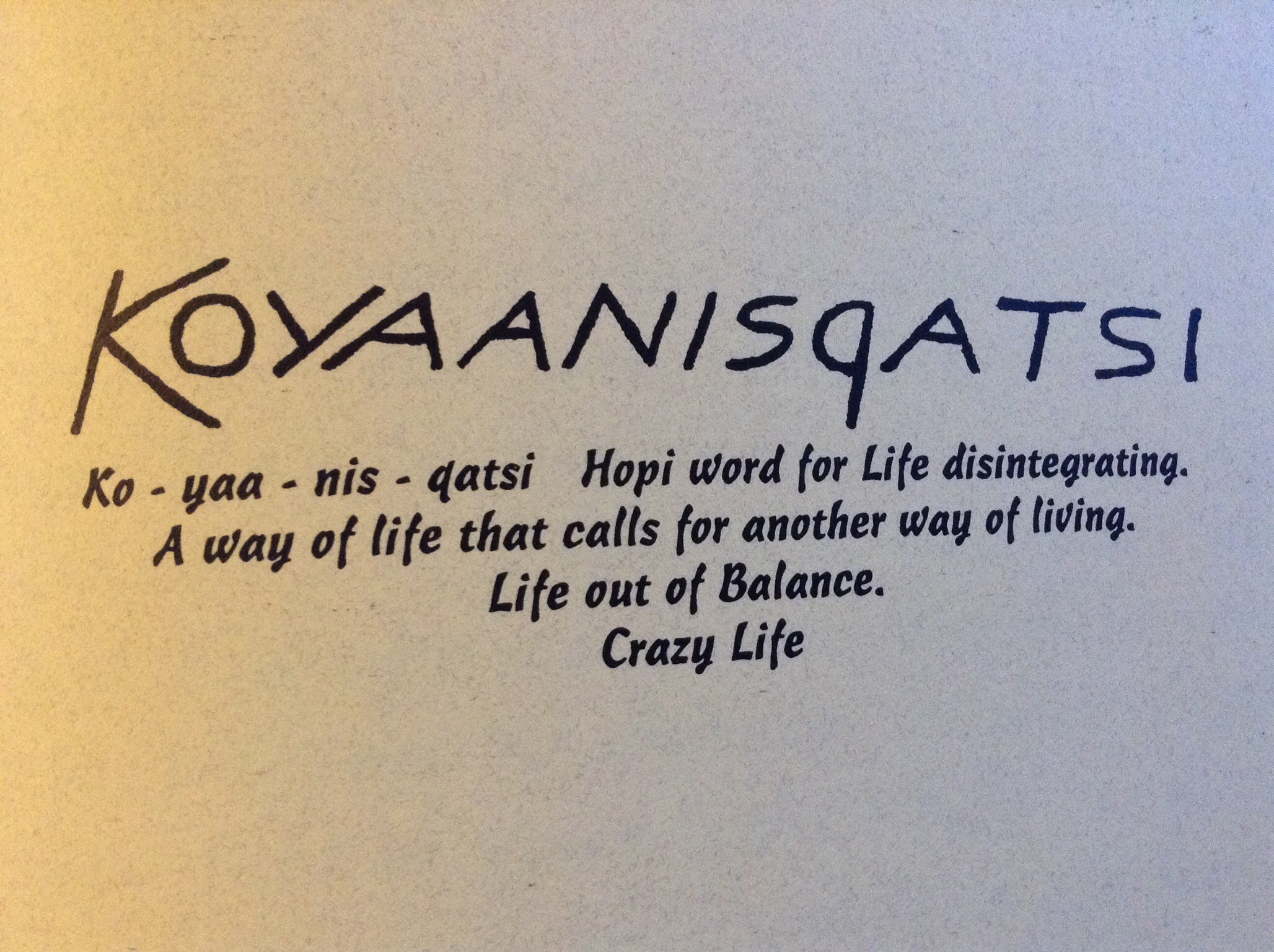
The best parts of the movie were the space sequences which reminded me so much of 2001: A Space Odyssey filmed in complete silence—just as they would have been. The catastrophes in space were just mind bogglingly beautiful. As I have also reported at this site I am a tremendous Koyaanisqatsi fan—even to the extent that I designed a line of t-shirts years ago as a tribute to the 1983 experimental film. imageBut the problem with it was that it pointed to progress as a vile and evil thing ultimately and concluded with a rocket exploding on its way to space falling back to earth in complete silence to the score of a magnificent work by Philip Glass. Well—there was a lot of Koyaanisqatsi in this movie and the music by Hans Zimmer without being disrespectful to Philip Glass tackles the original Koyaanisqatsi score with a new level of boldness. The pipe organs from Hans Zimmer’s soundtrack gave narration to the silence of space in such a grand fashion that it will become the new standard for all filmmakers over the next century. If The Wizard of Oz brought color to film, Interstellar has brought music to space—and that is not an insult to the contributions of John Williams to Star Wars—but Interstellar is in a new category of its own that will become the new standard—it is that good. The flight sequences were so wonderfully done—they were like a concert set in space to silently floating images struggling to break the boundaries of not just earth—but previous human limitation. There were times when the thrusters to the ships kicked on and the music literally was blowing me into the back of the seat—it was jaw-dropping incredible.

I think most people seeing Interstellar will like something from it—but the movie was intended to be enjoyed by smart people—or at a minimum, those who strive to be. It is a thinker’s movie to say the least and deliberately reaches out into the audience to declare, “We feel your pain.” It is literally bigger than anything on earth, there is no mountain too tall, no ocean so great—by the time Interstellar is watched once, everything on earth seems small and silly—including the civilization we have so far built. This is easily the grandest production of ideas ever gathered for the silver screen and even challenges some of the greatest literary work put to print. Interstellar is a magnificent masterpiece assembled to please the mind—to see life beyond death, and to touch the true face of God.

When the main character Cooper finds himself in the fifth dimension it’s not aliens, or a “they” out there in space trying to help the silly ants of humanity with carefully placed worm holes next to Saturn or the rapture inside a singularity—it is us who have mastered multi-dimensional travel, who have left the door open to our former incantations so to achieve the task in a linier time—to tell the story of humanity as a struggling race beating an invisible clock against stupidity only to weave the universe into a canvas of our own creation. It is the mind of man who spills over outside of their bodies into the infinite and become the utterances of immortality. What is most unusual of all within Interstellar was the carefully constructed request from Christopher Nolan to Hans Zimmer to create music which would live up to such a lofty intention—and uniquely, the legendary composer did it in a fashion that is literally blowing minds too restricted to behold all the images with the must see movie not just of this year, decade, or era—but in the history of film both past and future. Interstellar is out of this world in every category that counts—especially in the swagger category of bolding going to places only contemplated by physics equations and warped imaginations. Now such places are available to anybody who can pay the price of a movie ticket and desire to peak beyond the shroud of impossibility manifested into the bold reality of a destiny that is there within reach, now.

Interstellar is simply a new standard of excellence and will be copied hundreds of different ways from now on. History has just been made with this masterpiece of modern cinema—it is everything that many films have tried to be. The difference is that Interstellar pulled it off.

Rich Hoffman

www.OVERMANWARRIOR.com

Navagate the Universe of Kip Thorne: Solar system driven climate change that is inevitable

There are some who are anxious that Christopher Nolan’s new film Interstellar is another blind narrative from the Hollywood left portraying climate change as a central theme based on Al Gore’s global warming concerns. The science of that leftist position is a fiction. Nolan’s climate change is based on events well beyond the control of anything mankind can do, and dictates that earth’s inhabitants must leave the planet or face extinction. Nolan’s view and that of his brother who wrote the film is much more galactic based, and not rooted in the political scheme to increase taxation on productivity through the sale of carbon credits. It is based on legitimate science, and very real concerns which are unraveling the nerves of everyone who has so far seen the film, and will shatter the reality of all those who will see it. As stated in a previous article on this subject, Interstellar is based on a very dear book to me called Black Holes and Time Warps: Einstein’s Outrageous Legacy by Kip Thorne who is an executive producer on the new film. Needless to say it will be an incredible movie—but it will not be just another example of leftist trash and theoretical nonsense. So do not let the early concerns about such things keep you from the wonderful experience of seeing this movie. The science is beyond the scope of most, including all the climate bashers from the political left, so they will be equally displaced upon viewing the contents of Interstellar.

Even more impressive as an unforeseen byproduct of the release of Kip’s book into this screen format are the marketing opportunities that have presented themselves as the release date has approached. My wife and I have read Kip’s book so many times that the pages of our hard cover edition are literally falling out of the binding. The edges are blackened from our fingertips and the glue no longer holds the pages to the spine of the book—which is quite thick. When my children were very young, my wife used to take them to the pool in Mason, Ohio and let them play while she read that book for many, many hours contemplating the contents. It is one of the great books of science ever put to print. So it was bewildering to me to discover that the Interstellar websites shown below have released a game based on the film that is just fantastic. Paramount has just released the new Android game on Google Play based on director Christopher Nolan’s upcoming sci-fi epic Interstellar and it is a tad different from the normal movie tie-in as the player can not only create his or her own solar system but can also explore it as well as others made by fans.

This game is no space shooter but one that is supposed to simulate real physics as you pilot a ship through these solar systems. Here’s a quick bullet list of the game’s features:

  • Create your own solar system and share it with friends
  • Customize planets, stars and asteroids
  • Pilot the Endurance through friend’s and other fan’s solar systems
  • Upgrade your ship to increase durability and range
  • Earn mission patches for completing objectives
  • Based on Newtonian physics with simulated gravitational fields endorsed by the movie’s science advisor Kip Thorne
  • Slingshot between planets and return research data to Earth
  • Navigate past massive black holes

Needless to say I downloaded the app onto my iPad and I spent the entire weekend playing it—nearly nonstop. It was absolutely fascinating to traverse through Kip Thorne’s treasured book finally with a video game played on my tablet. Absolutely stunning! The most fun in the game is navigating past the black holes, which are rendered accurately and really for the first time ever. Part of the means for getting to worm holes so that you can punch through various layers of folded space-and time, is by sling-shooting passed the dreaded black holes.

http://www.interstellar-movie.com/

http://www.androidcentral.com/interstellar-movie-based-game-android-lets-you-make-and-explore-your-own-solar-system

If you have the means and scientific inquiry, this is a must have app—a real journey and best use imaginable for a few moments at the airport waiting to catch a flight. It duplicates some of the most basic concepts of Kip Thorne’s book so wonderfully. For instance, one of the ways that you collect power to stay in space is to move into orbit around a sun. It is difficult to maintain a trajectory that puts you in that sweet spot orbit, but once you do, you can load up on power to further your voyage. The trouble is, while in orbit around a sun, its imprint into the space-time continuum is much slower than the time on earth. So while you are communicating with earth on your missions, time for them is moving at a much more rapid way than it is for you during your power collection around suns. Also, the distance between planets involves many millions of miles which is passed by instantly in the game. It does calculate out the years the endeavor is taking so that it is understood how much time is passing on earth while all this effort is being undertaken.

What this does is shatter the concept of time as a liner type of thing that is currently understood. Instead, it plays with time as a force of momentum relative to where you are and what kind of mass the object you are near has on the space around it. To this effect space is divided up in the game with a grid system that shows the imprint the planet or sun involved has on the surrounding area. Within that imprint time will be affected differently than in other places within the galaxy, or galaxies involved. For a simple app, it is yet another example of a giant leap forward for human endeavor, to have such a powerful conceptual tool on a device that you can whip out in a McDonald’s over lunch and play a quick mission involving advanced physics concepts.

Often it is these by-products of such endeavors that films like Interstellar bring to the table of contemplation. And I am so excited that Kip’s treasured book is finally making it to formats of understanding that are so accessible. I knew when I first read the book Black Holes and Time Warps that there was something very special going on, and always thought that a fantastic movie could be made based on the concepts. But few in Hollywood really have the mind for something like that. I never fantasized that someone like Kip Thorne would be given a seat at the table to actually produce such a thing for mass audiences. And in a game app designed to bring awareness to the movie for marketing reasons, the Interstellar game does two things, it helps introduce people not familiar with Kip Thorne’s work to some of the basic ideals that have to be understood to relate to the actual movie. But for someone like me, who already loved the book, it provides the opportunity to dwell in that world in a virtual reality that has so far only been possible in a physics equation and the most active imaginations. It is just a wonderful addition to what is proving to be a very exciting time to be alive.

Now, if you’ll excuse me, I have to navigate passed a black hole in a distant solar system so that I can get to the worm hole that takes me back to earth before everyone is dead by the time I get there. And I’ll do it while eating a Big Mac, drinking a nice cold Coca Cola, and eating some upsized French Fries. Capitalism at its finest!

Rich Hoffman

www.OVERMANWARRIOR.com

‘Man of Steel’ Review: A message of American pride and conceptual philosophy

The other morning over breakfast my wife and I had a raging debate of mankind’s need and desire to behold simple “concepts,” as philosophy defines them.  It is because of concepts that I occasionally detour away from the normally serious matter at this site and dwell in great detail about the nature of Hollywood movies and published books.  In my private life I have two basic loves which drive me, a love of philosophy and the mythologies of thought which attempt to frame them to the human world through “concepts.”  Most everything else I care about in life drips off the leaves of knowledge from those basic forms of art esthetically.  The reason for the raging debate over breakfast with my wife was over the value of concepts in people’s lives versus a given morality.  My wife values morality among mankind as the highest honor, even over the air she breaths.  If she had to choose between morality and taking another breath, she would choose morality.  However, my side of the debate declared that the ability to behold a “concept” of morality is far more important, because without having the ability to grapple with conceptual ideas, morality falters in both human beings and animals 100% of the time.  I explained to her that the ability to understand concepts was like getting popcorn into a bowl that has been popped in a kitchen.  If a person’s mind is small, they have a small bowl from which they can place popcorn in from which to consume.  If a person’s mind is large they can hold a lot more popcorn.  In my metaphor I was of course transposing popcorn with ideas, or in this case “concepts” in order to explain why mankind is so sick these days.  We spend the first five years of our lives being given gigantic “concepts” from our parents, grandparents, friends, and extended family through the toys we play with and ideas they give us.  We are given from birth extremely large bowls which hold a lot of metaphorical popcorn so that concepts can be formed in our minds allowing us to walk, speak, and develop ranges of physical movement.   But from every year after our first kindergarten class in public school, we find that our bowls get smaller and by age 10 to age 15 our ability to hold thinking concepts diminishes greatly so that by the time we are grown adults, instead of holding a bowl of popcorn with most of what could possibly be popped in the kitchen, we are lucky to get a few small kernels into our 35-year-old brains.  I view human mythology as a way of expanding our metaphorical bowls so that our minds can hold more philosophy about the way life should be lived, and today in all of human history it is the movies produced from Hollywood which are the strongest creators of modern mythology, which makes them of great interest to me.  This basic preamble is needed before I say that I understand why so many critics stated that they did not enjoy the new movie which I have been raving about—Man of Steel.   They did not like the movie because they are suffering from conceptual handicaps given to them by their crumbling society, of which the most recent rendition of Superman clearly was conceptually articulating.  So I will provide you dear reader with a conceptual handicap free review so that you can understand why a slight tear was running down your face at the end of the movie, and why you thought about standing up and clapping at the end while others actually did with a ruckus ovation.

I have spoken before about how important the concept of Superman is to my family in a previous article.  CLICK HERE TO REVIEW.    Before seeing the film, we went to Newport on the Levee to view the new Man of Steel film by Zach Snyder and one of my favorite modern film producers, Christopher Nolan and have dinner at Claddah’s Irish Pub.  My daughter, son-in-law, and wife wanted to make a big event out of this film with me so we went to that particular theater and dining location to place the experience in proper perspective.  The AMC theaters at Newport are built three stories above the mall below, and are unique in their design.  Going up the escalator to arrive in the lobby is literally like arriving in some heavenly plateau which is appropriate for a modern viewing of Superman, especially for my family.  The reasons I love Ayn Rand’s characters in The Fountainhead and Atlas Shrugged are because her characters created during the same era as Superman are about the same elevated sense of mankind’s potential.  For Ayn Rand, Superman is in all men who have a thinking mind.  Yet for the character of Superman created by writer Jerry Siegel and artist Joe Shuster, high school students living in Cleveland, Ohio, in 1933 their large concept ultimate man had extraordinary powers given to him from the sun’s energy on earth.  But all these creations of the mind were a direct answer to the communism being imported into the United States by progressives during the roaring twenties and early thirties.  It was a time when President Calvin Coolidge was going door to door running for office with a miniature chalk board trying to educate voters on the perils of socialism.  Superheroes were born in literature as a way to protect the concept of Americanism against the anti-concept of European communism. Young Jerry Siegel and Joe Shuster created Superman to define what living life in America was all about creating a symbol that allowed the concept of Americanism to be defined in a single character named Kal-El from the planet Krypton.

To understand what this 2013 version of Superman is all about, let me explain how the film ends without giving away any particular spoilers.  Superman smashes out of the sky a drone aircraft which is attempting to spy on him and proceeds to lecture the U.S. military of his need for privacy even though he understands the military is afraid of all his vast powers.  Superman continues to make clear that nothing the military can do will hurt him anyway, so the effort is useless.  The military then asks Kal-El, how they can know Superman won’t use his superior powers against the American people.  Superman explains with a smile, “I grew up in Kansas and am as American as there is; you’re just going to have to trust me.”  This is almost the last scene of the film.  Superman was metaphorically speaking on behalf of all Americans to their modern government which is currently plagued by scandals such as the IRS, Benghazi, and spygates against the American people.    Superman represented in mythic form the power of every individual American who may not be able to leap about like Superman, or shoot lasers from their eyes, but hold the potential to be super in their own way which Ayn Rand would get more specific about in her own overmen exploits of literary endeavor.  The message at the end of Man of Steel is that Superman wanted to be left alone to live as an American and that if he wanted to he’d crush anybody who stood in his way of achieving that goal.  He chose to value the people of earth for the hope he had for them which was something that was lost to his dying planet of Krypton.

Russell Crow who played Kal-El’s father in Man of Steel was very good in his role of explaining how Krypton became doomed in the first place.  The highly technological society of the Kryptonians had enjoyed a period of great expansion in their culture where they planted seed societies throughout known space.  But as time moved on, their society had become more politically corrupt leaving them to pursue short-sighted goals like stripping out their own planet’s core for power, instead of harnessing the power from neighboring star systems, as they had in the past.  The Krypton metaphor was clearly in reference to our own times where space travel has been cut away to virtually nothing in America as left-leaning politicians squabble in endless debate with political apathy serving as the centerpiece of their action.  On Krypton, as many are attempting to suggest here on earth, they devolved from a flourishing society that embraced personal freedom and enterprise to one that micro managed the smallest detail of their lives including the birth of children which had been taken over by a technology called the Codex.  Jor-El and his wife gave birth to the first free-born child in centuries on Krypton.  That child was Kal-El–Superman, a free-born creation of two loving parents.  Knowing that Krypton was imploding on itself, even as the political class squabbled in denial of the impending doom Jor-El sent his child to earth to allow the best of what Krypton was to live on elsewhere.  All this while General Zod was staging a rebellion to turn Krypton back into a society under his managed care.  In Man of Steel, Zod is a collectivist born under the dystopian care of the Codex, not having natural parents, but instead being raised to and for the collective Krypton society.  (I knew Christopher Nolan would not let me down.)  I was very concerned about how Krypton’s demise would be handled in the film, and it is very appropriate to the direction our current society is devolving.  Man of Steel just in this regard is conceptually brilliant……….but that’s not all.

Even Kal-El’s adoptive parents were heroic as Jonathan Kent died in the Man of Steel defying a tornado’s wrath.  He ran into the blistering storm as it consumed cars and entire homes to save a few more people only to get caught because he broke his ankle and couldn’t run away fast enough……..but he saved Kal El’s dog!  That is a great dad!  The good guys in the film were all heroic in their own way.  Ultimately the pinnacle decision of the film was Kal-El having to decide whether the society of Krypton deserved to be resurrected on earth through the Codex killing all of humanity, or should the people who live on the planet be given the opportunity to have hope for their own future.  Superman ultimately decided that Krypton had its chance, and it screwed it up.  The people of earth had a real chance to get it right, and Superman had made a decision to lead them to the light under his guidance.  Superman made a value judgment between the two societies, Krypton had taken a noticeably collectivist route and destroyed itself, and earth was headed in the same direction, but could still change course.

On the way home from the movie my family was philosophizing about the very idea of Superman, a man who was invincible and could be harmed by nothing on earth.  For many this is a boring idea because the wish is to see conflict in their heroes brought about by fear and weakness.  But that is not what Superman is all about.  Superman could decide to rule the earth if he wanted as there would be nobody to stop him, but he doesn’t, because he is a good man who chooses to spend his time helping humanity instead of acting as a parasite off of it to feed his own ego.  What Kal-El gained from his adoptive parents was a sense of knowing the difference between right and wrong which would be the key to allowing the grown-up Superman to use his powers for good, instead of evil.  General Zod, with all his good intentions openly declared at the end of the film that his sole purpose in life was to serve the greater good of Krypton by any means necessary.  He was speaking as a product of the collective and might as well have been a Russian revolutionary from 1917 marching around Petrograd destroying any life that stood in the way of communism, as the greater good of mother Russia was more important than the whims of any individual who might think they were serving good as it is defined by anybody.  As I was explaining all this to my family a drunk driver nearly ran into the side of our minivan.  I reacted as I have hundreds and hundreds of times over the years, with quick aversion out of harm’s way.  It happened so quick that I barely paused in my sentence structure and after the danger was averted, I proceeded with the explanation of my metaphor without pause.  Such situations are only dangerous if the mind surrenders itself to panic, and I don’t.  After years of training myself, there is little that worries me.  And it is this kind of attitude that Kal-El maintained throughout the Man of Steel once he had become comfortable in his role as Superman, savior of the planet earth from falling to a similar fate as his home planet Krypton.   All men and women come to such a place in their own minds once the concept of goodness is understood by them.  But first they must have a bowl big enough to hold the concept of such goodness and behold the definitions of evil in the same container.  Once there, the mind can eliminate danger from its life-like avoiding a drunk driver by simply taking evasive action without any fanfare.  Panicky social commentary asking politicians for more public safety never works.  The truth is politicians are actually quite powerless to provide any safety without stealing from some to give to others in legalized theft.  All they can really do is react as a second-hander and write new laws which bring our present society that much closer to the fictional fate of Krypton.

At the conclusion of Man of Steel my family sat till the end of the credits as viewers gradually left the theater.  We were the last to leave.  Several young men who might look like gang-like thugs in any other circumstance from the streets of Cincinnati were wearing the Superman emblem on their shirts and had obviously given up for the evening  any youthful decadence they might otherwise engage in to see a story of “hope” unfold upon the silver screen.  A young man covered in tattoos and body piercings saw me smiling at his big “S” imprinted across his shirt as he left the theater to descend the escalator back down into the shopping complex of Newport on the Levee.  His first reaction was a bit of anxiety as he thought I was laughing at his immature love of Superman.  But I gave him a reassuring wink as he walked by to let the young man know that I understood.  He was attempting to behold a higher concept of what “man” should be, and I didn’t want him for a moment to think I didn’t approve.  He smiled boyishly as he walked by, realizing that my gaze at him was not condescending, but quite the opposite.

Small-minded reviewers after they saw the movie found that without large concepts in their own imaginations to allow them to behold the messages of the film they were regulated to commenting on the physical appearance of Henry Cavell, the young man who played Kal-El or criticizing the 40 minute climax which took place in an epic battle all over the globe ending in a fist fight between Superman and Zod which migrated into space at times where even satellites fell from the sky in destruction.  Critics spoke about the metaphors of 9/11 as half of the city of Metropolis was destroyed in the gigantic battle leaving a crater of cleared buildings in the center where the two earthly gods did battle in the climatic ending with Superman snapping the neck of Zod.  When Kal-El broke the neck of the villain there was emotion in the audience.  It was 1 AM in the morning, and the audience was filled back to the projection booth.  One man yelled out from the crowd………….”damn!”  Others clapped.  Some whistled.  It was not a critical appraisal, but one of approval from the audience, of seeing a battle between right and wrong, good and evil displayed clearly in front of them, resolving itself with the clear decision of a nearly decapitated villain.

Man of Steel is about “big concepts” and it assists the viewer in grasping those ideas which require large conceptual bowls to hold.  It is why in spite of the attempts by established Ellsworth Toohey type film critics taught in their institutions of learning to have small concepts in their lives, not large ones; Man of Steel will become the next $1 billion dollar film franchise.  Shortly after the drunk driver nearly hit us on the way home, and I dropped my kids off at their house, I thought of the export potential of this film.  Man of Steel is about undeniably American ideas and it didn’t waiver from that responsibility for even a moment.   Superman didn’t say he stood for “truth, justice, and the American way,” at the end of the movie, he simply said…………..”I’m an American.”  What a wonderful thing for kids throughout the world to see whether they are in London, or Delhi.  The best vehicle for projecting American ideas to the world is the film industry of Hollywood, which has traditionally been consumed by left leaning communist ideologues, like what’s represented in the upcoming Matt Damon film Elsyium.  Most movies that Hollywood produces like Elsyium or the 2012 fall attempt with Tom Hanks called Cloud Atlas are not so subtle attempts to sell socialism to America and the world.  But the box office take usually tells the story as fans reject the message.  They will go see the movies for entertainment, but quickly drop them, as word of mouth does not spread like wild-fire, the way it does during the very capitalist movie messages like Iron Man, and now Man of Steel, which is going to break records during its opening weekend.  The film made $21 million just off Thursday midnight shows, and $50 million on Friday alone.

Man of Steel is a fantastic film.  It is worth watching many more times than once.  It is a pleasure to live in a culture that can produce films like Man of Steel where the story telling is first class, the visual effects epic, the music astonishing, but most importantly, the concept is huge.  The value of Man of Steel is in its ability to generate a concept that is epic in scope and definitive in its message.  There is no question where the message of Man of Steel intends to go, and it is in no way complimentary to evil, weakness, or even blind dedication to a race of people just because they represent one’s ancestors.  It is more valuable as an American export than all the money that is currently spent on defense because the message is clear, and void of politics from any party.  Man of Steel is film making at its best and the message to everyone in the world with a mind to think is one of goodness!  It is a big bowl of philosophy that will take multiple viewings for those functioning with small bowls of conceptual thinking and will require expanding enough to behold the real message of Superman, which is certainly one of hope.  A hope that earth will find its way and not fail the way Krypton did, leaving that society to live on in the rebellion of an innovative young couple who decided to go against their entire society and have a natural child who would have to flee their planet and live again as the shining beacon of truth, justice, and the American way for not just on a continent in North America, but the entire world which desperately needs the message of Man of Steel.

One particular scene in Man of Steel defines the entire film.  It’s a scene when young Kal-El is being picked on by a group of bullies who are around 10 years old.  The little Superman is reading a book, called Plato’s Republic.  It wasn’t Tom Sawyer, or the Diary of Anne Frank.  It was a work of philosophy that the budding superhero was reading, and a message to all viewers was that Man of Steel is not just an action movie, it’s a work of conceptual philosophy designed to give mankind the tools it needs to save itself.  All society needs to do is listen to the message and allow their minds to conceptually hold the memorandum of goodness which is represented immaculately by Superman: Man of Steel.

The movie is better than Dark Knight Rises, and anyone who reads here knows how much I loved that film.  CLICK HERE FOR REVIEW. 

Rich Hoffman

“If they attack first………..blast em’!”

www.tailofthedragonbook.com

Superman: Man of Steel — an ideal to aspire to

I’m going to go out on a limb to declare that the new version of Superman: Man of Steel will be one of the best films of 2013.  Needless to say I am very much looking forward to Christopher Nolan’s version of Superman, because after Dark Knight Rises, I am pretty sure I know where Nolan is going with that long famed hero.  If I had to guess, I would say that Nolan and I share a love for the classic book Thus Spoke Zarathustra.   To understand what I am talking about, let us study just a few quotes known to come out of the new film set to be released on June 14th 2013 in tribute to the 75th year of the comic book creation.  Many similar quotes are spoken by Zarathustra in that wonderful book which has meant so much to me over the years.  They have been modified to fit the story of Superman, but the essence is there as either an accidental or intentional tribute by Nolan, to Thus Spoke Zarathustra.  To place faces to the dialogue below, Jonathan Kent is being played by Kevin Costner, and Jor-El by Russell Crow two of my favorite actors.

    1. Superman: My father believed that if the world found who I really was, they would reject me. He was convinced that the world wasn’t ready. What do you think?
    1. Jonathan Kent: You’re not just anyone. One day, you’re going to have to make a choice. You’ll have to decide what kind of man you want to grow up to be. Whoever that man is, good character or bad, he’s going to change the world.
    1. Jor-El: What if a child dreamed of becoming something other than what society had intended? What if a child aspired to something greater?
    1. Jor-El: You will give the people an ideal to strive towards. They will race behind you, they will stumble, they will fall. But in time, they will join you in the sun. In time you will help them accomplish wonders.

To understand what Superman means to me, let me take you dear reader back to the time when I met my wife 26 years ago who felt that her father was the only living embodiment to Superman on Earth.  She quite literally felt this way about him as he had then and still does have a Clark Kent quality of gentile courtesy even as a very large and strong man.  He could crush most people easily, yet he didn’t.  He supported the world in a way that Ayn Rand’s character of Hank Rearden did—another man of steel as a business tycoon—quietly, tenaciously, yet graciously.  That man, my wife’s father was involved in a very serious accident a few years ago at the age of 65 when he was riding his Vestpa home from the school where he taught geology and was hit by a car driven by a young girl texting on her phone.  The crash broke his leg so badly that doctors threatened to cut it off. Being a man of science, he knew that there was a chance his body could repair the fractured bones if only the living tissue within his femur would take and bond again.  Doctors were very doubtful.  There really wasn’t enough stable bone to even place rods through, so the prognosis was not good at all.  Months later he came to my house and my son-in-law and I tried to pep him up with a positive discussion so that his mood would influence his peptides and feed his cells into rebuilding the bone of the femur.  At the time, it looked like the bone was dying, as doctors had predicted.  Yet his mood was good.  He arrived at my house and insisted on walking on the broken leg.  He dressed in a very nice outfit complete with a fedora hat and suspenders which was typical for him.  He seemed to have a handle on the situation even though amputation seemed inevitable.

Months later the bone began to heel, and it was obvious that his shattered leg would repair.  He has recently just returned from a 10,000 mile trip all over the western United States with his spouse, my wife’s mother.  He hiked the Rocky Mountains with his leg and countless other places as a 67-year-old man.  He’s fine now and can walk without a cane when he wants to.  Over the years even during the tragic deaths of loved ones, economic difficulties, social upheavals, and any tribulation known to man, he has always risen to face those problems time and time again.  In fact, on the day of his mother’s burial recently, we spent some time in his basement movie theater watching movies and laughing as though nothing had happened in the outside world.  His ability to carry trouble on his back so adequately–protecting the more sensitive females in the family boldly is why my wife has always thought of him as Superman.   In fact, she is planning to take him to see this updated version for his birthday, which occurs around that time.

My wife let me know from date number one that she expected from me to be Superman too.  She wanted nothing less.  Now many people who knew me then thought that her expectations were outrageously high and terribly unrealistic.  Superman Part II from 1980 was the very first film she and I watched together and I noticed her sincerity when it came to Superman.  We were in Richmond Virginia the day that Christopher Reeve had an equestrian accident that left him paralyzed from the neck down.  She openly wept because reality had come to her mind that Superman played by Christopher Reeve was fictional.  It’s not that she didn’t know it already, but it was blatant that the idea of being greater than just a slop of human flesh was not obtainable in the world except in the fantasy of the mind.  To her it was sad that such a strong man in Christopher Reeve was imprisoned to a wheel chair for the rest of his life, which was greatly shortened because of the accident.  Reeve had put on a valiant “Superman” like fight, but in the end had lost.  My wife never really got over it.

When my wife met me, I was very rough around the edges.  Actually, I still am.  I don’t like dinning customs, social manners that remind me of European Victorianism, and I’ve been so mad that as recently of two years ago I’ve put my head through doors splitting them in two to make my point.  I used to hope that my wife would be impressed by those acts of strength, but she never was.  Now I only do things like that when I need to make my point to someone attempting to impose themselves on me.  What did impress her were the times I rode a bicycle for 12 miles a day round trip in 10 degree weather working two jobs so she could stay home with our growing children.  Or when I worked 16 hour days 7 days a week to make ends meet, or when I took on a whole neighborhood of rowdy kids to bust up a marijuana ring endorsed by the police, or the night I caught a peeping tom outside our window trying to get a look at my changing  wife—and many other incidents.  Not all of them were so obvious and clear-cut, but in my mind I always held in my mind the famous “S” shape that is the second most recognizable symbol in the entire world behind only the Christian cross—and I pushed forward no matter how daunting the feat in front of me was.  My wife’s insistence that only Superman would impress her put my mind into the mode that was required.  As a result, I don’t belch or fart and I never let even lip saliva run down a glass I drink out of.  The reason is that those things are reminders of the grotesque nature of the human body, the simple collectivism of cells running about trying to live one more day in slow decline toward death.  The human body needs to be more than that, or at least aim higher.  Because of my wife, I hold the door open for all ladies young and old, I walk on the street side of a sidewalk when I walk with her to protect her from dangers that might come from that direction, and I have learned that there is a lot of strength in kindness, which has preserved many walls, doors and windows over the last couple of years.  Instead, I have focused that energy not in the misplaced reaction to ill will toward me and my family, but in the pro-active attack of threats—often before they have a chance to manifest.

In short, since I have met my wife, I have tried every day to get up in the morning and be Superman.  I expect to be Superman.  That doesn’t necessarily mean the physical manifestation, or the ability to fly.  But what it does mean is the “IDEA” of superman, the yearning to be more than just an average man, a man of faults, of weakness, of scandalous character, of pathetic whimpering, a man less than super.  There were times where I thought such expectations where unrealistic, and that I thought she was the out-of-her mind to expect such high quality from me.  But the result is that I am now at an age where I can hear that classic John Williams score and understand it intellectually, not just perceptively.  I now have stories worth telling, and they are much greater than they would have been if I had not pushed myself to be a Superman every day of my life.

Sure, there were times like in Superman II where I understand just wanting to be a normal guy, and surrender all the power of the cape to be “human.”  But what is quickly learned, just like in that old film, is that without Superman, evil rules the Earth, and hiding in the mountains, or in the Fortress of Solitude with a loved one won’t stop evil from advancing.  It advances when there are no Supermen to meet it.  So the world needs Supermen.  My wife without realizing it set a high standard for me. I struggled to meet it, and in the end, I feel I understand Superman extremely well.  I strive every day of my life to be Superman and nothing less.

It is easy to see why my wife was so insistent on living up to the image of Superman now in hindsight.  Having kids of my own, they have a father who is someone they can legitimately look up to.  Like I always looked at my wife’s father as something to aspire to, I have now given a new generation something to emulate.  My version of Superman may be more like Indiana Jones, dirty, gritty, with streaks of blood running down my arms and back routinely.  I lack the cleanness of leaping buildings in a single bound and flying around the world to stop time itself, but the idea is what’s important.  The yearning to be more than just a decaying human being that simply wants to fill their bellies with food and have sexual relations with the same intensity that one uses the restroom—and for the same reasons, is something to be overcome, not cherished.

Because of Superman, I have looked for real examples of such an idea, and this is how I found Thus Spoke Zarathustra and ultimately became such a fan of the Übermensch idea which means in German “OVERMAN.”  This is why this site is named Overmanwarrior’s Wisdom as Overman means Superman.

It sounds as if Christopher Nolan and Zack Snyder made their version of Superman: Man of Steel understanding all of what I have said above.  After Dark Knight Rises for Nolan, and 300 for Snyder, I am 100 % sure that these guys understand what Superman is.  It is highly likely their own wives have a similar yearning from them to behold a Superman, after all, what woman in the world deep in their hearts doesn’t?  It is up to such men to be Supermen for their women.

But more than anything, Superman is an American idea.  Superman evolved from the German ubermensch of Nietzsche and was carved into a preserver of Truth, Justice and the “American” way through comicsI almost turned away from Superman not long ago when the comic took a dark turn toward statism and Superman declared his alliance to The United Nations, which is to take such an American icon and turn him into an advocate for socialism.  This is a trend I trust Christopher Nolan will halt in this upcoming film.

The only thing I am worried about concerning Superman: Man of Steel is the music by Hans Zimmer.  I am deeply in love with the John Williams score from 1978, and it will be difficult to accept anything less.  It is not rare for me to put that soundtrack on in our family car and blare it loudly with the windows down.  My kids know all too often that this is routine with me and comes with riding in the same car.  They were raised on that type of music.  But Zimmer is my second favorite music composer behind only Williams, and I have a sneaky feeling that the musical score may actually be spectacular on many intellectual levels.  Another popular soundtrack that is played all the time in my car and on my iPod is the soundtrack to Gladiator, which Hans Zimmer wrote.  So Superman is in good hands.

Superman is great not because of his strength, but because he stands as a symbol of what everyone should strive to become.  Unlike Robin Hood who steals from the rich and gives to the poor, which is an entirely socialist scheme, Superman stands alone as a beacon to the world as something to be aspired to, something to attempt to become.  Superman is what capitalism is to the world, an example of the best among all human beings and someone who drives all of society forward in an attempt to be better.  This is how Superman became the embodiment of the “American way.”  It is the same as to say Superman endorses capitalism and fights for the right of mankind to be free and not to struggle under the tyranny of scheming despots, like what Lex Luther always represented as the primary villain.

I feel a little sorry for my son-in-laws.  My daughters do expect them to be Supermen, and it will be tough.  They don’t expect those boys to be cut the way Henry Cavill is but they do expect the heart of the Superman character to be in their every day life.  They do expect their personal Supermen to hold up the entire world and crush any threat to their freedom; they expect a man who would crawl into the depths of hell to rescue a loved one, or to fight an army of millions all alone.  Is such a thing unrealistic……………of course…………….that is if the problem is viewed from the lens of being only human.  But if the same problems are viewed the way of Superman, then no problem is too great, and not threat is too severe.

The “S” on the front of Superman’s shirt does not stand for “super” but for “hope.”  This is why young women desire their men to be Supermen, and if they don’t they should.  Young men need such targets to aspire to.  They should not look up to weaklings, and belching comedians.  They should look up to Superman and work every day to be super.  In that fashion, the “S” represents the hope that all people have to be more than they were born into, to be more than any terrestrial goal could otherwise provide.  Hope is what Superman represents, and I “HOPE” that Man of Steel is even a fraction of what I desire it to be.  I am looking very forward to seeing that picture with my wife, because out of all the characters in film or literature there is not one that she admires more than Superman, and the idea of a man who is more than just average.

Today is the twenty-fifth anniversary of my wife and I.  Traditionally, a man is supposed to give his wife some kind of silver after 25 years of marriage.  But our life has not been conventional to say the least.  So some silly silver trinket just won’t do.  So what I give her instead is the gift of the Superman.  I give her the literal meaning of the “S” and everything it has come to represent.  It’s all she has ever wanted, and after 25 years of marriage she has the right to have it.  Thus Spoke the Overman.

superman-pirate1Rich Hoffman

166701_584023358276159_1119605693_n“If they attack first………..blast em’!”

www.tailofthedragonbook.com