The Freedom Outpost got it right when they captured a story about Dr. David Pook who is one of the co-authors of the new Common Core standards. Most politicians including Jeb Bush, and financiers like Bill Gates think that by just stating they are dedicated to better education is equivalent to a financial commitment, or a new policy. They fail to understand that the content of the type of education that government schools build by their policies will have a direct impact on the success or failure of education methods. It is not enough just to say you support something, and it is not enough to throw money at it. Education has to be of a type of content that is actually useful. And as many studies into Common Core have revealed, it is clear that its content was assembled by radical leftists who intend to instruct young people into become future radicals. In that regard, David Pook was caught—the details as reported are below:
According to Onan Coca, “Dr. David Pook is a professor at Granite State College in Manchester, New Hampshire. He’s also the chair of the History Department and one of the authors of the Common Core standards. He was a guest at the New Hampshire Institute of Politics when he opened up on his reasons for participating in the creation of the Common Core standards.”
So what were his reasons? You are about to learn the motivation behind Common Core.
According to Dr. Pook, he helped write it to balance the scales because he, and many others, are benefiting from some mythical ‘white privilege‘ that was not earned.
It is impossible for any hope nice guys like Bill Gates and Jeb Bush could obtain as far as education quality when they surrender Common Core to radicals like Dr. Pook who is an obvious bleeding heart liberal given extreme power to destroy the minds of young people through progressive nonsense.
White privilege in 2014 America is a myth—it does not exist. The quality of one people over another is completely dictated by the content of their character. It is impossible to build a productive culture when young people want to live a “narco” life as opposed to a Christian rancher, or an engineer with six years of schooling directly applicable to their field of study. Those two lifestyles are not compatible—one will be successful one will not and it has nothing—absolutely nothing—to do with skin color.
There is no way Common Core could work even under the best of circumstances—because government schools are run by progressive labor unions and the policies are set by pin-headed politicians. When radical liberals are allowed to set the pace for all the nations’ standards on education—then failure on a massive scale will be the direct by-product. This is what has happened even in these early phases and every governor who has signed up their states to operate under Common Core standards—they have doomed their youth through the education system to guaranteed failure unprepared for adulthood. Bill Gates Company Microsoft invented the Excel spreadsheet which I think is one of the most magnificent inventions of the 20th century. Using his spreadsheets the path to failure in public education is very easy to see—the numbers simply don’t add up to success when it is front loaded with progressive garbage and liberal jargon.
There is nothing positive which can come out of a belief in white privilege other than the belief that goods and services are dished out based on the color of one’s skin—which is absolutely not the case. It is the decisions that one makes with their life which dictates if they will live as a parasitic scum in a government slum, or a productive six figure earner living in a suburban neighborhood where the greatest crime occurring is the occasional toilet paper tossed across lawns during graduation periods.
David Pook is just another example of why it is dangerous to depend on one common standard set by government for students to achieve ignoring the benefits of competition to make those standards better. Without competition people like Pook look like geniuses—but with competition, they look like the idiot radicals that they really are. That is why they support a Common Core standard in the first place—and why it is wrong and vile taking American children backwards toward liberalism instead of forward to productive success—regardless of sex or skin color.
To get an idea of what the screenwriter was thinking during the development process of Interstellar—before diving too deeply into the contents of the story—read what he said to /Film.com which is a kind of industry insider blog site. Jonathan Nolan spoke openly about his motivations while writing Interstellar. He has brought his writing talents to the Dark Knight series which I have praised heavily because of the content and angle he chooses to provide in those films. In Interstellar his motivations were clear, persuasive, and as bold as anything that has ever been done before in a movie.
/Film question: So that was always the pitch that like it was set in the future where resources are, were our future’s looking bleak?
Nolan: Absolutely. I mean, look the reality is we stopped going to space because we’re too fucking wrapped up in whatever narcissistic bullshit, you know, as a sort of a collective. I mean, look, there’s an awful lot of things that still need to be fixed here on Earth, right? You know, problems that never seem to go away. Poverty, disease and a lot of stuff that we turned our attention to that is a good thing. We’re also just kind of sucked in the bullshit. I was talking downstairs, I grew up in Apollo space travel, we were promised jetpacks and fucking teleportation and instead we got fucking Facebook and Instagram. That’s a bummer.
But we don’t think of it in those terms. We think of ourselves as being the most magnificent, amazing universe ever and if we wanna go back to the Moon, sure, we could. It’s like no, those guys are all dead or retired. We’re not going back to the Moon. And if we wanted to, we’d have to spend billions of dollars and it would take years and years and years. We’re just done. We’re not doing that. We’re out of that business. And so people don’t think in those terms. We had to set the movie in the future in which that was abundantly clear.
Readers of this site will instantly recognize the angle Jonathan Nolan took in setting up the movie Interstellar. At the start he challenges the notion of public education when the government schools are caught lying to students about the Apollo missions—stating that they were only intended as propaganda against Russia. Public education in Interstellar is on Common Core overload as test assessments determine what kind of careers students can pursue as adults in the collective society.
Meanwhile, innovation is down, people are barely able to make food for themselves as a blight fungus similar to the current Ug99 strains that are currently moving across Africa into the Middle East-specifically target wheat and okra. Because the developed world has micromanaged the world’s resources—specifically the minds of their youth—there isn’t anybody anywhere who can stop the fungus as it thrusts the world into hunger slowly killing earth.
It was amazing how many reviewers on their first viewing of the film missed so many of the most important messages—many confused the fungus in the film to environmental recklessness supporting their global warming conspiracies when it is exactly that kind of stupidity which has lunched the world into regression. Interstellar is such an amazing film that people wanted to come away with something they liked in it, even if the premise of the film attacks many of the core beliefs that most of our current civilization holds. So there is some revisionist memory going on in almost every review I read. But it’s not fair to Interstellar because as a movie it is going to places that nobody ever has attempted before. It tackles 5th dimensional space; inter galactic travel, the nature of love, the transitory aspects of time, the foundations of religion, the deep human yearning for adventure, the magnificence of invention and the corrupt nature of politics most epically displayed in forcing NASA underground because public support could not fathom spending money on spaceships when the world needed food. The movie even tackles the premise and existence of poltergeists. There are so many big ideas harnessed in the movie that it really belongs in its own category. It seeks openly to advance the human mind—which is certainly no small feat and it succeeds on every level.
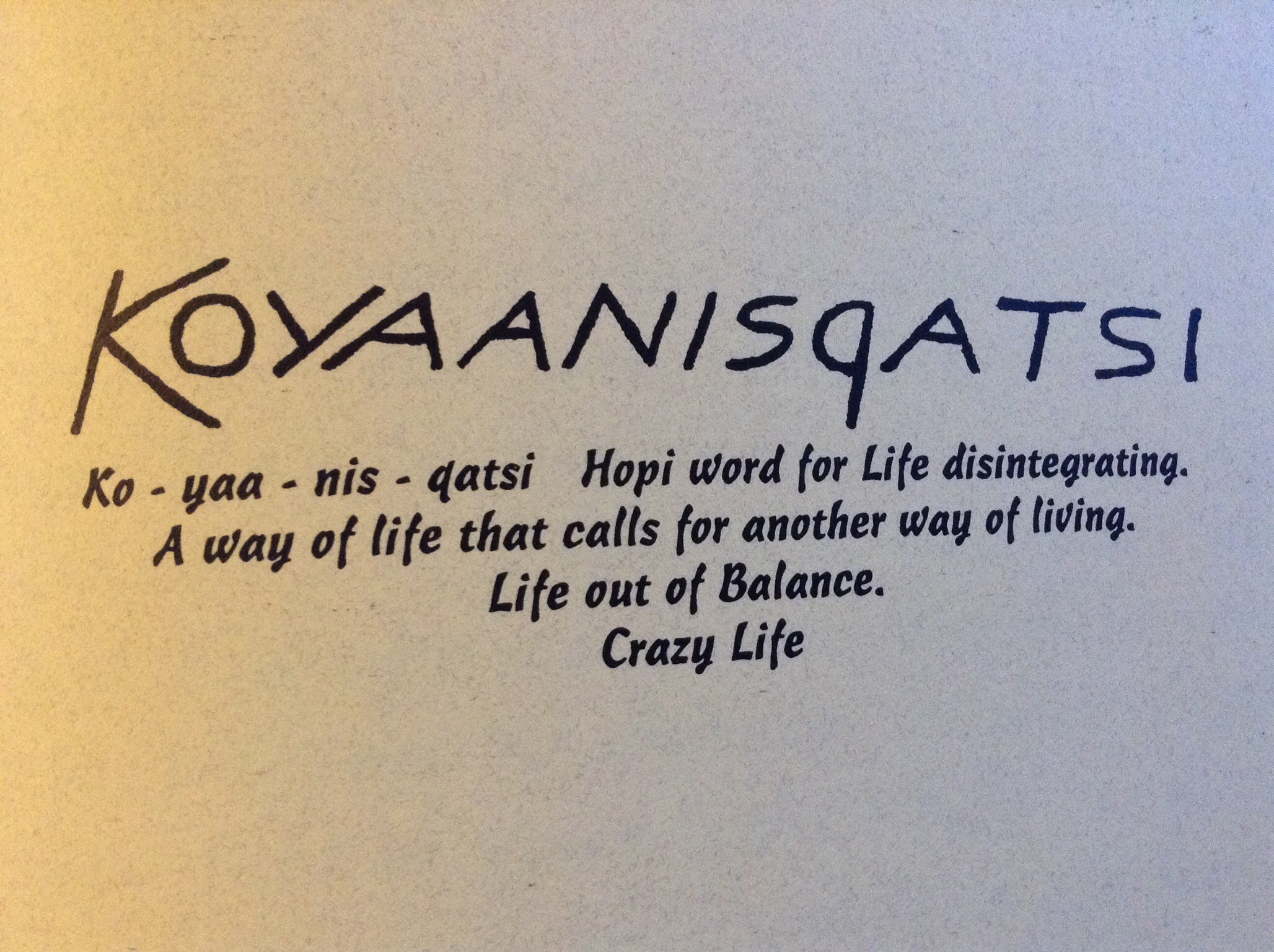
The best parts of the movie were the space sequences which reminded me so much of 2001: A Space Odyssey filmed in complete silence—just as they would have been. The catastrophes in space were just mind bogglingly beautiful. As I have also reported at this site I am a tremendous Koyaanisqatsi fan—even to the extent that I designed a line of t-shirts years ago as a tribute to the 1983 experimental film. But the problem with it was that it pointed to progress as a vile and evil thing ultimately and concluded with a rocket exploding on its way to space falling back to earth in complete silence to the score of a magnificent work by Philip Glass. Well—there was a lot of Koyaanisqatsi in this movie and the music by Hans Zimmer without being disrespectful to Philip Glass tackles the original Koyaanisqatsi score with a new level of boldness. The pipe organs from Hans Zimmer’s soundtrack gave narration to the silence of space in such a grand fashion that it will become the new standard for all filmmakers over the next century. If The Wizard of Oz brought color to film, Interstellar has brought music to space—and that is not an insult to the contributions of John Williams to Star Wars—but Interstellar is in a new category of its own that will become the new standard—it is that good. The flight sequences were so wonderfully done—they were like a concert set in space to silently floating images struggling to break the boundaries of not just earth—but previous human limitation. There were times when the thrusters to the ships kicked on and the music literally was blowing me into the back of the seat—it was jaw-dropping incredible.
I think most people seeing Interstellar will like something from it—but the movie was intended to be enjoyed by smart people—or at a minimum, those who strive to be. It is a thinker’s movie to say the least and deliberately reaches out into the audience to declare, “We feel your pain.” It is literally bigger than anything on earth, there is no mountain too tall, no ocean so great—by the time Interstellar is watched once, everything on earth seems small and silly—including the civilization we have so far built. This is easily the grandest production of ideas ever gathered for the silver screen and even challenges some of the greatest literary work put to print. Interstellar is a magnificent masterpiece assembled to please the mind—to see life beyond death, and to touch the true face of God.
When the main character Cooper finds himself in the fifth dimension it’s not aliens, or a “they” out there in space trying to help the silly ants of humanity with carefully placed worm holes next to Saturn or the rapture inside a singularity—it is us who have mastered multi-dimensional travel, who have left the door open to our former incantations so to achieve the task in a linier time—to tell the story of humanity as a struggling race beating an invisible clock against stupidity only to weave the universe into a canvas of our own creation. It is the mind of man who spills over outside of their bodies into the infinite and become the utterances of immortality. What is most unusual of all within Interstellar was the carefully constructed request from Christopher Nolan to Hans Zimmer to create music which would live up to such a lofty intention—and uniquely, the legendary composer did it in a fashion that is literally blowing minds too restricted to behold all the images with the must see movie not just of this year, decade, or era—but in the history of film both past and future. Interstellar is out of this world in every category that counts—especially in the swagger category of bolding going to places only contemplated by physics equations and warped imaginations. Now such places are available to anybody who can pay the price of a movie ticket and desire to peak beyond the shroud of impossibility manifested into the bold reality of a destiny that is there within reach, now.
Interstellar is simply a new standard of excellence and will be copied hundreds of different ways from now on. History has just been made with this masterpiece of modern cinema—it is everything that many films have tried to be. The difference is that Interstellar pulled it off.
If you have wondered what Fabio Lanzoni has been doing lately—who used to be a spokesman for the National Cancer Institute—he is now an advocate for Dr. Burzynski’s cancer treatments. This is not a happy place for the medical industry where a major celebrity has come out as a spokesman for the controversial doctor. Christina, Fabio’s sister, was treated and did end up dying of cancer but the track record Burzynski has is extremely good—much better than current treatments. You can see a special panel that Fabio participated in on behalf of Burzynski during a film festival showing the movie, Cancer is Serious Business Part II where he talks about his sister’s treatment and the path to life he worked so hard to provide her
To learn more about Dr. Burzynski read the information below by Dr. Mercola providing testimony about the cancer treatment doctor. The essence to the trouble that has come toward Burzynski is that he is the sole holder of the patent for antineoplastons which is the method he uses for treating cancer. If Burzynski’s antineoplastons become the industry standard, much of the 70 year old cancer fighting technology that is currently in practice, which pharmaceutical companies currently utilize will become obsolete. There is a lot of money in keeping people sick. There is also a lot of money to be made off of people’s deaths. Just consider the amount of revenue that is consumed through “death taxes” which states count on as part of their budget. As sad as it is, many in the medical industry are short-sighted enough to put such concerns ahead of the health, and quality of life of their patients. It’s not a sad conspiracy; it is a fact of modern life. The old guard of the medical industry is deliberately suppressing cures to maintain their federal funding structures and political status quo. Most in the medical industry desire to keep people sick to preserve their livelihoods. People like Burzynski are actually trying to cure people so that they can return to a normal life that does not involve a weekly visit to a doctor’s office.
Dr. Stanislaw Burzynski received much deserved publicity with the release of the 2011 film, Burzynski—The Movie.
Eric Merola’s award-winning documentary showcased Dr. Burzynski’s remarkable cancer discovery for all the world to see, and explained how he won the largest and possibly the most convoluted and intriguing legal battles against the Food and Drug Administration (FDA) in American history.
Dr. Burzynski’s story now continues in the compelling follow-up film: Burzynski—Cancer Is Serious Business, Part II. This second film details his continued struggles and victories, and explores the current status of Antineoplastons’ clinical testing—now (finally) sanctioned by the FDA.
Dr. Burzynski’s Cancer Treatment
Dr. Burzynski, trained as both a biochemist and a physician, has spent the last 35+ years developing and successfully treating cancer patients suffering with some of the most lethal forms of cancer at his clinic in Houston, Texas.
The treatment he developed involves a gene-targeted approach using non-toxic peptides and amino acids, known as Antineoplastons. I personally interviewed Dr. Burzynski about his treatment in the summer of 2011.
He coined the term ”antineoplastons” and defines them as peptides and derivatives of amino acids that act as molecular switches. However, as genome research blossomed and science progressed, Dr. Burzynski discovered that antineoplastons also work as genetic switches.
They actually turn off the genes that cause cancer (oncogenes), and turn on or activate tumor suppressor genes—genes that fight cancer. His treatment strategy, which he refers to as “Personalized Gene Targeted Cancer Therapy,” includes mapping the patient’s entire cancer genome.
This involves analyzing some 24,000 genes in order to identify the abnormal genes. Once they’ve determined which genes are involved in the cancer, drugs and supplements are identified to target those specific genes.
Antineoplastons work on approximately 100 cancer-causing genes, but traditional oncology agents (including chemotherapy) may also be used, typically in combination with antineoplastons. This expanded direction of “personalized gene-targeted treatment” has permitted people who would otherwise be denied access to the still-unapproved antineoplastons to benefit from his treatment.
The War on Cancer Cures
As the first film in this series clearly revealed, the FDA began scheming to eliminate the threat Dr. Burzynski and his discovery posed to the cancer industry as early as 1977, when Dr. Burzynski first tried to get antineoplastons approved.
The reason he was (and still is) considered a significant threat to the cancer industry is because he’s the sole patent holder of the treatment, which means he’s the sole beneficiary, should the FDA approve Antineoplastons—not a pharmaceutical company and the bosses thereof.
As a matter of fact, Dr. Burzynski is the first and only scientist in United States’ history to enter the federal drug approval process for a proprietary cancer therapy without any financial support from the American government, the pharmaceutical industry, or the cancer establishment.
Vast amounts of money are at stake, since FDA approval of Antineoplastons would not only threaten conventional chemotherapy and radiation, it would also result in billions of dollars of cancer research funds being funneled over to the one single scientist who has exclusive patent rights—Dr. Burzynski.
The sad fact is, as stated by Dr. Julian Whitaker in the featured film, that true medical breakthroughs are suppressed these days because they “put at risk the entire financial underpinnings” of medicine.
If a medical breakthrough replaces failing therapies, the cash flow and profits of those failing therapies are lost forever, and the industry simply chooses profits over cures… Instead of investing in actual cures, medicine, over the past five decades, has invested in awareness campaigns. But, as Dr. Whitaker points out, awareness does not cure the disease, and will never lead to a cure, no matter how much money is raised by these campaigns, for the simple fact that there’s too much vested interest in therapies that fail and perpetuate a money-making disease.
Cancer Is Serious Business
In recent years, the focus for cancer therapy has increasingly shifted toward individualized gene-targeted cancer treatment, such as that provided by Dr. Burzynski for the past decade. So it’s no wonder, really, that the industry has tried so hard to get rid of him, in order to protect their own profits and access to research funds. Burzynski—Cancer is Serious Business, picks up where the first movie left off, detailing Dr. Burzynski’s continued struggles and victories, and explores the current status of Antineoplastons’ clinical testing, now sanctioned by the FDA. It also follows the progress of several of his patients. As described in the film’s synopsis:1
“For most patients undergoing Burzynski’s treatment, their advanced cancer itself runs secondary to the constant barrage of skepticism coming not only from their local oncologists, but also from friends and family who feel their loved ones are making suspect treatment decisions—even though mainstream oncology has already left many for dead.
As the story unfolds, you will observe a real-time change of hearts and minds from many of these doctors and families. Unlike the first documentary, Part II showcases interviews with board-certified oncologists, surgeons and neurosurgeons, who witnessed patients leave their care, soon to return in great health after opting for the Burzynski Clinic.”
National Cancer Institute Acknowledges Antineoplastons’ Success
Incredibly, in August of last year, America’s National Cancer Institute (NCI) finally acknowledged and cited some of Burzynski’s peer-reviewed Antineoplaston studies, as well as findings by Japanese researchers who have been independently reproducing Antineoplaston clinical trial studies since the 1980’s, without any involvement by Dr. Burzynski. One of the most remarkable admissions by The National Cancer Institute is the following:2
“A Phase II study also conducted by the developer and his associates at his clinic reported on 12 patients with recurrent diffuse intrinsic brainstem glioma. Of the 10 patients who were evaluable, two achieved complete tumor response, three had partial tumor response, three had stable disease, and two had progressive disease.”
What’s truly remarkable about this is that a brainstem glioma has simply never been cured before in the history of medicine—Antineoplastons hold the first cures ever! In the featured film, you will also learn how a Japanese team, consisting of pathologists, oncologists and surgeons, has conducted the first-ever independently-run randomized controlled human clinical trials on Antineoplastons, and the results thereof. According to Dr. Hideaki Tsuda, MD with theKurume Medical University in Japan:
“After 27 years of independently testing Antineoplastons—including randomized clinical trials, we found that Dr. Burzynski was right. It’s obviously not anecdotal anymore.”
The Story Everyone Needs to Know
Dr. Burzynski has developed a cancer treatment that surpasses all other treatments on the market today, and the FDA and the pharmaceutical industry knows it. They also know his treatment threatens the entire paradigm of the cancer industry, which is based on expensive treatments with a high rate of failure and retreatment.
For the past 15 years, they’ve harassed him, tried to take away his medical license, and even tried to put him in prison for life—all in order to protect the status quo. Adding insult to injury, you and I have been paying for the brutal opposition to Dr. Burzynski’s cancer treatment this whole time. The US government spent $60 million on legal fees for just one of his trials alone.
Still, Dr. Burzynski has prevailed, and the truth about his gene-targeted treatment is finally receiving some well-deserved acknowledgment. After all, Dr. Burzynski has published over 300 articles on Antineoplastons, many of them peer-reviewed. And more than 100 independent Antineoplaston studies have been published, including those from Japan.
Support a Cancer Cure, Not Merely the Awareness of the Condition
Earlier this year, a group of patients and patient advocates launched a campaign to have Antineoplastons accepted worldwide as a “standard of care” for the treatment of cancer.3 For more information, please see www.iwantanp.com:
“Unlike all other cancer research campaigns which rely 100% on awareness alone, we realize that awareness itself does not cure the disease. Medications such as Antineoplastons are what can lead to the cure of the disease of cancer.
If the United States still refuses to allow Antineoplastons into its marketplace, we will then make sure another country will be properly funded to set up the proper channels for Antineoplastons to be approved for their marketplace. Another avenue would be simply opening up a massive Antineoplastons clinic allowing thecancer patients of the world to seek treatment using Antineoplastons.
Upon gaining either market approval—or the funding the construction of an Antineoplaston clinic overseas, our funds will then go to make sure everyone who cannot afford to travel overseas to receive Antineoplaston therapy—can do so by requesting money through this organization.
Either way, whether the market or its government’s regulatory agencies want Antineoplastons available to its citizens or not—Antineoplastons are here to stay, and the members of our global human family deserve the right to have access to them.”
The work of Dr. Burzynski is a game changer that will alter the way cancer is treated in the future. The crisis that exists now is not science fiction intended for some distant society. The solution is right there in front of us, just as energy methods exist that are far superior to modern means, skycars are available for manufacture right now, but lack any political support to implement, and even regenerative medicine has the ability to grow and replace every organ in the human body making modern health care providers a worthless enterprise. Think of how many people, many of whom are reading this right now work directly for, or around the health insurance industry. Consider what would happen if regenerative growth simply eliminated the need for surgery, or getting sick all together. Most of those people would be out of a job. More jobs would be created for sure, but most of the administrative positions that really just entail pushing paper from one place to another would be downsized. It is for that reason that progress is slow on implementing the kind of technology that actually improves the human condition.
Cancer is big business for medial care providers at every level. If cancer just dropped off the radar of concern, like it will once antineoplastons are widely used, a lot of the false wealth created that goes into medical industry pockets would dry up and disappear. That is the reason that people still die of cancer and the federal government is the primary guilty party in suppressing the new technology. Their biggest concern is not the death of people, but in the employment of them. No administration wants to be the one who sees a massive jump in unemployment, especially one that occupies more than 5% of the American economy just to cure people of a disease that should already be extinct.
Cancer cures aren’t the only suppressed technology out there, but it is one of the most impactful, and immediate ones. There will be a lot that will change in the very near future so much of the stonewalling done by modern bureaucrats will prove to only unnecessarily kill people for no reason. Even old age is quickly becoming a really dumb idea that will easily be avoided so to save all the terrible cost of health care to the elderly. Once a cure for old age comes into play, what will become of the mortuary industry? What about the nursing home industry? Or even the many hip and knee replacements that are currently conducted due to bones losing their bone mass? All of that loss and degradation is ridiculous and unnecessary. What holds us back is our old adherence to ancient medicines and security of livelihoods. Additionally, in the case of mortality—our religions—are outdated as well. Dr. Burzynski is just one example of a vast wall of conspiracies that are so openly played against the human race resistant to the inevitable changes that are coming. In the mean time, because of short-sighted selfishness, many people will die for absolutely no reason at all because the cure is right in front of them—but they aren’t allowed to have it—due to a trusted medical industry more interested in the serpents of the caduceus than in actually treating people. What those like Burzynski is proposing is to reinvent the very nature of medicine and redefine the industry for the 21st century.
I had a history all through my youth of telling those in authority how they should conduct their lives. I was bored to death in school and had no interest in it outside of the 2nd grade. Everything after that was simply a gradual withdrawal from a sick and twisted system. Occasionally I would tell a teacher how they should teach better—and I would do so just to try to stay engaged—but it never worked. So I tuned those education elements out of my life completely. I deemed them completely worthless and wasteful. The moment I could escape from them, I did and I never looked back with an ounce of regret.
Right out of high school I made more money as a car salesman than any of the adults I knew at the time so their constant uttering’s about college made no sense to me. I did attend the higher institution several times, but it was just as ridiculously stupid as public school was, so I eventually left to start my own company. Back then, even at 22 years of age I had a history of telling the presidents and owners of the companies I worked for how they should conduct their business. Some of these were big companies with very wealthy and arrogant owners and the last thing they wanted to hear was some young kid telling them how they could maximize their profits, and create new product lines for their future. It was a kind of running joke among the work forces that were around me at the time that I would produce these lengthy, extravagant letters telling company owners how to do their job—and I often let them have it heavily when I did such a thing. One company I had worked at for a number of years (19 to 22 years old)—was good honest factory work, but was a hard place filled with hard people. It had a terrible morale problem. I wrote the president a letter telling him that he could solve the problem by coming down out of his office and shaking hands with the people who made him money. I told him such actions were free and that he could wash his hands off when he was done—and it would do wonders for his productivity. I sent the letter through my floor supervisor who thought I was out of my mind. But he couldn’t disagree with a thing I said, just that the letter was harsh.
The president took the letter hard, and became very angry but did the things I told him to do. He thanked me a year later for an increase in profit of nearly 10%. This was a combination of a lot of things—most of which was directly attributed to decreased employee turnover. So that president sought me out often to help make key decisions in the future. This is a relationship that I would take with me at virtually every place I was ever employed in the future.
I was bold with my words because I have never in my life feared losing a job. I have always viewed employment as a kind of consultation job where my real passions resided in my personal endeavors. I never intended to hold a traditional job, so I had no concern about pissing off my bosses, just as I never cared to piss off my teachers. Compliance to authority figures is just never something I had a desire to do at any point in my life. Maybe as a small child I wanted to make my parents happy during the learning stages of reading, identifying colors, and walking, but this quickly went away. I always did intend to be self-employed as my mind was an idea factory that never shut off. And I was tapped into it 24/7.
At the age of 19 I filed for my first patent, a new kind of tool called a torque socket extension. I had a very negative experience working with a company that markets new inventions determining it to be a complete scam. So I started my own company called Cliffhanger Research and Development. It was to be an R&D company that would do everything from advanced machining to advanced medical breakthroughs. Instead of telling other companies how to conduct their lives and businesses, I would just let them follow the lead of Cliffhanger Research and Development. It was called Cliffhanger because the ideas were from the cutting edge of reality.
I had a whole list of projects to develop under Cliffhanger Research and Development and the start of them took me on quite an adventure. I ended up in court many times, speaking to the mayors of cities often, and running up against a lot of resistance primarily due to my age. I wasn’t yet 25 years old, so there were always mountains of skepticism that had to be overcome just in the perception of other people’s realities. I was friends with people who took $10,000 lunches daily and had many of them eager to listen to my advice. They didn’t discriminate against me for my age; they just listened as they were always on the look-out for a competitive edge.
One of my Cliffhanger projects took me to a trade show at the McCormick Center in Chicago. It was a funding mechanism intended to drive revenue to all the other projects on the table, so it was a big deal to me. I risked everything to show up for this convention as it was one of those pinnacle life moments. I had quit my good job in Ohio and sent my family down to Gatlinburg, Tennessee to purchase property for the move of our company headquarters there. To cover income in the mean time I picked up two jobs until revenue from the McCormick convention started paying off—I was set to be a roller coaster operator at Dollywood, and at night I was going to be a waiter at the Pigeon Forge Shoney’s. That would cover the loss in income from my day job in Cincinnati.
While in Chicago I learned several harsh realities that were life-changing. Even though many of the rich friends that I had warned me, I hoped that my ideas would punch through their skepticism. But youth in this case worked against me, because what worked in my mind could not be applied to a society not functioning from the same illumination. What I learned at the McCormick Center in the summer of 1994 was that what mattered more than what you knew and could invent was who you knew and what they could do for you. That was a concept that I simply rejected, and it cost me a lot of money to walk away from. I would not allow Cliffhanger Research and Development to become hen-pecked by lecherous governments, corrupt deal makers, and barnacle like lawyers. So I walked away from a deal in Chicago that could have set me up for life, but destroyed my company with an infusion of influences that were not unlike the many company presidents whom I had insulted for being complete idiots. It became clear to me that what made those company presidents idiots was their allowance of these influences into their life and biting on the temptation to sell-out their origin ideals in trade for financial security. I did not have the money to take Cliffhanger Research and Development to the next level without help, and I couldn’t accept the type of help being offered because the conditions allowed for complete louses to piggy-back off my efforts for no other reason than they brought money to the table—money obtained through political maneuvers that were very disingenuous.
I knew a scam when I saw it. As a car salesman right out of high school there was money laundering going on at the highest level of that company meant to disguise drug sales. I learned a lot by watching that place operate from behind the scenes and would listen with interest how the local police were all in on the deal. Most of the money being made was not through cars, it was in the sale of drugs. I saw as a very young man how the top and bottom of society fed off each other. So I quit that job in favor of an honest factory job—there I saw much the same type of thing between the company president and the local political establishment. He’d often take politicians out onto his boat on the Ohio River to schmooze for tax breaks and shelters. He wrecked that boat and got into a lot of trouble with a young woman who wasn’t much older than I was at the time causing me to loose much disrespect for the guy. And even when I wanted to file a patent for new inventions, the leeches were there to suck off the top of other people’s ideas and water them down with their infusion. Now in Chicago the deals were epic—to get the money you’d have to sign away your rights essentially to the creative process—and this was the reason I created Cliffhanger Research and Development in the first place.
My wife and I had a hard discussion in a Gatlinburg restaurant to make. Our entire lives were at risk. We had sold our house; our realtor had screwed up that deal as well leaving us in a world of hurt. To make the deal in Chicago would essentially kill the other purposes I had for Cliffhanger Research and Development. It would be absorbed by a larger conglomerate not yet even arriving to an age of its own maturity. It was like feeding a child of mine to a dirty old sex pervert for their temporary gratification and it hurt. So we decided to abandon the Chicago deal, abandon the Gatlinburg headquarters, and go back to Cincinnati to fight it out to keep our home. That’s what we did for the next several years.
Coming back to Cincinnati I served as my own attorney in challenging our realtor. I served as our own attorney in covering several law suits which tried to prevent our exodus from the type of consumption being set up in Chicago and nobody understood why my wife and I were upset. All we had to do was take the money, and we’d be wealthy—which is why people went to college, built careers, and sold themselves out politically to others—was to get money. People in the know thought that my desire to preserve my intentions for Cliffhanger Research and Development was youthful naïveté and simply didn’t understand what drove our intellectual decisions. In the realtor case and the Cliffhanger case it was ownership that I was after, the ability to retain my rights so that I could navigate them to success. And in that process were hordes of second handers who simply existed as barnacles—parasites to creative thought.
There hasn’t been a good second opportunity to put the name of Cliffhanger Research and Development back into the competitive marketplace. As my wife and I discussed at the Gatlinburg restaurant many years ago, I had other things I could do so I was never desperate for the money—and was never in a strategic position where I had to sell out Cliffhanger Research and Development to lesser minds. So I turned to writing because it allowed an author to make the world not necessarily as it is, but as it should be. Making Cliffhanger the main character of these future stories about a vigilante who used to be a CEO of Cliffhanger Research and Development allows me to paint the world as I think it should have been that day at the McCormick Center. It allows me to correct the mistakes that humanity has made and to put the world as it should be within the context of Cliffhanger.
Needless to say, there is an edge to Cliffhanger that is uncompromising. I write things there that few publishers would allow today in our politically correct world. I write Cliffhanger with the same spirit that I operated Cliffhanger Research and Development under. My wife likes that character because he is uncompromisingly good—like herself. And when we talked about what to do about the R&D company while in Gatlinburg it was her idea to put all these stories into a fictional context so people might learn from them. It has taken a while to put the proper emotional distance behind me to deal with the type of plot lines that are involved in the Cliffhanger stories—and this is what has lead to these present decisions.
Now you know a bit about my past dear reader, that I have not previously revealed. It is the reason that I write so much on this blog and elsewhere, and why there is an uncompromising approach to the material. Much stronger forces have tried to quell that self-assuredness when I was much, much, younger, so there isn’t any chance now of reaching through to my sensitivities and con me into a lighter approach.
As I made the decision to preserve Cliffhanger Research and Development within my own heart and soul by turning down significant amounts of money to retain my intellectual property, I will do the same with Cliffhanger and all the stories that follow—because I can. I don’t need to bend myself to the shape-shifters of the times. I think it is ironic that H.P. Lovecraft the pulp writer from the 1920s is just now obtaining a marketplace respect. He died extremely poverty stricken because there was no value for his stories in the roaring twenties by an industry concerned about other types of things. Now it is impossible to go to a Barnes and Noble book store and not see some reference to H.P. Lovecraft. I suspect that Cliffhanger will have the same type of transition—the immediacy of the political moment will find him reprehensible. But history will come to love him long after our days have extinguished. And that will be fine with me. The reason to do anything is because it’s the right thing to do, and as often has been proven—the masses do not have a clue as to what that is. I use Cliffhanger to articulate that righteousness through the hazes of confusion that have been purposely placed to consume our thoughts toward irrationality. Some things are more important than social acceptance and it is in that long view that Cliffhanger Research and Development will exist in immortality.
Adrian could think of no other response, “You do not represent the law, you are an outlaw and are responsible for the deaths of enough people to fill our courts for the next decade.”
“Thank you,” Cliffhanger said behind a mask which concealed his face. He wore the standard outback style hat and a poncho that blew in the wind like a cape as had previously been reported to his reputation. Sunglasses covered his eyes so there was no face to give away intentions to Adrian and his men. Only his words were as solidified as granite in an ancient quarry. “You have made my point for me. With the amount of crime that you alone are guilty of, courts have no time, or ability to process them all leaving the villains of the world to shower evil upon the lives of the many innocent. That is why I am here—no trial, no reports to file. And of all those villains, you are but a toe which helps it walk. Now, it is time to slow that walk down to a crawl.”
That is a small segment of the first chapter from my new project The Curse of Fort SevenMile which revisits the world of the vigilante Cliffhanger first introduced in my 2004 novel The Symposium of Justice. For my readers here I am happy to provide a teaser which is seen below—a very small section of the opening chapter first draft which is going very well. As I’ve jumped back into the world of Cliffhanger much of the work I’ve done over the last decade are filling the pages easily leading to a number of very interesting chapters. The below segment is essentially the president of the local F.O.P. of Fort Seven Mile Adrian Fellini demanding more money from the mayor and city council due to the rise in violence due to the roaming vigilante behavior of Cliffhanger. The mayor in this case is a young woman who stepped into the role as the former mayor had desired an affair with her and made her vice-mayor to maintain a proximity to her. After his death in the events from The Symposium of Justice, she is now in charge and she lets the F.O.P president know her thoughts about his demands.
This is just the first step of a project that will prove to be a massive ongoing endeavor. The plan is to release these chapters one by one over the coming months, but eventually they will fill rather large books inspired by pulp fiction. As a writer I am concerned about a great number of topics and the character Cliffhanger provides for a very rich canvas to paint all those issues into a coherent storyline that is suitable to the old pulp serials of the distant past—when literature and entertainment was at a peak that I greatly respect. The following section from The Curse of Fort Seven Mile doesn’t give away any spoilers as to plot points of any destruction to the integrity of the drama, but will provide some insight into what can be expected. So please do enjoy the following selection and stay tuned for much more to come.
Excerpt from The Curse of Fort Seven Mile
Chapter One
Misty Finnegan maintained her calm and her two allies on council sat stoically amidst the animal-like chatter of the rabid police officers smelling blood in the water due to Fellini’s comments. Without anger to fuel their antics, the clapping officers subsided into murmurs then quickly lost their enthusiasm as Fellini squared his shoulders confidently toward the council members. His posture indicated thathe felt his previous statement had been a check-mate against Finnegan and her council. But then Misty pushed her dainty hair behind her shoulder blades and let her tongue lose as if a knight combating a vile dragon had cast forth a lance intended for decapitation. “As you all know—those of you clapping and drumming up banter like vile baboons thumping their chests at a zoo, I am up for election next year. Of course there is a risk that the people of Fort Seven Mile may not vote for me during the next election. It is possible that they may witness my actions here before you today and remove me from office. If that were to happen it may be possible that I’ll lose the many offers of free lunches, the attempted bribes, the lecherous conduct of those looking for an advantage in their businesses with campaign donations to the candidate they put their money on, as if we were all as politicians a number on a gambling table. It is possible that these are the last months that I will be mayor of this city, or hold an office in its historic building.” Misty paused for effect. “It is possible that I may be forced to return back to my home to focus on my children and husband without a care for the outside world—that I may not feel thepressure to attend every charity event in town, every ribbon cutting, every attempt to have someone desire to have their picture taken with me only to be propped up and displayed as if I were a trophy in obtaining power. It is possible that I may be free of this burden for the rest of my life knowing that I did what was right and can sleep well at night cognoscente that I stood up for proper management and conduct of the Fort Seven Mile tax payers based on my own opinions and judgment. It is possible—all of it. And because all things are possible, here is what I have to say to you. Your police officers garner too high of a wage. There are too many of them and they pass their time too often harassing the good tax payers of Fort Seven Mile with traffic citations and cat-calling harassment—much of which I have had to suffer through myself. They are always late to a crime, and only show up to gather evidence. Their ability to stop crime is negligible at best
Fellini had heard enough, “negligible at best! How dare you make such an assertion!” The other police officer members rumbled angrily toward Misty Finnegan with red-faced utterances. “It is the thin blue line they walk, these officers of Fort Seven Mile who sacrifice their lives for the safety of our citizens.”
“The only sacrifice at play are those from the tax payers to pay their high salaries.” Misty said cutting off Fellini before he had a chance to continue. “You referred to the bandit Cliffhanger, Mr. Fellini. You spoke of him as a menace but who else has been present to stop crime before it happens, instead of after? Who else has risked their life in such an audacious manner than the masked outlaw known as Cliffhanger? Certainly nobody in this room—if so let them come forth now and make the pronouncements of valor which can eclipse the heroics of Cliffhanger.
Fellini was about to erupt with anger. “So you are a sympathizer to a known outlaw, a criminal, and a murderer? You speak highly of a menace to the fabric of society and an open violator of the law!”
“I speak as a member of the legislative body of our community to define law as our times dictate—not to carry on the mistakes of our past as they were manipulated by the likes of yourself, Mr. Fellini. Misty Finnegan sat forward and placed both of her elbows on her elevated desk. “You must remember your place, we were elected to legislate, and if that effort proves to be a failure, then the voters will remove us. We were not elected to dance from the fingertips of union presidents and allow open extortion of our tax payer dollars. If you want to see Cliffhanger off the streets of Fort Seven Mile, then be where crimes are committed before they happen and beat him to the effort. If you did such a thing, your officers may just catch him in the act. Then and only then will you be qualified to decide who is the criminal, the one who is trying to restore justice to Fort Seven Mile, or those offering to stop crime if only their pay checks would become more bolstered.”
A desperate silence filled the room as the spirits of intelligence had fled the minds of police union members upon hearing Misty’s dialogue. Adrian Fellini after many years of serving as a police officer and over a decade as the president of their labor union for the first time in his life was lost for words. Hestruggled to find them, but none were present causing him to stare blankly at the seat of Misty Finnegan. He wasn’t alone, not a word or murmur so much as a cough emerged from the mouths of the other officers who had gathered in solidarity believing that tonight’s ceremony would bring them wealth, not a grim reality of such audacious disrespect and contempt from an elected official. Worse yet, the rest of the council members made no show of chastising Misty Finnegan which was the worst of it. Two members of the five on council Fellini knew supported his cause, but because they were now outnumbered by the election of LaRue, they kept their mouths shut. Their finger to the wind told them that political change was coming to Fort Seven Mile and two primary figures were the cause of the sudden insurrection. Cliffhanger had embolden the population to question their authority figures disrupting the election cycle, and Misty Finnegan’s sudden acquisition of power in the wake of Mayor Goodman’s death was obviously going to her head. For three years she had hardly made a peep during public hearings and now she was giving anti-police speeches and openly supporting insurrection.
Misty Finnegan continued to speak for quite some time but Adrian Fellini had phased out her words. All he could feel now were the stares of his union members bearing holes in the back of his head looking for action. This insult could not be allowed to stand. The new mayor would have to be taught a lesson and be brought in line. Fellini didn’t like the public relation trouble that came with enforcing such punishment, but if there was ever a time for it—now was it. The F.O.P. labor unions across the nation over time had managed to maintain quite a lot of fear just through the threat of a reduced workplace presence. Always in the back of people’s minds were the early days of the union when dissidents on both sides were sometimes beaten into compliance. Without the threat of force the union was toothless, and it was obvious that Misty Finnegan did not fear that possibility. As leader of the Fort Seven Mile Fraternal Order of Police, it was up to Adrian Fellini to remind Finnegan of the implication of her actions and to fall into compliance.
He reasoned that with the recent upsurge of violence in Fort Seven Mile by the hands of Cliffhanger, that the media would be much more forgiving than they might otherwise be. A beaten mayor hospitalized for standing against the police dedicated to serving the public was a bet Fellini was willing to make in coming out on top during the court of public opinion debates that would inevitably come after.
For a brief moment he considered that a humiliating gang rape of the pretentious Misty Finnegan would be pleasurable—as she was an extremely handsome woman. Such a disgrace would mark her for life and shut her mouth forever. But, after what Cliffhanger did to “Scarface the Rapist,” the child molester Tanner who had just recently recovered from his wounds in that showdown organized by Mayor Goodman to rally support for an upcoming police levy, paving the way for the same raises that Fellini was now seeking support for—Fellini had second thoughts about the effectiveness of that strategy. A rape might make Finnegan a more sympathetic figure to the female voters of Fort Seven Mile whereas a good old-fashioned beating would be more appropriate in this case.
Of course everyone in town would know who was at fault, but would they care? Probably not, in all his years of police work, he knew the best way to make a compliant public was to bring fear to their minds. Nobody wanted to be on the wrong side of the law—and his police officers were the law. They were that thin blue line and nobody wanted to be on the wrong side of it. So Fellini rationed before Misty stopped lacerating him with her speech that tonight after the public hearing on her way to her car, she would be beaten to within inches of her life and hospitalized for insurrection. Fear would return to the minds of Fort Seven Mile which would lead to respect. Social order would then return. It was weak policy toward this type of rebellious conduct that had created Cliffhanger in the first place and now public officials were being emboldened by his antics. It was time to put a stop to it otherwise there would be no raises for his officers. Instead by the talk of Misty Finnegan, there may actually be lay-offs, and that was not going to happen on Adrian Fellini’s watch. The more he thought about it, the viler his evil deeds against Finnegan became filling his mind with excitement. As a benefit, it might even occur during this beating her cloths would be torn away in such a way to fill his nights with the sight of her innocent beauty robbed by him and his selected men. Upon such a visual saturation he would sleep soundly that night with dreams of passion released from prisons of pent-up aggression
Fellini quickly found three other rabid officers from his members willing to hide in the shadows with him dressed in black with their faces concealed waiting for Misty Finnegan to leave the council chambers for the night. As usual, she was the last to leave—all the other members had scurried to their cars and left for the day shortly after the late evening meeting had ended. When Finnegan had finally stopped talking most of the officers had left including Adrian showing their public displeasure with her words. In the end only a few curious citizens remained—none of them members of the police force. There are always pleasantries exchanged at the end of those types of meetings, but soon thereafter the other council members headed for their cars. Misty had remained in the mayor’s office for at least a half an hour after Mary Lawson had rolled out of the parking lot. A lone white GMC Yukon SUV remained parked under a lone parking lot light waiting for the mayor to occupy it.
The Finnegan’s were very wealthy—by far the wealthiest family in Fort Seven Mile. Rumors were that Misty’s husband Fletcher had won the lottery, but it had recently been revealed during a newspaper expose about Misty’s rise to power that neither of them had ever purchased a single lottery ticket in their lives. Their vast wealth had been created by her husband and his business dealings from a previous life—which was astonishing given his reputation as a simple grill cook at the popular hamburger restaurant, Republics. The couple owned a vast castle built on the outskirts of town which was the talk of every member of this rural Ohio farm community. Fort Seven Mile was considered a small town pretending to be a big city and was the battle ground between many modern controversies. But the most audacious of which was Misty’s strange husband—a supposed genius who chose to waste his time as a grill cook while his wife climbed the halls of power through politics.
There was much speculation that Misty’s flare for politics and rumored affair with Mayor Goodman was in her disapproval of her husband’s low social ambitions. For a beauty like her wanted to be seen and relished in the public light. Her wedding ring was a small little thing that showed poor taste in social delight—yet their home was certainly not part of any fashion trend ongoing anywhere in the country, let alone the world. The castle they lived in had now stood for over ten years and resembled a medieval structure that looked like a miniature version of a Crusader fortress. They held over two hundred acres yet performed almost no farming. The lifestyle within those fortress walls that Fletcher and his wife Misty conducted was the constant obsession of Adrian’s police officers. As public as Misty was, Fletcher was quite aloof and despondent toward social causes. Fellini could never remember a time that Misty was on the arm of her husband during a charity event or other political gathering deepening the mystery.
Perhaps her words in favor of Cliffhanger were that she fancied the bandit’s power. She obviously had an eye for strength and in the wake of Mayor Goodman’s life, who else could fill such an unquenchable appetite? Even the hired assassin personally brought in by police Chief Clyde and Mayor Goodman had found himself dead the night the water tower exploded. Mayor Goodman’s strange obsession with that water tower was quite another topic of speculation as strange electronic devices were found in the wreckage. But the big news story had been the hit man R.L Justice who had terrified Fellini during his brief visit. The giant hit-man ended up in the middle of the highway dead crushed by a tractor-trailer. Misty Finnegan just happened to be at the scene with her husband and their two young children. Another powerful man dead conveniently close to Misty Finnegan—there was a lot more to the young idealistic mayor than what she showed the public.
Chief Clyde had not been the same since the fight at the flooded river where most of the police officers of Fort Seven Mile had set a trap for Cliffhanger with the assassin and his personal assailants in command. Many body bags were filled that day including Mayor Goodman. Chief Clyde had been uncooperative and fearful since. Even when asked to be a part of this effort against the new mayor he refused—terrified that Cliffhanger might hunt him down in some way.
However there were three strong men—good long serving officers who were more than willing to take their batons to the skull of the dainty Mayor Finnegan. Four strong men against her would be too much as the back door opened into the parking lot and she emerged into the darkness. Adrian’s men remained concealed—they had done this type of thing before and knew how to behave. There would be no words of greeting to Finnegan, or warning. They would just overtake her and beat her into unconsciousness as quickly as possible making the whole thing look like a robbery. They wouldn’t try to kill her, but sometimes accidents happened. If she did die, there would be one less politician to deal with. On the upside there would be little future resistance from the public in providing pay increases to police officers when it wasn’t even safe for the mayor to walk to her car
Misty felt eyes bearing down upon her as she hastened her pace toward her SUV. She pulled out her keys and unlocked the doors even with a distance of thirty feet yet to travel. Evil was lurking somewhere in the shadows and the night was filled with warning—especially after all the police officers unceremoniously left the meeting without a word. Trouble was brewing and she suspected that many eyes watched from behind every window, every car, and every shadow. But she had been trained for this kind of thing and now was the time for it to reveal itself. Her role had changed and it was time to take the next step
Much to her fear, a rustle could be heard behind so she stopped and turned to face four assailants each with the police batons extended ready for action. She had just entered the light cast upon her vehicle from above by the lone light. She had almost made it, but there was no way to get to safety now. The heels she wore would not allow such swift action. She desired to run, to flee as fast as she could, but she remembered her training, and held strong. “I know that the face behind that mask is you Mr. Fellini. Your movement brings disrespect to your desire to conceal yourself.”
The body in the lead stopped and hovered with uncertainty.
“You don’t have to do this,” Misty warned as though a concerned mother. “You have not yet committed a crime.”
Three of the faces looked at the leader who stopped in their tracks with paralysis. “You know now that I cannot let you live,” Adrian muttered without even considering the words. “You have crossed the line and now there isn’t even deniability to mask these brutal necessities.”
“Mr. Fellini, if you do not put those weapons down, you may not live through the next two minutes,” Misty uttered with a frightening self-assurance.
For those who know my fiction writing, you can guess what happens next. For everyone else, you’ll be in for a treat. The action scenes such as what was in my Tail of the Dragon novel provides a good reference. Stay tuned for the rest of the story and the follow-up chapter titled, “Latte Sipping Prostitutes,” coming soon.
I once had the rare privilege of being called an “elitist” by Carlos Todd while speaking at a Liberty Township zoning hearing. So my comments about an event his grandson Todd Hall organized to rally Governor John Kasich at the Ronald Reagan building on Monday October 13th to a second term should be understood with clarity. I like Todd, he’s a nice fellow, but he’s running the Republican Party the way his grandfather did two decades ago, and it’s not working. The political tides are moving in a different direction and he doesn’t have the sail to those winds and this is a warning to him and those who are working with him so to save themselves before it’s too late. Todd and I have worked together before and when he listened, he had success. When he hasn’t, well things fell apart. So take this as a warning.
Early on Tuesday morning Hall sent out an email about the event citing that there was much excitement during the evening, that Cindy Carpenter, Sheriff Jones, and Bill Coley were speaking and that it was a packed house. Well, as the pictures here show, it was far from a crowded room that came out on a Monday evening to see the Governor of Ohio. I’ve seen more people show up in that building to rent boats for the lake on a Saturday afternoon. The amount of people who showed up to see the current governor was disgraceful. Just a few years ago—three to be exact—we packed the barn at Carriage Hill to welcome the Governor to Southern Ohio in support of the SB5 fight against public sector unions. But that night ended in a loss and the GOP reorganized to rally behind the moderates and push out the “right-wingers.” That was a stupid move.
So it should be no surprise that the only people at the rally, which should have filled the room with thousands—were political office holders and direct financial backers. It was an inbred event aimed at reconciliation of the party instead of addressing the differences. The first mistake was that it featured Sheriff Jones who spoke so poorly against John Kasich during the SB5 fight—but now was speaking at his rally. People see that kind of two faced opportunist as lecherous and very unattractive—and not worth the gas to put in their car to see, let alone donate money to the party. And Cindy Carpenter who is technically a liberal was there speaking as a representative of conservativism, that’s like inviting Bill Clinton to a morality conference. Most people who stand to make money off their political alliances—who were at that rally might have short memories because their livelihoods demand it. But for other people—the real conservatives who reside in Butler County, they have long memories—and they are looking for winners, not hand-shaking moderates.
For context there was much dispersion over the recent Cincinnati Bengal game which ended in a tie with the Carolina Panthers that took place just the day before the Kasich rally. Sure the Bengals didn’t lose the game, but they didn’t win it either. It is that kind of blasé political approach that guided the sparse few at the Kasich rally on Monday. People don’t get excited to see Kasich shake hands with his political Judas Sheriff Jones—they want to see Kasich body slam the union spokesman. If Kasich did that—more people would show up—not just the insiders who make money off the political process, as either office holders or business people seeking government contracts—but real people with real passions
When Carlos Todd called me an elitist it was in the context that I suggested that Liberty Township should strive to mold itself after Indian Hill—a successful and affluent community in the Cincinnati region—as opposed to a conglomeration of mixed development township with United Dairy Farmer stores every mile across the region. As much as I enjoy development and the creativity of capitalism, sometimes more is less. And when it comes to maintaining real estate values for the long haul, homes don’t need to be located near trendy endeavors. Today’s shiny new development is tomorrow’s slum—so I encouraged those leaders within the Republic Party over a decade ago to be mindful of the future and not the short-sighted development that puts money in their pockets tomorrow. Ethically, Todd’s interest in politics was not philosophically driven, but profit driven which makes him one of those crony capitalists unlike the laissez-faire capitalists that I advocate with much celebration. People are aware that there is a problem with such people and that their intentions are less than sincere. So their passions toward the cause of conservative philosophy is quelled and they are left without a spokesmen.
Political advocates and the money that comes from them want action, passion, and an adherence to a philosophy. The split in the Republican Party which took place in Butler County recently was reflected at this rally for Kasich and is the deliberate isolation that these moderate conservatives—bordering on out-right liberalism have created for themselves and the more traditional branches of the party. And unbeknownst to them they have played right into the strategy liberals have conducted against them allowing for this gradual erosion of value within the Republican Party. They listened to their critics and distanced themselves from the “radical right-wing” just as the liberal masses hoped they would. As a result, nobody of any passion showed up at the Kasich rally leaving Todd Hall to attempt to put a good spin on the event—which was embarrassing at best for a sitting governor who actually did straighten out some of the finances in Ohio
I’ll vote for Kasich but not with pleasure and pride. It will be a painful process not unlike scheduling surgery. Kasich is not what could be called a strong conservative—he is a moderate at best. For instance, he often states that he has a friendship with former Governor Strickland. I could not have such a friendship. To say such a thing indicates common values and beliefs that go beyond professional respect. Respect and friendship are not the same things. Kasich deep down inside believes some of the things that Strickland does leaving a small string of commonality that leads to friendship. In this way current Butler County Commissioner Don Dixon used to be a Democrat but converted because the politics of Butler County under Carlos Todd meant that Democrats would never get elected in such a conservative county. So he changed political parties to survive in that environment. Another Butler County Commissioner Cindy Carpenter if she lived in San Francisco or even New England would be a Democrat. Her behavior is undeniably liberal and she is Sheriff Jones’ right-hand woman in Butler County. There is nothing coming from Sheriff Jones and Cindy Carpenter that is going to excite the conservative base who lives in Butler County. They see through the haze at the reality that they have very weak representation in elected office as conservatives.
Kasich himself has spent the last couple of years seeking votes for Medicaid expansion essentially endorsing Obamacare. So there is nothing exciting there for real conservatives to invest their passions into—they will likely hold their noses and vote for Kasich, but they won’t waste their time on a Monday night to hang out with a sell-out and rally him to a victory. Sell-outs are easy to see, unique people with real passions are not—so this is why nobody showed up to the Kasich rally
It is easy to call people like me a radical elitist because the real concern is that moderate politicians like those at the Kasich rally can’t suddenly become ethical. It is easier to just isolate themselves from the competition of thought. It is more comforting for Todd Hall’s Republicans to compare themselves to their liberal rivals as opposed to their actual conservative base. Without that conservative base—and in Butler County it is the David Kern Republicans—there will continue to be eroding support for political events and the money that needs to be generated by them. The situation is quite serious as the evidence is in the event organized by Hall for the sitting Governor. In this part of the state he finds his strongest support. Just imagine the reaction in places like Toledo and Cleveland just days before the election. That is the cost of sitting in office and behaving like a liberal.
It is a neat time that we live in, years ago when I first found the old Johnston McCulley novel, The Curse of Capistrano, I considered it a real treasure. Actually, I still do. But these days with the simple click of a mouse you can not only find the book, but you can have someone read it to you, which is the case in the below video. I have always loved that novel for its expressive language and colorful expose of righteousness. I didn’t understand when I was younger why critics ridiculed McCulley so intensely—but have since learned that a progressive push was well underway in the second half of the 20th century to steer society away from tradition and into something else. That something else I simply despise and it has been quite an ordeal for me to find entertainment that I enjoy because of it. So it is a treat to revisit McCulley’s work whenever I can and relish in his pulp fiction.
There was obviously a time in our history when that kind of writing was all the rage and considered masterful. These days it’s out of fashion, and ridiculed so nobody makes the attempt. But in McCulley’s day, many westerns were made to emulate his style which defined early cinema. Being the type of person that I am, a person who loves traditional American western arts, there just isn’t much that impresses me in regards to entertainment from music to movies. My love of the Star Wars films and books could be simplified by attributing that they are simply westerns set in space. The old western values started by Johnston McCulley are there, which is the key reason that they are so popular—because people now are the same people as they were in 1919, 1419, or 0019—they essentially have the same hopes and dreams as they always have and from Johnston McCulley, his character of Zorro epitomized those values.
In recent years those values have been under attack, and those assailants know that people have values in line with tradition—so their solution has been to kill tradition. They have entered publishing, movie making, television broadcasting, music, commercial art—virtually every category with the sole intention of destroying American tradition—an aspect of American life that I enjoy. So I have taken this slight quite personal, as is in evidence by my many words upon these pages
I am in a unique position as opposed to Johnston McCulley to add to these traditions of westerns even in a modern context. Most writers are good with the pen but shrivel up in real life at the slightest drizzle of rain upon their skin. So they tend not to be men of action. I am the opposite; I have developed a writing ability as a natural overflow of my life of action. I have been all over and done virtually everything and associated with people at every level of society. So my perspective on things is unusually hands-on which carries over directly into my writing style and content.
The villains in the old McCulley novels were corrupt governors and big government statists aligned through crony capitalists to exploit the efforts of the innocent. However, times these days are more complicated so a similar story dealing with the same type of material would naturally involve government labor unions, diabolical politicians, and grand conspiracies involving sacrifice to supernatural beings. These will be the types of stories that will flow from the upcoming Cliffhanger stories offered under the banner, The Curse of Fort Seven Mile.
For years I have put up with the political messages with a liberal/progressive slant in movies and music, so I expect the same respect from that sector of the population when they see that the type of villains in my stories are the heroes of theirs. Surely they didn’t expect that the flow of artistic enterprise would move in only one progressive direction? But my hunch says that they did, and they will find Cliffhanger repulsive. I’ve been through the meat grinder of progressive influence in entertainment and am in the very unique position to have never compromised with them—which means that the Cliffhanger stories will have a uniquely authentic attribute that is innocently filled with righteousness—in a similar way that McCulley’s work was when it first appeared. America was a more innocent place then, so people like McCulley were a little more common. But today, there is no innocence left; most people fall in either a category of being intellectually damaged, or naively removed from reality. In my life, I have managed to have neither infliction which gives quite a lot more thrust to my prose. Within that thrust there will be familiar themes that will likely incite the political left. I can only say to them that they’ll have to live with it. Their sensitivities are not something that society should be molded around—and they won’t be as far as I’m concerned
It’s taken quite a number of years for me to solve the riddles of these upcoming chapters in The Curse of Fort Seven Mile. I had a pretty good ideal what Cliffhanger was all about when he was first introduced in 2004, but I had some more living to conduct before I felt comfortable with the philosophical assertions that were to be made. I still had young children at the time, money to make, and political navigation to understand. For those who follow me here at Overmanwarrior’s Wisdom you have seen much of that first-hand. But it was always my desire to take those experiences and place them into a story context involving the character of Cliffhanger.
A lot of people have been patiently waiting for my next Cliffhanger additions, and now is the time. So it will be with great fun and fanfare as soon as we figure out the distribution channels which accommodate all the modern tools that Cliffhanger will return to print quite audaciously. But it should never be forgotten that the tradition of Cliffhanger is a direct tip of the hat to Johnston McCulley and his character of Zorro. Zorro was needed in the 20th century to define values—and he did that. But for the 21st century, a new hero is needed, someone who can deal with all the strange new influences indicative to the modern times. That character is Cliffhanger, and he is coming.
So much has been said over the years of the value of a college education—as if just by attending some institution of higher learning that it naturally equated to intelligence. Well—that myth has been busted more than once over the last decade. College graduates continue to show well into their adulthoods that they have been taught not to think—not how to—and are lacking a very basic understanding of the world and how it works. This is the fault of the education institutions themselves for marketing a product which has turned out to be a complete scam. Colleges have not lived up to their promises but instead seem to have regressed society due to the overly liberal leanings of most of the employees at the hallowed halls of academia. This has never been clearer than in a recent random sampling of the Boston University students exhibited on a Jessie Waters segment of Fox News. Waters asked the college students there what they thought about the terror group ISIS, which has dominated news headlines for several months—and these were their answers.
A society cannot succeed if people are educated in such an inept fashion. The college kids in that segment are a pretty good sampling of the type of average college kids on any campus in America. I should know, I spent a year living on campus at the University of Cincinnati and got to know well all the layers of life at that particular college from the frat houses to the Alumni association parties. Every college is similar, and produces the type of people shown in the Waters’ World segment above. Democracy—which is so advocated by the political left requires some intellectual curiosity to succeed, but as seen by the sampling of college students at Boston, that curiosity is non-existent. The young people don’t possess any—let alone some.
This is a failure of the blind trust that society has placed in these institutions to do what they promised with the vast amounts of money which has been given to them. What they’ve done is waste it and teach instead liberal philosophy and social collectivism—and spent the rest on parties and opulence. The by-product of this behavior has built a nation of fools in America lacking basic common sense and intellectual aptitude leaving the concept of a democracy completely open to liberal take-over from within.
Stupidity is what is celebrated at such colleges like Boston University. Nobody wants to be that guy at a party who knows who ISIS is, or who the president currently is—because the culture at colleges celebrates ignorance, not intelligence. It is more popular to be the girl passed out on a floor with her face in her own puke being gang raped by those still standing than the book-worm know-it-all who is up to date on current events and could answer all of Jessie Waters’ comments fluently. The result of that value system is what we see today—a society of fools following other fools over an intellectual cliff which allows a bunch of knuckle dragging imbeciles like ISIS to look like a valiant fighting force.
Those same college kids will grow up unprepared to vote correctly, purchase groceries, or create businesses. It is no accident that many entrepreneurs are in fact college drop-outs instead of those who graduate at the top of their class. Most likely in a free society like America the valedictorian will end up being the assistant to the drop-out who starts and runs most businesses. But the valedictorian in most cases will not be the one to start anything from scratch as they have been taught to follow orders, not to give them from the perspective of vision. They are not taught to see, they are only taught to feel—which is a direct attribute to their college educations. This is the reason that even with all the news about ISIS, most college kids have no idea what is going on half way around the world. If ISIS were involved in a song discussed in popular culture college kids would know all there was to know about them, because music invokes feelings. But when the situation involves just raw data, knowledge of history, and general philosophy—they are completely lost.
I’ve said it many times—why do we support this public menace called colleges? Is it because we like the sports programs that often come from them, or because we remember the fun parties we had when we were in school? Because colleges are ineffective as learning institutions and do very little to create complete individuals—they are only good for building recruits for liberal viewpoints. Colleges take public money from tax payers and they take vast amounts of American savings accounts in the form of tuition—but for what—so kids can grow up and know nothing?
It is time to consider other options. Because the college path is all but useless and if it is continued will lead to the end of civilization—not the further advance of it. The terrorists of ISIS are in all reality only discombobulated religious radicals not unlike the KKK which used to operate openly in the American south. But they appear to be a superior fighting force when society fails to identify the value of their assaults and in the case of today’s college kids—they don’t even know that ISIS exists—let alone know what to do about them. And that greatly strengthens the enemy—not quells the emotions of radicalism. Colleges have made America weak—and the folly of those attributes is the fault of the education institutions themselves. They own the condition of modern youth and all the stupidity that follows. So it is time to give that responsibility to the proper owners and let the rectification begin for a new way of obtaining knowledge that is not controlled by a liberal viewpoint driven by government preservation.
The only way to measure the level of socialism that is in America today is to go to the source when communism was advocated around the world by Joseph Stalin and socialism by President Roosevelt. In 2014 and beyond socialism has become so much a part of people’s lives right down to their Social Security cards and their public schools. They accept socialism as a reality against pure market capitalism. Unfortunately the argument over time has been captured by those opposed to capitalism for so long that they changed the rules and the dialogue to what is now accepted. So to understand how much and to what degree you must go back to the source. One of the best ways to understand the vehement desire for global socialism by second-hander types—especially in America is to study the beliefs of the popular science fiction writer H.G. Wells and the leader of communist Russia. Below is an interview conducted by Wells of Stalin taken in 1937, before World War II became the defining premise of fascism—hiding the full impact of communism from the world for several decades behind an iron curtain. It is hard to enter a public school these days without finding the praise of H.G. Wells somewhere within it, and many do not understand to what degree an advocate of socialism he was—and used his popularity to advance socialism and liberalism among other writers. But by reading the interview below, which is long, you will see how many of the ridiculous beliefs that society has today were shaped by these two men. In contrast, once you have read the following interview, read the warning by Ayn Rand, Walt Disney and many others during the 30s and 40s about the spread of communism and socialism in America to see that the battles fought against collectivism did not take place in World War II, Korea, or Vietnam—but took place in our back yards without a single bullet shot. And America lost that war…….CLICK HERE TO REVIEW.
Read below to grapple with the chilling words of H.G. Wells and Joseph Stalin together and openly speaking about the advance of socialism across the globe against capitalists. Then and only then will it become understood how much ground socialists gained in America while nobody paid any attention for over 80 years of subtle erosion against creativity and productivity in the United States free market society.
Joseph Stalin and H. G. Wells, Marxism VS. Liberalism: An Interview
EXHIBIT No. 44
[New York, New Century Publishers, September 1937; reprinted October 1950. Joseph Stalin and H. G. Wells, Marxism VS. Liberalism: An Interview.]
NOTE H. G. Wells visited the Soviet Union in 1934 and on July 23 he inter¬viewed Joseph Stalin. The conversation, lasting from 4 P. M. to 6:50 P. M., was recorded by Constantine Oumansky, then head of the Press Bureau of the Commissariat of Foreign Affairs. The text, as printed in this pamphlet, has been approved by Mr. Wells.
WELLS: I am very much obliged to you, Mr. Stalin, for agreeing to see me. I was in the United States recently. I had a long conversation With President Roosevelt and tried to ascertain what his leading ideas were. Now I have come to you to ask you what you are doing to change the world. . . .
STALIN: Not so very much. . . .
WELLS: I wander around the world as a common man and, as a common man, observe what is going on around me.
STALIN: Important public men like yourself are not “common men.” Of course, history alone can show how important this or that public man has been; at all events you do not look at the world as a “common man.”
WELLS: I am not pretending humility. What I mean is that I try to see the world through the eyes of the common man, and not as a party politician or a responsible administrator. My visit to the United States excited my mind. The old financial world is collapsing; the economic life of the country is being reorganized on new lines. Lenin said: “We must learn to do business,” learn this from the capitalists. Today the capitalists have to learn from you, to grasp the spirit of socialism. It seems to me that what is taking place in the United States is a profound reorganization, the creation of planned, that is, socialist, economy. You and Roosevelt begin from two different starting points. But is there not a relation in ideas, a kinship of ideas, between Washington and Moscow? In Washington I was struck by the same thing I see going on here; they are building offices, they are creating a number of new state regulation bodies, they are organizing a long-needed Civil Service. Their need, like yours, is directive ability. STALIN: The United States is pursuing a different aim from that which we are pursuing in the U.S.S.R. The aim which the Americans are pursuing arose out of the economic troubles, out of the economic crisis. The Americans want to rid themselves of the crisis on the basis of private capitalist activity without changing the economic basis. They are trying to reduce to a minimum the ruin, the losses caused by the existing economic system. Here, however, as you know, in place of the old destroyed economic basis an entirely different, a new economic basis has been created. Even if the Americans you mention partly achieve their aim, i.e., reduce these losses to a minimum, they will not destroy the roots of the anarchy which is inherent in the existing capitalist system. They are preserving the economic system which must inevitably lead, and cannot but lead, to anarchy in production. Thus, at best, it will be a matter, not of the reorganization of society, not of abolishing the old social system which gives rise to anarchy and crises, but of restricting certain of its bad
290
features, restricting certain of its excesses. Subjectively, perhaps, these Americans think they are reorganizing society; objectively, however, they are preserving the present basis of society. That is why, objectively, there will be no reorganization of society. Nor will there be planned economy. What is planned economy? What are some of its attributes? Planned economy tries to abolish unemployment. Let us suppose it is possible, while preserving the capitalist system, to reduce unemployment to a certain minimum. But surely, no capitalist would ever agree to the complete abolition of unemployment, to the abolition of the reserve army of unemployed, the purpose of which is to bring pressure on the labor market, to ensure a supply of cheap labor. Here you have one of the rents in the “planned economy” of bourgeois society. Furthermore, planned economy presupposes increased output in those branches of industry which produce goods that the masses of the people need particularly. But you know that the expansion of production under capitalism takes place for entirely different motives, that capital flows into those branches of economy in which the rate of profit is highest. You will never compel a capitalist to incur loss to himself and agree to a lower rate of profit for the sake of satisfying the needs of the people. Without getting rid of the capitalists, without abolishing the principle of private property in the means of production, it is impossible to create planned economy.
WELLS: I agree with much of what you have said. But I would like to stress the point that if a country as a whole adopts the principle of planned economy, if the government, gradually, step by step, begins consistently to apply this principle, the financial oligarchy will at last be abolished and socialism, in the Anglo-Saxon meaning of the word, will be brought about. The effect of the ideas of Roosevelt’s “New Deal” is most powerful, and in my opinion they are socialist ideas. It seems to me that instead of stressing the antagonism between the two worlds, we should, in the present circumstances, strive to establish a common tongue for all the constructive forces.
STALIN: In speaking of the impossibility of realizing the principles of planned economy while preserving the economic basis of capitalism I do not in the least desire to belittle the outstanding personal qualities of Roosevelt, his initiative, courage, and determination. Undoubtedly Roosevelt stands out as one of the strongest figures among all the captains of the contemporary capitalist world. That is why I would like once again to emphasize the point that my conviction that planned economy is impossible under the conditions of capitalism does not mean that I have any doubts about the personal abilities, talent, and courage of President Roosevelt. But if the circumstances are unfavorable, the most talented captain cannot reach the goal you refer to. Theoretically, of course, the possibility of marching gradually, step by step, under the conditions of capitalism, towards the goal which you call socialism in the Anglo-Saxon meaning of the word, is not precluded. But what will this “socialism” be? At best, bridling to some extent the most unbridled of individual representatives of capitalist profit, some increase in the application of the principle of regulation in national economy. That is all very well. But as soon as Roosevelt, or any other captain in the contemporary bourgeois world, proceeds to undertake something serious against the foundation of capitalism, he will inevitably suffer utter defeat.
291
The banks, the industries, the large enterprises, the large farms are not in Roosevelt’s hands. All these are private property. The rail¬roads, the mercantile fleet, all these belong to private owners. And finally, the army of skilled workers, the engineers, the technicians, these too are not at Roosevelt’s command, they are at the command of the private owners; they all work for the private owners. We must not forget the functions of the State in the bourgeois world. The State is an institution that organizes the defense of the country, organizes the maintenance of “order”; it is an apparatus for collecting taxes. The capitalist State does not deal much with economy in the strict sense of the word; the latter is not in the hands of the State. On the contrary, the State is in the hands of capitalist economy. That is why I fear that, in spite of all his energy and abilities, Roosevelt will not achieve the goal you mention, if indeed that is his goal. Perhaps, in the course of several generations, it will be possible to approach this goal somewhat; but I personally think that even this is not very probable. .
WELLS: Perhaps I believe more strongly in the economic interpretation of politics than you do. Huge forces driving towards better organization, for the better functioning of the community, that is, for socialism, have been brought into action by invention and modern science. Organization, and the regulation of individual action, have become mechanical necessities, irrespective of social theories. If we begin with the State control of the banks. and then follow with the control of transport, of the heavy industries, of industry in general, of commerce, etc., such an all-embracing control will be equivalent to the State ownership of all branches of national economy. This will be the process of socialization. Socialism and individualism are not opposites like black and white. There are many intermediate stages between them. There is individualism that borders on brig¬andage, and there is discipline and organization that are the equiva¬lent of socialism. The introduction of planned economy depends, to a large degree, upon the organizers of economy, upon the skilled technical intelligentsia, who, step by step, can be converted to the socialist principles of organization. And this is the most important thing. Because organization comes before socialism. It is the more important fact. Without organization the socialist idea is a mere idea.
STALIN: There is no, nor should there be, irreconcilable contrast between the individual and the collective, between the interests of the individual person and the interests of the collective, There should be no such contrast, because collectivism, socialism, does not deny, but combines individual interests with the interests of the collective. Socialism cannot abstract itself from individual interests. Socialist society alone can most fully satisfy these personal interests. More than that; socialist society alone can firmly safeguard the interests of the individual. In this sense there is no irreconcilable contrast between “individualism” and socialism. But can we deny the contrast between classes, between the propertied class, the capitalist class, and the toiling class, the proletarian class? On the one hand we have the propertied class which owns the banks, the factories, the mines, transport, the plantations in colonies. These people see nothing but their own interests, their striving after profits. They do not submit to the will of the collective; they strive to subordinate every collective to their will. On the other hand we have
292
the class of the poor, the exploited Class, which owns neither factories nor works, nor banks, which is compelled to live by selling its labor power to the capitalists and which lacks the opportunity to satisfy its most elementary requirements. How can such opposite interests and strivings be reconciled? As far as I know, Roosevelt has not succeeded in finding the path of conciliation between these interests. And it is impossible, as experience has shown. Incidentally, you know the situation in the United States better than I do as I have never been there and I watch American affairs mainly from literature. But I have some experience in fighting for socialism and this experience tells me that if Roosevelt makes a real attempt to satisfy the interests of the proletarian class at the expense of the capitalist class, the latter will put another president in his place. The capitalists will say: Presidents come and presidents go, but we go on forever; if this or that president does not protect our interests, we shall find another. What can the president oppose to the will of the capitalist class?
WELLS: I object to this simplified classification of mankind into poor and rich. Of course there is a category of people which strives only for profit. But are not these people regarded as nuisances in the West just as much as here? Are there not plenty of people in the West for whom profit is not an end, who own a certain amount of wealth, who want to invest and obtain a profit from this investment, but who do not regard this as the main object? They regard invest¬ment as an inconvenient necessity. Are there not plenty of capable and devoted engineers, organizers of industry, whose activities are stimulated by something other than profit? In my opinion there is a numerous class of capable people who admit that the present system is unsatisfactory. and who are destined to playa great role in future socialist society. During the past few years I have been much engaged in and have thought of the need for conducting propaganda in favor of socialism and cosmopolitanism among wide circles of engineers, airmen, military-technical people, etc. It is useless approaching these circles with two track class war propaganda. These people understand the condition of the world. They understand that it is a bloody muddle, but they regard your simple class¬war antagonism as nonsense.
STALIN: You object to the simplified classification of mankind into rich and poor. Of course there is a middle stratum, there is the technical intelligentsia that you have mentioned and among which there are very good and very honest people. Among them there are also dishonest and wicked people, there are all sorts of people among them. But first of all mankind is divided into. rich and poor, into property owners and exploited; and to abstract oneself from this fundamental division and from the antagonism between poor and rich means abstracting oneself from the fundamental fact. I do not deny the existence of intermediate, middle strata, which either take the side of one or other of these two conflicting classes, or else take up a neutral or semineutral position in this struggle. But, I repeat, to abstract oneself from this fundamental division in society and from the fundamental struggle between the two main classes means ignoring facts. This struggle is going on and will continue. The outcome of the struggle will be determined by the proletarian class, the working class.
WELLS: But are there not many people who are not poor, but who work and work productively? .
STALIN: Of course, there are small landowners, artisans, small traders, but it is not these people who decide the fate of a country, but the toiling masses, who produce all the things society requires.
WELLS: But there are very different kinds of capitalists. There are capitalists who only think about profit, about getting rich; but there are also those who are prepared to make sacrifices. Take old Morgan for example. He only thought about profit; he was a parasite on society, simply, he merely accumulated wealth. But take Rocke¬feller. He is a brilliant organizer; he has set an example of how to organize the delivery of oil that is worthy of emulation. Or take Ford. Of course Ford is selfish. But is he not a passionate organizer of rationalized production from whom you take lessons? I would like to emphasize the fact that recently an important change in opinion towards the U.S.S.R. has taken place in English speaking countries. The reason for this, first of all, is the position of Japan and the events in Germany. But there are other reasons besides those arising from international politics. There is a more profound reason, namely, the recognition by many people of the fact that the system based on private profit is breaking down. Under these circumstances, it seems to me, we must not bring to the forefront the antagonism between the two worlds, but should strive to combine all the constructive movements, all the constructive forces in one line as much as possible. It seems to me that I am more to the Left than you, Mr. Stalin; I think the old system is nearer to its end than you think.
STALIN: In speaking of the capitalists who strive only for profit, only to get rich, I do not want to say that these are the most worthless people, capable of nothing else. Many of them undoubtedly possess great organizing talent, Which I do not dream of denying. We Soviet people learn a great deal from the capitalists. And Morgan, whom you characterize so unfavorably, was undoubtedly a good, capable organizer. But if you mean people who are prepared to reconstruct the world, of course, you will not be able to find them in the ranks of those who faithfully serve the cause of profit. We and they stand at opposite poles. You mentioned Ford. Of course, he is a capable organizer of production. But don’t you know his attitude towards the working class? Don’t you know how many workers he throws on the street? The capitalist is riveted to profit; and no power on earth can tear him away from it. Capitalism will be abolished, not, by “organizers” of production, not by the technical intelligentsia, but by the working class, because the aforementioned strata do not play an independent role. The engineer, the organizer of production, does not work as he would like to, but as he is ordered, in such a way as to serve the interests of his employers. There are exceptions of course; there are people in this stratum who have awakened from the intoxication of capitalism the technical intelligentsia can, under certain conditions, perform miracles and greatly benefit mankind. But It can also cause great harm. We Soviet people have not a little experience of the technical intelligentsia. After the October Revolution, a certain section of the technical intelligentsia refused to take part in the work of constructing the new society; they opposed this work of construction and sabotaged it. We did all we possibly could to bring the technical intelligentsia into this work of construction
293
we tried this way and that. Not a little time passed before our technical intelligentsia agreed actively to assist the new system. Today the best section of this technical intelligentsia are in the front rank of the builders of socialist society. Having this experience, we are far from underestimating the good and the bad sides of the technical intelligentsia and we know that on the one hand it can do harm, and on the other hand, it can perform “miracles.” Of course, things would be different if it were possible, at one stroke, spiritually to tear the technical intelligentsia away from the capitalist world. But that is utopia. Are there many of the technical intelligentsia who would dare break away from the bourgeois world and set to work to reconstruct society? Do you think there are many people of this kind, say, in England or in France? No, there are few who would be willing to break away from their employers and begin reconstructing the world. Besides, can we lose sight of the fact that in order to transform the world it is necessary’to have political power? It seems to me, Mr. Wells, that you greatly underestimate the question of political power, that it entirely drops out of your conception. What can those, even with the best intentions in the world, do if they are unable to raise the question of seizing power, and do not possess power? At best they can help the class which takes power, but they cannot change the world themselves. This can only be done by a great class which will take the place of the capitalist class and become the sovereign master as the latter was before. This class is the working class. Of course, the assistance of the technical intelligentsia must be accepted; and the latter, in turn, must be assisted. But it must not be thought that the technical intelligentsia can play an independent historical role. The transformation of the world is a great, complicated and painful process. For this great task a great class is required. Big ships go on long voyages.
WELLS: Yes, but for long voyages a captain and a navigator are required.
STALIN: That is true; but what is first required for a long voyage is a big ship. What is a navigator without a ship? An idle man.
WELLS: The big ship is humanity, not a class.
STALIN: You, Mr. Wells, evidently start out with the assumption that all men are good. I, however, do not forget that there are many wicked men. I do not believe in the goodness of the bourgeoisie.
WELLS: I remember the situation with regard to the technical intelligentsia several decades ago. At that time the technical intelli¬gentsia was numerically small, but there was much to do and every engineer, technician and intellectual found his opportunity. That is why the technical intelligentsia was the least revolutionary class. Now, however, there is a superabundance of technical intellectuals, and their mentality has changed very sharply. The skilled man, who would formerly never listen to revolutionary talk, is now greatly interested in it. Recently I was dining with the Royal Society, our great English scientific society. The President’s speech was a speech for social planning and scientific control. Thirty years ago, they would not have listened to what I say to them now. Today, the man at the head of the Royal Society holds revolutionary views and insists on the scientific reorganization of human society. Mentality changes. Your class-war propaganda has not. kept pace with these facts.
294
STALIN : Yes, I know this, and this is to be explained by the fact that capitalist society is now in a cul-de-sac. The capitalists are seeking, but cannot find, a way out of this cul-de-sac that would be compatible with the dignity of this class, compatible with the interests of this class. They could, to some extent, crawl out of the crisis on their hands and knees, but they cannot find an exit that would enable them to walk out of it with head raised high, a way out that would not. fundamentally disturb the interests of capitalism. This, of course, is realized by wide circles of the technical intelligentsia. A large section of it is beginning to realize the community of its interests with those of the class which is capable of pointing the way out of the cul-de-sac.
WELLS: You of all people know something about revolutions, Mr. Stalin, from the practical side. Do the masses ever rise? Is it not an established truth that all revolutions are made by a minority?
STALIN: To bring about a revolution a leading revolutionary minority is required; but the most talented, devoted and energetic minority would be helpless if it did not rely upon the at least passive support of millions.
WELLS: At least passive? Perhaps sub-conscious?
STALIN: Partly also the semi-instinctive and semiconscious, but without the support of millions, the best minority is impotent.
WELLS: I watch communist propaganda in the West and it seems to me that in modern conditions this propaganda sounds very old¬fashioned, because it is insurrectionary propaganda. Propaganda in favor of the violent overthrow of the social system ,was all very well when it was directed against tyranny. But under modern conditions, when the system is collapsing anyhow, stress should be laid on efficiency, on competence, on productiveness, and not on insurrection. It seems to me that the insurrectionary note is obsolete. The communist propaganda in the West is a nuisance to constructive minded people.
STALIN: Of course the old system is breaking down, decaying. That is true. But it is also true that new efforts are being made by other methods, by every means, to protect, to save this dying system. You draw a wrong conclusion from a correct postulate. You rightly state that the old world is breaking down. But you are wrong in thinking that it is breaking down of its own accord No, the substitution of one social system for another is a complicated and long revolutionary process. It is not simply a spontaneous process, but a struggle, it is a process connected with the clash of classes. Capitalism is decaying, but it must not be compared simply with a tree which has decayed to such an extent that it must fall to the ground of its own accord. No, revolution, the substitution of one social system for another, has always been a struggle, a painful and a cruel struggle, a life and death struggle. And every time the people of the new world came into power, they had to defend themselves against the attempts of the old world to restore the old order by force; these people of the new world always had to be on the alert, always had to be ready to repel the attacks of the old world upon the new system. Yes, you are right when you say that the old social system is breaking down; but it is not breaking down of its own accord. Take Fascism for example. Fascism is a reactionary force which is trying to preserve the old world by means of violence. What will you do
295
with the fascists? Argue with them? Try to convince them? But this will have no effect upon them at all. Communists do not in the least idealize the methods of violence. But they, the Communists, do not want to be taken by surprise, they cannot count on the old world voluntarily departing from the stage, they see that the old system is violently defending itself, and that is why the Communists say to the working class: Answer violence with violence; do all you can to prevent the old dying order from crushing you, do ,not permit it to put manacles on your hands, on the hands with which you will overthrow the old system. As you see, the Communists regard the substitution of one social system for another, not simply as a spontaneous and peaceful process, but as a complicated, long and violent process. Communists cannot ignore facts.
WELLS: But look at what is now going on in the capitalist world. The collapse is not a simple one: it is the outbreak of reactionary violence which is degenerating to gangsterism. And it seems to me that when it comes to a conflict with reactionary and unintelligent violence, socialists can appeal to the law, and instead of regarding the police as the enemy they should support them in the fight against the reactionaries. I think that it is useless operating with the methods of the old rigid insurrectionary socialism.
STALIN: The Communists base themselves on rich historical experience which teaches that obsolete classes do not voluntarily abandon the stage of history. Recall the history of England in the seventeenth century. Did not many say that the old social system had decayed? But did it not, nevertheless, require a Cromwell to crush it by force?
WELLS: Cromwell operated on the basis of the constitution and in the name of constitutional order.
STALIN: In the name of the constitution he resorted to violence, beheaded the king, dispersed Parliament, arrested some and beheaded others! Or take an example from our history. Was it not clear for a long time that the tsarist system was decaying, was breaking down? But how much blood had to be shed in order to overthrow it? And what about the October Revolution? Were there not plenty of people who knew that we alone, the Bolsheviks, were indicating the only correct way out? Was it not clear that Russian capitalism had decayed? But you know how great was the resistance, how much blood had to be shed in order to defend the October Revolution from all its enemies, internal and external. Or take France at the end of the eighteenth century. Long before 1789 it was clear to many how rotten the royal power, the feudal system was. But a popular insurrection, a clash of classes was not, ,could not be avoided. Why? Because the classes which must abandon the stage of history are the last to become convinced that their role is ended. It is impossible to convince them of this. They think that the fissures in the decaying edifice of the old order can be mended, that the tottering edifice of the old order can be repaired and saved. That is why dying classes take to arms and resort to every means to save their existence as a ruling class.
WELLS: But there were not a few lawyers at the head of the Great French Revolution.
STALIN: Do you deny the role of the intelligentsia in revolutionary movements? Was the Great French Revolution a lawyers’ revolution and not a popular revolution, which achieved victory by rousing vast masses of the people against feudalism and championed the interests of the Third Estate? And did the lawyers among the leaders of the Great French Revolution act in accordance with the laws of the old order? Did they not introduce new, bourgeois-revolutionary laws? The rich experience of history teaches that up to now not a single class has voluntarily made way for another class. There is no such precedent in world history. The Communists have learned this lesson of history. Communists would welcome the voluntary departure of the bourgeoisie. But such a turn of affairs is improbable: that is what experience teaches. That is why the Communists want to be prepared for the worst and call upon the working class to be vigilant, to be prepared for battle. Who wants a captain who lulls the vigilance of his army, a captain who does not understand that the enemy will not surrender, that he must be crushed? To be such a captain means deceiving, betraying the working class. That is why r think that what seems to you to be old-fashioned is in fact a measure of revolutionary expediency for the working class.
WELLS: I do not deny that force has to be used, but I think the forms of the struggle should fit as closely as possible to the opportunities presented by the existing laws, which must be defended against reactionary attacks. There is no need to disorganize the old system because it is’ disorganizing itself enough as it is. That is why it seems to me insurrection against the old order, against the law, is<‘obsolete, old-fashioned. Incidentally, I deliberately exaggerate in order to bring the truth out more clearly. I can formulate my point of view in the following way: first, I am for order; second, I attack the present system in so far as it cannot assure order: third, I think that class war propaganda may detach from socialism just those educated people whom socialism needs.
STALIN: In order to achieve a great object, an important social object, there must be a main force, a bulwark, a revolutionary class. Next it is necessary to organize the assistance of an auxiliary force for this main force: in this case this auxiliary force is the Party, to which the best forces of the intelligentsia belong. Just now you spoke about “educated people;” But what educated people did you have in mind? Were there not plenty of educated people on the side of the old order in England in the seventeenth century, in France at the end of the eighteenth century, and in Russia in the epoch of the October Revolution? The old order: had in its service many highly educated people who defended the old order, who opposed the new order. Education is a weapon the effect of which be struck down. Of course, the proletariat, socialism, needs is determined by the hands which wield it, by who is to highly educated people. Clearly, simpletons cannot help the proletariat to fight for socialism, to build a new society. I do not underestimate the role of the intelligentsia; on the contrary, emphasize it. The question is, however, which intelligentsia are we discussing? Because there are different kinds of intelligentsia.
WELLS: There can be no revolution without a radical change in the educational system. It is sufficient to quote two examples: The example of the German Republic, which did not touch the old educational system, and therefore never became a republic: and the example
297
of the British Labor Party, which lacks the determination to insist on a radical change in the educational system.
STALIN: That is a correct observation. Permit me now to reply to, your three points. First, the main thing for the revolution is the existence of a social bulwark. This bulwark of the revolution is the working class. Second, an auxiliary force is required, that which the Communists call a Party. To the Party belong the intelligent workers and those elements of the technical intelligentsia which are closely connected with the working class. The intelligentsia can be strong only if it combines with the working class. If it opposes the working class it becomes a cipher. Third, political power is required as a lever for change. The new political power creates the new laws, the new order, which is revolutionary order. I do not stand for any kind of order. I stand for order that corresponds to the interests of the working class. If however, any of the laws of the old order can be utilized in the interests of the struggle for the new order, the old laws should be utilized. I cannot object to your postulate that the present system should be attacked in so far as it does not insure the necessary order for the people. And, finally, you are wrong if you think that the Communists are enamored with violence. They would be very pleased to drop violent methods if the ruling class agreed to give way to the working class. But the experience of history speaks against such an assumption.
WELLS: There was a case in the history of England, however, of a class voluntarily handing over power to another class. In the period between 1830 and 1870, the aristocracy, whose influence was still very considerable at the end of the eighteenth century, voluntarily, without a severe struggle, surrendered power to the bourgeoisie, which serves as a sentimental support of the monarchy. Subsequently, this transference of power led to the establishment of the rule of the financial oligarchy.
STALIN: But you have imperceptibly passed from questions of revolution to questions of reform. This is not the same thing. Don’t you think that the Chartist movement played a great role in the Reforms in England in the nineteenth century?
WELLS: The Chartists did little and disappeared without leaving a trace.
STALIN: I do not agree with you. The Chartists, and the strike movement which they organized, played a great role; they compelled the ruling classes to make a number of concessions in regard to the franchise, in regard to abolishing the so-called “rotten boroughs,” and in regard to some of the points of the “Charter.” Chartism played a not unimportant historical role and compelled a section of the ruling classes to make certain concessions, reforms, in order to avert great shocks. Generally speaking, it must be said that of all the ruling classes, the ruling classes of England, both the aristocracy and the bourgeoisie, proved to be the cleverest, most flexible from the point of view of their class interests, from the point of view of maintaining their power. Take as an example, say, from modern history, the general strike in England in 1926. The first thing any other bourgeoisie would have done in the face. of such an event, when the General Council of Trade Unions called for a strike, would have been to arrest the trade union leaders. The British bourgeoisie did not do that, and it acted cleverly from the point of view of its own interests. I cannot conceive of such a flexible strategy being employed by the bourgeoisie in the United States, Germany or France. In order to maintain their rule, the ruling classes of Great Britain have never foresworn small concessions, reforms. But it would be a mistake to think that these reforms were revolutionary.
WELLS: You have a higher opinion of the ruling classes of my country than I have. But is there a great difference between a small revolution and a great reform? Is not a reform a small revolution?
STALIN: Owing to pressure from below, the pressure of the masses, the bourgeoisie may sometimes concede certain partial reforms while remaining on the basis of the existing social-economic system. Acting in this way, it calculates that these concessions are necessary in order to preserve its class rule. This is the essence of reform. Revolution, however, means the transference of power from one class to another. That is why it is impossible to describe any reform as revolution. That is why we cannot count on the change of social systems taking place as an imperceptible transition from one system to another by means, of reforms, by the ruling class making concessions. .
WELLS: I am very grateful to you for this talk which has meant a great deal to me. In explaining things to me you probably called to mind how you had to explain the fundamentals of socialism in the illegal circles before the revolution. At the present time there are in the world only two persons to whose opinion, to whose every word, millions are listening: you and Roosevelt. Others may preach as much as they like; what they say will never be printed or heeded. I cannot yet appreciate what has been done in your country; I only arrived yesterday. But I have already seen the happy faces of healthy men and women and I know that something very considerable is being done here. The contrast with 1920 is astounding.
STALIN: Much more could have been done had we Bolsheviks been cleverer.
WELLS: No, if human beings were cleverer it would be a good thing to invent a five-year plan for the reconstruction of the human brain which obviously lacks many things needed for a perfect social order. (Laughter).
STALIN: Don’t you intend to stay for the Congress of the Soviet Writers Union?
WELLS: Unfortunately, I have various engagements to fulfill and can stay in the U.S.S.R. only for a week. I came to see you and I am very satisfied by our talk. But I intend to discuss with such Soviet writers as I can meet the possibility of their affiliating to the P.E.N. club. This is an international organization of writers founded by Galsworthy; after his death I became president. The organization is still weak, but it has branches in many countries, and what is more important, the speeches of its members, are widely reported in the press. It insists upon this free expression of opinion, even of opposition opinion. I hope to discuss this point with Gorky. I do not know if you are prepared yet for that much freedom here.
298
STALIN: We Bolsheviks call it “self-criticism.” It is widely used in the ,U.S.S.R. If there is anything I can do to help you I shall be glad to do so. WELLS: (Expresses thanks.) STALIN: (Expresses thanks for the visit.)
Matt Clark did the world a tremendous favor during his weekend broadcast on WAAM radio in Ann Arbor, Michigan. He brought me on and between the two of us we explained during a two segment broadcast the entire problem centering on ISIS and the violence of the Middle East along with a direct tie-in to the violence revolving around the Ferguson riots outside of St. Louis. We also discussed the immigration border crises in America and the general ineptitude of the Obama administration through it all. We offered an accurate diagnosis of all those problems in just the two segments, and if people listened, they would find that the problems would evaporate. What was unique was that the broadcast was a history lesson, a psychological analysis, and a comparative overview of some very large and all-encompassing troubles. Most similar broadcasts only deal with one such topic. But these problems are all connected, and Matt Clark might be the only radio host in America who was able to put all those topics on the table with such brevity. For those who want to understand the essence of these many problems, enjoy the recordings of the broadcasts below as they were heard during Saturday on the air.
The compelling evidence involving all those critical issues, the ISIS terrorism, Ferguson, and immigration is the prevalence that they all are direct results of group oriented identification behavior. Even the gangs of thugs involved in the sex trade industry who cover their bodies with tattoos indicating their belonging to a particular gang share this old tribal desire to be recognized within a group. This desire is stronger than ever because in most cases families have been destroyed and young men have a strong desire to find a sense of family within the brotherhood of gang violence. As crazy as that might sound consider that of the young men involved in the street violence in Ferguson most are from fatherless homes, most of the thugs in ISIS are from homes destroyed by years of violence and their new families are the fellow terrorist groups who associate with them. Most of the gangs involved in trafficking children from Central America, across Mexico and into the United States are from homes vacant of fathers or fathers who were previously involved in illegal and illicit activity. There is a sense of family in such groups that makes them feel that it is they against the world validating their afflictions.
Politicians like President Obama, Jessie Jackson and many others have been caught fanning the flames to these revolts due to their own lack of parental structure in their lives. They seek in group behavior a rectification of their own lack of family structure from their childhoods. Obama gets caught in not calling the ISIS terrorism as outright evil, because he identifies more with them than he does a Tea Party supporter from the Midwest who knows who his mother and father are and can call them at any time and speak without shells exploding outside their windows. Obama instead comes across in his condemnation of ISIS sounding like a big brother talking to a bunch of little brothers who are conducting themselves in a way that might get them into trouble. When it comes to Ferguson, Obama sent Eric Holder to tell the residents there that he understood their issues—he too was once pulled over by a cop profiling him because he was black. When it comes to the border crises Obama as an open border supporter by practice created the policies that allowed the gangs of thugs to destroy lives, rape children and sell copious amounts of drugs to an unmanaged population. Obama’s administration through Fast and Furious actually helped put guns in the hands of border gangs which created a scandal only escaped through executive action.
Yet during our broadcast I reiterated to Matt that I felt sorry for Obama. Yes he proposed the burning of America (metaphorically speaking) and advocated many of the same kinds of things that the terrorist groups against America have, but the ramifications of his actions appear to hurt him—as if he didn’t know that he would bring so much pain to so many people through his treacherous behavior. But Matt was quick to point out that Obama was recently partying the night away in Martha’s Vineyard dancing to every song—which is detestable. Obama has the performance of a person who just can’t face the terrible conditions which he has delivered to the world and is behaving like an alcoholic knowing full well he is destroying his family through his actions. So he parties to hide the pain. But he never intended not to create pain. But the ramifications still hurt. Watching America burn even for a person who hates it—is painful. The responsibility is on his shoulders.
This is similar to the actions of those in ISIS or the looters in Ferguson, they without question feel bad about their acts of terror—any human would. But for them it is their family which comes before anybody else and for fatherless bastards (taken literally) they are instinctively drawn to the brotherhood of group involvement—gangs of thugs who become their new family in the absence of healthy relationships emitting from around a dinner table where a properly structured head of household manages his family with value and love.
We live in the day of the thug from every sector of society, where they greet one another with strange tribal handshakes and identify each other with tattoos and other markings to show their commitment to the collective cause of their created family—their brothers in crime and terror. Their brotherhood of destruction where crimes are hidden from their eyes through collective endorsement and justification are their identity and this is what makes them dangerously unmanageable. This is what Obama and others like him are guilty of—they support through their silence the actions of ISIS, Ferguson, and the gangs of Mexico. They endorse the behavior through a brotherhood intellectually accepted, not physically, but through a brotherhood of fatherless households.
I didn’t use the term bastard on Matt’s FCC controlled radio station, but it is in essence the cause of all these problems. We are living on a bastardnized planet advocated by political despots’ hell bent on social destruction leaving in their wake gangs of fatherless thugs as the only family identification left to them. No amount of money can solve these problems and no law can be written that will stop the continued degradation. Only love of a family—a real honest to goodness biological family can do the trick. A family of natural means must be created to override collective relationships driven by artificial factions.
It is not ironic that many of these problems are the creation of tampering governments who have sought to replace the parent as the supreme guide of individuals in society. England and France created the problem in the Middle East, Open Border advocates created the situation in Mexico, and civil rights leaders have taught for years that minority groups have been oppressed as they sought for personal power reasons to become the leader of a tribe and supreme father to large groups of people by turning masses of people into victims in need of a big brother like Al Sharpton. They want a daddy figure of an entire population to lead their made-up gang family. Most of these problems have risen during the progressive era and are a direct result of their big government tampering which has cheapened the role of fathers in families only to be replaced by government—poorly managed government to be exact.
Answers to these complicated problems have been provided by Matt Clark and me during the epic Clarkcast broadcast. There is no excuse not to know how to fix those problems; they are as evident as a bright sun in the desert on a cloudless day. The only thing that is up for contention is what to do about it. Humans need a sense of family—of knowing where they come from. If that family is a gang of thugs—then the quality of life in that family brotherhood will be destructive. If the family is healthy and good, then there is a good chance that terrorism will be far from their minds. That terrorism whether it is the reforming of America by Obama to represent an anti colonialism viewpoint given to him as a school child in Jakarta, or the Muslim radicals of ISIS—the heart of their problem is the lack of love of a father and a family to give them what their hearts deeply seek—a sense of belonging and knowing that they have a place in the hearts of people they admire. What all these modern terrorists have in common is that they are the direct result of a society of bastards—and that is the direct fault of progressive politics. Nobody else can share that blame with them—because they have pushed everyone else aside leaving them holding the responsibly exclusively.