It says a lot that after six years the Cincinnati Tea Party still draws such huge crowds such as they did during the 2015 Tax Day rally at the Sharonville Convention Center. Ann Becker and her band of righteous rebels have done a very good job of keeping everything together even when the established political party of Republicans has openly sought to destroy the fledgling movement. The Cincinnati Tea Party has so much influence throughout the country that it attracts national personalities like Matt Kibbe to speak at its events such as what can be seen in the following clip from that event.
Matthew B. “Matt” Kibbe is the President and CEO of FreedomWorks, a position he has held since 2004. He originally joined the organization (previously known as Citizens for a Sound Economy) as a policy analyst in 1986. He previously worked as Chief of Staff to U.S. Representative Dan Miller (R-FL), Senior Economist at the Republican National Committee (where he resigned in protest when George H. W. Bush violated his no new taxes pledge),[3] Director of Federal Budget Policy at the U.S. Chamber of Commerce, and Managing Editor of Market Process, an academic economics journal published by the Center for the Study of Market Processes at George Mason University.[4][5]
I enjoyed meeting Kibbe as he’s someone who has done some great national work on behalf of the Tea Party. If not for him, and a few like him, it would have been hard to continue this act of rebellion against big government for such a long period of time. As Kibbe said in his speech, there has been a shift in the power of new media to allow discussions of freedom to rise to the top in spite of attempts from the old world to confine them. Kibbe pointed out that John Boehner should have been in attendance since he lives up the road, but was scared because he knows what the Tea Party means to established Republicans.
Of the upcoming presidential nominees from the Republican Party so far, all are Tea Party candidates. There wasn’t anybody like these guys in 2008 when McCain ran against Obama—so this election of 2016 will naturally have some debate that the rest of America has not heard before. People within the Tea Party of course have been hearing these arguments for quite a long time, but now there will be a national audience that will be cast in competition against the ideas of the past—traditionally regulated to the progressive elements of the two-party systems. The Tea Party has not died, as many hoped, but has remained a force for change from a corrupt system into a more philosophic endeavor poised to provide definitions to economic and social boundaries that have long been ignored.
Kibbe with all his great experience was very at ease on stage and provided a wonderful talk. I came in behind him as he was registering at the VIP entrance once the crowds had settled inside the auditorium at the beginning. He was extremely unassuming and confident using logic to make his points as opposed to emotion. Even when nobody was looking Matt Kibbe was a solid representative of sound economic policy. I knew who he was but didn’t bother him as he gets hammered by fans everywhere he goes. He was very polite to everyone who tried to engage him and gave him their books hoping to get coverage on his FreedomWorks network. But Kibbe stayed on point and focused until it was time for him to speak.
In contrast was Benn Swan who I have also had some interaction with in the past who gave a speech with a pretension that projected he thought he was the next Glenn Beck. Kibbe has had a lot higher profile than Swan who made a name for himself at Channel 19 in Cincinnati. Swan ducked out as soon as his speech was over shaking hands and behaving like a star wanting to sign all his autographs. Kibbe stood next to me in the back of the room looking like the kind of guy you’d want to have a beer with. We spoke a bit but otherwise he kept his profile low and his attention on the task at hand. He was as much of a class act as I hoped he would be.
Kibbe’s speech left me thankful that he does all that he does. His contributions are direct, and having a dramatic effect. He is certainly one of the people in my opinion who have helped populate the field of current presidential candidates. His national work has after all these years began showing results–and for those in the Tea Party movement, they are favorable. It is certainly because of people like Ann Becker that the Cincinnati Tea Party is still so respected, but it is because of those like Matt Kibbe that advances in political, and economic philosophy have brought to fruition an option in thought that just wasn’t present in American politics six years ago. It has been a great six years, and the next six will produce advancements unfathomable to the John Boehner types of yesteryear. And the responsibility for many of those advancements will fall directly to the antics of Matt Kibbe and his FreedomWorks network. It is for that reason I enjoyed meeting him so much.
Essentially the argument in question revolving around the new Batman Versus Superman: The Dawn of Justice movie is a philosophic argument between Plato/Aristotle and Nietzsche/Ayn Rand. Batman represents the old human concept of law and order whereas Superman represents the overman. It is a compelling argument and one that I didn’t entirely expect to be conveyed so openly in a comic book movie—but here it is.
Of course it should be expected where my sentiments fall. And I’m sure Ayn Rand would be aghast that I compared her to Frederick Nietzsche. She would break things down by stating that she is more like Aristotle whereas Nietzsche is aligned more properly with the sentimental mysticism of Plato—but for this line of thought I’m breaking down philosophic development into the boundaries of western civilization itself. The minds of man have brought us into the modern age on the philosophy established in Greece. Ayn Rand and the concept of the overman is the future—it is the graduation of mankind from the boundaries of intellectual confinement driven by thousands of years of madness.
I have stated my love for both film franchises, of course the Batman films of Christopher Nolan and the Man of Steel film by the same producer. Both Christopher Nolan renditions of the comic legends have heavy doses of Ayn Rand in them—collectivism versus the individual. Yet Hollywood is directly opposed to Ayn Rand currently favoring heavily the Kantian philosophy of collectivism, altruism, and human depravity. The director of the Man of Steel films and the upcoming Dawn of Justice is Zach Snyder who obviously like Christopher Nolan, prefers Ayn Rand and even though Hollywood may not like it—the hot handed director is at the helm and is poised to deliver a powerful money-making franchise to Warner Bros that will compete directly with the wonderful Marvel Avengers films from Disney.
I’m actually going deeper into this line of thought with my Cliffhanger project, but for the masses right now at the start of the 21st century this Batman versus Superman battle needs to happen, and the trailer captured the essence of it very well. All through human history mankind has fallen in love with power and it has corrupted their minds. An overman on the other hand has no such love for power, because they understand the nature of it. Power is not given to other people through democratic measures. Just because one person can command hundreds, perhaps thousands from the lofty perches of a social title of some kind—there is no real power there—just an acknowledgment of collective will. Real power comes from an individual and will remain no matter what circumstances emerge.
In many ways in a modern since the director Ridley Scott surprisingly grasped this concept in his 2000 release of Gladiator, which won best picture that year along with a best actor award for Russel Crowe. Scott isn’t typically an Ayn Rand fan, but he did grasp the power of the individual in that film where Maximus—the protagonist had been the favored general of Marcus Aurelius due to his skill on the battlefield, but once the Emperor died, his son Commodus, deeply jealous of Maximus sought to put the general to death and kill his family. Maximus escaped, but not in time to save his family. The great man lost everything and is captured and toured around as a gladiator—one step always from death. Yet Maximus is so skilled at fighting that he quickly rose back to the top and eventually challenged again the Emperor of Rome as a masterful tactician. It is clearly one of the best films of its kind and is oozing with Ayn Rand strength centering on the individual over the collective. There is a truth in that particular film that Ridley Scott unintentionally released. I have put that truth to test many times and have discovered that it’s immensely accurate. You can take a great man and cast him onto a remote island in the middle of nowhere and he or she—will succeed in spite of the collective efforts to hold them down. Great people are not driven by collective salvation or sacrifice—they are creators of their own fates and can make success out of any situation—because success is an act of creation—not something granted by luck or the “gods.” A great person will always rise back to the top by default and there is a science to it that is predictable.
Zach Snyder seems compelled by this same resiliency and all the characters in his films embody some aspect of this. So it’s no accident that Christopher Nolan put Snyder in charge of the Superman franchise. There really is no better director today who knows how to handle the Man of Steel mythology. Superman is a superior being from another planet who simply wanted to help mankind become greater. He has absolute power, and came from a planet that collapsed under that power—not by his hand, but those of his people. Superman’s job is to ensure that the same thing doesn’t happen to earth. Batman on the other hand is a broken man who lost his parents at a young age and has spent his life righting wrongs essentially out of a vigilante need to rectify justice. But that justice is very terrestrial as it has been formulated around human perception. Batman is a second generation man of wealth meaning he inherited much of what his father made for him, but he is competent enough to sustain that wealth and apply it to fighting crime. Batman is always one step away from falling off the cliff whereas there is never any real danger that Superman would or could fall. Because no matter what happens Superman will always rise back to the top just like Maximus did from the Gladiator. So Snyder in the second film of his Man of Steel series is pitting these two heroes of entirely different philosophies against each other which is essentially the debate of our day.
The essential suspicion is that no man can resist the temptation toward corruption if given the opportunity. So Superman is a threat to the world even though all his efforts have been in trying to save it. But Superman is not a man of this world; he is essentially an alien functioning from an inner self-assurance that is a graduation of mankind’s limits. Yes, he has absolute power, but he also is immune to the desire to abuse it for the sake of social adornment. An overman knows where their power comes from so the appeasement of the masses does nothing for them. The only measure they have is themselves for success. Whereas the traditional western perspective is that if the masses support the power and authority of an individual that power is thus provided to control those people. This ultimately leads to a collapse of the individual ego upon itself because power is not generated from within, but from without.
It was the Fabian socialist George Bernard Shaw who termed the name “overman” or otherwise “superman” in his 1902 play Man and the Superman which would later inspire the comic. In the play established in Act 1 is the concept that the more things a man is ashamed of, the more respectable he is. This of course leads to a disastrous life making men miserable for most of their existence. As Shaw states in his play, “A lifetime of happiness! No man alive could bear it: it would be hell on earth.” This is the world of Batman—he’s never really happy and feels he is a Dark Night that stands in the shade between right and wrong. However Shaw was a socialist who did not believe in the abilities of mankind to overcome such faults so he regulated his sentiments toward collectivism being lead by the elite in charge—which of course took Nietzsche’s work and perverted it into the Nazi regime. A couple of high school kids from Cleveland, Ohio inspired by many science fiction writers from the early 20s—inspired by Shaw’s play—invented the comic Superman to fight for the rights of left-leaning causes during the Red Decade coming out in 1933. The big difference between Nietzsche’s overman and Siegel and Shuster’s “superman” was that one transcended the limitations of society, religion, and conventional morality while still being fundamentally human. The other was alien and gifted with incredible powers choosing honorable human moral codes, holding himself to a higher standard of adherence to them, purposely. Over time Superman has evolved ending up in the middle of those two viewpoints under Zach Snyder’s care. And that is a good and healthy thing.
So Batman versus Superman is more than another popcorn movie about superheroes. It’s a philosophy for our age that needs articulation. A lot of history has passed since Shaw wrote his play but what has come out in the end is a fully fleshed out philosophy that works. That philosophy is what the theme of this upcoming movie is between two of the most well-known and loved superheroes of our modern mythology. Under Zach Snyder’s care I think he’s going to produce something revolutionary and I’m very excited about it. But in that battle I know already who will win. The overman always comes out on top—because it’s in their nature to always do so.
Watching the below segment of The Daily Show featuring a question intended to be sarcastic regarding Ayn Rand it came to my mind that its time to make a legitimate argument against the general sentiment of today’s average political centralist, and Democrat. The segment attacked Ayn Rand’s philosophy in favor of self-interest over altruism by placing candidates running for president currently in alignment with the work of the controversial writer as a way to indirectly associate them as representatives of meanness. Politics in 2015 have been moved so far to the political left after over 100 years in argument in favor of altruism and collectivism, that today’s centralist would have been considered a radical left-winger in yesterday’s world—the world where America produced the Greatest Generation. So it is clearly time to re-evaluate the situation as Ayn Rand’s work was created on the heels of the greatest generation as the radical communists and extreme leftists were making themselves known—which today is the new standard. People are so confused as to what the proper behavior is for their society, that they no longer know what is up, down, left or right. They only react to the feelings and temperament of contemporary society shaped by years of chaos and wrecked philosophy.
The biggest attack against Ayn Rand is her philosophy which features a priority on self-interest. For generations of people raised within strict religious leanings featuring altruism as a sign of goodness, and a political system built on wealth-redistribution backing their inner mentality shaped by those same religious motivations the question has failed to be asked or answered as to whether or not we should help the poor and destitute. The comment was simply made that we should because it’s good—but good was never properly defined—so a valueless assumption was required to accept the proclamation which then constitutes the typical Democratic voting behavior. There should have been a sought after proven answer framing the cause of what makes people poor to begin with. But there wasn’t, only a kind of primitive belief similar to the tribes of yesteryear who believed that a rain dance would bring rain to their dried up crops. What factors make an individual poor? That is a question that deserves an answer such as why won’t my car start? Well, for the car, it might be a low battery, a bad starter, the car may be out of gas—those types of things. But in essence it makes logical sense—there is a cause and an effect. However, for the poor person, there is no attempt to designate a cause because the assumption is based on faith that some mythical gods have granted advantages to some while denying opportunity to others. While this was true in Medieval Europe, America was an invention to out-grow those limitations driven by philosophy which challenged the previous vantage point of victim hood.
The rest of the world largely driven by philosophies of collectivism, as they had been for millennia the last several thousand years worshipping kings and gods putting the sanctity of their nationality before their individual rights have set the stage for our current dilemmas in politics. America formed with an emphasis on individuality and rights as opposed to sacrifice. The economical means of this nation was capitalism—driven by individual need and desire. In America money was created not dispatched to the population through a top down hierarchy from kings and a ruling class. The rest of planet earth functioned from classic collectivism whereas America was experimenting with a practice specific to individual value using money as a measurement of productive enterprise. In Europe, Russia, Africa and the rest of Asia the general philosophy of those regions is that things happen to you due to an ancient belief that some god was in charge and that people were just along for the ride through life. In America, even though it was formed by religious men, they sought to run their nation by rational decisions conducted by men for the higher moral purpose of goodness—and that goodness eventually benefited God. The economical means to measure that goodness was money—because it was the only way to guarantee that good products purchased by individual self-interest would bring to the surface the best and brightest of our society. Capitalism couldn’t prevent people from wanting to cheat and take short cuts to wealth, but generally, a free society is able to reject the services of an organization they deem unworthy—and could vote with their dollars.
Trickle down economics such as what works best in America takes into account that not all people work hard, or are creative, but those who do and are—create opportunities for everyone. Those who take the most risk and have the most skin in the game generally make the most money as opposed to those most highly connected to the political structure of a ruling class. Over time, Washington D.C. has elected themselves the type of power that the ruling classes of Europe still enjoy—and have always benefited from. But those politicians do not represent the essence of America—or the philosophy which emerged from the rapid benefits which exploded from capitalism’s American experiment. That is the reason for the current issues of political corruption and the cries of the people for European style socialism, and communism. Under this corruption, communism has been as attractive to young people as it has been in Europe where peasants have no other means of stepping out of poverty and living equally to the richest of their nation. America has been and continues to be a place where anybody who works hard can brush shoulders with the very rich and powerful. In America classes are not divided as they are in Europe as upper, middle, and lower—they are divided by those who work hard and those who don’t—at least traditionally. Slowly over time as the nation has moved so far to the radical left, more European influence has won the day as opposed to the righteousness of the American experiment.
After witnessing all these elements several writers emerged to chronicle the pros and cons of what had occurred during the first two hundred years of American experience. One of course was Ayn Rand who has run up against the classic opposition such as what was seen in the Daily Show episode—where her announcement that self-interest is what actually leads to morality was considered preposterous viewed through the lens of the classic European progressive model. But another writer whom I think is much more important than Ayn Rand did at the same time much broader work which arrived at essentially the same conclusions by comparing all the mythologies and religions of the world and came up with the now popular term, “Follow your bliss.”
As Ayn Rand was writing The Fountainhead and Atlas Shrugged, Joseph Campbell was writing The Hero with a Thousand Faces. These books were uniquely American and have turned the literary world upside down challenging thousands and thousands of years of human thought. Campbell unlike Rand is much more inclusive in his comparative studies. He has a reverence for many progressive leaders uttering insight from the early 20th century, like Nietzsche, Jung, Joyce, Mann, Steinbeck and many others whom he read incessantly then compared them to his vast encyclopedia of knowledge of the world’s religions. His conclusions were that every individual on the face of planet earth needed to “follow their bliss” meaning their own internal call to living. They had to listen with an individual’s ear to the calls of their own life’s adventures. This was really revolutionary work done by Campbell as he was conducting it during the Red Decade in the presence of extreme left-winged radicals and open communists. Yet he took a path to scholarship that was unique to him and let the facts come in as he analyzed them—and his report was what is likely the most important book of the previous century and so far of the 21st. The Hero with a Thousand Faces explains why Atlas Shrugged is so powerful to so many people.
The Hero of a Thousand Faces would not have been written by a lettered academic at Oxford or any other major institution. Joseph Campbell led a life of unique individuality and his scholarship is a direct product of a very unusual life remarkably free of social strings conducting his thoughts and conclusions. His life’s work essentially became the Star Wars saga which is currently unleashing upon the world brand new updated religions and philosophies. George Lucas himself will declare that he could not have made Star Wars without the influence of Joseph Campbell. In Campbell’s work the individual has much more value over the collective—as described in the Navaho legend of the Twin War Gods who were on a quest to meet their father the Sun. They had to leave their village on a grand adventure as their people were being attacked by monsters. Everyone had tried just about everything and nobody had a solution, so the Twin War Gods had to travel in a direction nobody else had yet tried and endured a number of trial and tribulations to bring the boon of their discovery to their people.
There is no politics in Campbell’s work. His admires include radical leftists like Jerry Garcia from the Grateful Dead to Bill Moyers from the very left leaning PBS network. Campbell just let the facts speak about the nature of reality, and he was uniquely qualified to surmise the details through stories of this own. It is the clear distinction that Campbell makes through a lifetime of scholarship that it is the individual that moves the world and not the sacrifice of individuals to the collective good. Although sacrifice has been the mode of behavior that has driven most of society, it is the individual following their own unique bliss that brings the boons to society. Society does not bring boons to the individual. It is a fantasy that a collectivist hierarchy can bring joy and wonder to people of differing needs. The best way for people to serve each other is to allow their own lives to live to their own potential for the aims of their individual achievements. By doing that they create things that the rest of the world needs. Joseph Campbell’s outlook is uniquely American, just as Ayn Rand was. Both were authors of works that shook the foundations of thought, and their conclusions are here to stay leaving in their wake the destruction of the old modes of operation. Collectivism and religions of sacrifice are a way of the past that is in quick decline. The Daily Show in their presentation against Rand knows it. That much is evident by the type of people running for president in 2016. On one hand you have the collectivist Hillary Clinton representing the socialists and Democrats, then on the other, at least two candidates directly formed by the freedom loving Tea Party—the type of people who openly love the work of Ayn Rand.
As much as many from the old European world would like to see a continuation of their brand of collectivism, it is writers like Ayn Rand and Joseph Campbell who are shaping the world of tomorrow—and that is why their popularity is increasing while the desire for extremists like Karl Marx is declining. The weak and lazy still look to Marx, but there is no “Following your Bliss” in communism. You do what you are told, and that is not the way to lifetime fulfillment—just stifled misery and suffering due to unlived lives encumbered by sacrifice to speculative assumptions. Capitalism allows individuals to “Follow their Bliss” which is a long storied concept that started for Campbell in the radical troubadours of the High Middle Ages, (1100-1350AD ) from France. They were some of the first to challenge the collectivism of arranged marriages and sacrifice of the self to the many. America inherited from them the concept of courtly love and chivalry which eventually found their way into our western mythology. Before the troubadours marriages were all arranged for the benefits of a collective need and the individual was looked upon as something to be despised, and vanquished out of preservation for the many. But it never worked and never will work because whenever the collective is served values are what is sacrificed, because value is an individual assessment—not a collective one. Once values are sacrificed, a society crumbles into nothing to create the four-part cycle of Giambattista Vico–the age of gods, the age of heroes, the age of man and the age of chaos—more expressively described as theocracy, aristocracy, democracy and anarchy. Joseph Campbell and Ayn Rand proposed to Americans the notion that civilization should get off the circular highway going nowhere in between the aristocracy and democracy portions of that cycle and to emerge independent of collective influence toward an unknown horizon. By action out of each and every person’s “bliss” individuals would then do the job they were created for in the first place—and this is what gives the old world the anger toward Rand that they have—that management of those individual lives does not come from the church, or the political order—but the very essence of the soul encapsulated within every living thing. To grapple with such a thing means that society at large need to understand what a soul is, and how it functions within them. And to find that out, one cannot be told by a parent, a grandparent, a teacher or a lover what it is—you have to find it out for yourself. For the timid and weak, this is a scary prospect. For the brave and valiant—it is the essence of adventure. For society—it is through adventurers that new things come to sustain all life. It is in the timid that all things decay. The timid should not be cast aside, but should follow in the path of the brave toward a destiny their lack of courage would have never allowed them to behold otherwise. And the brave should allow those in their wake to follow their example without robbing them of the treasures of discovery—taken on an individual basis. Not everyone can slay a dragon, or race a car through danger, but everyone can find discoveries under a common rock and a path paved by their own intentions in their own way.
The answer to what makes wealth is found in the adventurer and the cure to the poor is to spark in them the essence of life—and for them to follow their own bliss instead of becoming dependent off a collective society. Once they find themselves dependent on others, they find themselves either poor, or like the classic European peasant—begging for bread and water by the political elites. And among them, there will always be other weaklings like Hillary Clinton who desires the old way of Europe so that meaning to their meaningless lives can have some measure of fulfillment. The way to make the poor into the rich is to get them to follow their bliss—and that is what Ayn Rand’s novels were all about. It is always why collectivists of all sizes and shapes hate her—because they can see within her work the end of their line of thought. But as to the science of why Ayn Rand works, all one need to do is look toward Joseph Campbell’s The Hero with a Thousand Faces. Heroes are not collectivists, and they don’t sacrifice themselves aimlessly for the needs of the many unless they discover that it is part of their bliss to do so—a bliss arrived at through their own individuality.
Many think that because I’m to the political right of Ted Cruz, that I don’t enjoy green technology. Contrary to the belief, I enjoy innovative technology regardless of the political sensibilities. I’m certainly not against green technology when it makes sense and is not uttered with religious-like fervor through belief in speculative science which indirectly attempts to undercut capitalist endeavors. With that said I was in for several surprises at the Cincinnati Zoo which greatly impressed me when I went there for the first time in several years in early April 2015 just as the flowers were blooming after a day of heavy rain.
I was loosely keeping track of events at my hometown zoo which I have always been proud of. My wife and I had been there so many times and never really saw any improvements so we took a break for a bit. I haven’t even driven down that particular stretch of Vine Street in at least six years, so I had no idea about the wonderful solar panels built in the new Vine Street parking lot. My wife and I have often given out season passes to the zoo during Christmas because we like to support the zoo, but we personally hadn’t gone in a while. My kids are all in their twenties now and our grandchildren have been too young. We have one grandson who is at the prime age, so we went with him for the first time and I was astonished by what we had discovered at the Cincinnati Zoo.
When I was a kid I loved going to the zoo. The Cincinnati Zoo is the second oldest zoo in America and has always been considered one of the top destinations in the country. At 16 years old I went to the San Diego Zoo, which was considered the best in America in the mid 1980s but I always thought it wasn’t by much. The zoo in Cincinnati has always been something I was proud of in my home town so I was eager to share it with my grandson and now grown daughter.
So I was in for a surprise when I tried to enter the parking lot that I always did when I was a child—the old one. I found I had to drive all the way around the block and park at the Vine Street entrance. I remembered that they were building a new Vine Street entrance when we came down for the Festival of Lights a half a decade ago, so I knew about the parking lot, but I had never seen the bridge that went over Vine Street or the new buildings consisting of the new heavily renovated entrance which turned out to be spectacular. That’s when we pulled in and I was astonished to see all the solar panels covering the parking lot.
I’m not a very big fan of solar panels because they take up so much space for what you get in energy feed back. However, the way that the Cincinnati Zoo utilized them was absolutely perfect; they essentially spent something around $11 million dollars to cover the parking lot for their guests dramatically cooling down the surrounding air during their intense summer season. The whole parking lot was basically a large car port which would really help visitors keep their cars cool while they enjoyed the zoo avoiding that terrible heat that often happens when a car has sat in the sun all day when visiting amusement parks as the sun beats on those cars for hours. The Cincinnati Zoo led by Mark Fisher had done something that I thought was incredibly smart with solar panel technology and found the perfect dual use. They gave their millions of yearly visitors a car port to park under while generating approximately 20% of their power needs at the zoo. Solar panels are expensive and spending $11 million to save a bit on the electric bill by itself doesn’t make much immediate sense. But improving the customer experience while doing so does, and I was extremely impressed by what the zoo had done with just the parking lot. Then we went inside.
The Cincinnati Zoo and Botanical Garden is as I said the second oldest zoo in America, just 14 months younger than the Philadelphia Zoo. On Vine Street in Avondale when the neighborhood was the premier suburb of Cincinnati in 1874 visitors entered off that classic street which extends from there to the south through the University of Cincinnati to downtown. The first thing visitors would see off that original entrance was the Reptile House which is the oldest zoo building in the United States built in 1875. So we are talking about some legitimate history here. The architect building the new entrance did a noticeably fabulous job of constructing a skyline from the vantage point of the parking lot that was consistent with the homes built around Vine Street. If I didn’t know where the zoo was, I would have thought that the new entrance was simply part of the community, and not the entrance to a major amusement park, which the Cincinnati Zoo is. It was an ascetic decision that greatly impressed me. But not as much as what the zoo had done to the original old parking lot which I noticed instantly after we had visited the new giraffe area.
Starting in 2010 through 2014 were four phases of a long-planned exhibit called Africa, which sat on 8-acres of former parking lot. A fifth phase was still under construction which would feature Nile hippos opening in 2016, but the four opened phases simply stunned me with their innovation. New to the zoo were these magnificent glass barriers which put little kids right up to the lions and gave the feeling of an open African savannah teeming with Africa’s most spectacular animals, like zebras, gazelles, impalas, ostriches, storks, cranes, and of course lions. It was very Jurassic Park inspired and was a massive improvement over my previous visits.
Yet even more impressive was the new Base Camp Café which is rumored to be the “greenest” restaurant in America, which was so effective I didn’t even think about it. It sat on a bit of a hill overlooking the four phases of the African exhibit with the kind of charm and utilization found in Disney theme parks. The dining area outside of the Base Camp was vast and well suited to allow diners to watch the animals while they ate. As we ordered our food gone were the employees at the zoo from old where they were sometimes a little grumpy and acted as if they were doing you a favor by talking to you. Here were very energetic employees who knew they were in competition with other tourism dollars and they wanted our money. They were polite, helpful, and fast with an eye on quality. They had an expediter at the counter to keep food moving from a very well-staffed kitchen working hard. That was good to see. Upon getting our food and sitting down to eat it outside I kept thinking that vacationers to Disney World or the actual African Serengeti were not so lucky to have such a view. The food was of a high enough quality to be considered good, but the view was simply spectacular. There really wasn’t a bad seat in the house and the whole Base Camp restaurant was stationed at such an angle that all the exhibits blended together into one giant plain. The animals were of course separated by different elevations of pooled water, which kept the lions from eating the gazelles, but from the point of view of the restaurant you really couldn’t tell. That was another brilliant move by the architect—who clearly knew what they were doing.
Throughout the rest of the park were small little improvements that showed a major investment of energy in updating the historic zoo to the level of competition influenced by the Disney Parks and offerings of Kings Island just up the road. Everything was just top-notch and improving. To make matters even better were all the flowers that had been planted and were blooming in the early April sun. The colors were just stunning. I love spring anyway, but the zoo took everything I love about spring and accentuated it dramatically with a visual display that rivals their winter time Festival of Lights.
Needless to say, I had a nice visit to the zoo with my family. It made me happy my daughter had kids just because it gave me an opportunity to return to a zoo I had gone to all my life, but had grown used to. If not for my little grandson, I might not have gone to the zoo so soon, because I thought I had seen and done everything that they could offer at such a city zoo location. But the Cincinnati Zoo showed that they were not happy just being one of the oldest zoos in the country with a respectable reputation for innovation over the years. They were still growing and wanting to get better. Their work with the parking lot and the African exhibit showed me that they were willing to compete directly with Disney World and Sea World for tourism dollars because they are offering a comparable experience. I had no problem spending a good deal of money at the zoo as if we were traveling to some exotic location to see the animals. I would go to the zoo again just to have lunch at the Base Camp.
I was surprised to learn that only the Cincinnati Zoo had utilized the solar panel parking lot concept. Conceived in 2011 it is still the only one of its kind anywhere—which again surprised me. I mean the sun shines regardless of whether someone captures some of it’s energy—so why not grab some of it for lights and to run a few of the water pumps that filter the water at theme parks like Disney World and Kings Island? I can only imagine what the impact would be at those two destinations if they did with their parking lot what the zoo had done. I have been to Disney World in the heat of mid summer and have returned to a car so hot that it took the whole ride back to the hotel to cool off with the windows down and air blowing. If they did what the Cincinnati Zoo had done, the cars would have all been shielded by the sun and the parks would have received some power to help with their energy costs. For a park like Disney World it would likely cost $200 million dollars which is a third of the cost of a whole new park. But it would enhance the customer experience while cutting down energy costs with their electric bill. The Cincinnati Zoo should be the showcase of how and why we should use solar panels, and if more businesses did the same type of thing, the cost might actually come down.
The solar panels at the zoo set up on just 6,400 solar arrays take about six acres and could power 200 homes of average size for a year. It really exhibits how roofing material made of solar arrays could capture energy to soften the blow of escalating electric bills. It’s a smart idea that should be gaining traction, but nobody but the zoo has yet to take that step. Granted, it’s a radical departure from tradition, and it is science that steps beyond politics. I’m sure Duke Energy would lobby the Ohio senate such as what is behind Ohio Senate Bill 310 to freeze state renewable energy standards for 2015 and 2016. The zoo was able to pay for the solar array with a multitude of options like tax credits, accelerated depreciation, and some debt financing, but it all paid off in what they were able to create. In my opinion, there should be a lot more of these solar panels anywhere that the sun beats down on a car in the hot summer sun, from shopping malls, to Cedar Point, and sports stadiums. It was a remarkably innovative idea that should be copied by everyone. And it made me proud to see that my favorite zoo, The Cincinnati Zoo, was the first to use them in a way that made sense and paved the way for what our future should hold. The Cincinnati Zoo is an organization that has always pushed the limit with innovation, and that is a tradition that looks to continue into the future. And what a treat it is to see that innovation at work. It made my trip to the zoo a wonder which I hadn’t expected. It reminded me of what a special place the Cincinnati Zoo is, and made me proud of all those season passes we passed out over the years even though we hadn’t gone ourselves. It was a pleasant surprise to say the least.
Star Wars is about substance. The stories and my love for them trace back to my Joseph Campbell Foundation days where George Lucas was one of the original board of directors. I understand and appreciate what he has been trying to do, which I have talked about extensively in other articles. To that effect, the first season of Star Wars: Rebels is about to air as of this writing and my reason for this article is to remind you to tune into Disney XD at 9 PM Eastern time to watch it. Here is a preview of what you will see.
If you think about the themes of that episode, the Empire torturing Kanan for information about the increasing resistance from the Rebellion is a theme that harkens directly back to the end of the great Ayn Rand novel, Atlas Shrugged. In that work John Galt was tortured into compliance for his help in assisting the collective whole of civilization. It’s a mature theme intended for adults in a very grown-up story. Star Wars is obviously for kids. George Lucas is an open supporter of Barack Obama and even has his hands in Chicago politics in paving the way for his Star Wars museum on the shores of Lake Michigan. But, the content of his intentions with the expansion of Star Wars through first the San Francisco operation expansion into the Presidio, then the sale to Disney and the upcoming films is a strategy through myth that I think is excessively important. Lucas has always been the best articulator of modern philosophy that our world currently knows. He will be remembered at the level of a Socrates, or Plato in bringing mythology, religion, and global cultural understanding to humanity in an excessively positive way. I doubt Lucas would see himself that way—but I do. History will prove me right.
Star Wars: Rebels is one of the best and most important programs on television currently. The season started off slow as it was obvious that the creative people behind the series were getting their feet wet with Star Wars without the hand of Lucas directly guiding them. But as they completed a few episodes, it is clear that they are off to a roaring beginning to a very dramatic series. I love the show and my wife and I watch it every week. I don’t know that I’m all that excited about the new movies because I have a feeling my favorite character isn’t going to be around much longer, but I love the overall world of Star Wars because of the power it has of harnessing myth in a positive way. Star Wars: Rebels is special because it has captured that power in a way that is appealing to adults and children—it is a truly family oriented show about values.
The depth of ability that Star Wars has to reach into the nature of politics is truly amazing. The range of characters and how they interconnect allows stories to truly explore human nature from the motives of a galactic empire hell-bent on power, to a common smuggler straddling the cracks of the law to make a living the best way possible without squandering away their integrity. It’s a very dramatic portrait of competing ideas that goes well beyond the simplicity of a child’s tale.
For those who know Star Wars, which is most everyone, Darth Vader will be in tonight’s episode. If you are reading this after the date of March 2nd 2015, then this episode will be available at Star Wars.com. Vader is from the original trilogy and is actually the main character through the first six films and the entire Clone Wars animated series that went on for six seasons. Vader will be there to torture Kanan and it will be intriguing. The point of the torture is of course to coerce Kanan into revealing the location of his friends and the greater threat of a larger rebellion emerging from the senate. In a lot of ways the story lines look to be peeled away from the pages of our current history. But what’s important is that they often deal with difficult issues of extreme complexity with a joy that is openly supportive of living life as joyfully as possible.
In the episode leading up to Fire Across the Galaxy the Rebels even under great duress, managed to have a good time finding out information on where their friend and leader is being held—which is on Mustafar—which those who know Revenge of the Sith will know as the planet that made Darth Vader into who he is. Also, Bail Organa makes another appearance revealing that he has all along been the contact the Rebels have been using to get information. So there are some critical plot points that will be revealed in this episode that will serve as a nice cliffhanger to the new season that will begin in the upcoming fall of 2015.
Prior to the release of this episode my wife and I discussed my upcoming birthday and in having some fun with it this year. We spent much of the weekend playing our new favorite game Star Wars: Commander and making plans for the birthday at Dave and Busters having a Star Wars theme party centered on their new arcade game Battle Pod. Star Wars never gets tired to me; it is fun, exciting and full of interesting things to think about if the conflict at large is considered. But more than any of that, the technical achievements to tell those stories never gets old. For instance, it’s been thirty years since the film Return of the Jedi, but in Battle Pod game players gain the opportunity to fly into the second Death Star and blow it up flying the Millennium Falcon which is something I’ve always wanted to do. Battle Pod allows for that kind of experience, which is exactly how I’d want to spend my birthday with my family. I wouldn’t want to go to Dave and Busters really for anything else, but that they have a Battle Pod machine there.
Star Wars is fun, and special, so it is quite a treat to having something as unique as the episode Fire Across the Galaxy coming up on television tonight at 9 PM. If you can make time, be sure to watch it. It’s about a lot of things, but more than anything, it’s about substance. By far, it’s the best kids show on the air. But, because of the serious content underlying the story lines, and the philosophy emerging from them, it’s the best adult show also. It’s just a matter of time before the full impact will be felt. But, tonight’s episode for the uninitiated would be a great place to start. Enjoy!
In its most elementary form, the FCC is trying to do the same thing. Their aim is to slow down emerging Internet markets, and get control of the kind of information reported there. It is about stopping innovation, not protecting its continuation. The federal government wants to tax trade over the Internet and to infuse the pure market capitalism of current online activity with the socialism normally associated with all government infusion.
Tech companies like Amazon became great because of the Internet—because government was out of their way. I use Amazon all the time—mostly to find books that are rare and out-of-print. When I was a little kid I used to get a publication in the mail showing me rare books and prints available throughout the country—and I’d usually have to pay several hundred dollars for such prints. One of those books was a hard to find copy of the Egyptian Book of the Dead which I considered a real treasure at the time. But along came Amazon, and virtually any book I have needed over the last decade has been found and purchased through Amazon.com. I consider them an amazing delivery service and they became that way without an ounce of government involvement.
But now they’ve hit a government regulatory wall—actually two. First the FAA shut down their delivery proposal. Pinheads in the government likely can’t foresee why anybody would want under 30 minute delivery service—but I can report that I’d personally use it several times a year. It would be very useful for me to buy a book without having to leave my house that I would want to start reading that same afternoon once a number of other tasks had been completed for the day. Traveling about takes time, and if I could save that hour of transportation time, I could gain one hour of productive time out of a 24 hour day by ordering a book from Amazon and having it delivered 30 minutes later. That would be extremely valuable to me.
Government workers don’t understand the value of such time—because they spend most of their days wasting it. They are timid creatures—those who work in government. They are afraid of every little thing falling out of the sky and hitting them in the head, and fear dramatically a free Internet without government’s grubby paws within it. So they get into the business of making rules that they can deal with so to limit the rest of the world to their weaknesses. That is what the FCC is doing with Net Neutrality. A branch of government guided by the Obama White House sought to take control of the Internet because in this case, his political party can’t compete with the flow of information that is coming out against his progressive way of thinking—so he brought in Tom Wheeler at the FCC and created an insurrection without any public comment or scope of intrusion—and just like that—the Internet is no longer a free place. Government regulation is coming and soon those who were in favor of Net Neutrality will realize why people like me were against it. The rules that are coming will be noticed, and intrusive.
The Skycar would of course be the next step beyond drone delivery. Once people realized that the drones were reasonably safe, they’d accept that personal delivery using Skycars was entirely possible. Instead of a UPS or FedEx truck driving from one point through countless steams of ground traffic, the vehicle would take off from a distribution center and land at a residence within 10 to 15 minutes avoiding traffic all together. It would be an advance guidance system that would keep track of all the sky traffic without human error contributing to any danger. However, if the FAA won’t allow a small little drone to fly through the air without a human being guiding it by line of sight, they surely will not allow large vehicles transporting human beings around in the sky controlled by Google Earth navigational systems.
The only real restriction is the federal government, and now thanks to America’s first openly socialist president, the only place where explosive innovation actually takes place through unfettered capitalism is the Internet which the FCC just voted itself to control under the careful guidance of the White House. There are hundreds of wonderful ideas just waiting to be nurtured into existence right now, but the government is impeding them with a mask of safety—and security—yet with a reality of protection of existing, ancient technology.
Imagine if the federal government had prevented the Wright Brothers from taking aviation to the sky so to protect the union workers who made roads back at the turn of the 20th century. Or imagine that a horse breeder was afraid that the invention of the automobile would destroy their way of life, so they lobbied the federal government to make automobiles so controlled by regulation that it wouldn’t be worth building cars—which actually happened. After all, imagine the arguments of giving human beings a guided missile to drive around possibly running into countless other human beings on a massive scale. It would be impossible to develop the automotive industry in modern America—because regulators would snuff it out of existence before it ever got off the ground. That is the cost of the FCC intrusion of the Internet—a government takeover of the freest place on earth that will limit innovation from now on. History will prove it so.
Yet what few people asked was how those companies, Google, the Free Press and New America’s Open Technology Institute had access to the net neutrality report before any voting American. Now you know dear reader why we still have clunky cars, cancer, and cumbersome delivery systems—because the government picks winners and losers based on their personal preference and comfort level. And that is why the FCC takeover of the Internet is one of the greatest tragedies in our lifetime. It’s equal to the government taking over the aviation industry before Boeing built their first airplane.
Compared to most everyone else I have some bizarre ideals about leadership that certainly don’t travel well with the currents of civilization. Yet I am so certain of them that I no longer entertain opinions to the contrary because I recognize it as a special gift that is of great benefit not only to myself, but everyone I happen to know. Of course this leads to many matters of conflict which part of me strategically avoids while at the same time seeking it out. Leadership is one of the least understood attributes to modern society even though it should be easily plotted through history. Our best modern attempts is to believe that somehow West Point makes leaders through the military and that somehow the armed services through the concept of sacrifice makes great people. The other belief is that somehow in the classrooms of our colleges a teacher touches the life of a student and magic happens and a leader is born. So the mystical belief is that if society wants leaders, they need more procedures and rules to create an environment for a leader to evolve into the role of a savior willing to sacrifice themselves for a common good—so most schools of thought travel down that path. Yet, that grasp is likely the most ardent enemy of leadership that there is, and ends up crushing such opportunities for such people to emerge leaving in the wake chaos and process driven bureaucracy where everything just grinds to a halt with inaction.
Many times while dealing with a political system from local government to a business of some kind, what is found there is a process driven commitment to a rigid line of thought mystically protecting them from the scandal of inefficiency. The belief is actually as stupid as a group of head hunters from a South Pacific island refusing to allow their picture to be taken because they believe that their soul will be captured in the process. The belief in processes and procedures comes directly from a lack of leadership—it doesn’t act as a substitute. Where it gets really confusing is that some sense of order is needed for mankind to act with one another but to have real leadership it often requires visionaries to break those rules so that leadership can occur.
Readers here know of my thoughts on the work of Robert Pirsig who developed the Metaphysics of Quality and specifically captured the essence of leadership in his contemplations on philosophy. I often refer to his train motif to explain leadership—who is always the character at the front of a long train spotting things at the cutting edge of travel along the tracks. Process driven analysis is usually at the back of the train—away from the leader—as far as possible in most organizations. They are never in a position to make decisions at the cutting edge because by the time the problem gets to their part of the train at the back, decisions are long passed the point of no return. The only way that decisions can be made at the back of a train is for the train to go very slow or to stop all together—so that communication from the front can get to the back of the train in time for decision makers to consider the information and then project it back up to where the engineer is, and the train can turn, stop, or go faster depending on what is needed. It takes courage to be at the front of the train, and when decisions are made there, they can be immediately applied allowing for more swiftness in movement. Most modern organizations, the American military included, function from the back of a train of thought.
The back of the train is safe. It covers up the great mystery as to why some people are naturally better than others at the task of leadership. In fact, it avoids the entire question when process driven analysis can just keep everyone busy giving the illusion of productivity. But frustration often emerges that the train just doesn’t move fast enough—and that is because there isn’t anybody competent at the front of the train because everyone is stuck in the back. Those most able to be great leaders get bored and just step off in frustration leaving an organization even more befuddled than they were before. This is essentially why Apple fired Steve Jobs the first time—before hiring him again to save their company. Steve Jobs was always at the front of the train—and was happy no place else. Most great companies with the most innovation coming out of them have a leader at the front of the train who is most comfortable being there. There are of course people in the back who collect data to analyze, but the train is not driven from there. It is given to the leader to create a history to learn from so that decisions can most fluidly be made at the very front of the train as the future progresses.
I would never make it in todays military. Even while watching American Sniper I kept thinking how stifling the military is on a human mind, and that is for a good reason. When you become a soldier, you become part of a system and surrender your individuality to process driven goals. I could never do that, and I never have been able to. Yet great individuals in the military like Chris Kyle, Chuck Yeager, General Claire Lee Chennault, and General Patton all had a strong streak of individuality in them that sometimes defied orders and acted on their own merit from the front of whatever train they were on. All those characters found life at the back of the train boring and stifling desiring instead to be at the cutting edge of action. For those characters, the orders were less process driven because they were literally on the front lines of combat. However, especially in Chennault’s case when General Stillwell became U.S. Army commander in China during World War II Chennault was much less effective as a leader because the jealous Stillwell insisted on running the war from the back of the train, instead of the front where Chennault resided. This caused constant feuding between the two generals and cost the lives of many soldiers as the end result. Patton was much the same kind of man, and if reading the book Killing Patton is studied, it was likely that someone killed the general because nobody wanted to deal with him in peace time. Likely it was Stalin who ordered the assassination, and at the time they were supposedly allies with the United States-but Stalin just didn’t want to deal with Patton in a future war—so they killed him—likely. And many in the U.S.—including the White House—secretly breathed a sigh of relief. But why? Because, Patton insisted not only at being at the front of the train, he wanted to be on the sweep at the front—the closest to the tracks as he could get. He was a real, natural-born leader and he often defied orders to do what he thought was best. If not for Patton, it is likely that the Germans would have beat America to the bomb—and the Allies would have lost.
The failure to recognize such people is the problem, and they are often concealed behind jealousy, inflated egos, and overly educated process driven knuckle-draggers. Even the best leaders were hated even when they were loved. People love the results, but they hate that they can’t emulate a leader through processes, graphs, and structural definitions. There isn’t a class at West Point that can properly teach leadership and there isn’t a single course anywhere that can teach the proper behavior. It comes to some people naturally who love to stand in the fire at the front of the train. Leadership takes a natural courage that is vacant from most people, and if a society wants more leaders—it has to create an environment that produces more of them. But more often than when potential leaders are discovered within government schools they are beat into submission before they get out of the fifth grade and destroyed like baby seals surrounded by sharks that just want a meal. Most leaders are destroyed before they ever make it to adulthood. Today’s real leaders are taught early and often to stand at the back of the train and to shut up. So, not knowing any better, they do—and live desperate lives unfulfilled quietly screaming in silence to words that can’t be articulated.
For more on this topic read my article “Making Omelets: The essence of leadership” which features several videos of Gordon Ramsay the popular chef and television personality who is famous for fixing failed restaurants. There are millions upon millions of people who can cook, and there are hundreds of others who have made successful television careers out of cooking. But Ramsay is different. It’s because he makes decisions at the front of the train instead of the back—and that skill is one of the most unusual in the world—the culinary world is much, much better off. Whether its food, war, or just aspects of manufacturing, real leaders are hard to come by, but when they are found, they are more precious than a treasure trove of wealth discovered. They have the ability to see and guide others through dangers not yet seen and can create what’s needed before anybody even understands why. But before one can be a leader they must have courage—because the front of the train is scary. And that is why organizations without good leadership languish in bureaucracy. Because they have to go slow enough for the cowards in the back to make a decision—and that is a promise of inevitable failure—because the competition out there will likely happen across a leader—and they won’t be moving slowly—they’ll travel fast because they have a leader at the front of the train. It’s not the size of an organization that makes it successful; it’s about the quality of their leadership. And to understand that, quality has to be understood—which is the topic of a whole new article.
The Ayn Rand Institute recently posted the below video from 1961 by Ayn Rand herself about capitalism and communism. At the time there was a lot of debate about which was better for society. The political class and intelligentsia decided they liked communism whereas the American people still in love with their John Wayne westerns and old-fashioned ideas of westward expansion loved their capitalism. Democrats and labor unions in a partnership with each other decided that they would avoid the name of communism in much the same way that Fidel Castro did during the period that he was trying to convince Cuba to turn toward Marxism by denying that his proposed dictatorship was a party of communists. Of course we know by history that it was a complete lie, just as history will show that in America public schools, colleges, and the federal government itself has fully embraced communism all along—and sought to teach children those “communal” concepts from before even kindergarten. Visit any daycare facility and you will see communism being taught to 3 and 4 year olds in great abundance. In 1961 Ayn Rand was despondent as to how the great America could even conceive of making the mistakes she had just escaped from in her mother Russia. So she made the below recording to the Presidents Club of the American Management Association to contemplate why.
Speaking of management associations and the innovations available to America it is an aspect to my life that I know first hand. I came to know Ayn Rand and the ARI work because I share with them very similar ideals about how business should be conducted and why capitalism is such a vastly superior mechanism in any global marketplace. I never read Ayn Rand until just a few years ago, yet I lived my life nearly in parallel with her character Howard Roark from the great novel The Fountainhead. When I finally did read it I wondered how I had traveled through life for over 40 years without running across it—and once I did I understood completely the intentions of the novel.
For me the most powerful part of the book was when Roark refused to be a member of the architectural board for the World’s Fair exhibit because of his strict personal revulsion toward collectivism. I too have been invited and had to decline many such associations and it has cost me likely millions in so doing. For thirty years I have been given many, many, many opportunities to do just as what was offered to Roark in The Fountainhead and I declined for the same reasons so to keep my own integrity intact. I had never heard of anybody doing the things I had been doing and taking the social positions I had until I read The Fountainhead, which was really the first time I had a measure that I was actually right in my instincts—and it was good to hear Ayn Rand from beyond the grave tell me she understood.
I had for years been struggling with the communism so present in American business—everything from Six Sigma concepts to Jack Welch management methods. I was sent to many classes over a great deal of time and on day one I lost interest because essentially what they were teaching was classic communism—not capitalism. It was no wonder that companies struggled with profits and innovation and I had no desire to learn such a stupid thing. I often refer to my years at Cincinnati Milacron as one of those pinnacle moments of understanding. I was sent to a Lean Manufacturing seminar as a hand-picked bright spot in their future only to discover that the company was dying on the first day of class. I lost interest in that company once I realized that they were has-beens and would soon go out of business more or less—which of course they did. My views at the time I couldn’t articulate against the current because everyone essentially thought I was nuts—since I was the lone voice against “consensus” and other focus group derivatives. I knew from experience that I wanted to maintain my individuality because it was within that element that true innovation in thought was brought forth.
I still run into the same opposition—actually every day. But I now have a track record to beat over people’s heads which quiets them. When I was in my 20s and 30s everyone just thought I’d grow out of such thoughts of independence—but instead I just got worse over time the more I saw that my methods worked as opposed to other studies. During the 90s I likely read every management book there was in Barnes and Nobel over a ten-year period, and most of them were so wrong, that they might as well be the equivalent to the latest “quick diet” fad because the methods were built around the same mysticism. Most corporations, and most businesses function like a communist dictatorship which quickly saps the strength of an organization of its most valuable resource—the individuals who actually work for the institution. It isn’t long that a company dies on the vine once a few decades of communist dictatorship ruins them for life. Cincinnati Milacron died in this fashion—as did General Motors. The later was only saved by government bail-outs.
Banking institutions, corporations, political structures—everywhere that there is a hierarchy of a few nameplate administrators who have power over others just by title, communism is found to be at the core philosophy of the leaders within the institution. Many of those tuning in to listen to Ayn Ran only cared about what she had to say about profit—not about the means of obtaining it. Most American businesses in 1961 were already infiltrated with communist ideals through their education institutions. They were already thinking in the wrong manner and were mapping out their own personal destructions even as the leaders built their careers and retirement pensions. Those same individuals might have been paid good money for their leadership—but what they often left in their wake was a declining business, not a flourishing one. I simply refused to play along—and over time it has benefited me and many others because when fresh ideals are needed, they are available because I have not destroyed the means of obtaining them.
As Ayn Rand said, it wasn’t communism that proved to be superior to capitalism. It was that in America capitalism committed suicide because businessmen and women discovered that to be good at capitalism they actually had to be good people to the very core of their being and could not have their egos uselessly massaged by corporate structure. The ability to dictate the lives of others because they held power over their employees’ financial purse strings proved too tempting and they fell in love with the power of communism—the ability to be the center of control of all things distributed to others according to their need. For men, the best way to test this morality is in placing a beautiful young secretary outside of their offices. If they contemplate using their power and influence to bed her—they are not moral enough men for capitalism. For women, if they use their power and position to decorate themselves with excessive sign stimuli and tales of oversea travel not out of necessity—but grandeur for the sake of it—as if to exemplify that they hold a higher title than others and therefore hold the fate of so many in their hands—then they are not moral enough for capitalism and will become seduced by the profiteer communism eventually. Once they do, you can hear the term, “team” uttered from their mouths more and more often as they are always on the search for “communal” exercises intended to achieve consensus. A typical episode of The Office is a good place to start to see this withering, pathetic diatribe of failure manifested through comic relief.
As I write this article my wife and I just bought iPhone 6 mobile devices—which to me is one of the most innovative items on planet earth presently. The company itself is nearly at a $1 trillion market cap valuation, and they’ve done it their way. They are very much as a company the way Howard Roarke conducted his business—vastly independent of other companies. They make the market come to them instead of forming themselves to the market. Many analysts college trained to think like nice little communists wonder why the market evaluation of Apple isn’t already over $1.26 trillion—after all it could be. But Apple does things their way for their own reasons and they are driving the market according to their creative input as a company driven by individuals. Steve Jobs after all was a very informal businessman who didn’t have a college degree, and was actually fired from the company he created. But in the end it was Jobs who made Apple what it is and paved the way for creative minds through an excessive commitment to a capitalism loving culture that made Apple such a successful company. Jobs was one of the first to introduce casual wear to the business place just to break down the top down communist culture of rigid dress codes and oppressive company reminders that the employees served the institution—not the other way around. What Jobs did at Apple he was able to perform because he wasn’t taught in college to hate it capitalism—but to use it to be a creative human being. He was essentially a modern real-life Howard Roarke.
Apple isn’t the only company out there who understands that communism has no place in American business. There are others, but they are definitely on the fringe. I am one of those proud fringe people and I know of several others because like-minded people tend to know each other. But what Ayn Rand said in her lecture to the Presidents Club of the American Management Association was completely accurate. It’s not that communism is superior, or had even won. Communism has seeped into our culture as a profiteer while those who were supposed to protect capitalism were too busy thinking about how powerful they are over their employees, or in banging their secretaries. Instead of conducting themselves in a moral way, they have instead turned toward Apple and tried to copy everything about the company hoping that they will strike gold in the same manner. But they can dress in jeans and follow other similar attributes of Apple, but if they don’t develop a creative—capitalist environment for their employees to prosper in—they will fail leaving the default mode of operation to the mindless communists who will sweep in to save the day with bail-outs, focus groups and the constant reminder that institutions are all about “consensus” building. But they were, and will always be wrong. Successful companies are built by individuals for the sake of creative enterprise and it is there that capitalism shines best and brightest—and for the most people’s benefit. It is what’s missing from our present culture and why everything taught counter to that basic ideal is a waste of time. American business knows how to get there, but they are not willing to act morally to achieve it—which is why Ayn Rand in 1961 was so baffled by the American approach to the long-standing debate. There just weren’t enough defenders of capitalism out there because too many executives were staring at the boobies of their secretaries—instead of on the next great idea and how to free the minds of mankind to unleash the power of capitalism and the ideals that spring forth from such a culture.
“The problem extends beyond police departments. What is the next institution that needs to be isolated and challenged?” guest host Eric Dyson asked Clemente.
“The economy. Capitalism,” Clemente responded. ”I think that’s the institution all over this country, it is really what is the oppressive force.”
Clemente went on to say that law enforcement officers keep working-class people from achieving “economic justice.”
“Economic justice is not devoid from racial justice, just like it’s not devoid of gender justice,” Clemente added.
The guest MSNBC host seemed to agree: “Absolutely,” Dyson said.
Of course they didn’t use the “communist” word by direct name, but instead used all the key words around its meaning—such as “economic justice,” “working-class,” and most specifically—the oppressive nature of capitalism as an evil institution. To understand how those meanings apply directly to Karl Marx—read the work of the old German philosopher and it will quickly become clear. Matt and I as recently as last week discussed this very issue on the radio for all to hear yet many thought we were making too much of the issue—as communism supposedly died with the walls of the Cold War. Well, it didn’t and once again, you heard it here before the mainstream accepted that grim reality.
I’m not very sympathetic to the come-lately types who think that their faulty viewpoints warrant respect just because of their existence. I have a track record that is robust—even if controversial—time has validated the things I have said too many times that I no longer feel it necessary to sugar feed the facts to people any longer. When it comes to communist influence directly and indirectly influencing black neighborhoods with the sole purpose of keeping them poor and ready for revolution at any minute just to take advantage of their collective based cultures to exploit for political upheaval—I don’t have any tolerance for practitioners of deceit who still point at McCarthyism and racism as reasons to disguise the military objective against capitalism.
The left was so successful in labeling anybody who called them communists with the derogatory title—McCarthyism that the term actually is in the dictionary. According to official definitions, McCarthyism is the practice of publicly accusing somebody, especially somebody in government or the media, of subversive or Communist activities or sympathies, especially without real evidence to substantiate the claim. Only the evidence is abundant—it’s not without proof, and even for all the hoopla against the McCarthy hearings—he turned out to be right after all—as history proved also. In the 1960s when the hippies emerged to overturn college campuses with a counter-culture movement the culture that they attacked was the one built by capitalism. Through music and liberal institutions communist insurgents straight from the KGB fanned the flames of rebellion on behalf of the Soviet Union. If anyone named the evil thus—and pointed to the communists behind the movement, they were called MacCarthy conspiracy advocates and categorized as kooks—even though what they said was true.
Years later those same influences went to work again measuring the ground they had made in the 60s. The “make love not war” mantra didn’t hold as Charlie Manson scared America away from the hippie cult. So communists turned toward civil rights to hide their insurrection attempts this time attacking youth with the “wigger culture” largely led by rap artists intent to tear down American culture to be rebuilt into a socialist utopia. The anger behind rap music is to destroy the institutions of capitalism and give rise to something else. When youth began pulling down their pants and walking around like penguins it was in rebellion toward the traditional young male built under capitalism. The deliberate defacing of that youth was to declare to the world that they didn’t care if they worked for white America and its “corporate” structure of pin-heads. They’d rebel against them to bring down the evil institutions which fuel capitalism, and greed. So they pulled down their pants in protest to proper—American conduct—to be rebuilt into the same old communist radicals of old—to tear down capitalism to create room for socialism and communism in the future of America.
But this story has been told before—especially by me. History will confirm each and every word of my statements—it is not my burden to prove myself to anybody. MSNBC has already provided the evidence—along with a long list of other revolutionary communist driven radicals who have only hid their intentions loosely behind the mask of McCarthyism anxiety. If the intent of a movement is to destroy capitalism, it is communism at the root of that attempt—because the beginnings started with Karl Marx.
Only fools and willing idiots would take anything that is happening now with a spoonful of sugar and a lot of good will—because it is insurrection that MSNBC and other progressive organizations are after. They want the destruction of capitalism to make way for more socialism and they are using poor black communities—which they created—to provide troops for their aggression. When you see a kid with his pants pulled down walking around in public—you are seeing a created insurgent desired to use sympathy toward black poverty to attack institutional capitalism with defaced young people ill prepared toward productive lives—only left to be rotting husks of future welfare—the ultimate socialism controlled by the state. The fantasy of the music industry is that capitalism will fall if there are no youth to fill its corporate boardrooms and its factories of unfairness. Of course they’d be wrong—because in capitalism it is not the masses who make wealth—it is individuals—and individuals don’t find themselves pawns in a global game of communist insurrection. They make money through productivity.
Maybe you didn’t know it as the news is saturated with crises after crises attached to political affiliation. The marvelous news of America’s first spaceport in New Mexico has likely been lost to curious eyes. Perhaps you have just watched the movie Interstellar, or have watched a movie about space travel on a home theater system and were wondering why we aren’t doing more in space. Perhaps you just visited the Kennedy Space Center—one of my favorite places on earth and detected accurately that NASA seems to refer to itself in the past tense as opposed to the present. NASA used to be the best and brightest, but they have been defunded and mismanaged by the same federal government that can’t find their way out of a paper bag—so they are no longer what they used to be and you likely felt sorrow for the realization. You probably heard on the news that American astronauts have to pay Russia to journey into space with the same helplessness that travelers to New York City have to call upon the services of an overpriced taxi just to move four blocks in a crowded Manhattan. But you have not heard that in southern New Mexico innovation and space exploration is alive and well—and thriving.
Gateway to Space
Behold the headquarters of the first-ever ‘commercial passenger spaceline’.
Developed by the international design team of URS Corp. and Foster + Partners, the award-winning Virgin Galactic Gateway to Space is the iconic home of Virgin Galactic’s global operations and fleet of motherships and spaceships. Precision-engineered to exacting LEED Gold environmental requirements, the sinuous shape of the building in the landscape captures the drama and mystery of space flight itself, articulating the thrill of space travel for the first commercial space tourists. The Gateway’s many interior spaces, including its massive central super-hangar, astronaut multipurpose training rooms, and the exclusive astronaut lounge, may all be reserved in coordination with Virgin Galactic.
Literally, anybody who can afford a ticket can visit this spaceport and fly into space starting in 2015. It is available to the general public for the first time in human history and is a very exciting development. And it isn’t just Virgin Galactic which will operate at the spaceport, just as one particular airline doesn’t operate at an airport. Just a couple of days prior to this writing a new company has signed up with the spaceport to operate a new variety of space travel with a bit cheaper and more luxurious option. The following is from the Albuquerque Journal in New Mexico about this exciting new flight option from Spaceport of America.
World View Enterprises Inc. of Tucson, Ariz., plans to send customers on balloon flights that climb 20 miles into the stratosphere, allowing passengers to view the earth’s curvature and the dark of space while wining and dining in a luxurious cabin with 360-degree views.
No decisions have been made, but the company is in negotiations with Spaceport executives to launch its balloons from southern New Mexico, starting in late 2016, said Chief Technology Officer Taber MacCallum.
“We hope to have a home base at the Spaceport,” MacCallum told the Journal. “It’s an amazing facility.”
MacCallum and World View CEO Jane Poyntner were key players in the “Stratospheric Explorer” team that helped prepare Google executive Alan Eustice for his record-breaking supersonic skydive over Roswell last Friday. The team, set up by Paragon Space Development Corp., created the balloon technology that carried Eustice to nearly 136,000 feet, as well as the spacesuit Eustice used to safely leap back to Earth.
MacCallum and Poyntner co-founded Paragon and then launched World View as a separate company in 2013
World View has now acquired the balloon and spacesuit technology from Eustice’s jump for incorporation into the balloon flights that will eventually take paying passengers to the Earth’s outer edge.
The company expects to charge $75,000 for seats on a luxury capsule attached to a helium balloon. The capsule, which will carry six passengers and two pilots, willslowly ascend to 100,000 feet and then float in near space before returning to earth. The five-hour trip will include a meal and an open bar in the capsule, equipped with a lavatory and enough room for customers to walk around.
“The balloon will be the size of a football stadium once it’s fully blown up,” said World View Experience Manager Andrew Antonio. “Passengers won’t experience weightlessness, but that’s deliberate. The experience is about the spectacular views they’ll get while enjoying a leisurely flight and not even spill their drinks during takeoff and landing.”
The options being offered at this time from the Spaceport of America so far are just rides into space for the fun of it—for the experience. But with the construction and operation of the spaceport—and the type of people who will be the first to fly into space—new options will become available quickly. The area around that spaceport will soon become flooded with resident housing and commercial supplements to a new classification of human being, the first workers in space who will soon build hotels and launch platforms in space for future travel. At this phase, the Spaceport of America will allow investors into space to see the real-estate available to the ideas their minds create—the many factories, shopping destinations and resort communities that will soon float around the earth in zero gravity. It will not take long for the Spaceport of America to move from a novelty voyage to a daily commute to work as employees will fly up and down daily from that port building the next steps of human endeavor. In about the same time it took for the Wright Brothers Kitty Hawk plane to move into a thriving airport like O’Hara in Chicago, space travel will move from a gimmick of leisure to an act of function.
The gateway to it all is the Spaceport of America. It won’t take long for there to be spaceports in Japan, in Indonesia and other places so that voyagers can even use space travel to shave time off their flights around the world. A flight to Japan for instance from New York would be just a few hours instead of an entire day—which can be very valuable if the meeting requires a face to face encounter to fulfill the needs and speed of business. The degree to space travel that will occur will be directly tied to the amount of government intrusion there is into the surrounding culture. Large intrusive governments obviously will not be able to sustain such projects—and concepts, but those that allow entrepreneurial efforts to flourish will explode with opportunities. What is a desert now in southern New Mexico will soon become an oasis of capitalism and opportunity. The Spaceport of America will soon change the way everyone does business and spends their leisure.
You likely didn’t hear about this Spaceport of America because government considers its business of elections and chaotic micromanagement of tax payer resources as a priority—but to the world at large—its not. The true miracle of our age is there in the New Mexico desert growing by the day. In just a few short years it will be a hub of activity for all those scratching at the sky for an opportunity that only space can provide. If you are an older couple who has a few million dollars sitting in your bank account knowing that you likely won’t live long enough to spend it during your life time—what they Hell, get your tickets at the Spaceport of America for a memorable 50th anniversary in space from the luxury of a balloon cabin. Why not, the government will just steal all your money if you leave it to your children. Spend it on yourself and have some fun starting with the Spaceport of America and start a new club of romance called the “20-mile club.” The ticket office is now open so book your trip today!




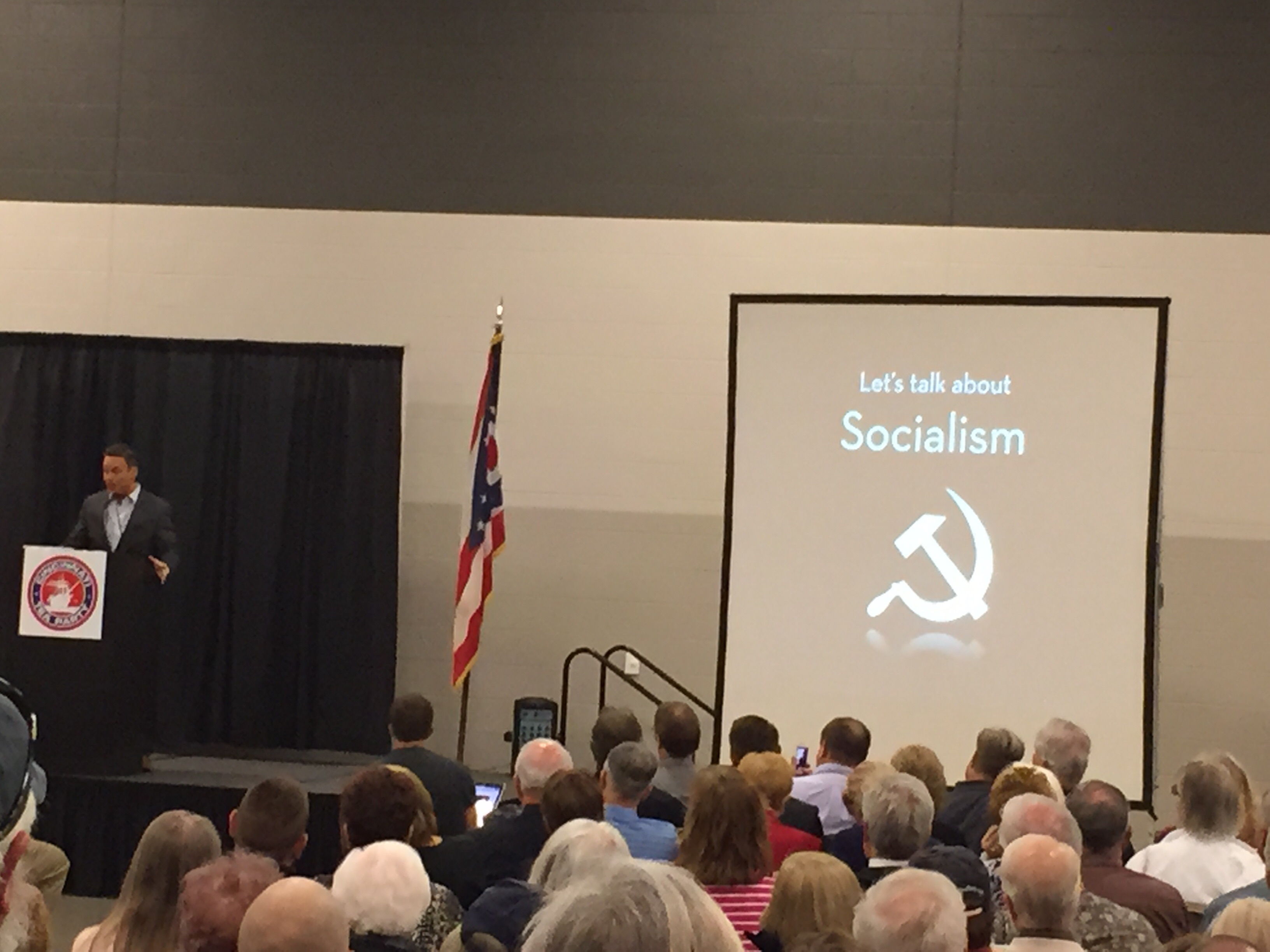 Kibbe’s speech left me thankful that he does all that he does. His contributions are direct, and having a dramatic effect. He is certainly one of the people in my opinion who have helped populate the field of current presidential candidates. His national work has after all these years began showing results–and for those in the Tea Party movement, they are favorable. It is certainly because of people like Ann Becker that the Cincinnati Tea Party is still so respected, but it is because of those like Matt Kibbe that advances in political, and economic philosophy have brought to fruition an option in thought that just wasn’t present in American politics six years ago. It has been a great six years, and the next six will produce advancements unfathomable to the John Boehner types of yesteryear. And the responsibility for many of those advancements will fall directly to the antics of Matt Kibbe and his FreedomWorks network. It is for that reason I enjoyed meeting him so much.