The Treachery of Mr. Thompson: Thorium’s tenacious enemy

For me, there were several moments in the new film Atlas Shrugged Part III: Who is John Galt which was particularly powerful.  But the most powerful attribute of the film based on the 1957 novel by the same name was the actual electric motor invented by John Galt which runs nearly self-sustaining and provides all the power needed in Galt’s Gulch.  In the film when the police come to arrest Galt and take him to see Mr. Thompson they attempt to break into the room where the magic motor is kept only to discover that there is nothing there.  This was a neat concept as the motor seemed to be hidden from the world through a dimensional fold in space-time continuity which further substantiates the quality of the John Galt figure as an expert in physics.  In the film it was science fiction, but little do many know that such science is actually quite factual.

Several years ago I wrote an article about the technology of Thorium—which has the ability to provide power—extremely clean energy, and cheap to every home in the world.  A revolution in Thorium could give the simple hut in the middle of Africa or Brazil electric power without complicated infrastructure, and costly imports from foreign suppliers.  CLICK HERE TO REVIEW.    By clicking that link, you will see dear reader that the kind of energy shown in Who Is John Galt is not just science fiction, but is entirely rooted in reality.  But as usual, the reason that we do not have such technologies are the same ones provided in the film—the desire for power by characters like Mr. Thompson prevent technology from arriving to the marketplace because it denies the intellectually insecure control over the delivery method.

I have been a student of management methods for most of my life and I know all too well the cause of most misery in the world—its self-inflicted neurosis by the power-hungry to control the many through laws, technology, and other forms of manipulation.  There are many who work for organizations like the Red Cross—who get invited to Washington parties due to their altruistic endeavors overseas who would despise seeing a Thorium reactor powering a village in Africa.  Deep down inside they want African people dependent on charity organizations to bring food and medical supplies to the poor so that they have something beneficial to do with their lives.  They want the death and misery because they believe it will get them into heaven through some distorted grasp of Biblical teaching.  They cannot accept that by giving the people of Africa power that they might care for themselves—therefore not needing the West to care for them at all.  So they deem Thorium technology dangerous and a threat to the earth—so to take the debate off the table.

Another set of characters who do not want Thorium power, or anything like it, are those who work in the dirty energy business—oil and coal.  Although there are great uses for these energy providers today, at some point in the future—we can do better.  Thorium is but one potential source.  However, the energy industry does not want to alter their market plans—their labor unions don’t want the competition, so they lobby politicians to maintain the status quo.   Many publications against fuel sources like Thorium are created through this method—to scare the public into submission of dirty fuel forever—leaving greenie weenie activists plenty of ammunition to utilize against such industries as environmentally hazardous.  So in a stalemate between the environmentalists who believe the printed articles against Thorium and the dirty energy companies making great livings off the old technology—nothing happens.  After all, the goal of the typical progressives is not to advance forward as mankind but to make the developed world more like the undeveloped—to demonize technology until everyone lives in a kind of hut—like the poor Africans.  Watch the following video documentary about Thorium to learn much more.  

Since I wrote that article about Thorium nothing much has happened to advance the technology just as nothing much has happened regarding the Mollar flying car.  The technology is there to cure cancer, to fix bodies through regeneration, to have self-sustaining electrical power, to completely revolutionize the transportation industry—but what is in the way are too many people like Mr. Thompson in Atlas Shrugged Part III.  For those who criticize Atlas Shrugged, if people like John Galt were free to think and act without restriction, world hunger would be eliminated, poverty would be nearly eradicated, disease destroyed, cancer solved and society would advance greatly.  But the trouble is we allow people like Mr. Thompson to stand between us and fate.  We give them power because we fear the responsibility of it.  Mr. Thompson in the film Atlas III was a complete idiot, he does not fear that responsibility, but is addicted to the power it gives him making him an opposite menace.  There are many like him running governments and companies the world over and they are there because we fear what might happen when altruism is stripped from our reasoning.  Society fears not having problems that require charity—because their ideals of religion and good living have been defined by misery—and stupidity.

So it was wonderful to see the science fiction of a world where at least someone has broken through the shroud of foolishness and actually built a perpetual motor that runs off static electricity naturally existing in the world around us—which never ceases to run and does not need government, infrastructure, labor unions, or the Red Cross to operate.  As usual it is groups of people who stand in the way of what human beings can invent for themselves to advance their culture—but through advancement those who currently have power would lose it if they could not adapt to the changing circumstances.  It is those who run those groups who fear losing their power to the self-empowering technology that comes with invention.  It almost always comes down to poor management ability of personal and external resources and the secret desire to control those resources so that options are limited.  Some examples might be the fearful husband who tries to keep his wife lacking a car because he fears she may seek to cheat on him.  It doesn’t occur to him that if he were a better husband, that such temptations might be avoided.  So rather than deal with the effect of the cause, he denies the mechanism for performing the task out of fear of losing control of the wife.  The same might occur when a boss sees in a subordinate ability that might challenge their authority in the future, so they find ways to clip the wings of the subordinate through management tricks so to keep them grounded and under control.  This actually happens every day in virtually every place of business on the face of planet earth.  Or consider the lazy parent who attempts to make their children fearful of everything because they don’t want to get up off the couch to help teach a curious child—so they numb that curiosity with fear so that they can be free in the afternoon to catch Jerry Springer at 5 PM.

Governments run by people like Mr. Thompson have strangled our future through such methods and most accept that reality as a fact because they are beaten and defeated people intellectually crippled at birth by an anemic education system and faulty parents.  But a few, people who went to see Atlas Shrugged Part III and enjoyed it—even with all the flaws of the film technically were able to see the miracle of the John Galt motor and know that the possibility for such a thing is very real—and immensely intriguing.  I think I’m going to see that movie a few more times before it leaves the theater just for the pleasure of seeing such a world alive even in the fantasy of a darkened theater.

Rich Hoffman

www.OVERMANWARRIOR.com


The Dot and the Line: A Romance in Lower Mathematics

There comes many times over any given year where I find myself in a situation that in order to explain a basic elementary ideal to someone who requires a vast background education just to grapple with the topic at hand, I have to find some way to show them a proper metaphor to bring them up to speed.  They do not have the foundation understanding to build anything of merit conversation wise–when they ask a question, or series of questions just to understand the answer given to them.  Sadly, modern culture has failed to deliver those foundations to the last couple of generations.  There is a part of me that feels sorry for those people, but not to the extent where I am willing to sacrifice my own happiness to quell their suffering.  The reason is logic and a foundation belief system that is rooted in another time when the world made a lot more sense.  It wasn’t however that long ago, but just long enough for modern society to completely revert to the animal mindset of a scribble.

I feel fortunate to have grown up in a time when one of my favorite cartoons was called The Dot and the Line: A Romance in Lower Mathematics which played continuously on the Looney Tunes half hour afternoon lineup every day after school.  It was my favorite cartoon as a young kid which came out in 1965 and was directed by my favorite animator, Chuck Jones.  I watched his cartoons as a child and read his book as a young man in my twenties and soaked up every word.  That particular cartoon was a masterpiece and a needed lesson for every young male looking for love.  Watch that classic cartoon below before continuing:

That cartoon reflects an interesting period in American history, and such a time is mandated to return.  Because if it doesn’t, there will not be a civilization to behold in any capacity.  The cartoon is about values and the three-way romance between a dot, a line, and a scribble.  In 2014 America, it is the scribbles who rule the world in virtually every aspect of our society.  As a line who has forced himself to bend into many angles, I understand the line in the story very, very well.

The Dot and the Line: A Romance in Lower Mathematics (ISBN 1-58717-066-3) is a book written and illustrated by Norton Juster, first published by Random House in 1963. The story was inspired by Flatland: A Romance of Many Dimensions, in which the protagonist visits a one-dimensional universe called Lineland, where women are dots and men are lines.

In 1965, famed animator Chuck Jones and the MGM Animation/Visual Arts studio adapted The Dot and the Line into a 10-minute animated short film for Metro-Goldwyn-Mayer, narrated by Robert Morley with the narration almost verbatim to the book. The Dot and the Line won the 1965 Academy Award for Animated Short Film.[1] It was entered into the Short Film Palme d’Or competition at the 1966 Cannes Film Festival.[2]

The cartoon was released as a special feature on the The Glass Bottom Boat DVD in 2005. The cartoon is also featured on the 2008 release of Warner Brothers Home Entertainment Academy Awards Animation Collection and the 2011 release of the Looney Tunes Platinum Collection: Volume 1 Blu-ray box-set on the third disc as a special feature. In 2005, Robert Xavier Rodriguez made a musical setting of the book for narrator and chamber ensemble with projected images, and in 2011 he made a version for full orchestra.

The story details a straight line who is hopelessly in love with a dot. The dot, finding the line to be stiff, dull, and conventional, turns her affections toward a wild and unkempt squiggle. The line, unable to fall out of love and willing to do whatever it takes to win the dot’s affection, manages to bend himself and form an angle. He works to refine this new ability, creating shapes so complex that he has to label his sides and angles to keep his place.

The dot realizes that she has made a mistake: what she had seen in the squiggle to be freedom and joy was nothing more than chaos and sloth. She leaves with the line, having realized that he has much more to offer, and the punning moral is presented: “To the vector belong the spoils.”

http://en.wikipedia.org/wiki/The_Dot_and_the_Line

Clearly the story of the dot and the line is a morality tale about values; the scribble didn’t have much to offer the dot once she realized that the line had advanced himself into a sophisticated dynamic.  To my young mind it took me nearly twenty years to forgive the dot for neglecting the line in the first place running off with the scribble.  I always sympathized with the line and always—always hated the scribble.  Hate actually may not be a strong enough word—but the human language has not yet come up with something stronger—so for now we’ll let it stand.  But as the years moved on and my life experiences filled me with observation I realized that the journey of the dot running toward the scribble is what drove the line to become better.  If such a thing never happened, the line would have remained one-dimensional and un-sensational.

I have learned throughout time that many women behave like the dot in the story.  They are drawn toward the scribbles of existence constantly pursuing a fantasy of reforming them—mothering them into health.  Women are often not interested in a straight line which does not require their love and affection—they are almost biologically drawn toward scribbles by default.  This is a painful realization if you were born to be a line.  However, if competition is embraced, the line can become something more than normal and if he forces himself to the task, can become much more powerful than the scribbles of existence.  The dot is the female goddess who brings out in the clash of males the best between the two through competitions for her affection.  Without that bar of measurement, then scribbles are the default mode of males.  What has happened to our current society is that females have given up hope of ever seeing a refined line and are just giving up and falling for scribbles.  If scribbles rule the world, then the world becomes their image.  Without the refined, well-managed—articulate lines—the world crumbles.

In this romance the dot plays her part in being the vehicle of transformation of the line into something better.  The scribble plays his part as a rival for the line to work against, but the line is most important—because it is he who brings order and morality to the world through his refined action.  Without that understanding, there is no way for any contemporary conversation about value between males and females to take place.  But make no mistake about it—the villain of life itself is the scribble.  The morality of the scribble is not something to be cherished on any level—but despised and beaten utterly.  There is no choice in the matter.  It is the way things have to be.

Rich Hoffman

www.OVERMANWARRIOR.com


‘Atlas Shrugged Part III’ Movie Review: The value of a gift–a scribble and a diamond

I have received many gifts from people over the years that were expensive, and well crafted.  However, some of the best gifts I have received came from children whose minds were just coming into their own and what they gave me was a scribble on a piece of paper that to them looked like a da Vinci painting.  To me it looked like scribbles but I saw within their gift all the hopes and dreams of their thoughts which have more meaning personally than a Rolex watch, or a new Mercedes car.  Society the world over may look at such scribbles and think them inferior to the diamonds, and other luxury items, but not me.  I’d rather have the childlike scribbles of ambition and innocence than the refinement of cultural creations.  And that is exactly how I felt walking out of the new film Atlas Shrugged Part III: Who is John Galt.   The film itself was far from technically perfect—the filmmakers themselves without the polished background of the greater Hollywood community are like children coming of age—but even their shortcomings garner superiority when compared to the standard product coming from the vast ocean of entertainment culture.  I’d rather see two or three movies per year like Atlas Shrugged Part III than twenty polished blockbusters lacking a heart and soul.

The third film in a series of three Who Is John Galt was a movie about values.  Based on the treasured novel Atlas Shrugged, it did a good job of Cliff-Noting through the most important topics of the American classic.  The famous John Galt speech from the novel to the movie was greatly condensed and enormously effective.  The sections of the movie containing the speech along with the scene between John Galt and Mr. Thompson was powerful.  Just a few weeks prior to the release of Who Is John Galt, I watched Steven Spielberg’s Lincoln and can declare that there was nothing in that great movie about the last days of the Lincoln presidency that eclipsed the value of John Galt being offered all the power of the world by Mr. Thompson and Galt laughing in his face saying, “nobody should have that kind of power.”  For me, it was the most powerful scene in the movie—one I would pay again and again to see—just for that one scene.  There is within that exchange between Thompson and Galt the keys to most modern problems and Galt has the answer delivered with excessive minimalism.  The movie shines most during this moment.

Regarding Galt, Kristoffer Polaha played one of the most iconic literary creations wonderfully. There hasn’t been a better character of such swagger and confidence since many of the old Clint Eastwood movies.  Polaha was wonderful in the role and the movie could have excelled if it could have featured him more prominently—but there were a lot of characters and a limited time to get to the point of the movie.  So Polaha had to share a lot of screen time.   Of those other characters, they were as portrayed in Atlantis, the hidden world deep in the Colorado Mountains unlike any other characters in cinema.  Leading up to the movie the previews for upcoming releases featured two Reese Witherspoon films and a Bill Murray picture that were politically and ideologically 180 degrees in the opposite direction as Atlas.  In those films the characters in the Gulch would have been the villains.  In Atlas Shrugged those characters are the heroes.  It was clear that the target demographic for the typical Hollywood product had no idea who the viewer for Atlas Shrugged Part III would be because it was evident in the previews before the film.  Another television series was previewed at the Regal Cinemas called The Affair—as if the ideal of illicit romance was conducive to the message of Atlas Shrugged Part III—which of course it wasn’t.    One actress from The Affair declared during the preview—“We are all just trying to get by,” as opposed to the message of Atlas III by John Galt, “The world you desire can be won.  It exists…it is real…it is possible…it is yours.”  The philosophy of Atlas III is unlike anything being put out by Hollywood in any capacity—so for many people it is a very foreign concept.

My wife and I went to see Atlas III with our kids at the Regal in Mason, and didn’t expect much by way of a crowd.  We arrived about 25 minutes early to get a good seat.  I was a bit shocked to see that the only seats available for the 8:10 PM showing were high up in the stadium seating, which is not where I normally like to sit.  By the time the movie started, the theater was nearly full.  It was very close to a sellout, which was very encouraging.  Several times during the movie people cheered.  At the end of the film the audience clapped.  It had been a long time since I have seen that occur at the end of a movie.  So in spite of the parade of bad reviews and complaints about the technical aspects of the film, the audience I saw the picture with loved it—and were hungry for the message.  Most of the audience was above 40 years of age, and most were couples—(a man and a wife.)  However, dotted among the male and female heads of the audience were a few intelligent looking college students bright-eyed and excited—as if they were on the edge of a wave in thought.  There was rebellion in their eyes as if by coming to the movie, they were participating in a dirty little secret that the rest of society wish to conceal—and they’d be right.  Those same snickers came from young people who used to see The Rocky Horror Picture Show in 1975 and routinely since attend the midnight showings which promotes homosexual relationships and transgender exploits.  The Rocky Horror film is a terrible monstrosity of a movie that is now considered mainstream.  Any critic of the quality of the Atlas films needs to think long and hard about talking low quality cinematography, editing, and acting but praising The Rocky Horror Picture Show.  They can’t have it both ways.  Refreshingly, Atlas Shrugged Part III did have a sex scene that was very PG.  As written in the novel, it could have been rated NC17, but under John Aglialoro’s production value, it was greatly scaled back to nearly a G rating.  The filmmakers wisely knew that their audience was conservative and did not want the uncomfortable distraction of gross sexual imposition which comes in droves at the Rocky Horror Picture Show screenings.  For today’s young people, Atlas Shrugged is the new rebellion—and that delights me to no end.  It’s about time!

I will see Atlas III many more times and will treasure it for it’s worth.  I see the Atlas films as difficult to make and attribute most of their technical challenges to pushing the philosophy of Objectivism up an extremely steep hill.  My experience tells me that the panic of Mr. Thompson at the end of the movie is true and that the few people flying away in the helicopter at the end was 100% accurate.  There are always only a few people who do everything and that is a terrifying message to the masses who hope and pray that Mr. Thompson’s view of the world can be true.  Atlas Shrugged Part III tells them that it isn’t—and it is in that utterance that the anger toward the film is shouted loudest.  Atlas III is a work and offering of love by filmmakers who are coming into their own with the best tools available to them, like children trying to prove to the adults of the entertainment world that they have something important to say too.  The adults look at their offerings and see a scribble which they laugh off and make fun of.  But for me, I’d rather have the scribble of the Atlas Shrugged film makers than the polished diamond of Hollywood with messages that are false and completely ignorant.  It is for that reason that going to see Atlas Shrugged Part III: Who is John Galt was more like a gift than an entertainment experience.  And it is one that I will proudly hang from my refrigerator like many of the fine art pieces that my kids have provided over the years on their progression toward expertise, to enjoy as a daily reminder of something that has value where others only see a scribble.

Rich Hoffman

www.OVERMANWARRIOR.com


11 Ways You Know You Live in a Country Run by Idiots: The sad truth of our modern age


There has been a lot of talk in the news lately about abused wives who stay with husbands who beat them—primarily due to the latest round of NFL domestic violence cases. The level of amazement persists from millions who wonder why gold digging women would stay with men who beat them routinely. But for the answer, all anyone need to do is look at themselves and wonder why they allow the same type of abuse when their government is doing the same on a larger scale. That abuse tends to be more psychological as opposed to physical, but it is still abuse and representative of a dysfunctional household. Below are 11 ways that you know you live in a country run by idiots prone to abuse. To continue to allow these idiots to have such power over the population is allow an abusive relationship to continue. Here they are:

1. If you can get arrested for hunting or fishing without a license, but not for being in the country illegally, you live in a country run by idiots.

2. If you have to get your parents’ permission to go on a field trip or take an aspirin in school, but not to get an abortion, you live in a country run by idiots.

3. If you have to show identification to board an airplane, cash a check, buy liquor or check out a library book, but not to vote on who runs the government, you live in a country run by idiots.

4. If the government wants to ban stable, law-abiding citizens from owning gun magazines with more than ten rounds, but gives 20 F-16 fighter jets to the crazy leaders in Egypt, you live in a country run by idiots.

5. If, in the largest city, you can buy two 16-ounce sodas, but not a 24-ounce soda because 24-ounces of a sugary drink might make you fat, you live in a country run by idiots.

6. If an 80-year-old woman can be stripped searched by the TSA but a woman in a hijab is only subject to having her neck and head searched, you live in a country run by idiots.

7. If your government believes that the best way to eradicate trillions of dollars of debt is to spend trillions more, you live in a country run by idiots.

8. If a seven-year old boy can be thrown out of grade school for saying his teacher’s “cute,” but hosting a sexual exploration or diversity class in grade school is perfectly acceptable, you live in a country run by idiots.

9. If hard work and success are met with higher taxes and more government intrusion, while not working is rewarded with EBT cards, WIC checks, Medicaid, subsidized housing and free cell phones, you live in a country run by idiots.

10. If the government’s plan for getting people back to work is to incentivize NOT working, with 99 weeks of unemployment checks and no requirement to prove they applied but can’t find work, you live in a country run by idiots.

11. If being stripped of the ability to defend yourself makes you more “safe” according to the government, you live in a country run by idiots.

There is no dispute in these assertions. Yet they continue and prosper—and the reason comes from the same people who point to the NFL and call for Rodger Goodell’s head for allowing domestic violence to occur from his players. The government is engaging in far worse abuses—yet we keep coming back time and time again. The reason is the same as the abused NFL wife—because people become comfortable even within abusive relationships as they function from low self-esteem—which a predator like the government will always take advantage of.

http://www.theblaze.com/stories/2014/09/10/glenn-beck-reads-11-ways-you-know-you-live-in-a-country-run-by-idiots/


Rich Hoffman  

www.OVERMANWARRIOR.com


The Grinding Hurt of Betrayal: John Aglialor’s ‘Atlas III’ interview with Nick Gillespie

The third and final installment, Who is John Galt? hits theaters on Friday, Sept. 12, 2014 and John Aglialoro sat down with Reason TV’s Nick Gillespie to discuss the completion of the Atlas Shrugged films, their negative critical reception, and the enduring influence of Ayn Rand’s thought. As usual when it comes to Gillespie, it was a good interview and covered a lot of ground. It is a tough task to adopt a film from a novel that means so much to so many people, yet a movie is the perfect gateway to bringing more people into the Objectivist philosophy. Many hard-core Rand fans from the novel want the salacious sex that Ayn Rand wrote about—which was greatly removed from John Aglialoro’s renditions. Personally, I’m grateful as the sex could easily overpower the story in such a movie and I appreciated the tastefulness that it was handled by the Atlas Shrugged trilogy.

http://reason.com/reasontv/2014/09/08/producer-john-aglialoro-on-ayn-rands-imp

Every time I watch Aglialoro in an interview it is easy to see the hurt behind his eyes. Like Rand, who thought that the unspoken and neglected businessmen would flock to her support of them after the release of her 1957 novel, most cowered in the darkness like idiots paralyzed by the political left into silence. Aglialoro during the second film premiered Atlas II in Washington D.C. right before the 2012 election. Not a single politician, not Ted Cruz, not Rand Paul and certainly not Vice-Presidential candidate Paul Ryan showed up for the movie as they tried to maintain their political distance—so not to have people from the left call them names. Ryan had been an open Ayn Rand supporter before being put on the national ticket with Mitt Romney. Nobody from the political class showed up in Washington D.C. to show their support of a conservative leaning movie featuring ideals that the political right should have openly embraced with great enthusiasm. Republicans played it safe and guess what………….they lost in the 2012 elections all across the nation.

I have felt the bite of that kind of pain a time or two, most recently when I was on 700 WLW radio dealing with a controversy—a sexist accusation by my political enemies who were trying to the same smear tactic used against Rush Limbaugh and Mitt Romney at the time. Unlike those guys, I defended my position proudly. In 2012 I was a spokesman for a group standing against higher school taxes, which was a very unpopular position. I had in my circle a number of high-profile movers and shakers and was proud of them for supporting such a controversial topic. My plan with the pro tax people was in full swing, they were attacking our side by calling us greedy businessmen, so I attacked back with the truth—that a majority of the pro tax advocates were fat assed, out-of-touched parents. Of course they didn’t like it—because the truth hurt. I meant for it to. So I was on the air ready to defend our position and those prominent local businessmen and politicians sent a press release to the station while I was on the air distancing themselves from me. The controversy I didn’t mind at all. The betrayal did bother me. I shut off interviews for the rest of the day as I recalibrated my position. It hurt terribly to trust people then watch them fall for the old liberal tricks of guilt abasement. I couldn’t let that hurt come out in my public statements—which is a really tough thing to do when an entire city is ready to pounce on your every word.

The motivations of those fearful dissidents are the same at every spectrum, from Ayn Rand, to John Aglialoro, to me—we have all been left at the alter by those we were trying to help. It feels like being cheated on by a spouse—just as you are declaring your love for that significant other, you learn that they have been doing the horizontal shuffle with the very people you are fighting—and it hurts. It hurts whether it is sex or politics—in both cases you end up screwed. It is that screwed look that Aglialoro has on his face with each interview he does. He was much more hopeful after Atlas I did respectable opening night numbers, but by the time Atlas III hit theaters he had a hurt look on his face from all the betrayals he had experienced over the last couple of years, while making the movie. For him he continued to make the movies even though very few supported the endeavor. The enemies of the movie were perplexed as to why he continued even though the films were box office failures and did not have majority support from the public. What those same people did not understand was that John Aglialoro made the movies for himself, not for the public. He did it to accomplish a task, not to win approval as a second-hander. Since most of society functions as second-handers, they don’t understand Aglialoro, or his movie. So there is sadness when he talks about the films. He knows as the words leave his mouth that nobody really is going to understand why he made the films—yet he does it anyway in a hope that something will change—someday.

Atlas III won’t be any different. People who understand it will love it, various others who have skin in some type of political game, even within Ayn Rand circles, will hate it. They’ll hate it for Aglialoro’s point of view in making the movie—they’ll complain about the lack of sex, the lack of depth, the lack of good actors, the lack of budget, the lack of public support, the lack of technical aptitude, and every lack of anything else they can think of. But what they can’t accuse John Aglialoro of is a lack of heart and determination. What he did was hard and deserves admiration in the face of much hurt which only those who have been betrayed in a similar fashion can understand.

Rich Hoffman

www.OVERMANWARRIOR.com


Atlas Shrugged: Now, Non-Fiction

I’ve been involved with literary driven “think-tanks” for several occasions in years past covering everything from James Joyce to Thomas Mann. All those authors were wonderful in their own way, even the collectivist Victor Hugo and Russian recluse Leo Tolstoy. But they were not as good as Ayn Rand who changed the literary narrative with her larger-than-life characters. Rand’s characters are not like Marvel Comics superheroes, they are every day people lacking magical powers, but they are non-the-less super. They are an inspiration to all who ever wanted to be a superhero as a corporate businessman or woman—and continue to resonate particularly in America as a mold to follow. Ayn Rand is one of the most prolific and most important writers in American history which is saying a lot. Her work of most importance was Atlas Shrugged and began as a kind of science fiction fantasy in 1957 and has proven itself to be astonishingly prophetic in 2014 just prior to the third release of a movie adoption based on John Aglialoro’s interpretation of the novel. The movie hits theaters on September 12th, but the book continues to sell, and sell, and sell because the content which appeared sensational at first—and unrealistic is occurring almost on queue just as Rand always thought it would. The producers of the new movie have put together a wonderful little documentary which features clips from the new film seen below called Atlas Shrugged: Now, Non-Fiction and is well worth watching. In addition to clips from ASP3, this video includes commentary from liberty leaders including Ron Paul, Matt Kibbe, Jonathan Hoenig, Phil Valentine, David Kelley and more.

Atlas Shrugged is not for everyone. It is however for the kind of people who work hard and try every day to be the best they can be. If you are the kind of employee who usually works later at the office and is the first to arrive in the morning—you will like Atlas Shrugged. If you are the kind of person who runs over rate in a union shop—even though there is intense opposition against you for doing so, Atlas Shrugged is for you. If you are the kind of person who is constantly hounded by family and friends to step down off your “high horse” so that you are more “likable” and approachable, you will like and enjoy Atlas Shrugged. However, if you are the kind of person who hates those who do all or even part of the above—you will hate Atlas Shrugged and will do everything in your power to disgrace the literary work from being recognized as a literary endeavor.

For the same reason that the co-worker who feels guilty by leaving the office before the star of the company does attempts to put pressure on that person by saying “it’s time to get out of here” Atlas Shrugged is slammed and ridiculed.   Not because it is a bad novel written poorly—but because it makes guilty people feel bad about themselves. They feel bad because they have sold out. Their ideal of a superhero has been regulated to someone who is bit by a magic spider—or someone who comes from another planet. They don’t look in their mirror and see anything super about themselves and they are too lazy to develop it on their own. Atlas Shrugged   shows how average people are super just by having values and fighting to maintain those values. It is also about how it is that adherence to value which makes the engine of the world run, culturally, economically, and philosophically.

When John Galt proclaims that he will stop the engine of the world in the new film version titled Atlas Shrugged Part III he is stating that by removing his value from an organization, or society in general that the parasites of reality will have nowhere to hide and civilization will collapse. What prevents this collapse from occurring is that the few protect the masses with their values. But over time it gets harder and harder leaving the looted few to eventually become depleted and perish. The masses expect this sacrifice to occur—they expect the few to serve the many and those with value to give it to them in their vacancy. It is this belief that destroys the world and why the classic novel Atlas Shrugged has now been declared non-fiction—because it has all come true.

The people who hate Atlas Shrugged are also the same people who hate those who try to be good—too good. They are advocates for complacency—for setting the bar low so that they can easily achieve success in life. Ayn Rand’s novel points to that tendency as the invisible destroyer of the world and spits on it placing value where it deservedly always belonged with the heroes of creation—those who work late, early and often—who don’t live their lives through others, but in spite of the efforts to stop them. That hatred is very real. The masses of existence—who advocate so loudly for democracy are the same people who wish to believe that because they outnumber the truly good they can capture the definition of good, and bad, profitable, and unprofitable, and of success or failure. Atlas Shrugged was not written for those people—it was written for those who see heroic deeds in getting up in the morning to face the troubles of the world as an individual without apologizing for working every day to do the best in every aspect of their lives that they can. Ayn Rand’s heroes are not drunks, sexual deviants, or crooked politicians. They are not truly fearful of anything—because they know that it is they who are ultimately in control—so they trust themselves to overcome any problem that comes their way. This gives the heroes a god-like presence in the Atlas Shrugged novel as interpreted by the weak, frightened, and complacent.

Atlas Shrugged was so brilliant because it goes literally against thousands of years of sacrificial belief by the human race. Rand could have played it safe and given the world a novel reminiscent of War and Peace. But she didn’t instead she wrote an epic book of similar length and content but along the way tackled directly the philosophical failure inherit in human beings ridiculous belief that achievement of anything is caused by “sacrifice.” Rand challenges that premise and her heroes refuse it revealing the true success of all societies that prosper. It is literally the best kept secret—and Ayn Rand exploited it putting it in story form so that it would be easy to understand. It has taken literally a half of a century for most of America to figure out the meaning of Atlas Shrugged. Even today, after decades of contemplation, only a handful of the population anywhere in the world understand the message because in any company, any institution, any endeavor what-so-ever, there are only a few who work 12 hour days for the joy of it, get up before the sun even considers rising, because they are trying to squeeze more life out of daylight once it arrives, and do good work not for the pat on the head, or even a pay raise—but because it makes them feel good to do good work.

Atlas Shrugged is essentially the first major literary work in human history that recognizes the benefit of good work and productivity over the emotional pleas of the democratic masses who lobby with every effort to stop the productive who make them feel guilty for being less than robust. It is for that reason that Atlas Shrugged continues to draw scorn from intelligentsia because they want a monopoly on social opinion built upon the foundations of laziness. It is also why Atlas Shrugged is only playing in a few hundred movie theaters and why even in those theaters there will be only 5 or 6 groups of people seeing the movie. The people attending will tend to be the last to leave at their places of business, and the first to arrive, they work hard and take pride in doing a good job—and they can relate to the kind of society that John Galt builds in Atlantis during the film. And as every organization in the country knows, there are always those few who do most of the work. Atlas Shrugged is made for them, not the other idiots who stand at a time clock five minutes before the end of a day and flee to the parking lot like escaped convicts once their work is over for the day only to complain and bitch about how sucky their lives are for the rest of the evening. What happens when people stop doing the extra work for the pure enjoyment of it? You get the events of Atlas Shrugged—now-nonfiction.

Rich Hoffman   www.OVERMANWARRIOR.com


‘Atlas Shrugged Part III’ is Showing at Mason’s Regal: Why Mahogany’s is failing while The Blaze Pizza thrives

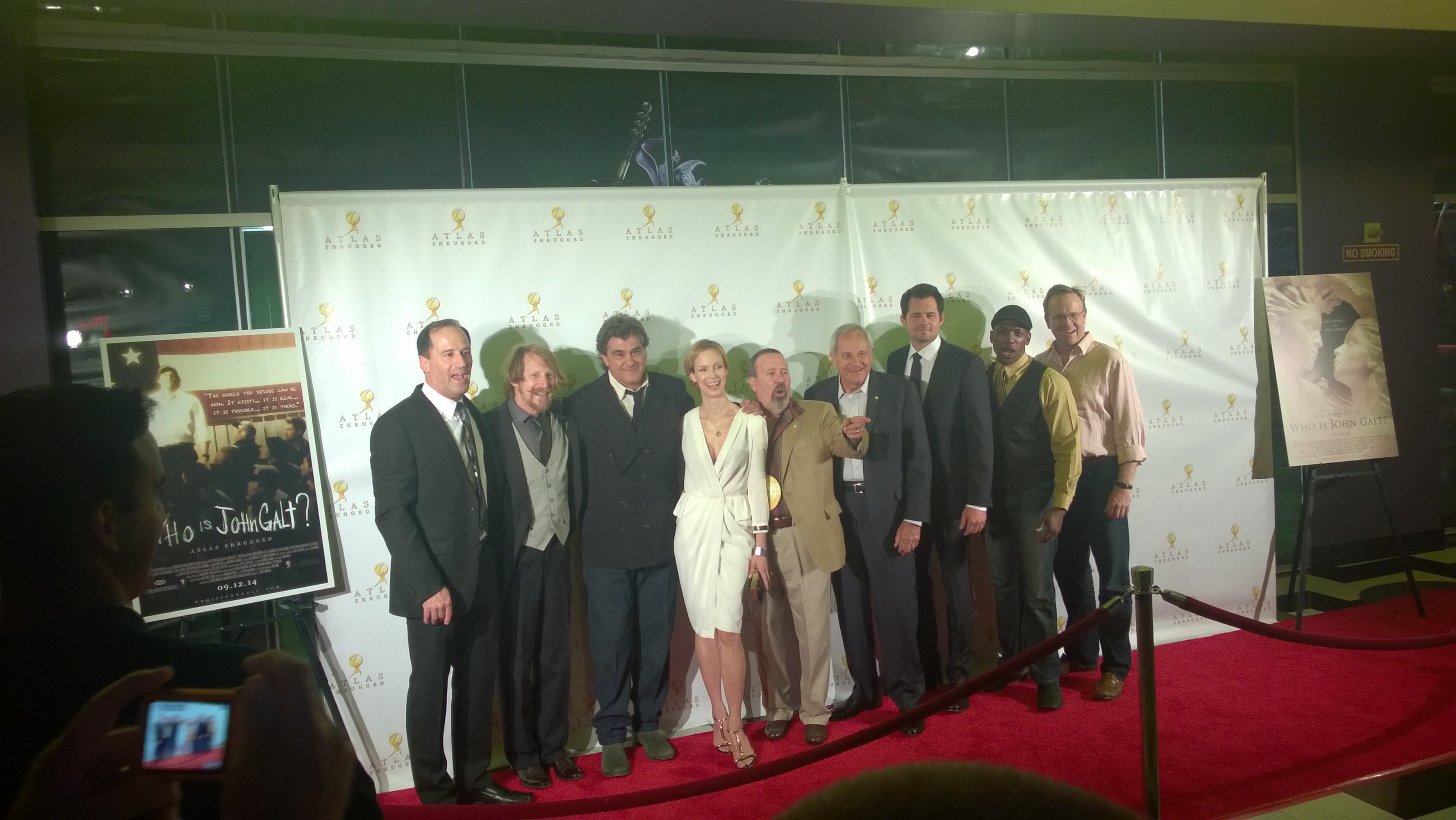
If you read this site there is only one place you should be on Friday September 12th, and that is the Regal cinemas in Mason, Ohio.  The reason is that Atlas Shrugged Part III: Who is John Galt hits theaters that day and the only place in Cincinnati that it can be seen is at the Regal.  The Regal has been very supportive of the Atlas films over the years and I can’t think of a better theater than that one to see this new movie at.   I have been to every theater in the Cincinnati area for some reason or another and the Regal is one of my favorites.  I love the way it sits on a hill looking out over all the development of the Fields Ertel region.   For Atlas, after the kind of philosophy that is explored in that movie, those are the kinds of things you want to see while going to dinner after—development, excess, and elements of capitalism.  You don’t want to see slums, decrepit people addicted to welfare, and you don’t want to see defeated people.  In Mason, just down the road from the theater are million dollar homes, P&G is across the street, and countless restaurants of all varieties are available for selection.  It is a wealthy area representative of the type of values that the Atlas films advocate.  So the Regal is the place to see Who is John Galt.  The premier for the film just occurred in Las Vegas as seen in the picture below with Laura Regan in the center who plays Dagny Taggart.  She is a very good Dagny.  Women should feel honored to see such an empowering woman in such a strong role.image

It’s OK to be a little snobby especially in regard to surroundings while seeing certain kinds of movies for leisure entertainment.  So often hypocritical assessment is applied to these types of things—the same women who declare that they support feminism and a helping hand to the poor—along with other progressive values are the same women who shop at the Fields Ertel area because they are afraid of the gangs of youth that accost them at the shopping malls to the southwest and avoid Ayn Rand because she is against their system of beliefs.  But in regard to that, no author has ever written a stronger female lead character than Dagny Taggart.  She’s in charge of a railroad, she has the heart of the strongest most profound male character in classic literature and she is unyielding during the entire Atlas Shrugged story—right up until the end.  You’d think that feminists would flock to see Laura Regan’s portrayal of Dagny Taggart—but of course they won’t, and can’t.  Their politics betray them.  So it was nice to see Laura Regan posing proudly with the producers during the premier.  The producers worked their asses off to make that movie and it is good to see her embrace the role without political shame.  Atlas Shrugged punches through much of that modern hypocrisy of politically correct behavior.  So in tribute to that honesty, I can be quite forthright—when I see Atlas Shrugged Part III at a theater, I want that theater to be nice—I don’t want it to smell like dirty kids, I don’t want to park next to beat up pieces of shit cars, I don’t want to sit next to walking zombies of people slack-jawed and stupid, and I want to drive down roads to and from the theater lined with wealthy businesses oozing with creativity.

One such place that embodies the kind of business that might be found in Atlantis featured in Atlas III is the Blaze Pizza which is just down the road from the Regal Theater.  Mason was one of the test locations for this burgeoning franchise which was quite an honor.  The reason is that the demographics of the area are conducive to their market research.  The Blaze Pizza is about to explode all across the nation, but there are still only a few locations and Mason is one of them.  What makes them unique from other pizza places is that they make customized pizzas in a fast food style.  The pizza is literally made right in front of the customer and fired in a gas fired oven and ready by the time you pay for it.  They are the Chipotle of pizza making.  Their pizzas are typically a $15 of value which they sell for around $7 to $8.

The Blaze does great numbers and is changing the industry of pizza making.  My daughters introduced me to the place and we plan to visit there after seeing Atlas Shrugged Part III.  Also, we have plans to bring The Blaze Pizza to my grandson’s birthday party which is coming up quick because what they do is so good and unique that it is worth it.  It is in that type of business creativity that the movie Who is John Galt is all about.  So it is fitting to have the film playing at the Regal while burgeoning businesses like The Blaze Pizza are changing the industry right next door.

The Blaze Pizza is not the only regional business in the Fields Ertel location that I enjoy.  Although it is dated, I happen to like the Pizza Tower which is also down the road.  I love the Kings Auto Mall, I like White Castle, Frisch’s and the half-dozen other fine restaurants up and down the strip all with wonderful market niches that they have carved out for themselves in the Mason, Deerfield township area.  But the reason they are there is because the area is wealthy, and that wealth was created by cleaver ideas like The Blaze Pizza and capitalism in general.  In Mason, there is some socialism around the government school, and the city politics, but it is still minimal.  The character of Mason has been shaped by the amusement park Kings Island which is also down the road, the PGA Tennis tournament, and the Jack Nicklaus Golf Center which is right across the highway from Kings Island.  Next to Kings Island is The Great Wolf Lodge, a giant hotel chain with and indoor water park on-site.  I love the region because capitalism still rules in that area which is why it is fitting that Atlas Shrugged Part III play there and no place else in the city of Cincinnati.

Elsewhere, socialism has taken hold.  For instance much as been made about the failed restaurant on The Banks in Cincinnati called Mahogany’s.  That restaurant is a government planned project where money was poured into the deal by the city to prop up a minority owned business.  Liz Rogers is the owner and has been losing money for over two years forcing the city to consider further bailouts of her.  Her attorney recently plead her case to the Cincinnati Enquirer reporting, “General Electric has a tax credit worth $51 million dollars for its new banks project , and Liz has worked for two-plus years without drawing a salary, which is more than you can say for the top dogs at GE.  But why has she done this?  Because she has a dream and a vision of a better Cincinnati, one that appreciates Southern cuisine.”  The Enquirer—a very progressive newspaper owned by Gannett goes on to say, “on the other hand, we have had the dubious distinction of race riots.  The federal government has monitored our police force after accusations of brutality, and some undoubtedly legitimate complaints.  Our schools are integrated (by busing) but our churches and social life are largely segregated (by choice and comfort level) It goes on and on like that discussing Harriet Beecher Stowe, Jackie Robinson and Louis Armstrong.   

But what the Enquirer doesn’t deal with is that people don’t want to go to a restaurant that they don’t support through free market capitalism.  Cincinnati as a government should have never become involved in tampering with the free market hoping to prop up an owner just because of the color of her skin.  Basically here is the gist, the city government in Cincinnati thought it would be cool to have a black owner of a restaurant on their coveted banks project which has taken over 20 years to build.  I’ve been to The Banks on several occasions, and it’s nice.  I typically eat at Great American Ball Park or at the Christian Moerlein Larger House (wonderful place by the way).  Liz has not been successful because with other options at The Banks that are better, Liz is sinking.  The socialism of Cincinnati and the Enquirer failed because they put value on skin diversity over values of intellect—resulting in the failure of Mahogany’s.

The Blaze Pizza is doing well in Mason because they did market research and used private investment to make a proper business decision.  When it came to Mahogany’s all the socialist civil servants thought it would be wonderful to have a “woman” and a “minority” member an owner of a restaurant on The Banks.  They thought it would be “stylish.”  They made their decision based on feel good politics, not free market considerations.  If Liz Rogers made a product with Southern cuisine that people actually wanted, the restaurant would be doing booming business, but people obviously don’t want that kind of food in that location, so it is failing.  Meanwhile, The Blaze Pizza is doing smashing business in its location and is now expanding.  It’s not because the owners are white, or male, but because they are competent and enterprising.  This is essentially what Atlas Shrugged Part III is all about.  Only in the movie it is Laura Regan playing Dagny Taggart who has all the answers for her railroad company that none of her male counterparts have a single answer for.  It doesn’t matter the color of her skin, but rather the contents of her mind that makes her either successful, or a failure.  Thus, the same goes for the success of The Blaze Pizza, and the failure of Mahogany’s.

This is why it is such a relief to see Atlas Shrugged Part III in Mason at the Regal as opposed to somewhere else.  After such a movie nobody wants to come out and see evidence of socialism and its failures with degenerate slack-jawed hippies, skate boarders, and gangs of thugs bobbing their heads to rap music.  To see a movie like Atlas for people who enjoy thinking and being successful at things, it is nice to take a vacation away from the poverty created by government tampering and enjoy an evening of excess produced by the capitalism of Mason, Ohio.  Those are many of the reasons and more that I am so happy that it is the Regal who is playing Atlas Shrugged Part III: Who is John Galt on September 12th.  It will be a lot of fun and a nice vacation away from socialism—at least for the evening.

Rich Hoffman   www.OVERMANWARRIOR.com


Ragnar Danneskjöld and Howard Roark Take On the World: Thoughts while trying to save the Cincinnati Ghost Ship

As the new film Atlas Shrugged Part III: Who is John Galt hits theaters and the production team wraps up their tasks for distribution now would be a good time to bring up some thoughts about the future.  In the Gulch I have brought it up before but knowing that Aglialoro and Kaslow are considering a miniseries based on Atlas Shrugged events to further explore the concepts of the novel, the time to further conceptualize that endeavor is now.  CLICK HERE TO READ ABOUT THE PREMIER.  In the new movie Eric Allan Kramer plays the famous pirate who is personal friends with John Galt.  I have thought for a long time that there are many untold stories which could be utilized to further advance the parts of the book that did not have time to make it into the original films.  (Click the link to read my previous article–Eric Allan Kramer, is playing the pirate Ragnar Danneskjöld in“Atlas Shrugged: Who is John Galt?.”  )  A show like that could be aired on The Blaze TV as Glenn Beck seems hungry to use his Dallas movie studios for something along these lines.  Such a thing may already be in the works at this point, but if it isn’t—and there is a desire to keep the Atlas film crew together—then it should be.

Over the summer I ran into an ancient relic of a steam ship called The Sachem.  Click the following link for a review.  https://overmanwarrior.wordpress.com/2014/07/15/saving-a-cincinnati-ghost-ship-history-and-methods-of-resurrecting-the-sachem/  As I toured that ship I couldn’t help but think of Ragnar Danneskjöld.  Thomas Edison and the adventurer Jake Martin essentially used the ship in a similar way that Ragnar would have from the novel Atlas Shrugged—only Danneskjöld was not under official government backing.  As I walked the deck of the ship known as the Cincinnati Ghost Ship hidden deep in the woods of Kentucky I couldn’t help but think of all the many hours of conversations that would have filled the cabins on the open sea with nothing else to do but to contemplate the advantages of Objectivism and the romanticism of the next great adventure.

I know a few people at The Blaze and contemplated having the ship resurrected by a film crew for its vast historic value not to become sea worthy again, but to set it up in a studio somewhere in front of a green screen to serve as a stage prop for countless episodes of thematic television exploring the Objectivist life of Ragnar Danneskjöld.  After all, what museum would desire to preserve the old ghost ship and to what cost.  It would have little value used in such a way—but what if the old ship were converted into an actual set complete with cannons and modern gadgets that would make the modern pirate vessel fast and nimble on the open seas able to outrun the sluggish military vessels of the world’s governments.  But, the Atlas Company has more of an ability to do something like that and it’s currently their property.  But it sure seemed like a good idea.

Lately I have been writing a lot about the new Disney XD television show called Star Wars: Rebels.  That show will be a game changer both in thematic storytelling and content.  One look at the clip below will indicate what kind of cartoon that show will be—and kids are not the only target audience.  But what is bigger about the show is that it will give Disney XD an anchor that it currently doesn’t have.  Until Rebels went into production, I didn’t know that there was a Disney XD channel—but I do now.  The same thing could happen for The Blaze if it had the kind of show on it that people really wanted to see.

These days, a Ragnar television series could be done cheaply with models for wide shots in a tank and lots of night work.  I imagine that Ragnar Danneskjöld as a pirate would spend most of his time traveling at night and resting during the day.  Most of the scenes on the deck of his ship would have to take place at night, or below decks in the cabins where philosophical dilemmas would present themselves to advance the plot.  Another good example of how such a thing could be achieved for television would be the old Young Indiana Jones Chronicles.  A sample episode can be seen by clicking here.  Most of the show would be Ragnar Danneskjöld talking about Objectivist philosophy on the deck of his pirate ship at night in front of a green screen.  It would be up to writers to come up with some compelling narrative bookends to make people want to sit and listen to it all.

And while brainstorming here—it would not be out-of-line to have Howard Roark traveling with his wife Dominique mimicking the journey taken with Gail Wynand years before spending time with Ragnar in some of these adventures.  Howard being the master architect who has also quit the world isn’t in the Gulch, but is sailing the world with his wife.  There are opportunities for Objectivism there that are quite extensive.

For my own selfish reasons, I want such a show.  My friend Doc works at The Blaze as a radio guy and has Beck’s ear.  I want to help them out and get The Blaze to the level I know Beck wants to take it.  I also want more Atlas Shrugged movies.  I want television that is designed for people like me, because I don’t like much of anything that anybody makes—because it doesn’t hold my values.  But most of all I am looking for some way to save that ship.  Sure, it would be cheaper to build a ship like that from scratch, but a restoration in a dry dock condition would provide some much-needed press for such a project.  The ship itself might just provide some cross-over ink in the media—who will otherwise be turned off by anything mentioning Atlas Shrugged.

I only bring all this up because I know that there is a desire to continue with these Atlas films.  With each Atlas film culminating with Who is John Galt, they have only gotten better and it would be a shame to dismantle all that when Objectivism needs a voice to help usher it into the public.  It might take another 15 years, but the world is primed for the message.  It is only the delivery method that is in question—and the who, what, why, when and where.  I have looked forward to each Atlas Shrugged movie and even though I am extremely busy, I have stuck around the virtual Gulch for several years now adding to the conversation when and where I could.  I’d like to see that kind of thing continue to grow, and a good way to do that is to start another project if the money is there and a willing studio was in place that could pull off something like that affordably.

As Disney puts out their Star Wars: Rebels, the bar is set and primed for something like a Ragnar Danneskjöld television series.  Imagine Howard Roark and Ragnar sitting on the deck of a pirate ship concealed from the governments of the world all looking for a way to track down the elusive pirate—talking about Objectivism under a star-lit sky.  It could be a huge game changer in entertainment and that would be a suitable afterlife for the Ghost Ship of Cincinnati.

Rich Hoffman   www.OVERMANWARRIOR.com


‘Who Is John Galt’ Vegas Premier: The Real life 20th Century Motor Companies

It is a shame that Leonard Peikoff and most of the people at the Ayn Rand Institute did not embrace more openly the John Aglialoro Atlas Shrugged films.  I’ve read Peikoff’s book on Objectivism and would have thought that he would have supported the endeavor which premiered in Las Vegas last night showing the third and final film—which is clearly the best of the three film series.  All the Atlas movies were good, but this third film certainly puts the proper end cap on the long cinematic journey which took so many years for Aglialoro to achieve.  The key to the third film is in meeting for the first time the long talked about John Galt and seeing the kind of life that he inspired in a hidden valley called Atlantis.  The Atlas Shrugged filmmakers have been very open to those who are part of their online world called Galt’s Gulch and after several years of work had a special showing for them in Vegas which was a wonderful idea.  As for the work of Ayn Rand, I can’t think of anywhere better that Objectivism has gained the most ground than with the group that has emerged out of Galt’s Gulch at the Atlas Shrugged web site—and that would not have happened without Aglialoro’s films or his team behind one of the most ambitions independent films ever done.image

The third film is titled, Atlas Shrugged Part III: Who is John Galt and is clearly a work of philosophy draped with a love story between Dagny Taggart and John Galt.  It has a wonderful message and for those who think in such a way was a comfortable place to spend a couple of hours.  For the rest of the world—those who live their lives as second-handers—they will hate the movie.  Because of the effort involved, I wish John Aglialoro would have had a larger presence from the Gulch and that online media buzz would have been more robust.  But it has been ignored by virtually everyone, including The Ayn Rand Institute which has done a fantastic job over the years of keeping Rand’s books published and teaching Objectivism to people hungry for a functioning philosophy that actually works.  I can’t think of a bigger Objectivist event than Atlas Shrugged Part III premiering in Vegas and opening to the world on September 12th, but on the morning of the premier, there was not a single mention of the film by the Institute even though they have their big benefit dinner in New York City on September 23rd.  The closest that they have is that Yaron Brook is one of the guest speakers who was also a consultant for the movie.  But there is no direct mention of Aglialoro or the new movie by the official gatekeepers of Ayn Rand’s legacy.

With that kind of in-fighting there is no way that the rest of the nation or the  world can be expected to get behind an ambitious project like a film adaption of one of America’s most monstrously successful novels.  Like it or not, Atlas Shrugged is the great American novel and is much better—and more relevant than any of Mark Twain’s work or John Steinbeck.  Atlas Shrugged is what America was and will always be about and those who wish to change that definition absolutely hate the novel and refuse to recognize it—even though the public has bought the book for over half a century on pure word of mouth.  It is the biggest underground classic in print, and the Ayn Rand Institute has helped make that so.  They will only benefit from the John Aglialoro film as viewers wanting to know more will buy the book to get more details after watching.

To understand Atlas Shrugged and specifically this third film I recently drove my son-in-law who moved here from socialist England through the city of Norwood, Ohio.  In the movie, John Galt gives a speech to the owners and workers of a manufacturing facility called the 20th Century Motor Company that is being overtaken by a socialist plan hatched by the company’s inherited owners.  The labor union adopts socialism at the company which destroys the plant leaving it vacated of any life within a few years.  What they made at the facility becomes quickly lost to history.  Driving through modern-day Norwood I showed my son-in-law how the same thing had happened to that poor city just north of Cincinnati, Ohio.  I showed him the vacant spot where the Cincinnati Milacron plant used to be.  I worked there when I was young and felt very much like a young John Galt—the speech in the film hit home to me and was all too autobiographical.  Shortly after I left Milacron, the company destroyed itself with socialism and is no longer there.  It used to be a large sprawling campus in Oakley, but now it is empty except for a few small office buildings.  Just a few miles to the west are the remains of the old General Motors plant that built Cameros during the hot selling 70s and 80s.  Now it is an empty parking lot.  Across the Norwood Lateral used to be the largest movie theater house in Cincinnati, the Showcase Cinemas of Norwood.   I used to see small art films there like Clint Eastwood’s White Hunter Black Heart which played nowhere else in the city.  It only played there because they had so many theaters they could afford to dedicate a few of them to pictures that were more philosophic than commercial.  Back then, it was the kind of theater that would have shown Atlas Shrugged Part III.  Now that theater is gone, it’s an empty parking lot.  As Cincinnati Milacron died and the General Motors plant along with many other smaller businesses all for the same reasons—the investment money moved north to flee the high taxes of the city and parasitic nature of local governments who gain fame for themselves by spending other people’s money.  Norwood is essentially a ghost town today after only 20 years of failed economic policy—just like the 20th Century Motor Company in the movie.  The only theater that Atlas is playing now is where the money is currently, about 20 miles north in Mason, Ohio at the Regal.  Many of the people who reside in neighborhoods around that theater moved from areas like Norwood years ago leaving only the parasites living through socialism to inhabit which collapsed the economy.  Some of those Mason people understand the message of Atlas Shrugged because they have been through it, so the movie is showing there.  But for the people of Norwood who are typically on welfare, jobless, and from families with several baby daddies coming in and out of their lives—the Objectivist message of the Atlas films are lost to them.

Burger King along with almost every large corporation is seeking to move their headquarters out of America for the same reasons that large companies closed in Norwood—the taxes were too high, and the socialism from their local governments were simply too intrusive, and costly.  America has a corporate tax rate of 39.1% which is the highest rate in the entire world which is simply ridiculous.  For anybody who has had to actually earn money it is known that for every dollar lost from productivity, that additional productivity must be generated to offset the cost.  For an average parasite that is just happy to have food in their bellies, and cable television to watch, they may not wish to be productive so to earn extra money to pay for nice cars, expensive vacations and a life style that is generally comfortable.  So they can’t conceive why a CEO would need millions of dollars to run a company because they have no concept of the risks involved in doing so, or the responsibility.  When the profitability of responsibility becomes no longer worth it, most CEO’s knowing that they cannot possibly generate enough sales to offset their margins will simply cash out and retire—doing essentially what John Galt and his friends did in the new Atlas film.  In the best cases they move their company somewhere where the tax rates are not so high, or they just shut down and retire off their earnings letting the world go to hell.  That’s what happened in Norwood leaving the residents there to deal with the mess they created by electing socialist community leaders who thought that taxation could always be proportionally increased.  They were wrong, the empty buildings and terrible real estate values are testimony.

When I was a kid my grandfather used to take pigs to slaughter at a meat market near Union Terminal.  Back in those days there were several breweries, packaging houses and much industry along the Western Hills Viaduct.   Now it is an area mired in poverty driven by an overload of the welfare system.  The Viaduct itself is falling apart and nobody can figure out where to get the money to fix it.  The Brent Spence Bridge just to the south of the Viaduct is also falling apart and needs replacement.  It is major highway artery from the north of the United States to the south, but there are no politicians with any answers even as the highway runs by Paul Brown Stadium which hosts only eight events a year during football season costing $455 million to build in the year 2000 numbers which equates out with inflation to $623 million.  Just the spike in inflation rates should be alarming in only 14 years.   But worst than that, it was some of the only new construction to take place in downtown Cincinnati in decades.  That construction is driven by pure entertainment value which is hardly sustainable for long-term growth and profitability.  There has to be industry which actually makes things in order to sustain other businesses and landmarks like the Western Hills Viaduct.  The city of Cincinnati is dying just like what was seen in Atlas Shrugged Part III.

Of course people who don’t wish to acknowledge these issues will hate the Atlas films for bringing it to their attention.  They wish to remain second-handers forever and don’t want to give up on their illusions of socialism.  But for the few who are bold enough to look at the situation squarely—and with honesty, Atlas Shrugged Part III is a blessing.  There are already an extreme minority who find that kind of subject matter enjoyable and they are lucky that John Aglialoro made a film for them.  It’s not financially profitable to do such a thing, but for a producer like Aglialoro, money can always be made.  What cannot be recovered is the American nation and if one truly does love their country—they would obviously try to save it.  The Atlas films are an attempt to save the country before everyone simply leaves.   The new Atlas film might be called Who Is John Galt, but I suspect that John Aglialoro has more in common with Dagny Taggert from the film than John Galt.  Aglialoro is still functioning in the world trying to warn people of what’s coming with his movie.  The people at the Atlas Society are already in Atlantis and hope to see it all crumble away—which is the likely anxiety between the two groups.

I thought all this while watching the scene where Dagny decided to leave Atlantis and return back to the world and fix her railroad problems.  John Galt, who is the leader in the Gulch decides to leave with her much to the shock of his friends.  Because of his attachment to Dagny, John Galt is put in danger of being looted off of once discovered because the world is desperate for someone with some kind of answer.  If Dangy had stayed put, it is likely that their paradise would survive forever as the world around them crumbled.  But because Dagny chose to leave and continue to fight—it brought John Galt back into the world to provide a deciding blow against socialism.  The Atlas Society wants to stay in the Gulch and John Aglialoro—at least a time or two more, wants to fight it out to save America.  And that is the crux of the matter.  It is a shame; because the Atlas Society has a lot that they could do and if they worked with the Atlas III film, would find that the cause of Objectivism is ripe for the many millions of empty minds out there looking desperately for something to fill them.  For the Atlas Society to not attach themselves to the film Atlas Shrugged Part III, they are missing a strategic opportunity that won’t easily come again.

As for where I stand in the film, it is the character Ragnar Danneskjold.  John Galt simply wants to cut off the parasites from their theft against the productive.  Ragnar wants to take back what was stolen along the way.

Rich Hoffman

www.OVERMANWARRIOR.com


Beating “Bucketheads”: The strength of Individualism over Collectivism

In the upcoming television show Star Wars: Rebels one of the characters named Zeb is seen joyously dismantling squads of stormtroppers singlehandedly.  This has provoked much online forum discussion about how easily the stormtroopers are defeated by a single person.  For instance, after seeing the clip below one online commenter uttered the complaint, “If these stormtroopers are supposed to be the scourge of the galaxy and strike fear wherever they go by committing atrocities and striking down innocent people left and right, they sure ain’t getting that across here in this new Disney series.  And to be honest, that might be the whole f**king problem right there—Disney.”  Watch the clip in question for yourself.

One of the reasons that Star Wars as opposed to other kinds of entertainment hits such a nerve with people—and has for generations—is because it is essentially a realistic fantasy.  It is true that one motivated rebel like Zeb could dismantle a whole squad of stormtroopers because it happens every day in real life.  People like that complainer have been taught that there is strength in collectivism–in numbers.  And while this may be true in physical force, often collective masses are cumbersome in their thinking and easy to exploit.  This is certainly the case with the Empire in the Star Wars stories who have subjected themselves to the tyranny of an emperor.

A term that is used to discuss stormtroopers in Star Wars is “buckethead.”  The big difference between the bucketheads from the period of the Clone Wars and these in Rebels is that as the Empire was built upon a premise of collectivism becoming larger and more robust, the individualism of the bucketheads became less developed.  The key is that through individuality the traits of decision-making and strength are developed.  If individuality is lacking then thought becomes less of a priority and a squad of bucketheads can find themselves defeated by a lone rebel.

Star Wars is a very anti-institutional storyline.  Within that mythology, societies who are too collective fail and societies that prosper are often driven by very individualistic personalities.  This period of the Rebels is just such an example.   Strong individuals beat collectivists in the rock, paper, scissors game of life if pure mass can be avoided.  A prime example of this is in the X-wing Miniatures game where the current reigning champion of strategy is to run 7 ship squads of TIE Fighters against 2 to 3 ship formations.  For  instance, I have been practicing a 6 ship squad against the Millennium Falcon and only one other ship—and if such a formation is taken on directly, the TIE Fighters will shoot six times to my two per each combat round, which is a great way to get killed.  But, if I can get in behind that formation while they are forced to turn their entire formation around and get their guns pointed in the right direction again, I can disseminate them quite easily.  Their TIE Fighter ships are unshielded and pretty weak one on one.

The same type of strategy can be applied to a board room with several executives sitting around a table.  If taken as a group, they may appear daunting.  But once you get in behind their defenses it will be discovered that they lack individual strength and can easily be picked off and out maneuvered by a single assailant.  This ironically is exactly how the Obama administration has been behaving for years.  As a collective ideological mass, they look overpowering—but if the efforts of Jen Psaki are measured individually, they look and act like girls trying to get a date to the prom in a high school cafeteria.  No terrorist organization in the world is going to fear them once it is determined that individually they cannot take responsibility for anything—not even simple decisions like where to go for lunch.  Meanwhile the ISIS army in Northern Iraq is driving around unorganized in beat-up cars posing as military vehicles striking terror to the high offices of the United Nations who scramble about like buffoons as to what to do next.  The reason is that the collectivists are functioning from institutionalized behavior while the aggressors are driven by individual action—random—unpredictable conduct.

In Star Wars as the Empire rose to power, individual initiative was driven from the bucketheads.  Even their pride to serve the Old Republic was driven by individual value—their fear of disgrace in not doing a job well.  The bucketheads of the Rebels show is the result—beat down individuals who simply take orders and have lost the ability to think.  So bucketheads are only dangerous if taken collectively.  If they can be broken down and handled out of a collective formation—they can be easily defeated and this is the important lesson of the show and the overall Star Wars mythology.  Collective institutionalization destroys value and without value bucketheads are easy to beat.  Nations are easy to destroy if they are functioning from collectivism as opposed to individualism.  The primary reason that the Second Amendment works in America is because it makes it difficult for an enemy to attack a nation of individuals as opposed to a collective mass such as the National Guard.  If only a military had to be overcome, North Korea, China, or even Russia would have attacked a long time ago.  But, it is impossible to overtake a society that is driven by individuality.  While mass can defeat all in head to head combat, once a collective body is outflanked—they are vulnerable simply because they can’t out think their opponent.

So the concept of Zeb beating a whole squad of bucketheads by himself is quite realistic.  The real threats in the upcoming series are not the stormtroppers but the people who give them their orders, individuals like the Inquisitor and ultimately Darth Vader.  Most of the time the real fight to most battles occurs between two individuals, not collective masses—and the keys to victory are in identifying who are the motivating minds behind a collective mass.  In a boardroom, once it is discovered who the mind is behind their institutional values—they can be beaten through direct exploitation of their poorly developed individuality.  This is why Star Wars has more value for people than say, Star Trek or some other science fiction show—because it deals with a mysterious concept that is elusive to most people—why individualism beats collectivism when society has been taught the opposite.  Star Wars is more than a fun show and entertainment venue—it is a philosophy that has value in individuals over collectivists—which is a primal concern as old as time itself.

For all those reasons, that is why Zeb rocks!  And this new Star Wars: Rebels isn’t just for kids.  It’s for  everything that breaths and thinks.  It is game changing in so many ways.  Mark my words.

Rich Hoffman

www.OVERMANWARRIOR.com