Maybe you didn’t know it as the news is saturated with crises after crises attached to political affiliation. The marvelous news of America’s first spaceport in New Mexico has likely been lost to curious eyes. Perhaps you have just watched the movie Interstellar, or have watched a movie about space travel on a home theater system and were wondering why we aren’t doing more in space. Perhaps you just visited the Kennedy Space Center—one of my favorite places on earth and detected accurately that NASA seems to refer to itself in the past tense as opposed to the present. NASA used to be the best and brightest, but they have been defunded and mismanaged by the same federal government that can’t find their way out of a paper bag—so they are no longer what they used to be and you likely felt sorrow for the realization. You probably heard on the news that American astronauts have to pay Russia to journey into space with the same helplessness that travelers to New York City have to call upon the services of an overpriced taxi just to move four blocks in a crowded Manhattan. But you have not heard that in southern New Mexico innovation and space exploration is alive and well—and thriving.
Gateway to Space
Behold the headquarters of the first-ever ‘commercial passenger spaceline’.
Developed by the international design team of URS Corp. and Foster + Partners, the award-winning Virgin Galactic Gateway to Space is the iconic home of Virgin Galactic’s global operations and fleet of motherships and spaceships. Precision-engineered to exacting LEED Gold environmental requirements, the sinuous shape of the building in the landscape captures the drama and mystery of space flight itself, articulating the thrill of space travel for the first commercial space tourists. The Gateway’s many interior spaces, including its massive central super-hangar, astronaut multipurpose training rooms, and the exclusive astronaut lounge, may all be reserved in coordination with Virgin Galactic.
Literally, anybody who can afford a ticket can visit this spaceport and fly into space starting in 2015. It is available to the general public for the first time in human history and is a very exciting development. And it isn’t just Virgin Galactic which will operate at the spaceport, just as one particular airline doesn’t operate at an airport. Just a couple of days prior to this writing a new company has signed up with the spaceport to operate a new variety of space travel with a bit cheaper and more luxurious option. The following is from the Albuquerque Journal in New Mexico about this exciting new flight option from Spaceport of America.
World View Enterprises Inc. of Tucson, Ariz., plans to send customers on balloon flights that climb 20 miles into the stratosphere, allowing passengers to view the earth’s curvature and the dark of space while wining and dining in a luxurious cabin with 360-degree views.
No decisions have been made, but the company is in negotiations with Spaceport executives to launch its balloons from southern New Mexico, starting in late 2016, said Chief Technology Officer Taber MacCallum.
“We hope to have a home base at the Spaceport,” MacCallum told the Journal. “It’s an amazing facility.”
MacCallum and World View CEO Jane Poyntner were key players in the “Stratospheric Explorer” team that helped prepare Google executive Alan Eustice for his record-breaking supersonic skydive over Roswell last Friday. The team, set up by Paragon Space Development Corp., created the balloon technology that carried Eustice to nearly 136,000 feet, as well as the spacesuit Eustice used to safely leap back to Earth.
MacCallum and Poyntner co-founded Paragon and then launched World View as a separate company in 2013
World View has now acquired the balloon and spacesuit technology from Eustice’s jump for incorporation into the balloon flights that will eventually take paying passengers to the Earth’s outer edge.
The company expects to charge $75,000 for seats on a luxury capsule attached to a helium balloon. The capsule, which will carry six passengers and two pilots, willslowly ascend to 100,000 feet and then float in near space before returning to earth. The five-hour trip will include a meal and an open bar in the capsule, equipped with a lavatory and enough room for customers to walk around.
“The balloon will be the size of a football stadium once it’s fully blown up,” said World View Experience Manager Andrew Antonio. “Passengers won’t experience weightlessness, but that’s deliberate. The experience is about the spectacular views they’ll get while enjoying a leisurely flight and not even spill their drinks during takeoff and landing.”
The options being offered at this time from the Spaceport of America so far are just rides into space for the fun of it—for the experience. But with the construction and operation of the spaceport—and the type of people who will be the first to fly into space—new options will become available quickly. The area around that spaceport will soon become flooded with resident housing and commercial supplements to a new classification of human being, the first workers in space who will soon build hotels and launch platforms in space for future travel. At this phase, the Spaceport of America will allow investors into space to see the real-estate available to the ideas their minds create—the many factories, shopping destinations and resort communities that will soon float around the earth in zero gravity. It will not take long for the Spaceport of America to move from a novelty voyage to a daily commute to work as employees will fly up and down daily from that port building the next steps of human endeavor. In about the same time it took for the Wright Brothers Kitty Hawk plane to move into a thriving airport like O’Hara in Chicago, space travel will move from a gimmick of leisure to an act of function.
The gateway to it all is the Spaceport of America. It won’t take long for there to be spaceports in Japan, in Indonesia and other places so that voyagers can even use space travel to shave time off their flights around the world. A flight to Japan for instance from New York would be just a few hours instead of an entire day—which can be very valuable if the meeting requires a face to face encounter to fulfill the needs and speed of business. The degree to space travel that will occur will be directly tied to the amount of government intrusion there is into the surrounding culture. Large intrusive governments obviously will not be able to sustain such projects—and concepts, but those that allow entrepreneurial efforts to flourish will explode with opportunities. What is a desert now in southern New Mexico will soon become an oasis of capitalism and opportunity. The Spaceport of America will soon change the way everyone does business and spends their leisure.
You likely didn’t hear about this Spaceport of America because government considers its business of elections and chaotic micromanagement of tax payer resources as a priority—but to the world at large—its not. The true miracle of our age is there in the New Mexico desert growing by the day. In just a few short years it will be a hub of activity for all those scratching at the sky for an opportunity that only space can provide. If you are an older couple who has a few million dollars sitting in your bank account knowing that you likely won’t live long enough to spend it during your life time—what they Hell, get your tickets at the Spaceport of America for a memorable 50th anniversary in space from the luxury of a balloon cabin. Why not, the government will just steal all your money if you leave it to your children. Spend it on yourself and have some fun starting with the Spaceport of America and start a new club of romance called the “20-mile club.” The ticket office is now open so book your trip today!
Even more impressive as an unforeseen byproduct of the release of Kip’s book into this screen format are the marketing opportunities that have presented themselves as the release date has approached. My wife and I have read Kip’s book so many times that the pages of our hard cover edition are literally falling out of the binding. The edges are blackened from our fingertips and the glue no longer holds the pages to the spine of the book—which is quite thick. When my children were very young, my wife used to take them to the pool in Mason, Ohio and let them play while she read that book for many, many hours contemplating the contents. It is one of the great books of science ever put to print. So it was bewildering to me to discover that the Interstellar websites shown below have released a game based on the film that is just fantastic. Paramount has just released the new Android game on Google Play based on director Christopher Nolan’s upcoming sci-fi epic Interstellar and it is a tad different from the normal movie tie-in as the player can not only create his or her own solar system but can also explore it as well as others made by fans.
This game is no space shooter but one that is supposed to simulate real physics as you pilot a ship through these solar systems. Here’s a quick bullet list of the game’s features:
Create your own solar system and share it with friends
Customize planets, stars and asteroids
Pilot the Endurance through friend’s and other fan’s solar systems
Upgrade your ship to increase durability and range
Earn mission patches for completing objectives
Based on Newtonian physics with simulated gravitational fields endorsed by the movie’s science advisor Kip Thorne
Slingshot between planets and return research data to Earth
Navigate past massive black holes
Needless to say I downloaded the app onto my iPad and I spent the entire weekend playing it—nearly nonstop. It was absolutely fascinating to traverse through Kip Thorne’s treasured book finally with a video game played on my tablet. Absolutely stunning! The most fun in the game is navigating past the black holes, which are rendered accurately and really for the first time ever. Part of the means for getting to worm holes so that you can punch through various layers of folded space-and time, is by sling-shooting passed the dreaded black holes.
If you have the means and scientific inquiry, this is a must have app—a real journey and best use imaginable for a few moments at the airport waiting to catch a flight. It duplicates some of the most basic concepts of Kip Thorne’s book so wonderfully. For instance, one of the ways that you collect power to stay in space is to move into orbit around a sun. It is difficult to maintain a trajectory that puts you in that sweet spot orbit, but once you do, you can load up on power to further your voyage. The trouble is, while in orbit around a sun, its imprint into the space-time continuum is much slower than the time on earth. So while you are communicating with earth on your missions, time for them is moving at a much more rapid way than it is for you during your power collection around suns. Also, the distance between planets involves many millions of miles which is passed by instantly in the game. It does calculate out the years the endeavor is taking so that it is understood how much time is passing on earth while all this effort is being undertaken.
What this does is shatter the concept of time as a liner type of thing that is currently understood. Instead, it plays with time as a force of momentum relative to where you are and what kind of mass the object you are near has on the space around it. To this effect space is divided up in the game with a grid system that shows the imprint the planet or sun involved has on the surrounding area. Within that imprint time will be affected differently than in other places within the galaxy, or galaxies involved. For a simple app, it is yet another example of a giant leap forward for human endeavor, to have such a powerful conceptual tool on a device that you can whip out in a McDonald’s over lunch and play a quick mission involving advanced physics concepts.
Often it is these by-products of such endeavors that films like Interstellar bring to the table of contemplation. And I am so excited that Kip’s treasured book is finally making it to formats of understanding that are so accessible. I knew when I first read the book Black Holes and Time Warps that there was something very special going on, and always thought that a fantastic movie could be made based on the concepts. But few in Hollywood really have the mind for something like that. I never fantasized that someone like Kip Thorne would be given a seat at the table to actually produce such a thing for mass audiences. And in a game app designed to bring awareness to the movie for marketing reasons, the Interstellar game does two things, it helps introduce people not familiar with Kip Thorne’s work to some of the basic ideals that have to be understood to relate to the actual movie. But for someone like me, who already loved the book, it provides the opportunity to dwell in that world in a virtual reality that has so far only been possible in a physics equation and the most active imaginations. It is just a wonderful addition to what is proving to be a very exciting time to be alive.
Now, if you’ll excuse me, I have to navigate passed a black hole in a distant solar system so that I can get to the worm hole that takes me back to earth before everyone is dead by the time I get there. And I’ll do it while eating a Big Mac, drinking a nice cold Coca Cola, and eating some upsized French Fries. Capitalism at its finest!
Over twenty years ago I read a book by Kip Thorne about black holes and time warps that was a treasure I will never forget. In it the theoretical physics applied I knew would alter the way human beings relate to virtually everything in their lives. It has taken a long time, but finally that applied science is emerging into a film that I think will shatter the perceptions many have of their reality and I am ecstatic about its release in theaters everywhere on November 7th. I have been waiting a long time for this movie as the subject matter is one that excites great passion in me. The topic of black holes as a category of science is an obsession of my wife who spends most of her time contemplating them and how they relate to the universe. It makes for some interesting dinner conversation. As I pay attention to politics and social sciences to a large degree, she would rather not have her mind encumbered with such sluggish perceptions. But when it comes to theoretical physics and the morality of the universe—she blooms like a spring flower. The movie is called Interstellar and was developed by Steven Spielberg then taken over and directed by Christopher Nolan in 2010, whom I have said so many positive things about as a young film maker.
When the movie Back to the Future came out, the film left a mark on the public consciousness that changed social vocabulary. It was a Spielberg produced project that made discussions about the space-time continuum a topic of dinner time conversation. Mankind became smarter because of the comedy Back to the Future due to the presentation of the theoretical science involved. A few years later Spielberg did it again with Jurassic Park and the concept of DNA building of living creatures. Complicated discussion about DNA engineering soon filled the airwaves and mankind took another complicated step forward. Only through the popular action movie Jurassic Park was the hard debate about DNA framed for public dialogue. In the new film Interstellar the concept of space, time, and even the life of the earth will be brought into a focus yet unexplored properly. That is because Kip is the executive producer of this important film and Christopher Nolan along with composer Hans Zimmer are willing to take epic risks to portray these complicated elements on-screen for audiences who had been previously unaware of these scientific concepts.
Warner Bros., who produced and distributed some of Nolan’s previous films, negotiated with Paramount, traditionally a rival studio, to have a financial stake in Interstellar. Legendary Pictures, which formerly partnered with Warner Bros., also sought a stake. The three companies co-financed the film, and the production companies Syncopy and Lynda Obst Productions were enlisted. The director also hired cinematographer Hoyte van Hoytema since his long-time collaborator Wally Pfister was busy working on Transcendence, his directorial debut. Interstellar was filmed with a combination of anamorphic35mm and IMAX film photography. Filming took place in the last quarter of 2013 in locations in the province of Alberta, Canada, in southern Iceland, and in Los Angeles, California. The visual effects company Double Negative created visual effects for Interstellar.
Thorne was born in Logan, Utah, the son of Utah State Universityprofessors D. Wynne Thorne and Alison C. Thorne, a soil chemist and an economist, respectively. Raised in an academic environment, two of his four siblings are also professors. He became interested in science at the age of eight, after attending a lecture about the solar system. Thorne and his mother then worked out calculations for their own model of the solar system.
Thorne rapidly excelled at academics early in life, becoming one of the youngest full professors in the history of the California Institute of Technology. He received his B.S. degree from Caltech in 1962, and Ph.D. degree from Princeton University in 1965. He wrote his doctoral thesis, Geometrodynamics of Cylindrical Systems, under the supervision of relativist John Wheeler. Thorne returned to Caltech as an associate professor in 1967 and became a professor of theoretical physics in 1970, the William R. Kenan, Jr. Professor in 1981, and the Feynman Professor of Theoretical Physics in 1991. In June 2009 he resigned his Feynman Professorship (he is now the Feynman Professor of Theoretical Physics, Emeritus) to pursue a career of writing and movie making. His first film project will team him with Christopher Nolan.
Throughout the years, Thorne has served as a mentor and thesis advisor for many leading theorists who now work on observational, experimental, or astrophysical aspects of general relativity. Approximately 50 physicists have received Ph.D.s at Caltech under Thorne’s personal mentorship.
Thorne is known for his ability to convey the excitement and significance of discoveries in gravitation and astrophysics to both professional and lay audiences. In 1999, Thorne made some speculations on what the 21st century will find as the answers to the following questions:
Is there a “dark side of the universe” populated by objects such as black holes?
Can we observe the birth of the universe and its dark side using radiation made from space-time warpage, or so-called “gravitational waves”?
Will 21st century technology reveal quantum behavior in the realm of human-size objects?
Thorne has made contributions to black hole cosmology. Thorne proposed his Hoop Conjecture that cast aside the thought of a naked singularity. The Hoop Conjecture describes an imploding star turning into a black hole when the critical circumference of the designed hoop can be placed around it and set into rotation.[5] That is, any object of mass M around which a hoop of circumference can be spun must be a black hole. As a tool to be used in both enterprises, astrophysics and theoretical physics, Thorne has developed an unusual approach, called the “Membrane Paradigm“, to the theory of black holes and used it to clarify the “Blandford-Znajek” mechanism by which black holes may power some quasars and active galactic nuclei. Thorne has investigated the quantumstatistical mechanical origin of the entropy of a black hole and the entropy of a cosmological horizon in an inflationary model of the universe. With Wojciech Zurek he showed that the entropy of a black hole of known mass, angular momentum, and electric charge is the logarithm of the number of ways that the hole could have been made. With Igor Novikov and Don Page he developed the general relativistic theory of thin accretion disks around black holes, and using this theory he deduced that with a doubling of its mass by such accretion a black hole will be spun up to 0.998 of the maximum spin allowed by general relativity, but not any farther. This is probably the maximum black-hole spin allowed in nature. He, along with his mentor John Wheeler, additionally proved that it was impossible for cylindrical magnetic field lines to implode. Both Hawking and Thorne have theorized that a singularity exists in the interior of a black hole.
Wormholes and time travel
Thorne was one of the first people to conduct scientific research on whether the laws of physics permit space and time to be multiply connected (can there exist classical, traversable wormholes and “time machines“?). With Sung-Won Kim, Thorne identified a universal physical mechanism (the explosive growth of vacuum polarization of quantum fields), that may always prevent spacetime from developing closed timelike curves (i.e., prevent “backward time travel”). With Mike Morris and Ulvi Yurtsever he showed that traversable Lorentzian wormholes can exist in the structure of spacetime only if they are threaded by quantum fields in quantum states that violate the averaged null energy condition (i.e. have negative renormalized energy spread over a sufficiently large region). This has triggered research to explore the ability of quantum fields to possess such extended negative energy. Recent calculations by Thorne indicate that simple masses passing through traversable wormholes could never engender paradoxes – there are no initial conditions that lead to paradox once time travel is introduced. If his results can be generalized, they would suggest that none of the supposed paradoxes formulated in time travel stories can actually be formulated at a precise physical level: that is, that any situation in a time travel story turns out to permit many consistent solutions.
Relativistic stars, multipole moments and other endeavors
With Anna Żytkow, Thorne predicted the existence of red supergiant stars with neutron-star cores (Thorne–Żytkow objects). He laid the foundations for the theory of pulsations of relativistic stars and the gravitational radiation they emit. With James Hartle, Thorne derived from general relativity the laws of motion and precession of black holes and other relativistic bodies, including the influence of the coupling of their multipole moments to the spacetime curvature of nearby objects. Thorne has also theoretically predicted the existence of universally antigravitating “exotic matter” – the element needed to accelerate the expansion rate of the universe, keep traversable wormhole “Star Gates” open and keep timelikegeodesic free float “warp drives” working. With Clifford Will and others of his students, he laid the foundations for the theoretical interpretation of experimental tests of relativistic theories of gravity – foundations on which Will and others then built. Thorne is currently interested in the origin of classical space and time from the quantum foam of quantum gravity theory.
All of that complicated dialogue will be presented with a coherent and compelling story driven by the director Christopher Nolan. It will be an epic event to say the least as many of Kip’s theories described above will be presented in Interstellar. For my wife and I it will make for marvelous diner conversation afterwards—an event that is rare indeed. It’s the kind of thing that we talk about often and it will be a pleasure to see such obscure topics presented in a way that elevates the future dialogue of the human race. On November 7th 2014, mankind will take a new step forward toward a fate that has not yet been written.
A regular citizen shown in the video below pulled over a police officer—a government worker who believes that they are exempt from the law. The officer was driving an unmarked police car and using it for traffic citations—which in Washington state is illegal. The private citizen knew as much and pulled over the bewildered officer. Notice the arrogance of the officer in believing that because he was a police officer, that he was held to a different standard than the rest of society. Wisely, he realized that the citizen knew more about the law than he did, so he shut his mouth rather quickly—but his irritation at being called out for illegal action was classic.
This is what you get when you have unionized employees in charge of society. Unionized behavior doesn’t work in private industry and it certainly doesn’t work in the public sector. It is because of the lack of competition in promotions, raises, and benefits acquisition that there is so much incompetence in the public sector centering around union contracts paid for with tax payer funds. As predicted at this site four years ago, time is running out for this kind of behavior as city managers and councils are beginning to understand that the only way they can manage tax funded resources is to introduce competition to the equations so that they can get better value for the consumed dollar.
Two remarkable stories happened over the last week resulting in the cancelling of union contracts by public officials. One is the dissolving of the Lincoln Heights police department in Ohio due to excessive insurance costs triggered by union driven law suits so to move the bar of progressive activism far to the left—which has cost Lincoln Heights a lot of money. They decided to just drop their police department to stop the bleeding—which was an excellent decision. The other is the Philadelphia school system cancelling their teacher’s contract because of the excessive cost of health care contributions. The union over the years refused to budge on their golden plans with little contributions from themselves which has broken the bank leaving the only responsible thing to do is to just drop the contract. I have reprinted each story with the original links below. The Lincoln Heights story was the result of a WCPO I-Team investigation and is what journalism is supposed to be about. The Philadelphia schools system story is a Fox News feature. Both have their roots in the same crises located in different parts of the country to show that this is not a regional problem. One is in a relatively conservative area, the other a very liberal one. In the coming months and years this will become a much more common occurrence as it is the only way to properly manage tax payer resources from the greedy hands of public sector unions who just don’t know when to stop asking for more, and more, and more.
CINCINNATI – Lincoln Heights police and fire departments were shut down Thursday after a “lapse in insurance coverage,” but at least one service returned Friday morning.
Hamilton County dispatchers said the fire department reopened, but the police department will remain closed.
Public Entities Pool of Ohio (PEP) – an insurance group that provides property and liability coverage to public entities – terminated the village’s insurance at 12 a.m. Thursday, forcing the departments to shut down.
“It was a yearly renewal,” Lincoln Heights Village Manager Stephanie Summerow-Dumas said. “It was time for a renewal and (PEP) made the decision (to cut coverage) because of certain variables.”
Those variables are lawsuits, according to PEP Executive Vice President JT. Babish.
Babish said coverage was pulled due to the “substantial negative financial impact” of wage disputes, employment harassment, wrongful terminations, allegations of wrongful arrest and violations of civil rights within the departments.
Twenty-three of those claims have resulted in lawsuits – nine of which are still being defended, he said.
PEP officials said the village could not keep up with the costs of those suits.
“Any company would look at that and see if they want to be vulnerable to offer insurance,” Summerow-Dumas said. “I’m sure that came into play and they looked at some of that.”
Lincoln Heights emergency dispatchers were advised to tell callers to contact the Lockland Police Department and Hamilton County Sheriff’s Office, which have taken over emergency duties.
The closure of Lincoln Heights’ safety services comes on the heels of an I-Team investigation looking into allegations of corruption inside the police department.
Philadelphia schools cancel teachers’ union contract
PHILADELPHIA – The troubled Philadelphia school district abruptly canceled its teachers’ contract Monday, a surprise move designed to force health care contributions after two years of stalled labor talks.
The announcement came at a hastily-called meeting of the state-run School Reform Commission.
ADVERTISEMENT
ADVERTISEMENT
District officials said they have no plans to cut wages of the 15,000 teachers, nurses and other members of the Philadelphia Federation of Teachers. They would pay about $55 to $140 per month for health care premiums, and face other benefit cuts, starting in December, unless the move is challenged in court.
The American Federation of Teachers called the vote Monday “a well-planned Hail Mary ambush” by Republican Gov. Tom Corbett, who faces a tough re-election fight next month.
“Corbett’s School Reform Commission has amped up a war on teachers and support staff,” AFT President Randi Weingarten said in a statement. “The commission would rather attempt to impose a contract than work with teachers to figure out what is best for Philadelphia’s kids.”
The district, one of the nation’s largest, has 135,000 students. Officials have eliminated 5,000 jobs and closed more than 30 schools as they cut nearly $1 billion in expenses in the past few years. The district perennially struggles with a structural deficit caused by rising pension and health care costs and payments to charter schools, which serve an additional 65,000 students.
Officials said the benefit concessions were on a par with those made by administrators and other workers in recent years.
“Requiring teachers and other employees to contribute to their health care costs is a change and a sacrifice, but contributing to health care benefits is the reality of today’s workplace,” Superintendent William Hite said in a letter to parents. “Limited resources require difficult decisions.”
He expected the teacher health care contributions to yield more than $50 million in savings and new funding per school year. At the same time, Hite urged parents to keep pushing state lawmakers for what he called a fair funding formula.
“Philadelphia families have made extraordinary sacrifices: students come to school every day in buildings that lack critical resources necessary for teaching and learning,” said SRC Chairman William J. Green, a longtime Philadelphia councilman appointed to the post by Corbett earlier this year.
Corbett just two weeks ago signed off on a $2-a-pack cigarette tax in Philadelphia, which city leaders had sought to raise $83 million a year for the school district.
One Democratic lawmaker, Rep. Mike O’Brien of Philadelphia, called the SRC’s unanimous vote to break the contract Monday “an exercise in union busting.”
“It’s certainly a violation of all laws dealing with collective bargaining,” he said. “I think it winds its way into the federal courts.”
Union officials planned an afternoon news conference.
City schools have been under state control since 2001, but have always worked under a negotiated contract. Under the takeover law, teachers do not have the right to strike.
Only a few dozen people attended the surprise session Monday morning, according to parent activist Helen Gym, who said she only learned of the meeting at midnight.
“It’s a disgrace in terms of public governance and democracy,” said Gym, the co-founder of Parents United for Public Education.
“As parents, we’re obviously concerned, because the only thing that is really holding our schools together right now is the teachers and staff,” she said. “I just don’t know how we’re going to sustain and keep a talented teaching force without a contract.”
If you have wondered what Fabio Lanzoni has been doing lately—who used to be a spokesman for the National Cancer Institute—he is now an advocate for Dr. Burzynski’s cancer treatments. This is not a happy place for the medical industry where a major celebrity has come out as a spokesman for the controversial doctor. Christina, Fabio’s sister, was treated and did end up dying of cancer but the track record Burzynski has is extremely good—much better than current treatments. You can see a special panel that Fabio participated in on behalf of Burzynski during a film festival showing the movie, Cancer is Serious Business Part II where he talks about his sister’s treatment and the path to life he worked so hard to provide her
To learn more about Dr. Burzynski read the information below by Dr. Mercola providing testimony about the cancer treatment doctor. The essence to the trouble that has come toward Burzynski is that he is the sole holder of the patent for antineoplastons which is the method he uses for treating cancer. If Burzynski’s antineoplastons become the industry standard, much of the 70 year old cancer fighting technology that is currently in practice, which pharmaceutical companies currently utilize will become obsolete. There is a lot of money in keeping people sick. There is also a lot of money to be made off of people’s deaths. Just consider the amount of revenue that is consumed through “death taxes” which states count on as part of their budget. As sad as it is, many in the medical industry are short-sighted enough to put such concerns ahead of the health, and quality of life of their patients. It’s not a sad conspiracy; it is a fact of modern life. The old guard of the medical industry is deliberately suppressing cures to maintain their federal funding structures and political status quo. Most in the medical industry desire to keep people sick to preserve their livelihoods. People like Burzynski are actually trying to cure people so that they can return to a normal life that does not involve a weekly visit to a doctor’s office.
Dr. Stanislaw Burzynski received much deserved publicity with the release of the 2011 film, Burzynski—The Movie.
Eric Merola’s award-winning documentary showcased Dr. Burzynski’s remarkable cancer discovery for all the world to see, and explained how he won the largest and possibly the most convoluted and intriguing legal battles against the Food and Drug Administration (FDA) in American history.
Dr. Burzynski’s story now continues in the compelling follow-up film: Burzynski—Cancer Is Serious Business, Part II. This second film details his continued struggles and victories, and explores the current status of Antineoplastons’ clinical testing—now (finally) sanctioned by the FDA.
Dr. Burzynski’s Cancer Treatment
Dr. Burzynski, trained as both a biochemist and a physician, has spent the last 35+ years developing and successfully treating cancer patients suffering with some of the most lethal forms of cancer at his clinic in Houston, Texas.
The treatment he developed involves a gene-targeted approach using non-toxic peptides and amino acids, known as Antineoplastons. I personally interviewed Dr. Burzynski about his treatment in the summer of 2011.
He coined the term ”antineoplastons” and defines them as peptides and derivatives of amino acids that act as molecular switches. However, as genome research blossomed and science progressed, Dr. Burzynski discovered that antineoplastons also work as genetic switches.
They actually turn off the genes that cause cancer (oncogenes), and turn on or activate tumor suppressor genes—genes that fight cancer. His treatment strategy, which he refers to as “Personalized Gene Targeted Cancer Therapy,” includes mapping the patient’s entire cancer genome.
This involves analyzing some 24,000 genes in order to identify the abnormal genes. Once they’ve determined which genes are involved in the cancer, drugs and supplements are identified to target those specific genes.
Antineoplastons work on approximately 100 cancer-causing genes, but traditional oncology agents (including chemotherapy) may also be used, typically in combination with antineoplastons. This expanded direction of “personalized gene-targeted treatment” has permitted people who would otherwise be denied access to the still-unapproved antineoplastons to benefit from his treatment.
The War on Cancer Cures
As the first film in this series clearly revealed, the FDA began scheming to eliminate the threat Dr. Burzynski and his discovery posed to the cancer industry as early as 1977, when Dr. Burzynski first tried to get antineoplastons approved.
The reason he was (and still is) considered a significant threat to the cancer industry is because he’s the sole patent holder of the treatment, which means he’s the sole beneficiary, should the FDA approve Antineoplastons—not a pharmaceutical company and the bosses thereof.
As a matter of fact, Dr. Burzynski is the first and only scientist in United States’ history to enter the federal drug approval process for a proprietary cancer therapy without any financial support from the American government, the pharmaceutical industry, or the cancer establishment.
Vast amounts of money are at stake, since FDA approval of Antineoplastons would not only threaten conventional chemotherapy and radiation, it would also result in billions of dollars of cancer research funds being funneled over to the one single scientist who has exclusive patent rights—Dr. Burzynski.
The sad fact is, as stated by Dr. Julian Whitaker in the featured film, that true medical breakthroughs are suppressed these days because they “put at risk the entire financial underpinnings” of medicine.
If a medical breakthrough replaces failing therapies, the cash flow and profits of those failing therapies are lost forever, and the industry simply chooses profits over cures… Instead of investing in actual cures, medicine, over the past five decades, has invested in awareness campaigns. But, as Dr. Whitaker points out, awareness does not cure the disease, and will never lead to a cure, no matter how much money is raised by these campaigns, for the simple fact that there’s too much vested interest in therapies that fail and perpetuate a money-making disease.
Cancer Is Serious Business
In recent years, the focus for cancer therapy has increasingly shifted toward individualized gene-targeted cancer treatment, such as that provided by Dr. Burzynski for the past decade. So it’s no wonder, really, that the industry has tried so hard to get rid of him, in order to protect their own profits and access to research funds. Burzynski—Cancer is Serious Business, picks up where the first movie left off, detailing Dr. Burzynski’s continued struggles and victories, and explores the current status of Antineoplastons’ clinical testing, now sanctioned by the FDA. It also follows the progress of several of his patients. As described in the film’s synopsis:1
“For most patients undergoing Burzynski’s treatment, their advanced cancer itself runs secondary to the constant barrage of skepticism coming not only from their local oncologists, but also from friends and family who feel their loved ones are making suspect treatment decisions—even though mainstream oncology has already left many for dead.
As the story unfolds, you will observe a real-time change of hearts and minds from many of these doctors and families. Unlike the first documentary, Part II showcases interviews with board-certified oncologists, surgeons and neurosurgeons, who witnessed patients leave their care, soon to return in great health after opting for the Burzynski Clinic.”
National Cancer Institute Acknowledges Antineoplastons’ Success
Incredibly, in August of last year, America’s National Cancer Institute (NCI) finally acknowledged and cited some of Burzynski’s peer-reviewed Antineoplaston studies, as well as findings by Japanese researchers who have been independently reproducing Antineoplaston clinical trial studies since the 1980’s, without any involvement by Dr. Burzynski. One of the most remarkable admissions by The National Cancer Institute is the following:2
“A Phase II study also conducted by the developer and his associates at his clinic reported on 12 patients with recurrent diffuse intrinsic brainstem glioma. Of the 10 patients who were evaluable, two achieved complete tumor response, three had partial tumor response, three had stable disease, and two had progressive disease.”
What’s truly remarkable about this is that a brainstem glioma has simply never been cured before in the history of medicine—Antineoplastons hold the first cures ever! In the featured film, you will also learn how a Japanese team, consisting of pathologists, oncologists and surgeons, has conducted the first-ever independently-run randomized controlled human clinical trials on Antineoplastons, and the results thereof. According to Dr. Hideaki Tsuda, MD with theKurume Medical University in Japan:
“After 27 years of independently testing Antineoplastons—including randomized clinical trials, we found that Dr. Burzynski was right. It’s obviously not anecdotal anymore.”
The Story Everyone Needs to Know
Dr. Burzynski has developed a cancer treatment that surpasses all other treatments on the market today, and the FDA and the pharmaceutical industry knows it. They also know his treatment threatens the entire paradigm of the cancer industry, which is based on expensive treatments with a high rate of failure and retreatment.
For the past 15 years, they’ve harassed him, tried to take away his medical license, and even tried to put him in prison for life—all in order to protect the status quo. Adding insult to injury, you and I have been paying for the brutal opposition to Dr. Burzynski’s cancer treatment this whole time. The US government spent $60 million on legal fees for just one of his trials alone.
Still, Dr. Burzynski has prevailed, and the truth about his gene-targeted treatment is finally receiving some well-deserved acknowledgment. After all, Dr. Burzynski has published over 300 articles on Antineoplastons, many of them peer-reviewed. And more than 100 independent Antineoplaston studies have been published, including those from Japan.
Support a Cancer Cure, Not Merely the Awareness of the Condition
Earlier this year, a group of patients and patient advocates launched a campaign to have Antineoplastons accepted worldwide as a “standard of care” for the treatment of cancer.3 For more information, please see www.iwantanp.com:
“Unlike all other cancer research campaigns which rely 100% on awareness alone, we realize that awareness itself does not cure the disease. Medications such as Antineoplastons are what can lead to the cure of the disease of cancer.
If the United States still refuses to allow Antineoplastons into its marketplace, we will then make sure another country will be properly funded to set up the proper channels for Antineoplastons to be approved for their marketplace. Another avenue would be simply opening up a massive Antineoplastons clinic allowing thecancer patients of the world to seek treatment using Antineoplastons.
Upon gaining either market approval—or the funding the construction of an Antineoplaston clinic overseas, our funds will then go to make sure everyone who cannot afford to travel overseas to receive Antineoplaston therapy—can do so by requesting money through this organization.
Either way, whether the market or its government’s regulatory agencies want Antineoplastons available to its citizens or not—Antineoplastons are here to stay, and the members of our global human family deserve the right to have access to them.”
The work of Dr. Burzynski is a game changer that will alter the way cancer is treated in the future. The crisis that exists now is not science fiction intended for some distant society. The solution is right there in front of us, just as energy methods exist that are far superior to modern means, skycars are available for manufacture right now, but lack any political support to implement, and even regenerative medicine has the ability to grow and replace every organ in the human body making modern health care providers a worthless enterprise. Think of how many people, many of whom are reading this right now work directly for, or around the health insurance industry. Consider what would happen if regenerative growth simply eliminated the need for surgery, or getting sick all together. Most of those people would be out of a job. More jobs would be created for sure, but most of the administrative positions that really just entail pushing paper from one place to another would be downsized. It is for that reason that progress is slow on implementing the kind of technology that actually improves the human condition.
Cancer is big business for medial care providers at every level. If cancer just dropped off the radar of concern, like it will once antineoplastons are widely used, a lot of the false wealth created that goes into medical industry pockets would dry up and disappear. That is the reason that people still die of cancer and the federal government is the primary guilty party in suppressing the new technology. Their biggest concern is not the death of people, but in the employment of them. No administration wants to be the one who sees a massive jump in unemployment, especially one that occupies more than 5% of the American economy just to cure people of a disease that should already be extinct.
Cancer cures aren’t the only suppressed technology out there, but it is one of the most impactful, and immediate ones. There will be a lot that will change in the very near future so much of the stonewalling done by modern bureaucrats will prove to only unnecessarily kill people for no reason. Even old age is quickly becoming a really dumb idea that will easily be avoided so to save all the terrible cost of health care to the elderly. Once a cure for old age comes into play, what will become of the mortuary industry? What about the nursing home industry? Or even the many hip and knee replacements that are currently conducted due to bones losing their bone mass? All of that loss and degradation is ridiculous and unnecessary. What holds us back is our old adherence to ancient medicines and security of livelihoods. Additionally, in the case of mortality—our religions—are outdated as well. Dr. Burzynski is just one example of a vast wall of conspiracies that are so openly played against the human race resistant to the inevitable changes that are coming. In the mean time, because of short-sighted selfishness, many people will die for absolutely no reason at all because the cure is right in front of them—but they aren’t allowed to have it—due to a trusted medical industry more interested in the serpents of the caduceus than in actually treating people. What those like Burzynski is proposing is to reinvent the very nature of medicine and redefine the industry for the 21st century.
Adrian could think of no other response, “You do not represent the law, you are an outlaw and are responsible for the deaths of enough people to fill our courts for the next decade.”
“Thank you,” Cliffhanger said behind a mask which concealed his face. He wore the standard outback style hat and a poncho that blew in the wind like a cape as had previously been reported to his reputation. Sunglasses covered his eyes so there was no face to give away intentions to Adrian and his men. Only his words were as solidified as granite in an ancient quarry. “You have made my point for me. With the amount of crime that you alone are guilty of, courts have no time, or ability to process them all leaving the villains of the world to shower evil upon the lives of the many innocent. That is why I am here—no trial, no reports to file. And of all those villains, you are but a toe which helps it walk. Now, it is time to slow that walk down to a crawl.”
That is a small segment of the first chapter from my new project The Curse of Fort SevenMile which revisits the world of the vigilante Cliffhanger first introduced in my 2004 novel The Symposium of Justice. For my readers here I am happy to provide a teaser which is seen below—a very small section of the opening chapter first draft which is going very well. As I’ve jumped back into the world of Cliffhanger much of the work I’ve done over the last decade are filling the pages easily leading to a number of very interesting chapters. The below segment is essentially the president of the local F.O.P. of Fort Seven Mile Adrian Fellini demanding more money from the mayor and city council due to the rise in violence due to the roaming vigilante behavior of Cliffhanger. The mayor in this case is a young woman who stepped into the role as the former mayor had desired an affair with her and made her vice-mayor to maintain a proximity to her. After his death in the events from The Symposium of Justice, she is now in charge and she lets the F.O.P president know her thoughts about his demands.
This is just the first step of a project that will prove to be a massive ongoing endeavor. The plan is to release these chapters one by one over the coming months, but eventually they will fill rather large books inspired by pulp fiction. As a writer I am concerned about a great number of topics and the character Cliffhanger provides for a very rich canvas to paint all those issues into a coherent storyline that is suitable to the old pulp serials of the distant past—when literature and entertainment was at a peak that I greatly respect. The following section from The Curse of Fort Seven Mile doesn’t give away any spoilers as to plot points of any destruction to the integrity of the drama, but will provide some insight into what can be expected. So please do enjoy the following selection and stay tuned for much more to come.
Excerpt from The Curse of Fort Seven Mile
Chapter One
Misty Finnegan maintained her calm and her two allies on council sat stoically amidst the animal-like chatter of the rabid police officers smelling blood in the water due to Fellini’s comments. Without anger to fuel their antics, the clapping officers subsided into murmurs then quickly lost their enthusiasm as Fellini squared his shoulders confidently toward the council members. His posture indicated thathe felt his previous statement had been a check-mate against Finnegan and her council. But then Misty pushed her dainty hair behind her shoulder blades and let her tongue lose as if a knight combating a vile dragon had cast forth a lance intended for decapitation. “As you all know—those of you clapping and drumming up banter like vile baboons thumping their chests at a zoo, I am up for election next year. Of course there is a risk that the people of Fort Seven Mile may not vote for me during the next election. It is possible that they may witness my actions here before you today and remove me from office. If that were to happen it may be possible that I’ll lose the many offers of free lunches, the attempted bribes, the lecherous conduct of those looking for an advantage in their businesses with campaign donations to the candidate they put their money on, as if we were all as politicians a number on a gambling table. It is possible that these are the last months that I will be mayor of this city, or hold an office in its historic building.” Misty paused for effect. “It is possible that I may be forced to return back to my home to focus on my children and husband without a care for the outside world—that I may not feel thepressure to attend every charity event in town, every ribbon cutting, every attempt to have someone desire to have their picture taken with me only to be propped up and displayed as if I were a trophy in obtaining power. It is possible that I may be free of this burden for the rest of my life knowing that I did what was right and can sleep well at night cognoscente that I stood up for proper management and conduct of the Fort Seven Mile tax payers based on my own opinions and judgment. It is possible—all of it. And because all things are possible, here is what I have to say to you. Your police officers garner too high of a wage. There are too many of them and they pass their time too often harassing the good tax payers of Fort Seven Mile with traffic citations and cat-calling harassment—much of which I have had to suffer through myself. They are always late to a crime, and only show up to gather evidence. Their ability to stop crime is negligible at best
Fellini had heard enough, “negligible at best! How dare you make such an assertion!” The other police officer members rumbled angrily toward Misty Finnegan with red-faced utterances. “It is the thin blue line they walk, these officers of Fort Seven Mile who sacrifice their lives for the safety of our citizens.”
“The only sacrifice at play are those from the tax payers to pay their high salaries.” Misty said cutting off Fellini before he had a chance to continue. “You referred to the bandit Cliffhanger, Mr. Fellini. You spoke of him as a menace but who else has been present to stop crime before it happens, instead of after? Who else has risked their life in such an audacious manner than the masked outlaw known as Cliffhanger? Certainly nobody in this room—if so let them come forth now and make the pronouncements of valor which can eclipse the heroics of Cliffhanger.
Fellini was about to erupt with anger. “So you are a sympathizer to a known outlaw, a criminal, and a murderer? You speak highly of a menace to the fabric of society and an open violator of the law!”
“I speak as a member of the legislative body of our community to define law as our times dictate—not to carry on the mistakes of our past as they were manipulated by the likes of yourself, Mr. Fellini. Misty Finnegan sat forward and placed both of her elbows on her elevated desk. “You must remember your place, we were elected to legislate, and if that effort proves to be a failure, then the voters will remove us. We were not elected to dance from the fingertips of union presidents and allow open extortion of our tax payer dollars. If you want to see Cliffhanger off the streets of Fort Seven Mile, then be where crimes are committed before they happen and beat him to the effort. If you did such a thing, your officers may just catch him in the act. Then and only then will you be qualified to decide who is the criminal, the one who is trying to restore justice to Fort Seven Mile, or those offering to stop crime if only their pay checks would become more bolstered.”
A desperate silence filled the room as the spirits of intelligence had fled the minds of police union members upon hearing Misty’s dialogue. Adrian Fellini after many years of serving as a police officer and over a decade as the president of their labor union for the first time in his life was lost for words. Hestruggled to find them, but none were present causing him to stare blankly at the seat of Misty Finnegan. He wasn’t alone, not a word or murmur so much as a cough emerged from the mouths of the other officers who had gathered in solidarity believing that tonight’s ceremony would bring them wealth, not a grim reality of such audacious disrespect and contempt from an elected official. Worse yet, the rest of the council members made no show of chastising Misty Finnegan which was the worst of it. Two members of the five on council Fellini knew supported his cause, but because they were now outnumbered by the election of LaRue, they kept their mouths shut. Their finger to the wind told them that political change was coming to Fort Seven Mile and two primary figures were the cause of the sudden insurrection. Cliffhanger had embolden the population to question their authority figures disrupting the election cycle, and Misty Finnegan’s sudden acquisition of power in the wake of Mayor Goodman’s death was obviously going to her head. For three years she had hardly made a peep during public hearings and now she was giving anti-police speeches and openly supporting insurrection.
Misty Finnegan continued to speak for quite some time but Adrian Fellini had phased out her words. All he could feel now were the stares of his union members bearing holes in the back of his head looking for action. This insult could not be allowed to stand. The new mayor would have to be taught a lesson and be brought in line. Fellini didn’t like the public relation trouble that came with enforcing such punishment, but if there was ever a time for it—now was it. The F.O.P. labor unions across the nation over time had managed to maintain quite a lot of fear just through the threat of a reduced workplace presence. Always in the back of people’s minds were the early days of the union when dissidents on both sides were sometimes beaten into compliance. Without the threat of force the union was toothless, and it was obvious that Misty Finnegan did not fear that possibility. As leader of the Fort Seven Mile Fraternal Order of Police, it was up to Adrian Fellini to remind Finnegan of the implication of her actions and to fall into compliance.
He reasoned that with the recent upsurge of violence in Fort Seven Mile by the hands of Cliffhanger, that the media would be much more forgiving than they might otherwise be. A beaten mayor hospitalized for standing against the police dedicated to serving the public was a bet Fellini was willing to make in coming out on top during the court of public opinion debates that would inevitably come after.
For a brief moment he considered that a humiliating gang rape of the pretentious Misty Finnegan would be pleasurable—as she was an extremely handsome woman. Such a disgrace would mark her for life and shut her mouth forever. But, after what Cliffhanger did to “Scarface the Rapist,” the child molester Tanner who had just recently recovered from his wounds in that showdown organized by Mayor Goodman to rally support for an upcoming police levy, paving the way for the same raises that Fellini was now seeking support for—Fellini had second thoughts about the effectiveness of that strategy. A rape might make Finnegan a more sympathetic figure to the female voters of Fort Seven Mile whereas a good old-fashioned beating would be more appropriate in this case.
Of course everyone in town would know who was at fault, but would they care? Probably not, in all his years of police work, he knew the best way to make a compliant public was to bring fear to their minds. Nobody wanted to be on the wrong side of the law—and his police officers were the law. They were that thin blue line and nobody wanted to be on the wrong side of it. So Fellini rationed before Misty stopped lacerating him with her speech that tonight after the public hearing on her way to her car, she would be beaten to within inches of her life and hospitalized for insurrection. Fear would return to the minds of Fort Seven Mile which would lead to respect. Social order would then return. It was weak policy toward this type of rebellious conduct that had created Cliffhanger in the first place and now public officials were being emboldened by his antics. It was time to put a stop to it otherwise there would be no raises for his officers. Instead by the talk of Misty Finnegan, there may actually be lay-offs, and that was not going to happen on Adrian Fellini’s watch. The more he thought about it, the viler his evil deeds against Finnegan became filling his mind with excitement. As a benefit, it might even occur during this beating her cloths would be torn away in such a way to fill his nights with the sight of her innocent beauty robbed by him and his selected men. Upon such a visual saturation he would sleep soundly that night with dreams of passion released from prisons of pent-up aggression
Fellini quickly found three other rabid officers from his members willing to hide in the shadows with him dressed in black with their faces concealed waiting for Misty Finnegan to leave the council chambers for the night. As usual, she was the last to leave—all the other members had scurried to their cars and left for the day shortly after the late evening meeting had ended. When Finnegan had finally stopped talking most of the officers had left including Adrian showing their public displeasure with her words. In the end only a few curious citizens remained—none of them members of the police force. There are always pleasantries exchanged at the end of those types of meetings, but soon thereafter the other council members headed for their cars. Misty had remained in the mayor’s office for at least a half an hour after Mary Lawson had rolled out of the parking lot. A lone white GMC Yukon SUV remained parked under a lone parking lot light waiting for the mayor to occupy it.
The Finnegan’s were very wealthy—by far the wealthiest family in Fort Seven Mile. Rumors were that Misty’s husband Fletcher had won the lottery, but it had recently been revealed during a newspaper expose about Misty’s rise to power that neither of them had ever purchased a single lottery ticket in their lives. Their vast wealth had been created by her husband and his business dealings from a previous life—which was astonishing given his reputation as a simple grill cook at the popular hamburger restaurant, Republics. The couple owned a vast castle built on the outskirts of town which was the talk of every member of this rural Ohio farm community. Fort Seven Mile was considered a small town pretending to be a big city and was the battle ground between many modern controversies. But the most audacious of which was Misty’s strange husband—a supposed genius who chose to waste his time as a grill cook while his wife climbed the halls of power through politics.
There was much speculation that Misty’s flare for politics and rumored affair with Mayor Goodman was in her disapproval of her husband’s low social ambitions. For a beauty like her wanted to be seen and relished in the public light. Her wedding ring was a small little thing that showed poor taste in social delight—yet their home was certainly not part of any fashion trend ongoing anywhere in the country, let alone the world. The castle they lived in had now stood for over ten years and resembled a medieval structure that looked like a miniature version of a Crusader fortress. They held over two hundred acres yet performed almost no farming. The lifestyle within those fortress walls that Fletcher and his wife Misty conducted was the constant obsession of Adrian’s police officers. As public as Misty was, Fletcher was quite aloof and despondent toward social causes. Fellini could never remember a time that Misty was on the arm of her husband during a charity event or other political gathering deepening the mystery.
Perhaps her words in favor of Cliffhanger were that she fancied the bandit’s power. She obviously had an eye for strength and in the wake of Mayor Goodman’s life, who else could fill such an unquenchable appetite? Even the hired assassin personally brought in by police Chief Clyde and Mayor Goodman had found himself dead the night the water tower exploded. Mayor Goodman’s strange obsession with that water tower was quite another topic of speculation as strange electronic devices were found in the wreckage. But the big news story had been the hit man R.L Justice who had terrified Fellini during his brief visit. The giant hit-man ended up in the middle of the highway dead crushed by a tractor-trailer. Misty Finnegan just happened to be at the scene with her husband and their two young children. Another powerful man dead conveniently close to Misty Finnegan—there was a lot more to the young idealistic mayor than what she showed the public.
Chief Clyde had not been the same since the fight at the flooded river where most of the police officers of Fort Seven Mile had set a trap for Cliffhanger with the assassin and his personal assailants in command. Many body bags were filled that day including Mayor Goodman. Chief Clyde had been uncooperative and fearful since. Even when asked to be a part of this effort against the new mayor he refused—terrified that Cliffhanger might hunt him down in some way.
However there were three strong men—good long serving officers who were more than willing to take their batons to the skull of the dainty Mayor Finnegan. Four strong men against her would be too much as the back door opened into the parking lot and she emerged into the darkness. Adrian’s men remained concealed—they had done this type of thing before and knew how to behave. There would be no words of greeting to Finnegan, or warning. They would just overtake her and beat her into unconsciousness as quickly as possible making the whole thing look like a robbery. They wouldn’t try to kill her, but sometimes accidents happened. If she did die, there would be one less politician to deal with. On the upside there would be little future resistance from the public in providing pay increases to police officers when it wasn’t even safe for the mayor to walk to her car
Misty felt eyes bearing down upon her as she hastened her pace toward her SUV. She pulled out her keys and unlocked the doors even with a distance of thirty feet yet to travel. Evil was lurking somewhere in the shadows and the night was filled with warning—especially after all the police officers unceremoniously left the meeting without a word. Trouble was brewing and she suspected that many eyes watched from behind every window, every car, and every shadow. But she had been trained for this kind of thing and now was the time for it to reveal itself. Her role had changed and it was time to take the next step
Much to her fear, a rustle could be heard behind so she stopped and turned to face four assailants each with the police batons extended ready for action. She had just entered the light cast upon her vehicle from above by the lone light. She had almost made it, but there was no way to get to safety now. The heels she wore would not allow such swift action. She desired to run, to flee as fast as she could, but she remembered her training, and held strong. “I know that the face behind that mask is you Mr. Fellini. Your movement brings disrespect to your desire to conceal yourself.”
The body in the lead stopped and hovered with uncertainty.
“You don’t have to do this,” Misty warned as though a concerned mother. “You have not yet committed a crime.”
Three of the faces looked at the leader who stopped in their tracks with paralysis. “You know now that I cannot let you live,” Adrian muttered without even considering the words. “You have crossed the line and now there isn’t even deniability to mask these brutal necessities.”
“Mr. Fellini, if you do not put those weapons down, you may not live through the next two minutes,” Misty uttered with a frightening self-assurance.
For those who know my fiction writing, you can guess what happens next. For everyone else, you’ll be in for a treat. The action scenes such as what was in my Tail of the Dragon novel provides a good reference. Stay tuned for the rest of the story and the follow-up chapter titled, “Latte Sipping Prostitutes,” coming soon.
I once had the rare privilege of being called an “elitist” by Carlos Todd while speaking at a Liberty Township zoning hearing. So my comments about an event his grandson Todd Hall organized to rally Governor John Kasich at the Ronald Reagan building on Monday October 13th to a second term should be understood with clarity. I like Todd, he’s a nice fellow, but he’s running the Republican Party the way his grandfather did two decades ago, and it’s not working. The political tides are moving in a different direction and he doesn’t have the sail to those winds and this is a warning to him and those who are working with him so to save themselves before it’s too late. Todd and I have worked together before and when he listened, he had success. When he hasn’t, well things fell apart. So take this as a warning.
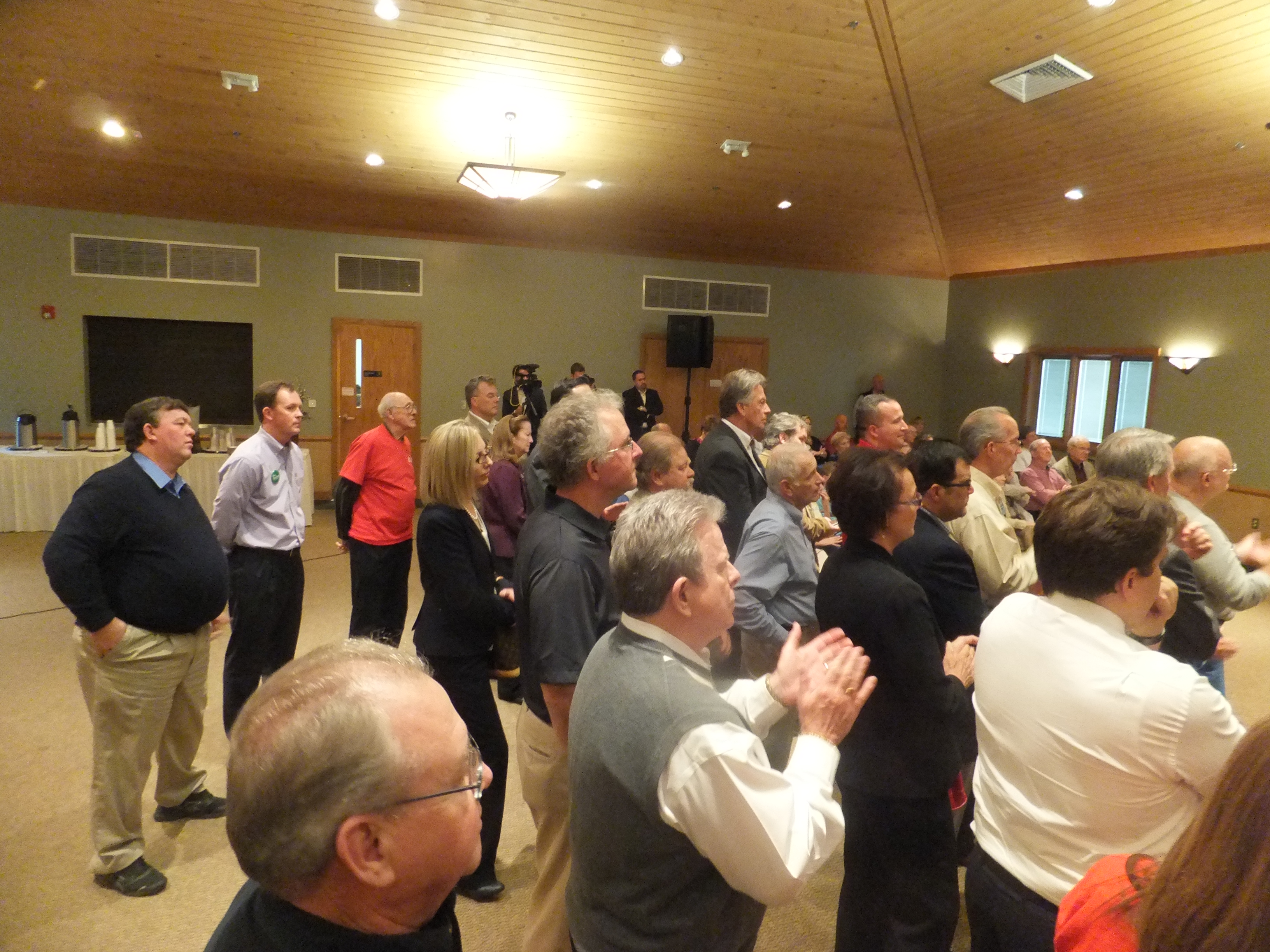
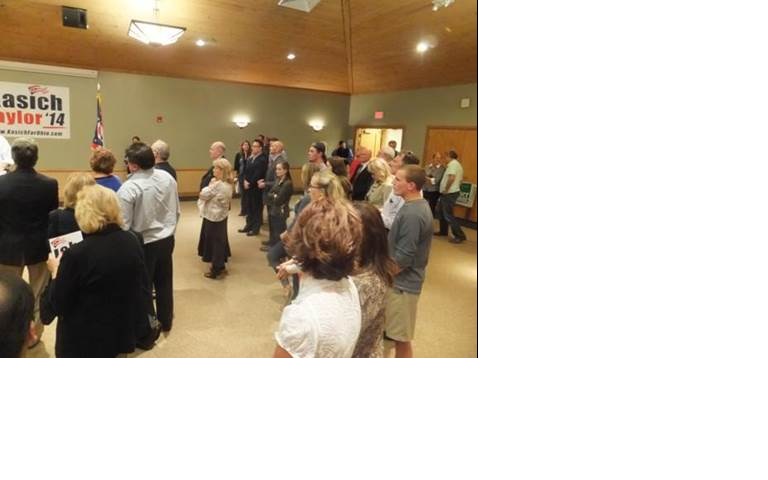
Early on Tuesday morning Hall sent out an email about the event citing that there was much excitement during the evening, that Cindy Carpenter, Sheriff Jones, and Bill Coley were speaking and that it was a packed house. Well, as the pictures here show, it was far from a crowded room that came out on a Monday evening to see the Governor of Ohio. I’ve seen more people show up in that building to rent boats for the lake on a Saturday afternoon. The amount of people who showed up to see the current governor was disgraceful. Just a few years ago—three to be exact—we packed the barn at Carriage Hill to welcome the Governor to Southern Ohio in support of the SB5 fight against public sector unions. But that night ended in a loss and the GOP reorganized to rally behind the moderates and push out the “right-wingers.” That was a stupid move.
So it should be no surprise that the only people at the rally, which should have filled the room with thousands—were political office holders and direct financial backers. It was an inbred event aimed at reconciliation of the party instead of addressing the differences. The first mistake was that it featured Sheriff Jones who spoke so poorly against John Kasich during the SB5 fight—but now was speaking at his rally. People see that kind of two faced opportunist as lecherous and very unattractive—and not worth the gas to put in their car to see, let alone donate money to the party. And Cindy Carpenter who is technically a liberal was there speaking as a representative of conservativism, that’s like inviting Bill Clinton to a morality conference. Most people who stand to make money off their political alliances—who were at that rally might have short memories because their livelihoods demand it. But for other people—the real conservatives who reside in Butler County, they have long memories—and they are looking for winners, not hand-shaking moderates.
For context there was much dispersion over the recent Cincinnati Bengal game which ended in a tie with the Carolina Panthers that took place just the day before the Kasich rally. Sure the Bengals didn’t lose the game, but they didn’t win it either. It is that kind of blasé political approach that guided the sparse few at the Kasich rally on Monday. People don’t get excited to see Kasich shake hands with his political Judas Sheriff Jones—they want to see Kasich body slam the union spokesman. If Kasich did that—more people would show up—not just the insiders who make money off the political process, as either office holders or business people seeking government contracts—but real people with real passions
When Carlos Todd called me an elitist it was in the context that I suggested that Liberty Township should strive to mold itself after Indian Hill—a successful and affluent community in the Cincinnati region—as opposed to a conglomeration of mixed development township with United Dairy Farmer stores every mile across the region. As much as I enjoy development and the creativity of capitalism, sometimes more is less. And when it comes to maintaining real estate values for the long haul, homes don’t need to be located near trendy endeavors. Today’s shiny new development is tomorrow’s slum—so I encouraged those leaders within the Republic Party over a decade ago to be mindful of the future and not the short-sighted development that puts money in their pockets tomorrow. Ethically, Todd’s interest in politics was not philosophically driven, but profit driven which makes him one of those crony capitalists unlike the laissez-faire capitalists that I advocate with much celebration. People are aware that there is a problem with such people and that their intentions are less than sincere. So their passions toward the cause of conservative philosophy is quelled and they are left without a spokesmen.
Political advocates and the money that comes from them want action, passion, and an adherence to a philosophy. The split in the Republican Party which took place in Butler County recently was reflected at this rally for Kasich and is the deliberate isolation that these moderate conservatives—bordering on out-right liberalism have created for themselves and the more traditional branches of the party. And unbeknownst to them they have played right into the strategy liberals have conducted against them allowing for this gradual erosion of value within the Republican Party. They listened to their critics and distanced themselves from the “radical right-wing” just as the liberal masses hoped they would. As a result, nobody of any passion showed up at the Kasich rally leaving Todd Hall to attempt to put a good spin on the event—which was embarrassing at best for a sitting governor who actually did straighten out some of the finances in Ohio
I’ll vote for Kasich but not with pleasure and pride. It will be a painful process not unlike scheduling surgery. Kasich is not what could be called a strong conservative—he is a moderate at best. For instance, he often states that he has a friendship with former Governor Strickland. I could not have such a friendship. To say such a thing indicates common values and beliefs that go beyond professional respect. Respect and friendship are not the same things. Kasich deep down inside believes some of the things that Strickland does leaving a small string of commonality that leads to friendship. In this way current Butler County Commissioner Don Dixon used to be a Democrat but converted because the politics of Butler County under Carlos Todd meant that Democrats would never get elected in such a conservative county. So he changed political parties to survive in that environment. Another Butler County Commissioner Cindy Carpenter if she lived in San Francisco or even New England would be a Democrat. Her behavior is undeniably liberal and she is Sheriff Jones’ right-hand woman in Butler County. There is nothing coming from Sheriff Jones and Cindy Carpenter that is going to excite the conservative base who lives in Butler County. They see through the haze at the reality that they have very weak representation in elected office as conservatives.
Kasich himself has spent the last couple of years seeking votes for Medicaid expansion essentially endorsing Obamacare. So there is nothing exciting there for real conservatives to invest their passions into—they will likely hold their noses and vote for Kasich, but they won’t waste their time on a Monday night to hang out with a sell-out and rally him to a victory. Sell-outs are easy to see, unique people with real passions are not—so this is why nobody showed up to the Kasich rally
It is easy to call people like me a radical elitist because the real concern is that moderate politicians like those at the Kasich rally can’t suddenly become ethical. It is easier to just isolate themselves from the competition of thought. It is more comforting for Todd Hall’s Republicans to compare themselves to their liberal rivals as opposed to their actual conservative base. Without that conservative base—and in Butler County it is the David Kern Republicans—there will continue to be eroding support for political events and the money that needs to be generated by them. The situation is quite serious as the evidence is in the event organized by Hall for the sitting Governor. In this part of the state he finds his strongest support. Just imagine the reaction in places like Toledo and Cleveland just days before the election. That is the cost of sitting in office and behaving like a liberal.
Many think that because I’m a conservative that I naturally do not support conservation. These are the same types who think that the issue of slavery was only a white on black occurrence occurring in America from the 1600s until the mid 1800s. Of course slavery was a much larger social problem involving all races and sexes of that particular time period and it was America who was the first to take a moral stand against it—to such an extent that a war was fought over it—led by Republicans. The same type of manipulation has occurred to make conservatives into villains regarding conservation—and largely it has gone unchallenged. That is because the answer to the conservation question is again that it is capitalism which is the biggest spokesman for the conservation movement which is much to the frustration of the bleeding heart liberal types. So it is with some surprise that people learn of my love and support of the Newport Aquarium.
The primary reason that I am so excited about the upcoming Liberty Center development being constructed as we speak in my community of Liberty Township is because it is a Steiner project. The Steiner group twenty years ago envisioned a way to save the embattled city of Newport, Kentucky with a brilliant new development on the river built around a new state-of-the art aquarium. That aquarium was a game changer and to this day is worth an out-of-state visit just to see. Situated across from the Cincinnati skyline, it has changed life on the banks of the Ohio River for the culture of the Cincinnati region and it all started with the capitalist Steiner.
Years later during a week in mid October 2014 the Newport Aquarium brought in the Weeki Wachee Mermaids from the popular Florida resort to perform in an extravaganza that I thought was incredibly wonderful. To the music of the Little Mermaid from Disney thousands upon thousands of little girls lined up to meet the beautiful mermaids and see them perform in the Coral Reef tank—which was absolutely glorious. Capitalism was on display at its finest. Of all the little girls present many will find they have an appreciation of sea life because of that experience and will likely carry it with them their entire lives. Two Disney films dominate the exhibits in a subtle way at the Newport Aquarium, Finding Nemo and of course TheLittle Mermaid. Disney created the gateway into such stories by creating the mythology. Steiner and his group brought that mythology to reality. And the wonderful Weeki Wachee swimmers from Florida and their capitalist endeavor their brought mythology to life for profit which further intensifies the experience for countless lives touched by their endeavors.
Leaving the Newport Aquarium after seeing the exhibit of mermaids on a sunny day in October with the great Ohio River rolling by just feet away, with Mitchells, Barnes and Noble and the AMC movie theater looming above, it was the vision of the Steiner group which brought this experience to so many people and God love him for it. It took a lot of headache to bring that vision to reality and I am thankful that he did so twenty years ago. My brother is a diver at the Newport Aquarium and it has been an important place for my family for a number of years. I simply love the place, but without Steiner—the capitalist—it would have never happened. The Newport Aquarium is one of the best exhibits of its kind in the world and has maintained that status into its second decade. And it’s still going strong and is able to bring in talent like the Weeki Wachee Mermaids from such a distance to bring a bit of Disney World to the Midwest.
At the aquarium in Newport, conservation is on full display. It is evident why manufacturers would want to refrain from careless drilling, over deforestation, and a destruction of the earth’s natural resources by seeing the exhibits. Science driven by capitalism is the best conservation method that there is, and the Newport Aquarium is the perfect example of such an endeavor. I could sit in front of their exhibits for hours and just watch the animals—and appreciate the unique circumstances which made them possible as a life form. Without a profit motive however, there would be no Newport Aquarium, or a Newport Levee experience. Profit drives science and conservation. A lack of such formulas gives you the Middle East—sand, poverty, and stupidity. The Newport Aquarium is culture at its finest—it brings out the best in people and is a wonderful, magnificent creation of the Steiner group.
With the same epic vision the Steiner group is bringing its latest creation to Liberty Center. I expect that complex to dwarf what has occurred at the Newport on the Levee development. And because of the well-designed shopping complex the very popular outdoor store Cabela’s is moving in across the street on Liberty Way. I can’t think of any aspect of modern culture that most brings conservation to the minds of the masses than such a shopping experience at Cabela’s—an outlet dedicated to the outdoor experience and the preservation of those outdoors for future lives. Without Steiner, there would be no Cabela’s. And without Cabela’s the Bass Pro Shops down the road wouldn’t be expanding the way they are by necessity of competition. Because of those two retail outlets millions of people will become inspired to not only participate in outdoor activities, but to preserve them through the education programs that come as natural off-shoots of those shopping experiences. Because of the Steiner group and their use of capitalism to create profit driven experiences, conservation awareness will be greatly expanded dwarfing the great work done at the Newport Aquarium so many years ago even into the present.
If there are little ones in your family now is the time to see the Weekie Wachee Mermaids at the Newport Aquarium. I’ve seen the show in Florida and it was wonderful, but the Newport Aquarium provides a much more up-close and personal experience because of the tubular design of the display in the Coral Reef section. It was quite majestic. It was a brilliant move by both the Weekie Wachee crew and the Aquarium to pull those two elements together. They are playing only through this upcoming weekend, so make sure to see it. Better yet, take a day off work and visit during the day when the crowds are much less. Take your kids out of school for the experience. They’ll learn a whole lot more at the Newport Aquarium than they will in school, that’s for sure, and the experience you’ll share as a family will be unrivaled. It is that good, and is just one more reminder of how wonderful capitalism can be when it’s used properly in the hands of wonderful people in the Steiner Group. Their creativity and desire for quality has given thousands an experience in their own back yards worthy of a week-long vacation to a distant land. Only it’s right there at Newport on the Levee. So take your kids, eat at their fine restaurant, pet some sharks and thank a capitalist for the enriching experience.
The Wall Street Journal had a wonderful little essay in their Saturday review section that sounded like something one might find at this site every day. The author Hernando De Soto wrote a nice little article titled The Capitalist Cure for Terrorism: Military might alone won’t defeat Islamic State and its ilk. The U.S. needs to promote economic empowerment. It was such a good article I place a portion of it below along with a link to the whole article for further review. In it Hernando talks about his experiences in Peru as communism was moving through South America and Central America during the 80s and 90s and how it was defeated with economic prosperity. He suggests that if the same strategy were employed in the Middle East, that it would be a lot more powerful than airstrikes and “troops on the ground.” The way to beat communism which is always floating around in between the sentences of progressive thought is to advocate capitalism. There is a lot more strength in that economic policy than in any military occupation by force of a people in a remote land. Here is some of Hernando’s article.
By 1990, a Marxist-Leninist terrorist organization called Sendero Luminoso, or Shining Path, had seized control of most of my home country, Peru, where I served as the president’s principal adviser. Fashionable opinion held that the people rebelling were the impoverished or underemployed wage slaves of Latin America, that capitalism couldn’t work outside the West and that Latin cultures didn’t really understand market economics.
The conventional wisdom proved to be wrong, however. Reforms in Peru gave indigenous entrepreneurs and farmers control over their assets and a new, more accessible legal framework in which to run businesses, make contracts and borrow—spurring an unprecedented rise in living standards.
Between 1980 and 1993, Peru won the only victory against a terrorist movement since the fall of communism without the intervention of foreign troops or significant outside financial support for its military. Over the next two decades, Peru’s gross national product per capita grew twice as fast as the average in the rest of Latin America, with its middle class growing four times faster.
Today we hear the same economic and cultural pessimism about the Arab world that we did about Peru in the 1980s. But we know better. Just as Shining Path was beaten in Peru, so can terrorists be defeated by reforms that create an unstoppable constituency for rising living standards in the Middle East and North Africa.
To make this agenda a reality, the only requirements are a little imagination, a hefty dose of capital (injected from the bottom up) and government leadership to build, streamline and fortify the laws and structures that let capitalism flourish. As anyone who’s walked the streets of Lima, Tunis and Cairo knows, capital isn’t the problem—it is the solution.
Here’s the Peru story in brief: Shining Path, led by a former professor named Abimael Guzmán, attempted to overthrow the Peruvian government in the 1980s. The group initially appealed to some desperately poor farmers in the countryside, who shared their profound distrust of Peru’s elites. Mr. Guzmán cast himself as the savior of proletarians who had languished for too long under Peru’s abusive capitalists.
What changed the debate, and ultimately the government’s response, was proof that the poor in Peru weren’t unemployed or underemployed laborers or farmers, as the conventional wisdom held at the time. Instead, most of them were small entrepreneurs, operating off the books in Peru’s “informal” economy. They accounted for 62% of Peru’s population and generated 34% of its gross domestic product—and they had accumulated some $70 billion worth of real-estate assets.
This new way of seeing economic reality led to major constitutional and legal reforms. Peru reduced by 75% the red tape blocking access to economic activity, provided ombudsmen and mechanisms for filing complaints against government agencies and recognized the property rights of the majority. One legislative package alone gave official recognition to 380,000 informal businesses, thus bringing above board, from 1990 to 1994, some 500,000 jobs and $8 billion in tax revenue.
Of course President Obama would never consider the types of reforms which took place in Peru because as a progressive—his underlying philosophy is that of Karl Marx communism—the same brand that is behind the Muslim Brotherhood, the tyrants of South and Central America and in general the labor unions of the world. As enemies of capitalism, they are in paralysis to utilize it as a military objective and are thus forced to commit the type of imperialism that America is often criticized for. But that is entirely unnecessary—as capitalism is the best strategic mode of military conquest. Free people to their own economic success and they will have no need for a dictator. Make people wealthy in the Middle East, and they will have no desire to feed the resources of ISIS.
It is wonderful to see such strategic thinking coming out of the Wall Street Journal. New York, even though it was built by capitalism is a hard place these days comprehend such an economic philosophy. Progressivism is the ruler of that city these days. Yes capitalism still speaks loudly in Times Square, but the underpinnings of progressive philosophy are slowly destroying everything that city has meant to America which is a military objective coming from the other direction—from antagonists like ISIS and other Muslim radicals. They wish communism upon the earth and they use religion to hide it. So it is only fair to utilize the strength of the West—capitalism—to crush the enemies of our nation without firing a shot.
You’d think that Obama being the peace-loving old hippie follower that he was and is would love the idea of a peaceful solution to the world’s problems. But Obama is an enemy of capitalism, so he cannot use it to save the world, which is a shame, because it is the most effective weapon that America has against its enemies. And America has enemies not because of what it does to other nations through imperialism, but because it is always a threat to tyrannical control they wish to impose on the world. America because of its capitalism is an example to the world that tyrants hope to extinguish so that promises of a better life do not come from economic freedom, but through the support of the next rulers of a Karl Marx economy where each takes from confiscated wealth according to their need.
The solution to many of the world’s anxieties could be accomplished through the simple embrace of capitalism as an economic force. The continued desire to find the next subtle way to deliver world-wide communism is the root of much trouble that can be seen today whether it is the ISIS terrorism, or the border troubles with Mexico. At the heart of most third world economies and their hatred for America is the old relic of thought started by Karl Marx, the great destroyer. And the best counter measure to Marx and his communism is the fine essence of self-empowerment through glorious capitalism.
A few years ago I made mention that I was working on a new book titled The Trial of Fletcher Finnegan, and that it would be ready for public consumption in around 5 years. That is still a goal I am working toward. However, changes to the publishing industry and the general market place dictate a more entrepreneurial approach. My publisher for Tail of the Dragon went out of business last year leaving me without a means of distribution in a traditional sense and I had so many requests for an uploaded version which my publisher didn’t offer that it caused me to re-evaluate the situation. I have been and will always be a physical book type of person—however, the industry certainly has moved away from that supply model. So while I work on the various means of distribution for my past works and pave the way for the future endeavors I have found a much-needed bridge to test out the market and give fans what they really want. For me right now, and filled in my email box from most of the people who know me as either friends, family, or acquaintances they will be delighted to know that this new endeavor will be essentially book two of the Cliffhanger series titled, The Curse of Fort Seven Mile.
For several years—nearly a decade now I have had frequent requests to return to the events of Fort Seven Mile and the vigilante antics of Cliffhanger—which is what the Trial of Fletcher Finnegan is to be about. However, as I’ve outlined the story there is a very ripe period that can fill volumes of material all on its own. I have said for quite some time that this blog site are my personal notes for these future stories. I share them with the public because there are things today that people can learn from and help navigate their lives. However, putting those ideals into a story context is another matter and is what I am going to do with these new Cliffhanger stories.
The plan is to publish a chapter each week of these further Cliffhanger stories and make them available for digital upload. For readers here they will essentially get the material of this blog site integrated into a narrative that is exciting and fun. For instance the first chapter consists of a labor union president for the Fort Seven Mile police who after the tragic events from my first novel, The Symposium of Justice is seeking to increase the police budget for his members to the city council. Misty Finnegan is now the mayor after former Mayor Goodman was killed during his encounter with the vigilante Cliffhanger. Misty on the other hand had been working to place on city council a more conservative presence so that she can gain legislative control of the governing body away from the progressive liberals who had made enticing deals with the local labor unions. The union president despondent with Misty Finnagan’s resistance to throw money at the police union so that they can go out and capture Cliffhanger decides that the new mayor needs to be removed from office and plans her assassination. The rest of the story evolves from there and will feature the type of material I write about often with the pulpy antics I tend to elaborate on with great enthusiasm. I love to write action, so each of these chapters will of course end with a great climax of an action sequence that is the norm of my style of writing.
This ideal came from two sources. First it was a recent visit to the Apple Store in Kenwood, Ohio. I was quite impressed with the high level of interest people had for Apple Products. I realized what many other people within publishing had been telling me for years, that the traditional way of publishing was moving to digital uploads. But these new Apple type customers don’t necessarily want a huge 1,000,0000 word novel to upload onto their devices—which is what the Trial of Fletcher Finnegan is slated to be. It could possibly dwarf Atlas Shrugged as far as size and scope. Many of the Apple users want things quickly so they can move on to the next thing—essentially because they want to be able to use all the features of their device. They want to do a little reading of something that inspires them, they want to listen to some music, text friends, update their online accounts and check out current events. To carry Cliffhanger into the 21st century, all these considerations have to be taken seriously. The other source actually came from a favorite writer of mine, Johnston McCulley who wrote the original Zorro story The Curse of Capistrano. The original Zorro stories were published in newspapers as separate chapters nearly 100 years ago to the day. Douglas Fairbanks would take those stories and make them into a motion picture called the Mark of Zorro. Then there were the various Republic serials shown in chapters for the Saturday matinee editions. All this led to the Disney television show which was what I grew up with. I loved that show and still do. Like many people who have not been consumed by progressivism and yearn for these traditional American stories, it quickly becomes evident that nobody else in the industry will do them, so the task falls on the present to find a way to create a new market where there is no other path. This is no different from the type of path Johnston McCulley faced in 1919 when all his individual chapters of Zorro provided to All-Story Weekly a novel.
These types of things usually take time to work through and only in hind-sight does a pattern emerge. McCulley’s first Zorro novel emerged in 1919, his second in 1922, the third in 1931, and the fourth in 1941. We tend to think of all this work happening at the same time, but essentially they took place over a twenty year span. The style of writing I enjoy most is a pulp brand popularized by McCulley and Lovecraft from this time period. However, my subject matter tends to lean in a conservative direction making modern-day publishers weary of my work. It’s not a conspiracy, if they thought they would make a lot of money, they’d jump on board in a minute. But they don’t often have patience to allow a story like Cliffhanger to develop as the story goes against the grain of the progressive types who currently run most of the entertainment industry for many of the reasons described in great detail at this site.
A third influence is actually two-fold which has driven me to attempt something new with the Cliffhanger character. A dinner I had over the summer with Gery Deer, then a few discussions I had with one of my son-in-laws indicated what an extreme hunger a public who generally has traditional values that used to be realized in American westerns, desired material that they could relate to. I would tell them the story about how publishers are going belly up left and right—specifically thinking of my experiences with Tail of the Dragon and they’d just sort of listen patiently hoping that I’d come up with something. Well, now I have and I intend to have some fun with it.
Readers of this new series will instantly recognize the type of themes I write about in this blog. As I have said, I use this forum as a kind of note pad. So it should come as no surprise. Chapter two for the new Cliffhanger series is already in process and features a chapter on homeschooling as a teacher’s union is the villain in that particular story. It is one thing to tell literal news stories like I do every day on this blog site. It is quite another to put that subject into the context of a story, which often has more communicative power than a literal translation. It is that kind of contextual ability that made Zorro so popular, but for the complicated times that we currently live in, a more updated hero needs to help flesh out the anxieties that we all live with each day. For that, Cliffhanger is a character that can take many of these traditional American concepts and let them play out in story form in the kind of doses that a modern audience can enjoy.
There will be more news on this endeavor over the next couple of weeks, but I am already writing the chapters and having fun with the characters. For my readers, it should be a lot of fun. And it will be an inventive way to reach new fans in ways that have not been done before. It’s fun to revisit the Cliffhanger character and I’m sure it will bring a smile to the many faces who for a decade have coaxed me to write book two of a story that touched their lives as a throwback to the kind of character that started all of modern entertainment—Zorro. It is only appropriate in these current times that a new character emerge to convey our modern concerns articulated with great fanfare in the upcoming Curse of Fort Seven Mile.