The Grinding Hurt of Betrayal: John Aglialor’s ‘Atlas III’ interview with Nick Gillespie

The third and final installment, Who is John Galt? hits theaters on Friday, Sept. 12, 2014 and John Aglialoro sat down with Reason TV’s Nick Gillespie to discuss the completion of the Atlas Shrugged films, their negative critical reception, and the enduring influence of Ayn Rand’s thought. As usual when it comes to Gillespie, it was a good interview and covered a lot of ground. It is a tough task to adopt a film from a novel that means so much to so many people, yet a movie is the perfect gateway to bringing more people into the Objectivist philosophy. Many hard-core Rand fans from the novel want the salacious sex that Ayn Rand wrote about—which was greatly removed from John Aglialoro’s renditions. Personally, I’m grateful as the sex could easily overpower the story in such a movie and I appreciated the tastefulness that it was handled by the Atlas Shrugged trilogy.

http://reason.com/reasontv/2014/09/08/producer-john-aglialoro-on-ayn-rands-imp

Every time I watch Aglialoro in an interview it is easy to see the hurt behind his eyes. Like Rand, who thought that the unspoken and neglected businessmen would flock to her support of them after the release of her 1957 novel, most cowered in the darkness like idiots paralyzed by the political left into silence. Aglialoro during the second film premiered Atlas II in Washington D.C. right before the 2012 election. Not a single politician, not Ted Cruz, not Rand Paul and certainly not Vice-Presidential candidate Paul Ryan showed up for the movie as they tried to maintain their political distance—so not to have people from the left call them names. Ryan had been an open Ayn Rand supporter before being put on the national ticket with Mitt Romney. Nobody from the political class showed up in Washington D.C. to show their support of a conservative leaning movie featuring ideals that the political right should have openly embraced with great enthusiasm. Republicans played it safe and guess what………….they lost in the 2012 elections all across the nation.

I have felt the bite of that kind of pain a time or two, most recently when I was on 700 WLW radio dealing with a controversy—a sexist accusation by my political enemies who were trying to the same smear tactic used against Rush Limbaugh and Mitt Romney at the time. Unlike those guys, I defended my position proudly. In 2012 I was a spokesman for a group standing against higher school taxes, which was a very unpopular position. I had in my circle a number of high-profile movers and shakers and was proud of them for supporting such a controversial topic. My plan with the pro tax people was in full swing, they were attacking our side by calling us greedy businessmen, so I attacked back with the truth—that a majority of the pro tax advocates were fat assed, out-of-touched parents. Of course they didn’t like it—because the truth hurt. I meant for it to. So I was on the air ready to defend our position and those prominent local businessmen and politicians sent a press release to the station while I was on the air distancing themselves from me. The controversy I didn’t mind at all. The betrayal did bother me. I shut off interviews for the rest of the day as I recalibrated my position. It hurt terribly to trust people then watch them fall for the old liberal tricks of guilt abasement. I couldn’t let that hurt come out in my public statements—which is a really tough thing to do when an entire city is ready to pounce on your every word.

The motivations of those fearful dissidents are the same at every spectrum, from Ayn Rand, to John Aglialoro, to me—we have all been left at the alter by those we were trying to help. It feels like being cheated on by a spouse—just as you are declaring your love for that significant other, you learn that they have been doing the horizontal shuffle with the very people you are fighting—and it hurts. It hurts whether it is sex or politics—in both cases you end up screwed. It is that screwed look that Aglialoro has on his face with each interview he does. He was much more hopeful after Atlas I did respectable opening night numbers, but by the time Atlas III hit theaters he had a hurt look on his face from all the betrayals he had experienced over the last couple of years, while making the movie. For him he continued to make the movies even though very few supported the endeavor. The enemies of the movie were perplexed as to why he continued even though the films were box office failures and did not have majority support from the public. What those same people did not understand was that John Aglialoro made the movies for himself, not for the public. He did it to accomplish a task, not to win approval as a second-hander. Since most of society functions as second-handers, they don’t understand Aglialoro, or his movie. So there is sadness when he talks about the films. He knows as the words leave his mouth that nobody really is going to understand why he made the films—yet he does it anyway in a hope that something will change—someday.

Atlas III won’t be any different. People who understand it will love it, various others who have skin in some type of political game, even within Ayn Rand circles, will hate it. They’ll hate it for Aglialoro’s point of view in making the movie—they’ll complain about the lack of sex, the lack of depth, the lack of good actors, the lack of budget, the lack of public support, the lack of technical aptitude, and every lack of anything else they can think of. But what they can’t accuse John Aglialoro of is a lack of heart and determination. What he did was hard and deserves admiration in the face of much hurt which only those who have been betrayed in a similar fashion can understand.

Rich Hoffman

www.OVERMANWARRIOR.com


Atlas Shrugged: Now, Non-Fiction

I’ve been involved with literary driven “think-tanks” for several occasions in years past covering everything from James Joyce to Thomas Mann. All those authors were wonderful in their own way, even the collectivist Victor Hugo and Russian recluse Leo Tolstoy. But they were not as good as Ayn Rand who changed the literary narrative with her larger-than-life characters. Rand’s characters are not like Marvel Comics superheroes, they are every day people lacking magical powers, but they are non-the-less super. They are an inspiration to all who ever wanted to be a superhero as a corporate businessman or woman—and continue to resonate particularly in America as a mold to follow. Ayn Rand is one of the most prolific and most important writers in American history which is saying a lot. Her work of most importance was Atlas Shrugged and began as a kind of science fiction fantasy in 1957 and has proven itself to be astonishingly prophetic in 2014 just prior to the third release of a movie adoption based on John Aglialoro’s interpretation of the novel. The movie hits theaters on September 12th, but the book continues to sell, and sell, and sell because the content which appeared sensational at first—and unrealistic is occurring almost on queue just as Rand always thought it would. The producers of the new movie have put together a wonderful little documentary which features clips from the new film seen below called Atlas Shrugged: Now, Non-Fiction and is well worth watching. In addition to clips from ASP3, this video includes commentary from liberty leaders including Ron Paul, Matt Kibbe, Jonathan Hoenig, Phil Valentine, David Kelley and more.

Atlas Shrugged is not for everyone. It is however for the kind of people who work hard and try every day to be the best they can be. If you are the kind of employee who usually works later at the office and is the first to arrive in the morning—you will like Atlas Shrugged. If you are the kind of person who runs over rate in a union shop—even though there is intense opposition against you for doing so, Atlas Shrugged is for you. If you are the kind of person who is constantly hounded by family and friends to step down off your “high horse” so that you are more “likable” and approachable, you will like and enjoy Atlas Shrugged. However, if you are the kind of person who hates those who do all or even part of the above—you will hate Atlas Shrugged and will do everything in your power to disgrace the literary work from being recognized as a literary endeavor.

For the same reason that the co-worker who feels guilty by leaving the office before the star of the company does attempts to put pressure on that person by saying “it’s time to get out of here” Atlas Shrugged is slammed and ridiculed.   Not because it is a bad novel written poorly—but because it makes guilty people feel bad about themselves. They feel bad because they have sold out. Their ideal of a superhero has been regulated to someone who is bit by a magic spider—or someone who comes from another planet. They don’t look in their mirror and see anything super about themselves and they are too lazy to develop it on their own. Atlas Shrugged   shows how average people are super just by having values and fighting to maintain those values. It is also about how it is that adherence to value which makes the engine of the world run, culturally, economically, and philosophically.

When John Galt proclaims that he will stop the engine of the world in the new film version titled Atlas Shrugged Part III he is stating that by removing his value from an organization, or society in general that the parasites of reality will have nowhere to hide and civilization will collapse. What prevents this collapse from occurring is that the few protect the masses with their values. But over time it gets harder and harder leaving the looted few to eventually become depleted and perish. The masses expect this sacrifice to occur—they expect the few to serve the many and those with value to give it to them in their vacancy. It is this belief that destroys the world and why the classic novel Atlas Shrugged has now been declared non-fiction—because it has all come true.

The people who hate Atlas Shrugged are also the same people who hate those who try to be good—too good. They are advocates for complacency—for setting the bar low so that they can easily achieve success in life. Ayn Rand’s novel points to that tendency as the invisible destroyer of the world and spits on it placing value where it deservedly always belonged with the heroes of creation—those who work late, early and often—who don’t live their lives through others, but in spite of the efforts to stop them. That hatred is very real. The masses of existence—who advocate so loudly for democracy are the same people who wish to believe that because they outnumber the truly good they can capture the definition of good, and bad, profitable, and unprofitable, and of success or failure. Atlas Shrugged was not written for those people—it was written for those who see heroic deeds in getting up in the morning to face the troubles of the world as an individual without apologizing for working every day to do the best in every aspect of their lives that they can. Ayn Rand’s heroes are not drunks, sexual deviants, or crooked politicians. They are not truly fearful of anything—because they know that it is they who are ultimately in control—so they trust themselves to overcome any problem that comes their way. This gives the heroes a god-like presence in the Atlas Shrugged novel as interpreted by the weak, frightened, and complacent.

Atlas Shrugged was so brilliant because it goes literally against thousands of years of sacrificial belief by the human race. Rand could have played it safe and given the world a novel reminiscent of War and Peace. But she didn’t instead she wrote an epic book of similar length and content but along the way tackled directly the philosophical failure inherit in human beings ridiculous belief that achievement of anything is caused by “sacrifice.” Rand challenges that premise and her heroes refuse it revealing the true success of all societies that prosper. It is literally the best kept secret—and Ayn Rand exploited it putting it in story form so that it would be easy to understand. It has taken literally a half of a century for most of America to figure out the meaning of Atlas Shrugged. Even today, after decades of contemplation, only a handful of the population anywhere in the world understand the message because in any company, any institution, any endeavor what-so-ever, there are only a few who work 12 hour days for the joy of it, get up before the sun even considers rising, because they are trying to squeeze more life out of daylight once it arrives, and do good work not for the pat on the head, or even a pay raise—but because it makes them feel good to do good work.

Atlas Shrugged is essentially the first major literary work in human history that recognizes the benefit of good work and productivity over the emotional pleas of the democratic masses who lobby with every effort to stop the productive who make them feel guilty for being less than robust. It is for that reason that Atlas Shrugged continues to draw scorn from intelligentsia because they want a monopoly on social opinion built upon the foundations of laziness. It is also why Atlas Shrugged is only playing in a few hundred movie theaters and why even in those theaters there will be only 5 or 6 groups of people seeing the movie. The people attending will tend to be the last to leave at their places of business, and the first to arrive, they work hard and take pride in doing a good job—and they can relate to the kind of society that John Galt builds in Atlantis during the film. And as every organization in the country knows, there are always those few who do most of the work. Atlas Shrugged is made for them, not the other idiots who stand at a time clock five minutes before the end of a day and flee to the parking lot like escaped convicts once their work is over for the day only to complain and bitch about how sucky their lives are for the rest of the evening. What happens when people stop doing the extra work for the pure enjoyment of it? You get the events of Atlas Shrugged—now-nonfiction.

Rich Hoffman   www.OVERMANWARRIOR.com


‘Atlas Shrugged Part III’ is Showing at Mason’s Regal: Why Mahogany’s is failing while The Blaze Pizza thrives

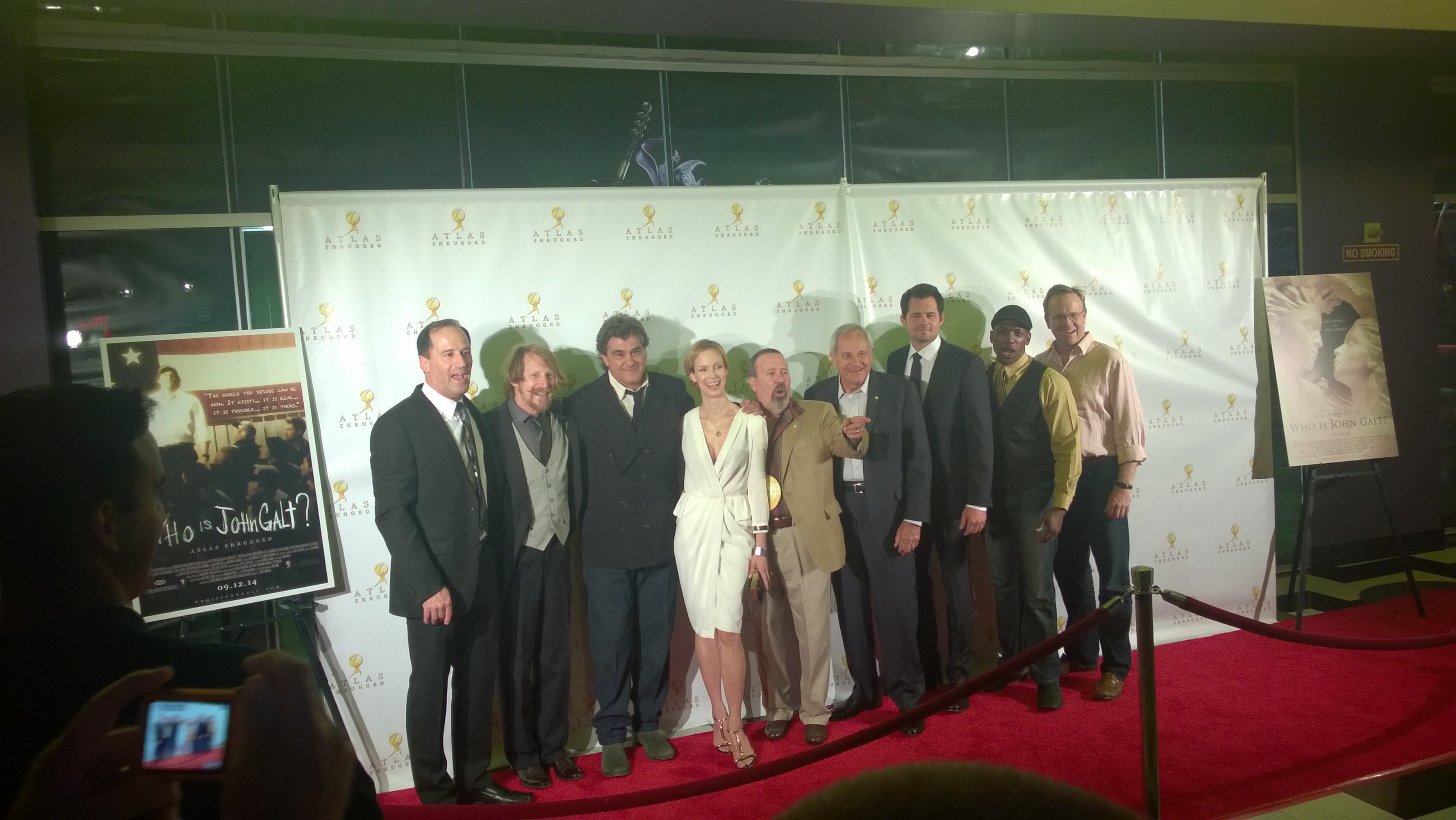
If you read this site there is only one place you should be on Friday September 12th, and that is the Regal cinemas in Mason, Ohio.  The reason is that Atlas Shrugged Part III: Who is John Galt hits theaters that day and the only place in Cincinnati that it can be seen is at the Regal.  The Regal has been very supportive of the Atlas films over the years and I can’t think of a better theater than that one to see this new movie at.   I have been to every theater in the Cincinnati area for some reason or another and the Regal is one of my favorites.  I love the way it sits on a hill looking out over all the development of the Fields Ertel region.   For Atlas, after the kind of philosophy that is explored in that movie, those are the kinds of things you want to see while going to dinner after—development, excess, and elements of capitalism.  You don’t want to see slums, decrepit people addicted to welfare, and you don’t want to see defeated people.  In Mason, just down the road from the theater are million dollar homes, P&G is across the street, and countless restaurants of all varieties are available for selection.  It is a wealthy area representative of the type of values that the Atlas films advocate.  So the Regal is the place to see Who is John Galt.  The premier for the film just occurred in Las Vegas as seen in the picture below with Laura Regan in the center who plays Dagny Taggart.  She is a very good Dagny.  Women should feel honored to see such an empowering woman in such a strong role.image

It’s OK to be a little snobby especially in regard to surroundings while seeing certain kinds of movies for leisure entertainment.  So often hypocritical assessment is applied to these types of things—the same women who declare that they support feminism and a helping hand to the poor—along with other progressive values are the same women who shop at the Fields Ertel area because they are afraid of the gangs of youth that accost them at the shopping malls to the southwest and avoid Ayn Rand because she is against their system of beliefs.  But in regard to that, no author has ever written a stronger female lead character than Dagny Taggart.  She’s in charge of a railroad, she has the heart of the strongest most profound male character in classic literature and she is unyielding during the entire Atlas Shrugged story—right up until the end.  You’d think that feminists would flock to see Laura Regan’s portrayal of Dagny Taggart—but of course they won’t, and can’t.  Their politics betray them.  So it was nice to see Laura Regan posing proudly with the producers during the premier.  The producers worked their asses off to make that movie and it is good to see her embrace the role without political shame.  Atlas Shrugged punches through much of that modern hypocrisy of politically correct behavior.  So in tribute to that honesty, I can be quite forthright—when I see Atlas Shrugged Part III at a theater, I want that theater to be nice—I don’t want it to smell like dirty kids, I don’t want to park next to beat up pieces of shit cars, I don’t want to sit next to walking zombies of people slack-jawed and stupid, and I want to drive down roads to and from the theater lined with wealthy businesses oozing with creativity.

One such place that embodies the kind of business that might be found in Atlantis featured in Atlas III is the Blaze Pizza which is just down the road from the Regal Theater.  Mason was one of the test locations for this burgeoning franchise which was quite an honor.  The reason is that the demographics of the area are conducive to their market research.  The Blaze Pizza is about to explode all across the nation, but there are still only a few locations and Mason is one of them.  What makes them unique from other pizza places is that they make customized pizzas in a fast food style.  The pizza is literally made right in front of the customer and fired in a gas fired oven and ready by the time you pay for it.  They are the Chipotle of pizza making.  Their pizzas are typically a $15 of value which they sell for around $7 to $8.

The Blaze does great numbers and is changing the industry of pizza making.  My daughters introduced me to the place and we plan to visit there after seeing Atlas Shrugged Part III.  Also, we have plans to bring The Blaze Pizza to my grandson’s birthday party which is coming up quick because what they do is so good and unique that it is worth it.  It is in that type of business creativity that the movie Who is John Galt is all about.  So it is fitting to have the film playing at the Regal while burgeoning businesses like The Blaze Pizza are changing the industry right next door.

The Blaze Pizza is not the only regional business in the Fields Ertel location that I enjoy.  Although it is dated, I happen to like the Pizza Tower which is also down the road.  I love the Kings Auto Mall, I like White Castle, Frisch’s and the half-dozen other fine restaurants up and down the strip all with wonderful market niches that they have carved out for themselves in the Mason, Deerfield township area.  But the reason they are there is because the area is wealthy, and that wealth was created by cleaver ideas like The Blaze Pizza and capitalism in general.  In Mason, there is some socialism around the government school, and the city politics, but it is still minimal.  The character of Mason has been shaped by the amusement park Kings Island which is also down the road, the PGA Tennis tournament, and the Jack Nicklaus Golf Center which is right across the highway from Kings Island.  Next to Kings Island is The Great Wolf Lodge, a giant hotel chain with and indoor water park on-site.  I love the region because capitalism still rules in that area which is why it is fitting that Atlas Shrugged Part III play there and no place else in the city of Cincinnati.

Elsewhere, socialism has taken hold.  For instance much as been made about the failed restaurant on The Banks in Cincinnati called Mahogany’s.  That restaurant is a government planned project where money was poured into the deal by the city to prop up a minority owned business.  Liz Rogers is the owner and has been losing money for over two years forcing the city to consider further bailouts of her.  Her attorney recently plead her case to the Cincinnati Enquirer reporting, “General Electric has a tax credit worth $51 million dollars for its new banks project , and Liz has worked for two-plus years without drawing a salary, which is more than you can say for the top dogs at GE.  But why has she done this?  Because she has a dream and a vision of a better Cincinnati, one that appreciates Southern cuisine.”  The Enquirer—a very progressive newspaper owned by Gannett goes on to say, “on the other hand, we have had the dubious distinction of race riots.  The federal government has monitored our police force after accusations of brutality, and some undoubtedly legitimate complaints.  Our schools are integrated (by busing) but our churches and social life are largely segregated (by choice and comfort level) It goes on and on like that discussing Harriet Beecher Stowe, Jackie Robinson and Louis Armstrong.   

But what the Enquirer doesn’t deal with is that people don’t want to go to a restaurant that they don’t support through free market capitalism.  Cincinnati as a government should have never become involved in tampering with the free market hoping to prop up an owner just because of the color of her skin.  Basically here is the gist, the city government in Cincinnati thought it would be cool to have a black owner of a restaurant on their coveted banks project which has taken over 20 years to build.  I’ve been to The Banks on several occasions, and it’s nice.  I typically eat at Great American Ball Park or at the Christian Moerlein Larger House (wonderful place by the way).  Liz has not been successful because with other options at The Banks that are better, Liz is sinking.  The socialism of Cincinnati and the Enquirer failed because they put value on skin diversity over values of intellect—resulting in the failure of Mahogany’s.

The Blaze Pizza is doing well in Mason because they did market research and used private investment to make a proper business decision.  When it came to Mahogany’s all the socialist civil servants thought it would be wonderful to have a “woman” and a “minority” member an owner of a restaurant on The Banks.  They thought it would be “stylish.”  They made their decision based on feel good politics, not free market considerations.  If Liz Rogers made a product with Southern cuisine that people actually wanted, the restaurant would be doing booming business, but people obviously don’t want that kind of food in that location, so it is failing.  Meanwhile, The Blaze Pizza is doing smashing business in its location and is now expanding.  It’s not because the owners are white, or male, but because they are competent and enterprising.  This is essentially what Atlas Shrugged Part III is all about.  Only in the movie it is Laura Regan playing Dagny Taggart who has all the answers for her railroad company that none of her male counterparts have a single answer for.  It doesn’t matter the color of her skin, but rather the contents of her mind that makes her either successful, or a failure.  Thus, the same goes for the success of The Blaze Pizza, and the failure of Mahogany’s.

This is why it is such a relief to see Atlas Shrugged Part III in Mason at the Regal as opposed to somewhere else.  After such a movie nobody wants to come out and see evidence of socialism and its failures with degenerate slack-jawed hippies, skate boarders, and gangs of thugs bobbing their heads to rap music.  To see a movie like Atlas for people who enjoy thinking and being successful at things, it is nice to take a vacation away from the poverty created by government tampering and enjoy an evening of excess produced by the capitalism of Mason, Ohio.  Those are many of the reasons and more that I am so happy that it is the Regal who is playing Atlas Shrugged Part III: Who is John Galt on September 12th.  It will be a lot of fun and a nice vacation away from socialism—at least for the evening.

Rich Hoffman   www.OVERMANWARRIOR.com


Ragnar Danneskjöld and Howard Roark Take On the World: Thoughts while trying to save the Cincinnati Ghost Ship

As the new film Atlas Shrugged Part III: Who is John Galt hits theaters and the production team wraps up their tasks for distribution now would be a good time to bring up some thoughts about the future.  In the Gulch I have brought it up before but knowing that Aglialoro and Kaslow are considering a miniseries based on Atlas Shrugged events to further explore the concepts of the novel, the time to further conceptualize that endeavor is now.  CLICK HERE TO READ ABOUT THE PREMIER.  In the new movie Eric Allan Kramer plays the famous pirate who is personal friends with John Galt.  I have thought for a long time that there are many untold stories which could be utilized to further advance the parts of the book that did not have time to make it into the original films.  (Click the link to read my previous article–Eric Allan Kramer, is playing the pirate Ragnar Danneskjöld in“Atlas Shrugged: Who is John Galt?.”  )  A show like that could be aired on The Blaze TV as Glenn Beck seems hungry to use his Dallas movie studios for something along these lines.  Such a thing may already be in the works at this point, but if it isn’t—and there is a desire to keep the Atlas film crew together—then it should be.

Over the summer I ran into an ancient relic of a steam ship called The Sachem.  Click the following link for a review.  https://overmanwarrior.wordpress.com/2014/07/15/saving-a-cincinnati-ghost-ship-history-and-methods-of-resurrecting-the-sachem/  As I toured that ship I couldn’t help but think of Ragnar Danneskjöld.  Thomas Edison and the adventurer Jake Martin essentially used the ship in a similar way that Ragnar would have from the novel Atlas Shrugged—only Danneskjöld was not under official government backing.  As I walked the deck of the ship known as the Cincinnati Ghost Ship hidden deep in the woods of Kentucky I couldn’t help but think of all the many hours of conversations that would have filled the cabins on the open sea with nothing else to do but to contemplate the advantages of Objectivism and the romanticism of the next great adventure.

I know a few people at The Blaze and contemplated having the ship resurrected by a film crew for its vast historic value not to become sea worthy again, but to set it up in a studio somewhere in front of a green screen to serve as a stage prop for countless episodes of thematic television exploring the Objectivist life of Ragnar Danneskjöld.  After all, what museum would desire to preserve the old ghost ship and to what cost.  It would have little value used in such a way—but what if the old ship were converted into an actual set complete with cannons and modern gadgets that would make the modern pirate vessel fast and nimble on the open seas able to outrun the sluggish military vessels of the world’s governments.  But, the Atlas Company has more of an ability to do something like that and it’s currently their property.  But it sure seemed like a good idea.

Lately I have been writing a lot about the new Disney XD television show called Star Wars: Rebels.  That show will be a game changer both in thematic storytelling and content.  One look at the clip below will indicate what kind of cartoon that show will be—and kids are not the only target audience.  But what is bigger about the show is that it will give Disney XD an anchor that it currently doesn’t have.  Until Rebels went into production, I didn’t know that there was a Disney XD channel—but I do now.  The same thing could happen for The Blaze if it had the kind of show on it that people really wanted to see.

These days, a Ragnar television series could be done cheaply with models for wide shots in a tank and lots of night work.  I imagine that Ragnar Danneskjöld as a pirate would spend most of his time traveling at night and resting during the day.  Most of the scenes on the deck of his ship would have to take place at night, or below decks in the cabins where philosophical dilemmas would present themselves to advance the plot.  Another good example of how such a thing could be achieved for television would be the old Young Indiana Jones Chronicles.  A sample episode can be seen by clicking here.  Most of the show would be Ragnar Danneskjöld talking about Objectivist philosophy on the deck of his pirate ship at night in front of a green screen.  It would be up to writers to come up with some compelling narrative bookends to make people want to sit and listen to it all.

And while brainstorming here—it would not be out-of-line to have Howard Roark traveling with his wife Dominique mimicking the journey taken with Gail Wynand years before spending time with Ragnar in some of these adventures.  Howard being the master architect who has also quit the world isn’t in the Gulch, but is sailing the world with his wife.  There are opportunities for Objectivism there that are quite extensive.

For my own selfish reasons, I want such a show.  My friend Doc works at The Blaze as a radio guy and has Beck’s ear.  I want to help them out and get The Blaze to the level I know Beck wants to take it.  I also want more Atlas Shrugged movies.  I want television that is designed for people like me, because I don’t like much of anything that anybody makes—because it doesn’t hold my values.  But most of all I am looking for some way to save that ship.  Sure, it would be cheaper to build a ship like that from scratch, but a restoration in a dry dock condition would provide some much-needed press for such a project.  The ship itself might just provide some cross-over ink in the media—who will otherwise be turned off by anything mentioning Atlas Shrugged.

I only bring all this up because I know that there is a desire to continue with these Atlas films.  With each Atlas film culminating with Who is John Galt, they have only gotten better and it would be a shame to dismantle all that when Objectivism needs a voice to help usher it into the public.  It might take another 15 years, but the world is primed for the message.  It is only the delivery method that is in question—and the who, what, why, when and where.  I have looked forward to each Atlas Shrugged movie and even though I am extremely busy, I have stuck around the virtual Gulch for several years now adding to the conversation when and where I could.  I’d like to see that kind of thing continue to grow, and a good way to do that is to start another project if the money is there and a willing studio was in place that could pull off something like that affordably.

As Disney puts out their Star Wars: Rebels, the bar is set and primed for something like a Ragnar Danneskjöld television series.  Imagine Howard Roark and Ragnar sitting on the deck of a pirate ship concealed from the governments of the world all looking for a way to track down the elusive pirate—talking about Objectivism under a star-lit sky.  It could be a huge game changer in entertainment and that would be a suitable afterlife for the Ghost Ship of Cincinnati.

Rich Hoffman   www.OVERMANWARRIOR.com


‘Who Is John Galt’ Vegas Premier: The Real life 20th Century Motor Companies

It is a shame that Leonard Peikoff and most of the people at the Ayn Rand Institute did not embrace more openly the John Aglialoro Atlas Shrugged films.  I’ve read Peikoff’s book on Objectivism and would have thought that he would have supported the endeavor which premiered in Las Vegas last night showing the third and final film—which is clearly the best of the three film series.  All the Atlas movies were good, but this third film certainly puts the proper end cap on the long cinematic journey which took so many years for Aglialoro to achieve.  The key to the third film is in meeting for the first time the long talked about John Galt and seeing the kind of life that he inspired in a hidden valley called Atlantis.  The Atlas Shrugged filmmakers have been very open to those who are part of their online world called Galt’s Gulch and after several years of work had a special showing for them in Vegas which was a wonderful idea.  As for the work of Ayn Rand, I can’t think of anywhere better that Objectivism has gained the most ground than with the group that has emerged out of Galt’s Gulch at the Atlas Shrugged web site—and that would not have happened without Aglialoro’s films or his team behind one of the most ambitions independent films ever done.image

The third film is titled, Atlas Shrugged Part III: Who is John Galt and is clearly a work of philosophy draped with a love story between Dagny Taggart and John Galt.  It has a wonderful message and for those who think in such a way was a comfortable place to spend a couple of hours.  For the rest of the world—those who live their lives as second-handers—they will hate the movie.  Because of the effort involved, I wish John Aglialoro would have had a larger presence from the Gulch and that online media buzz would have been more robust.  But it has been ignored by virtually everyone, including The Ayn Rand Institute which has done a fantastic job over the years of keeping Rand’s books published and teaching Objectivism to people hungry for a functioning philosophy that actually works.  I can’t think of a bigger Objectivist event than Atlas Shrugged Part III premiering in Vegas and opening to the world on September 12th, but on the morning of the premier, there was not a single mention of the film by the Institute even though they have their big benefit dinner in New York City on September 23rd.  The closest that they have is that Yaron Brook is one of the guest speakers who was also a consultant for the movie.  But there is no direct mention of Aglialoro or the new movie by the official gatekeepers of Ayn Rand’s legacy.

With that kind of in-fighting there is no way that the rest of the nation or the  world can be expected to get behind an ambitious project like a film adaption of one of America’s most monstrously successful novels.  Like it or not, Atlas Shrugged is the great American novel and is much better—and more relevant than any of Mark Twain’s work or John Steinbeck.  Atlas Shrugged is what America was and will always be about and those who wish to change that definition absolutely hate the novel and refuse to recognize it—even though the public has bought the book for over half a century on pure word of mouth.  It is the biggest underground classic in print, and the Ayn Rand Institute has helped make that so.  They will only benefit from the John Aglialoro film as viewers wanting to know more will buy the book to get more details after watching.

To understand Atlas Shrugged and specifically this third film I recently drove my son-in-law who moved here from socialist England through the city of Norwood, Ohio.  In the movie, John Galt gives a speech to the owners and workers of a manufacturing facility called the 20th Century Motor Company that is being overtaken by a socialist plan hatched by the company’s inherited owners.  The labor union adopts socialism at the company which destroys the plant leaving it vacated of any life within a few years.  What they made at the facility becomes quickly lost to history.  Driving through modern-day Norwood I showed my son-in-law how the same thing had happened to that poor city just north of Cincinnati, Ohio.  I showed him the vacant spot where the Cincinnati Milacron plant used to be.  I worked there when I was young and felt very much like a young John Galt—the speech in the film hit home to me and was all too autobiographical.  Shortly after I left Milacron, the company destroyed itself with socialism and is no longer there.  It used to be a large sprawling campus in Oakley, but now it is empty except for a few small office buildings.  Just a few miles to the west are the remains of the old General Motors plant that built Cameros during the hot selling 70s and 80s.  Now it is an empty parking lot.  Across the Norwood Lateral used to be the largest movie theater house in Cincinnati, the Showcase Cinemas of Norwood.   I used to see small art films there like Clint Eastwood’s White Hunter Black Heart which played nowhere else in the city.  It only played there because they had so many theaters they could afford to dedicate a few of them to pictures that were more philosophic than commercial.  Back then, it was the kind of theater that would have shown Atlas Shrugged Part III.  Now that theater is gone, it’s an empty parking lot.  As Cincinnati Milacron died and the General Motors plant along with many other smaller businesses all for the same reasons—the investment money moved north to flee the high taxes of the city and parasitic nature of local governments who gain fame for themselves by spending other people’s money.  Norwood is essentially a ghost town today after only 20 years of failed economic policy—just like the 20th Century Motor Company in the movie.  The only theater that Atlas is playing now is where the money is currently, about 20 miles north in Mason, Ohio at the Regal.  Many of the people who reside in neighborhoods around that theater moved from areas like Norwood years ago leaving only the parasites living through socialism to inhabit which collapsed the economy.  Some of those Mason people understand the message of Atlas Shrugged because they have been through it, so the movie is showing there.  But for the people of Norwood who are typically on welfare, jobless, and from families with several baby daddies coming in and out of their lives—the Objectivist message of the Atlas films are lost to them.

Burger King along with almost every large corporation is seeking to move their headquarters out of America for the same reasons that large companies closed in Norwood—the taxes were too high, and the socialism from their local governments were simply too intrusive, and costly.  America has a corporate tax rate of 39.1% which is the highest rate in the entire world which is simply ridiculous.  For anybody who has had to actually earn money it is known that for every dollar lost from productivity, that additional productivity must be generated to offset the cost.  For an average parasite that is just happy to have food in their bellies, and cable television to watch, they may not wish to be productive so to earn extra money to pay for nice cars, expensive vacations and a life style that is generally comfortable.  So they can’t conceive why a CEO would need millions of dollars to run a company because they have no concept of the risks involved in doing so, or the responsibility.  When the profitability of responsibility becomes no longer worth it, most CEO’s knowing that they cannot possibly generate enough sales to offset their margins will simply cash out and retire—doing essentially what John Galt and his friends did in the new Atlas film.  In the best cases they move their company somewhere where the tax rates are not so high, or they just shut down and retire off their earnings letting the world go to hell.  That’s what happened in Norwood leaving the residents there to deal with the mess they created by electing socialist community leaders who thought that taxation could always be proportionally increased.  They were wrong, the empty buildings and terrible real estate values are testimony.

When I was a kid my grandfather used to take pigs to slaughter at a meat market near Union Terminal.  Back in those days there were several breweries, packaging houses and much industry along the Western Hills Viaduct.   Now it is an area mired in poverty driven by an overload of the welfare system.  The Viaduct itself is falling apart and nobody can figure out where to get the money to fix it.  The Brent Spence Bridge just to the south of the Viaduct is also falling apart and needs replacement.  It is major highway artery from the north of the United States to the south, but there are no politicians with any answers even as the highway runs by Paul Brown Stadium which hosts only eight events a year during football season costing $455 million to build in the year 2000 numbers which equates out with inflation to $623 million.  Just the spike in inflation rates should be alarming in only 14 years.   But worst than that, it was some of the only new construction to take place in downtown Cincinnati in decades.  That construction is driven by pure entertainment value which is hardly sustainable for long-term growth and profitability.  There has to be industry which actually makes things in order to sustain other businesses and landmarks like the Western Hills Viaduct.  The city of Cincinnati is dying just like what was seen in Atlas Shrugged Part III.

Of course people who don’t wish to acknowledge these issues will hate the Atlas films for bringing it to their attention.  They wish to remain second-handers forever and don’t want to give up on their illusions of socialism.  But for the few who are bold enough to look at the situation squarely—and with honesty, Atlas Shrugged Part III is a blessing.  There are already an extreme minority who find that kind of subject matter enjoyable and they are lucky that John Aglialoro made a film for them.  It’s not financially profitable to do such a thing, but for a producer like Aglialoro, money can always be made.  What cannot be recovered is the American nation and if one truly does love their country—they would obviously try to save it.  The Atlas films are an attempt to save the country before everyone simply leaves.   The new Atlas film might be called Who Is John Galt, but I suspect that John Aglialoro has more in common with Dagny Taggert from the film than John Galt.  Aglialoro is still functioning in the world trying to warn people of what’s coming with his movie.  The people at the Atlas Society are already in Atlantis and hope to see it all crumble away—which is the likely anxiety between the two groups.

I thought all this while watching the scene where Dagny decided to leave Atlantis and return back to the world and fix her railroad problems.  John Galt, who is the leader in the Gulch decides to leave with her much to the shock of his friends.  Because of his attachment to Dagny, John Galt is put in danger of being looted off of once discovered because the world is desperate for someone with some kind of answer.  If Dangy had stayed put, it is likely that their paradise would survive forever as the world around them crumbled.  But because Dagny chose to leave and continue to fight—it brought John Galt back into the world to provide a deciding blow against socialism.  The Atlas Society wants to stay in the Gulch and John Aglialoro—at least a time or two more, wants to fight it out to save America.  And that is the crux of the matter.  It is a shame; because the Atlas Society has a lot that they could do and if they worked with the Atlas III film, would find that the cause of Objectivism is ripe for the many millions of empty minds out there looking desperately for something to fill them.  For the Atlas Society to not attach themselves to the film Atlas Shrugged Part III, they are missing a strategic opportunity that won’t easily come again.

As for where I stand in the film, it is the character Ragnar Danneskjold.  John Galt simply wants to cut off the parasites from their theft against the productive.  Ragnar wants to take back what was stolen along the way.

Rich Hoffman

www.OVERMANWARRIOR.com


Beating “Bucketheads”: The strength of Individualism over Collectivism

In the upcoming television show Star Wars: Rebels one of the characters named Zeb is seen joyously dismantling squads of stormtroppers singlehandedly.  This has provoked much online forum discussion about how easily the stormtroopers are defeated by a single person.  For instance, after seeing the clip below one online commenter uttered the complaint, “If these stormtroopers are supposed to be the scourge of the galaxy and strike fear wherever they go by committing atrocities and striking down innocent people left and right, they sure ain’t getting that across here in this new Disney series.  And to be honest, that might be the whole f**king problem right there—Disney.”  Watch the clip in question for yourself.

One of the reasons that Star Wars as opposed to other kinds of entertainment hits such a nerve with people—and has for generations—is because it is essentially a realistic fantasy.  It is true that one motivated rebel like Zeb could dismantle a whole squad of stormtroopers because it happens every day in real life.  People like that complainer have been taught that there is strength in collectivism–in numbers.  And while this may be true in physical force, often collective masses are cumbersome in their thinking and easy to exploit.  This is certainly the case with the Empire in the Star Wars stories who have subjected themselves to the tyranny of an emperor.

A term that is used to discuss stormtroopers in Star Wars is “buckethead.”  The big difference between the bucketheads from the period of the Clone Wars and these in Rebels is that as the Empire was built upon a premise of collectivism becoming larger and more robust, the individualism of the bucketheads became less developed.  The key is that through individuality the traits of decision-making and strength are developed.  If individuality is lacking then thought becomes less of a priority and a squad of bucketheads can find themselves defeated by a lone rebel.

Star Wars is a very anti-institutional storyline.  Within that mythology, societies who are too collective fail and societies that prosper are often driven by very individualistic personalities.  This period of the Rebels is just such an example.   Strong individuals beat collectivists in the rock, paper, scissors game of life if pure mass can be avoided.  A prime example of this is in the X-wing Miniatures game where the current reigning champion of strategy is to run 7 ship squads of TIE Fighters against 2 to 3 ship formations.  For  instance, I have been practicing a 6 ship squad against the Millennium Falcon and only one other ship—and if such a formation is taken on directly, the TIE Fighters will shoot six times to my two per each combat round, which is a great way to get killed.  But, if I can get in behind that formation while they are forced to turn their entire formation around and get their guns pointed in the right direction again, I can disseminate them quite easily.  Their TIE Fighter ships are unshielded and pretty weak one on one.

The same type of strategy can be applied to a board room with several executives sitting around a table.  If taken as a group, they may appear daunting.  But once you get in behind their defenses it will be discovered that they lack individual strength and can easily be picked off and out maneuvered by a single assailant.  This ironically is exactly how the Obama administration has been behaving for years.  As a collective ideological mass, they look overpowering—but if the efforts of Jen Psaki are measured individually, they look and act like girls trying to get a date to the prom in a high school cafeteria.  No terrorist organization in the world is going to fear them once it is determined that individually they cannot take responsibility for anything—not even simple decisions like where to go for lunch.  Meanwhile the ISIS army in Northern Iraq is driving around unorganized in beat-up cars posing as military vehicles striking terror to the high offices of the United Nations who scramble about like buffoons as to what to do next.  The reason is that the collectivists are functioning from institutionalized behavior while the aggressors are driven by individual action—random—unpredictable conduct.

In Star Wars as the Empire rose to power, individual initiative was driven from the bucketheads.  Even their pride to serve the Old Republic was driven by individual value—their fear of disgrace in not doing a job well.  The bucketheads of the Rebels show is the result—beat down individuals who simply take orders and have lost the ability to think.  So bucketheads are only dangerous if taken collectively.  If they can be broken down and handled out of a collective formation—they can be easily defeated and this is the important lesson of the show and the overall Star Wars mythology.  Collective institutionalization destroys value and without value bucketheads are easy to beat.  Nations are easy to destroy if they are functioning from collectivism as opposed to individualism.  The primary reason that the Second Amendment works in America is because it makes it difficult for an enemy to attack a nation of individuals as opposed to a collective mass such as the National Guard.  If only a military had to be overcome, North Korea, China, or even Russia would have attacked a long time ago.  But, it is impossible to overtake a society that is driven by individuality.  While mass can defeat all in head to head combat, once a collective body is outflanked—they are vulnerable simply because they can’t out think their opponent.

So the concept of Zeb beating a whole squad of bucketheads by himself is quite realistic.  The real threats in the upcoming series are not the stormtroppers but the people who give them their orders, individuals like the Inquisitor and ultimately Darth Vader.  Most of the time the real fight to most battles occurs between two individuals, not collective masses—and the keys to victory are in identifying who are the motivating minds behind a collective mass.  In a boardroom, once it is discovered who the mind is behind their institutional values—they can be beaten through direct exploitation of their poorly developed individuality.  This is why Star Wars has more value for people than say, Star Trek or some other science fiction show—because it deals with a mysterious concept that is elusive to most people—why individualism beats collectivism when society has been taught the opposite.  Star Wars is more than a fun show and entertainment venue—it is a philosophy that has value in individuals over collectivists—which is a primal concern as old as time itself.

For all those reasons, that is why Zeb rocks!  And this new Star Wars: Rebels isn’t just for kids.  It’s for  everything that breaths and thinks.  It is game changing in so many ways.  Mark my words.

Rich Hoffman

www.OVERMANWARRIOR.com


E-wing Fighter from Fantasy Flight Games: Signs of the future for the Star Wars Expanded Universe

Given my recent comments about the importance of mythology, it should come as no surprise when I do these occasional articles about the Star Wars Miniatures game, X-wing. It is a participatory mythology that is a real step up from the old days of exclusively verbal and written myth. As a strategy game it has a real power to it that never ceases to impress me—as a creative endeavor. I find it an amazing game which I play often. With that said, within the game I have a new love which nearly mimics the response of a new ship called the E-wing from the video below. The Millennium Falcon, which is my favorite ship, now has a rival, the E-Wing fighter has become a close second. A ship for the Rebellion, it is their best offering and fits nicely within a 100 point squad at the lowest pilot rating or the highest which features Corran Horn—one of my favorite Star Wars characters. For anybody who has played the game, the reaction of Steven should not come as a surprise once they have been used in a combat engagement.

I thought the Fantasy Flight Games inclusion of the E-wing was interesting. They have to get all their designs approved through Lucas Licensing—who already knows the contents of the new Star Wars films. Corran Horn and the E-Wing in general are exclusively creations of the Expanded Universe which supposedly Lucasfilm is abandoning with Disney’s urging. I am not one of those people who believe that Disney is scrapping the EU—as the media currently advocates. In fact, I think I know the entire plot—at least how Episode VII begins—but I’m not going to trample on what the filmmakers are trying to do. They are deliberately creating rumors to throw people off the truth of the film’s plot—so it is important to them to maintain that for their own reasons. So don’t believe what the media is reporting—because most of it is wrong. To confirm my beliefs about Episode VII, the inclusion of the E-Wing to the game X-wing speaks loudly about how much value the EU will maintain in the creation of further Star Wars stories. The E-wing was a ship that Corran Horn flew with Rogue Squadron several years after the initial Star Wars films and are comfortably into the years following the original trilogy, which delights me as to how it fits into the overall mythology. But the ship itself is one of the best that the rebels have. All Rebel squads should include at least one after I have spent some considerable time using them.

For those who do not know much about the E-wing this Wiki article should shine some light on how they fit into the EU story. The E-wing escort starfighter was a single-pilot starfighter developed by FreiTek Inc. It was the first fighter designed entirely under the support of the New Republic.

As designed, the E-wing was intended to match, or exceed, the performance of the preceding X-wing series in nearly every respect, and was originally intended to replace the older design in New Republic service. However, the craft suffered from some significant problems when first deployed among front-line squadrons, including malfunction issues with the laser cannons and the new R7 astromech units. As a result, many pilots continued to fly upgraded versions of the venerable X-wing.

Despite the initial problems, improved models of the E-wing would see wide-spread use by the New Republic, particularly by the Fifth Fleet, and later by the Galactic Alliance. They would play a significant role in every engagement from the Black Fleet Crisis, through the Yuuzhan Vong War, and beyond.

By the time of the Second Galactic Civil War, the E-wing had matured into an excellent starfighter design and equipped several elite squadrons of the Galactic Alliance. However, it never achieved the same popularity or wide-spread use as the X-wing.

The E-wing was considered an excellent combination of firepower, maneuverability, speed, and armor, but initial models required the use of the R7-series astromech droid, which was exclusively built for the E-wing.

The spaceframe of the E-wing was surrounded by two aerodynamic foils which provided stability and increased weapons ability. The nosecone contained the starfighter’s powerful sensors, while a concealed astromech droid could easily be positioned midway through the craft. Directly in front of the astromech slot was the cockpit.

The fighter was heavily armed with three laser cannons and oneproton torpedo launcher with a magazine of sixteen torpedoes. Like most Rebel designs, the lasers were spread out and could be set to converge at varying distances.

A single E-wing cost 185,000 credits.

Much of the great cost of the E-wing came from the use of the R7 droid, a much more sophisticated and expensive astromech than the classic R2 and R5 astromechs. Later models of the E-wing starfighters were however able to interface with earlier astromech models, such as an R2 or R5 unit.

The Republic introduced the E-wing during Grand Admiral Thrawn‘s campaign to rebuild the fallen Empire. The fighter later served in the fight against the “resurrected” Palpatine. Built with cutting-edge weapons, shielding, and propulsion systems, the fighter was extremely powerful and well-rounded. It was intended as an escort fighter and could also serve as a medium-range assault craft. It had enough speed to counter TIE/In starfighters and had better armor than other New Republic starfighters, including the X-wing. They were used by the Galactic Federation of Free Alliances during the Second Galactic Civil War, during early skirmishes with Corellia.

The E-wing had some initial teething problems relating to the placement of the wing lasers near the outboard engines. The synthetic Tibanna used for the lasers tended to degrade at accelerated rates, which swiftly rendered those guns near-useless (and cutting gun firepower to a third). Rebel engineers came up with a temporary solution during the World Devastator assault on Mon Calamari. Those problems were eventually resolved and the fighter entered fleet service. It is known to have served at least with the New Republic’s Fifth Fleet as the primary fleet space superiority fighter. When the Fifth Fleet was moved to the Koornacht Cluster during the Black Fleet Crisis, many E-wings saw action against the Yevetha in the conflict that ensued.

Four major models appeared to have been designed; the last (Series IV) was introduced around the time of the capture of Coruscant by the Yuuzhan Vong. By that point in the war, the XJ X-wing was rapidly equipping most squadrons in the massive military expansion; the more sophisticated E-wing may have been limited to some elite squadrons. The Series IV E-wing remained in service through the transition from New Republic to Galactic Alliance, and was still in operation as of the Second Galactic Civil War.

http://starwars.wikia.com/wiki/E-wing_escort_starfighter

During the era of the New Republic the Rogue Squadron was expanded vastly, turned into a multi-fighter unit based around E-wings and B-wings, and based on Lusankya, which Antilles departed the squadron to command, leaving Celchu as Rogue Leader. This unit first saw combat conquering Phaeda.[30] Shortly after that campaign, the last leaders of the unified Empire were defeated, and the former galactic power dissolved into warlordism.[29] Horn stayed and weathered these changes, which were only temporary, as the squadron was back in X-wings and at regular strength within the year.[8]

http://starwars.wikia.com/wiki/Corran_Horn

After reading all that it is quickly evident that if Disney were abandoning the EU, they would not have approved the inclusion of the E-wing into the canon of the X-wing Miniatures game. The game will continue selling for years and once the story is out upon the release of the new Star Wars film, the market potential for a non canon ship would be extremely weak. There is just too much story and history present to abandon those stories in favor of an alternate timeline within the Star Wars Universe. Time will tell the truth but for now, the E-wing is encouraging and brings with it a very rich history directly from the EU. There is so much potential for Disney and Lucasfilm to explode their merchandising base off the EU it would seem evident that the E-wing is just the tip of an iceberg. There should be much more to come. It is possible the decision to use the E-wing was exclusively to milk everything that could be milked to bring forth new ships for the hot selling strategy game, but as important as story has always been, and will always be in Star Wars—the E-wing is an exciting inclusion that points to wonderful things on the horizon.

For one of my nephews, Corran Horn was his favorite character created during an Expanded Universe novel series called X-wing. Corran would later become a Jedi Knight under Luke Skywalker and eventually serve on the council being a big part of the Yuuzhan Vong War. The literature produced for Star Wars far exceeds the content of the movies, so watching those EU elements percolate into the gaming world is a lot of fun.

Strategically speaking however, the E-wing is one of the best ships made in the game. It is a must for any collector and player. I doubt ever again I will create a squad of ships that does not in some way include an E-wing—they are just too powerful and nimble not to. I have spent many hours dazzled by mine and enjoyed the immense game play that they bring to a table. But what is most fun of all is knowing that the X-wing game is reflecting all the wonderful aspects of that larger world which is the Expanded Universe. While reporters are hinging on every morsel of information and scrap photo taken from the paparazzi about the new Episode VII movie, some of the best secrets are those hidden in plain site. Behind the E-wing are the answers that many Star Wars fans are looking for. Nobody is hiding the information, it’s there for all to see—if you know a little about the mythology of Star Wars—and in our house, we have one room full of every Star Wars book ever written, then its obvious. Nobody in the business of making money—which Disney is—would  let those rich stories fall into decline and disrespect. The E-wing is a part of the EU that is very important only to the values of events after the movie Return of the Jedi.   And it was given a dominate role in X-wing which greatly enhances the game play. Needless to say, Steven was right about that ship—it is a thing of wonder and beauty for more reasons than that it gives players a strategic advantage. It is a member of the cherished EU and hopefully a sign of great things to come.

Rich Hoffman

www.OVERMANWARRIOR.com


“Winds of Change”: Some of the best, most relevant television ever produced

As I spoke yesterday about the importance that Joseph Campbell played in my personal education, one of the people who most helped the JCF get off the ground and become that resolute organization was George Lucas.   Of course he is  known for the Star Wars films and was the creator of Indiana Jones—but I think George’s best  work as a filmmaker was a little known television project that was shown on ABC by Bob Igor, today’s CEO of Disney way back in 1992 to 1996.  That project was called The Young Indiana Jones Chronicles and was considered “edutainment.”  Just prior to the release of the last Indiana Jones feature film, Kingdom of the Crystal Skull Lucasfilm released all of the Young Indy television shows on DVD, which of course I snagged up the moment they were released.  I literally pulled them off the delivery truck at Best Buy.  The DVD set was released in three gigantic collections and feature what I think is some of the best television ever done—not just because I enjoy the Indiana Jones character, but because the production quality, and content of each of the shows was impeccable.  Lucas used the character of Indiana Jones to essentially tell the history of the start of the 20th century and it was a remarkable undertaking.  For instance—one of my favorite episodes is the one shown below in several parts.  It is called “Winds of Change” and is about the Treaty of Versailles and covers nothing less than the modern troubles in the Middle East, the cause of the Vietnam War, and the reason for World War II all in a one hour episode.  It is really quite brilliant and if you want your child to know anything about history—or you want to fill the gaps of your own understanding, this is a great place to start.  Because of the modern pertinence to the trouble in the Middle East, watch the “Winds of Change” now through the clips below.  If you enjoy it, consider picking up the entire DVD set. They are tremendous treasures.

The Young Indiana Jones Chronicles is an American television series that aired on ABC from March 4, 1992, to July 24, 1993. Filming took place in various locations around Wilmington, North Carolina and on the campus of UNCW. The series was an Amblin Entertainment/Lucasfilm production in association with Paramount Network Television.

The series explores the childhood and youth of the fictional character Indiana Jones and primarily stars Sean Patrick Flanery and Corey Carrier as the title character, with George Hall playing an elderly version of Jones for the bookends of most episodes, though Harrison Ford bookended one episode. The show was created and executively produced by George Lucas, who also created, co-wrote and executively produced the Indiana Jones feature films.

Most episodes of the series depicted famous and not-so-famous historical figures, for example T.E. Lawrence, Leo Tolstoy, Winston Churchill, Ernest Hemingway, Al Capone, Pablo Picasso, Frederick Selous and Mata Hari.

Notable guest stars (playing either fictional or historical characters) include: Catherine Zeta-Jones, Daniel Craig, Christopher Lee, Peter Firth, Vanessa Redgrave,Beata Pozniak, Jennifer Ehle, Elizabeth Hurley, Timothy Spall, Anne Heche, Jeffrey Wright, Jeroen Krabbé, Jason Flemyng, Michael Kitchen, Kevin McNally, Francisco Quinn, Ian McDiarmid, Max von Sydow, Douglas Henshall, Sean Pertwee, Terry Jones, Keith David, Lukas Haas, Jay Underwood, Michael Gough, Maria Charles, and Haluk Bilginer.

Due to its enormous budget, the series was canceled in 1993. However, following the series’ cancellation, four made-for-television films were produced from 1994 to 1996 in an attempt to continue the series. In 1999, the series was re-edited into 22 television films under the title The Adventures of Young Indiana Jones.

Between 1992 and 1997, the series was nominated for 27 Emmy Awards and won 12.[25] In 1993, Corey Carrier was nominated for the Young Artist Award in the category of “Best Young Actor Starring in a Television Series”. In 1994, David Tattersall was nominated for the ASC Award in the category of “Outstanding Achievement in Cinematography in Regular Series”. At the 1994 Golden Globes, the series was nominated for “Best TV-Series — Drama”.[26]

In 2002, series producer Rick McCallum confirmed in an interview with Variety that DVDs of the series were in development, but would not be released for “about three or four years”.[8] At the October 2005 press conference for the Star Wars Episode III: Revenge of the Sith DVD, McCallum explained that he expected the release to consist of 22 DVDs, which would include around 100 documentaries which would explore the real-life historical aspects that are fictionalized in the show. For the DVDs, Lucasfilm upgraded the picture quality of the original 16 mm prints and remastered the soundtracks. This, along with efforts to get best quality masters and bonus materials on the sets, delayed the release.[9] It was ultimately decided that the release would tie into the release of the fourth Indiana Jones feature film.

Two variations of Volume 1 were released by CBS DVD, one simply as “Volume One”, and the other as “Volume One — The Early Years” in order to match the subtitle of Volume 2.

The History Channel acquired television rights to all 94 of the DVD historical documentaries.[10][11] The airing of the documentaries was meant to bring in ratings for the History Channel and serve as marketing for the DVD release and the theatrical release ofIndiana Jones and the Kingdom of the Crystal Skull.[12] The History Channel and History International began airing the series every Saturday morning at 7AM/6C on The History Channel, and every Sunday morning at 8AM ET/PT on History International. A new division of History.com was created devoted to the show. As Paramount and Lucasfilm had already reserved IndianaJones.com solely for news and updates related to Indiana Jones and the Kingdom of the Crystal Skull, StarWars.com temporarily served as the official site for the DVDs—providing regular updates, insider looks and promotions related to them.[13] However, Lucasfilm and Paramount soon set up an official website proper for the series—YoungIndy.com.[14] Paramount released a press kit for the media promoting the DVDs, which consists of a .pdf file[15] and several videos with interviews with Lucas and McCallum, and footage from the DVDs.[16] A trailer for the DVDs was also published on YoungIndy.com, with a shorter version being shown on The History Channel and History International.

Lucas and McCallum hoped that the DVDs would be helpful to schools, as they believed the series was a good way to aid in teaching history. Lucas explained that the series’ DVD release will be shopped as “films for a modern day high school history class.”[17] He believes the series is a good way to teach high school students 20th Century history.[18] The plan was always to tie the DVD release of the series to the theatrical release of the fourth Indiana Jones feature film, Indiana Jones and the Kingdom of the Crystal Skull, which was released on May 22, 2008.[8][19][20][21]

http://en.wikipedia.org/wiki/The_Young_Indiana_Jones_Chronicles

After watching the Lawrence of Arabia recently I had to go back and watch the Young Indy episode “Winds of Change.”   It was after all through Young Indy that I was introduced to T.E. Lawrence who was a personal friend to Indiana Jones on the show.  Jones met T.E. Lawrence in Cairo at the pyramids when he was a very young child being homeschooled by a private tutor.  The Young Indiana Jones Chronicles is an answer to the education void found today.  The work has been done by producers like Lucas and is available for a relatively cheap price.  The series is television at its absolute best—it was entertaining, fun, but best of all—educational.  After watching all those episodes so many years ago, then again with my family when the DVDs hit the market once again with their 90 one hour long documentaries produced exclusively by Lucasfilm what is found is a phenomenal effort not even surpassed by the National Geographic Society or the Smithsonian.

Often I would read more about the characters in the Young Indy episodes after seeing them for the first time during the broadcasts and would marvel at how accurate the writers for the show were at capturing their historical significance with precision.  In the cynical world that we see today in most entertainment formats, do yourself a favor that will help directly in understanding the modern world—watch the DVDs of the Young Indiana Jones Chronicles with your family and learn together about history.  Because I can’t think of a better way to tell about the events that have shaped our lives better than through the character of Indiana Jones as he become the kind of action hero so well known to motion pictures presently.  The character became the kind of person he was due to his vast education with the most significant figures of the past who shaped the world for good and bad—but none-the-less—shaped it all the same.

If you care about the education of your family, click the link below to start an unforgettable journey.

http://www.amazon.com/Adventures-Young-Indiana-Jones-Volume/dp/B000VDDDVE

Rich Hoffman

www.OVERMANWARRIOR.com


How Presidents help “Hammer the Sky”: 2014 WEBN Fireworks make an impact

I am certainly not one of those people who look back into the past and declare that those were the best days of my life.  I enjoy every day as much as possible and can typically dig fun out of a dry rock. However, I felt the enthusiasm clearly at this year’s WEBN 2014 fireworks when for the first time they produced a soundtrack to the show that was exclusively dedicated to the optimistic music of the 1980’s.  Every generation believes that their music was the best—but this is in belief only.  The explosion of fresh music that followed the dog days of communism, socialism—Watergate and Jimmy Carter were an unbelievable period of American optimism established by the former movie actor and GE spokesman for capitalism—Ronald Reagan.  Reagan told America that capitalism was alright, so the guilt of the past that hangs over the heads of typical Democrats was thrown off and this attitude was reflected in the art produced by American society during the period of the so-called 80s.  I should know, because I came to age during the 80’s and they were a unique period of unmitigated optimism and American success.  Those who have come to age since, or before have not had such an opportunity as those who saw America as young uncorrupted teenagers during the 1980’s.  I am very much a product of that time when WEBN put together their soundtrack featuring a range of music from E.T., Ghostbusters, and Rocky III to Motley Crue’s “Kickstart My Heart.”  The Ohio River between Newport, Kentucky and Cincinnati, Ohio was absolutely rocking by hammering the sky with fireworks to an incredible soundtrack.

Even young people who are teenagers now were dancing openly to the songs as the crowd roared with an unmitigated lack of constraint while fireworks filled the air closing out a summer that I won’t soon forget.   There didn’t appear to be a lax soul among the half million viewers as the music poured from virtually everywhere.  The riverside condos and boats filling the river contained people in my age group who had thrown off their constraints and let the music overtake them leaving the question to be answered—what happened to that kind of optimism in our art?

Even for a product of the 80’s which was pretty hard-core American—I was a radicalized example.  I didn’t drink or smoke anything and I was never what anybody would term a “partier” but the soundtrack from WEBN sounded like it came directly off my mix tape from that age stolen from an old car that still sits in my garage.  I was an unmitigated reckless individual and unapologetic capitalist during the 1980’s.  I remember like it was yesterday storming through the streets of Hamilton racing a rival from the West Side across the Great Miami River with a parade of cop cars behind us—my radio blaring Quiet Riot’s “Bang Your Head.”  I passed the courthouse at over 100 MPH and won the race by beating a train the old-fashioned way—barely scooting in front of it while the other guy just a bit behind me threw on the brakes.  Miles to the east all the cops finally caught up to me as every Butler County police officer in the area was radioed to my location.  Pulled over with my Confederate Flag license plates and tires still smelling like burnt rubber and guns trained on me as I tossed my drivers licenses across the hood of my car, I felt no fear.  The cops knowing me from other antics and tired of my court appearances were not sure what to do with me until I called in a favor from one of the police car’s primitive cell phone to a judge who supported me from Sharonville.  That judge talked the cops away from prosecution for maybe the fifth time in a two month period.

I have thought often of writing a series of stories from that period as I lived it gloriously.  The closest I’ve come was my novel Tail of the Dragon—but those weren’t the best days of my life.  They appeared to be for the American nation.  I knew at the time what I was doing and the rest of the nation appeared to be riding along joyously.  Back in the 80’s our military used to play some of those songs to terrify our enemies in Russia, El Salvador and Cuba.  Capitalism was on full display and Americans during that decade from 1980 to 1990 didn’t feel guilty about it. This gave filmmakers and music producers an open template for creation—which is what I think is behind the joy of hearing that music to this day.  It is why many young people love those old songs even though they were not born until two decades later.

George Bush senior started the downward trend which accelerated under Bill Clinton as president by letting America feel less than exceptional on the world stage.  Both men were globalists and the arts in America took shape around their national outlook—unfortunately.  The situation became much worse under George W. Bush and eventually the communist leaning Barack Obama.  American culture has declined proportionally since and young people are aware of it.  Much thought isn’t given to these kinds of things until the music is put on from that period in such a mass gathering like what happened at the 2014 fireworks display—and the restraints come off—intellectually.

Most people thought I would be dead before I hit my 17th birthday.  The grim reaper was often trailing me everywhere I went.  I remember another story from the time when I had to drop off a friend to his West Chester home and we were in downtown Cincinnati during the summer of 1985.  He had strict parents who demanded he be home before his curfew.  I dropped him off with 30 seconds to spare after leaving the St. Bernard area with just 10 minutes to spare.  It was one of the fastest times I had ever driven dodging in and out of traffic at such a pace that I was moving sometimes two times the speed of the highway traffic up I-75.  Some of the songs blaring from my car radio were some of the same ones played at the 2014 Fireworks.  But I survived and really haven’t tempered off.  Over time I was able to apply that recklessness to focused directions instead of just outwardly rebellious behavior—but it is still very much there.  Like the music and movies of the time, I didn’t feel I needed to apologize for anything in America.  Alan Greenspan—a member of Ayn Rand’s elite inner circle was running the Fed, money was being made in America and Ronald Reagan was using that unprecedented productivity to destroy communism throughout the world.  University professors and old hippies didn’t like Reagan or the music which made me want to turn it up even louder

America wants to feel that way about itself again and as the show closed I can see it coming.  I remember how the situation was set up before and it can happen again—the nation is primed for it.  In so many ways America is worse now by far than it was transferring from 1979 to 1980.  Our current president is far worse than Jimmy Carter was and the repressed emotions so voluminous during the 60’s and 70’s are today exacerbated.  I knew what I was rebelling against in the 80’s.  I was a Reagan Republican and very proud of it.   I had no sympathy then as I don’t currently for radical old hippies from the past—from the folk songs of the Charlie Manson sex communes filled with marijuana smoke and communist rhetoric.  For the parents of the kids I called friends who used to be those loser hippies and the school teachers and college professors who thought Ronald Reagan was the devil himself for his unmitigated support of capitalism—I sought to rub it in their faces at every chance and the reason the 80’s were so much fun was that the rest of society was on board with that.  In the 90’s and the period from 2000 to 2010 America went back to feeling guilty for its Excepetionalism and people are sick of it.  They want to feel good about themselves once again which is evident in the superhero movies that are dominating the box-office at the moment.  Guardians of the Galaxy is not only the box office champ of the summer; it is also the top-selling soundtrack directly having an impact on the music industry.  2015 will be a mother load of positive films that may very well look like 1977 all over again when a string of movies starting with Jaws in 1975 to Close Encounters, Smokey and the Bandit, Saturday Night Fever and Star Wars knocked the rust off American consciousness and created the optimism of the 80’s nearly singlehandedly.  Coming up in 2015 is Jurassic World, Mad Max 4, The Avengers 2 and of course Star Wars—among many other titles that will be surprises the way Guardians of the Galaxy is this summer.  People are poised to admit that Obama was a joke, they are tired of not having money, and they are sick of the rest of the world thumbing their noses at America.  They are ready to reflect these emotions in their art and we may be seeing a period like the 80’s coming soon.  Very soon.

Send this video to ISIS, forget the air raids. 

That is fine with me, I still drive fast and am every bit as rebellious as I was then and am ready to do my part.  I expected to be melancholy as I normally am at the WEBN fireworks because I love summer, and typically Labor Day weekend is the close of that glorious time culturally in America.  But not this year—the music and people’s reaction to it was a light of hope where there wasn’t any before for me.  It’s not the reflection down memory lane so much as it’s the hunger for rebellion that was even present on Tricia Macke’s Channel 19 broadcast.  It’s more than buying cloths at the Merry-Go-Round at Kenwood Mall, or Michael Jackson songs—the 1980’s were a decade of not feeling guilty for America’s love of capitalism—and our culture prospered.  It can again if only it had a president who no longer allowed America to feel that guilt letting the arts of the period reflect that sentiment.  By the reaction of the audience at this year’s fireworks—society is primed and ready.

Rich Hoffman

www.OVERMANWARRIOR.com


An Oasis of Mythology: Great treasures in founding my own education

I once had a philosophy professor in college that infuriated me so much that I took a radical right turn into the oblivion of hidden knowledge—which I am grateful for.  Because of that occurrence, I am today able to think at a high level above all competition and connect the dots to topics that might seem totally unrelated.  Much of my own education could be attributed to Joseph Campbell, which partially caused the fight with that college professor—who was a complete idiot.  Because of Campbell I had already moved beyond the philosophy class and into a realm of my own making following the basic advice from Joseph Campbell listed below.  Today I am still affiliated with the foundation which stands in tribute to the late professor of mythology studies from Sarah Lawrence College.   I am passing along some important information from that foundation to my readers here so that they can have access to some of this same material which is a real treasure to me.

My education began actually right out of high school—literally within months and ended about 20 years later.  It started with Joseph Campbell’s own published works—which are extensive.  He was a prolific writer and some of his style can be noticed undeniably by my own to this day, the long paragraphs, the extensive use of commas—the type of writing that comes out sounding like a lecturer talking.  Much of his Masks of God series was written like this—and it irrevocably entered my consciousness in how I present material—both on a written page, and during public speeches.  Like Campbell, I do not use notes when I talk.  Even when I do radio broadcasts it is all from memory because the challenge is to gain that knowledge so that you interact with it, not simply regurgitate it to sound smart.  Because of Campbell I see magic in the toy aisles of Wal-Mart and deep literary sophistication on a restaurant menu—at times.

I spent a solid 10 years from age 18 to 28 reading Campbell’s work incessantly.  I often stayed out all night in 24 hour restaurants eating hamburgers, drinking Cokes and reading Joseph Campbell’s books until the sun appeared in the sky once again from the previous day.  When I finished with those, I read the authors that he always talked about, thinkers like Thomas Mann, James Joyce, and Friedrich Nietzsche.  The list is really too voluminous to include here—but it took me nearly 20 years.   The last ten of that twenty my reading rate had increased to where I could read some of those large and involved books within a few weeks as opposed to months so the speed of completion increased dramatically.  But it all started with Campbell.  Once I completed all of those works—much of it framed the progressive arguments to this very age—and was misread, or not understood by people who simply took college classes and were too lazy to absorb the material properly.  Eventually I was ready for Ayn Rand.  Without Campbell, I may not have enjoyed Rand so much, but because of him, I felt I could properly appreciate the anti institutional stance articulated so strongly in her writing with the follow your bliss teachings Campbell always possessed.  Campbell, even as an intellectual elite from the turn of the 20th century would have been aghast by the proposal of Common Core today—because of its presupposition against the individual needs of a child.

So for those who want to take a similar journey, I am pointing you in the right direction with the information below.  If you are over 50 years of age, fear not. I have friends who are in their 70s and they still read every day.  It keeps their minds sharp and they behave physically like much younger people.  So taking a twenty year journey should not stop you from starting now—even late in life.  For young people cheated out of a proper education by institutionalized public schools and colleges—feel free to start at the sources listed below.  It will point you in the right direction one way or another—just by going through the process of reading.  You can’t go wrong—but must reach those destinations on your own terms.  When it comes to Campbell, he is one of the most preeminent thinkers and scholars of the 20th century and because of the Joseph Campbell Foundation his work lives on to fill the huge gaps left by modern education.  Filling those gaps is the task I am most concerned with—so feel free to begin that journey at the links below from the press release by the JCF—a group I am very grateful to and support with immense enthusiasm.

Reading About Myth

Joseph Campbell observed that one of the best ways to delve deep into any subject is to find an author whose work touches you and read the books that writer read. But, as noted in a recent email to JCF, for those moved by Campbell’s own work it’s a tedious task to search through the footnotes and bibliographies of every book he’s written.

Other correspondents ask about the state of mythology in the post-Campbell era: who are the scholars and authors contributing to the field today, and where can their work be found?

One place to seek the answers is JCF’s online bookstore. Here you’ll find not only all of Joseph Campbell’s titles, but also books by scholars who influenced Campbell, authors Campbell cited, contemporary contributions to the field of mythology aimed at general and academic audiences, and much more.

JCF has added sections on Islamic Studies and Native American Studies under the Contemporary Voices category, and a section on “The Fairy Tale” in the Popular Voices category (you can also find academic studies of folklore and fairy tales under Contemporary Voices). We’ve added several titles to many of the other categories as well.


(“The Fairy Tale” section leads off with Lucy Cooper’s worthy The Element Encyclopedia of Fairies, pictured here. This work, published in the United Kingdom on August 28, will soon be available through to United States residents through the JCF Bookstore—but for now, those who live in England, Scotland, Wales, and the Emerald Isle can click on this image to order Ms. Cooper’s book at Amazon UK).

After clicking on the link to the JCF Bookstore, the menu on the right of each page lists 20 separate categories—”Campbell’s Reading List,” “Sacred Voices,” “Shapers of the Field,” etc.—many with multiple subcategories (e.g. “Ritual Studies,” “Feminine Images in Myth,” “Shamanism,” and more, collected under the broad category of “Contemporary Voices”). This can seem confusing to first-time visitors. Though once you click on a category in the list you’ll find its description at the top of the page, feel free to scroll though the brief rundown below for a sense of what each category contains:

  1. Sacred Voices– collections of myths, folklore, and fairy tales from around the globe (the category at the top of the list will change from time to time).
  2. Campbell’s Published Works
  3. Campbell’s Reading List– titles Campbell assigned in his mythology course at Sarah Lawrence
  4. Edited by Joseph Campbell– includes the brilliant Heinrich Zimmer volumes Campbell completed after Zimmer’s untimely passing
  5. E-Books(those available through Kindle)
  6. Video on Demand(streaming through Amazon)
  7. DVDs– Campbell lectures and interviews, including the Power of Myth
  8. Recorded Lectures– physical CDs now only available through third-party sellers (though all these lectures and more can be downloaded from JCF in our Contributions area)
  9. About Joseph Campbell– books that focus on aspects of Campbell’s personal history, including interviews, journal excerpts, and an extensive biography.
  10. Sources & Inspirations– authors who served as major inspirations in the development of Campbell’s own thought
  11. Shapers of the Field– anthropologists, archaeologists, and classical scholars in the late 19th and early 20th centuries who paved the way for the field of mythological studies.
  12. Campbell References– authors and scholars Campbell frequently cited in his work.
  13. Colleagues, Companions, and Kindred Spirits– writings by colleagues and personal friends of Campbell (18 individuals, from Alan Watts to James Hillman, each with their own section in the drop-down menu when you click on this category)
  14. JCF Fellows– writings and performances of individuals selected by the Foundation who have demonstrated in their work, and in their lives, a commitment to furthering Campbell’s vision
  15. Contemporary Voices– sixty general works by contemporary scholars on mythological studies and related academic fields, plus another hundred titles collected under specific subjects in the drop-down menu when you click on this category.
  16. Popular Voices– works that have broad popular appeal, written with the layperson in mind. Forty-five works of a general nature are on the main pages, with another one hundred twenty volumes divided among specific subjects in the drop-down menu when you click on this category.
  17. Dictionaries of Symbolism & Word Etymology– reference works on symbols and word origins. – invaluable tools for myth scholars.
  18. Mythological Resources– titles that have been nominated by JCF Associates.
  19. RoundTable Selections– volumes in this category have been featured at meetings of one or more of JCF’s 50 different local Mythological RoundTable® groups.
  20. Criticism– academic works that evaluate Campbell’s contributions to the field of comparative mythology.


If you begin your Amazon shopping in our online store (which is powered by Amazon), then JCF receives 5% of everything you place in your Amazon cart that you purchase the next 24 hours—even if not from our store, or not even a book (JCF has received fees on items from lawnmowers to computers—not sure if that’s intentional, but we are grateful!).

However, should you prefer a local brick-and-mortar store, or one of Amazon’s online competitors, browsing the selections in the JCF bookstore first can still be of value in helping you decide what to purchase through other outlets.

Of course, current titles just scratch the surface. More selections will be added over time.


Joseph Campbell Foundation relies on donations to help fulfill its mission of perpetuating Campbell’s ground-breaking work. Joseph Campbell Foundation is a US registered 501c(3) not-for-profit corporation (Federal Tax I.D. #99-0285097); contributions should be fully tax-deductible. Please consult your tax professional regarding deductibility.

Tax-deductible donations can be made online by clicking here, or by sending a check to:

Joseph Campbell Foundation
P.O. Box 36
San Anselmo, CA 94979-0036

Thank you for your support!

Rich Hoffman

www.OVERMANWARRIOR.com