Stephanie Rawlings-Blake’s Big Mistake: The progressive playbook

I have covered why people in these poor neighborhoods engage in these protests against police. CLICK HERE for review. There’s no point in reiterating the obvious. Rather, a much more important observation occurred that embodies a trend—especially among Democrats who say one thing, then pretend that they didn’t say what they did. The first obvious violator of this type of thing was of course Bill Clinton in modern times where a 24 hour news cycle easily was able to chronicle statements and the attempts to revise them later. When Bill Clinton was caught lying about the definition of sex, it was easy to play back his famous words, “I did not have sex with that woman……Ms. Lewinsky.” He lied, and everyone knew it leading to his congressional impeachment. Fast forward through many similar lies from several other politicians to the Mayor of Baltimore, Stephanie Rawlings-Blake.

BALTIMORE — After two weeks of tension over the death of Freddie Gray, Baltimore devolved into chaos Monday.

Roaming gangs clashed with police in the streets, seriously injuring officers, tearing open businesses and looting their stocks. Gov. Larry Hogan declared a state of emergency and called up the National Guard, and state police requested as many as 5,000 reinforcements from neighboring states.

Mayor Stephanie Rawlings-Blake instituted a weeklong citywide curfew for all residents from 10 p.m. to 5 a.m., starting Tuesday, as rioters damaged neighborhood after neighborhood into Monday night.

Rawlings-Blake called those involved “thugs who only want to incite violence and destroy our city,” joining a chorus of other officials and residents — some of whom fought off rioters to defend their homes and businesses.

“Too many people have spent generations building up this city for it to be destroyed by thugs who, in a very senseless way, are trying to tear down what so many have fought for, tearing down businesses, tearing down or destroying property,” Rawlings-Blake said. “It’s idiotic to think that by destroying your city, you’re going to make life better for anybody.”

A statement from the mayor over the weekend prompted many of the accusations, with critics saying it showed she was taking a “hands off” approach.

“It’s a very delicate balancing act because, while we try to make sure that they were protected … we also gave those who wished to destroy space to do that as well,” Rawlings-Blake said.

http://www.msn.com/en-us/news/us/baltimore-devolves-into-chaos-violence-looting/ar-BBiKXpR?ocid=LENDHP

http://www.journal-news.com/news/news/national/baltimore-mayor-talks-tough-after-hands-accusation/nk4nq/

Rawlings-Blake gave permission to the poor of her city to pillage. The next day after she saw the results of her bad decision she tried to tough talk her way out by calling the perpetrators thugs, but it was too late. She had already set the story in motion and made a bad situation much, much worse. She tried then to blame the media for twisting her words and attacked anyone who she could even remotely associate blame to, but to no avail. She failed as a leader and it will cost her city terribly in the future.

As I watched the CVG Pharmacy burn to the ground on television I couldn’t help but think of all the insurance companies and businesses who had been considering investments into that particular neighborhood—or the ones who would now consider leaving. Who in their right mind wants to deal with the “bloods and crips” and the drug culture that follows in their wake? Nobody, but thugs, losers, and the perpetually lazy. Anyone with half a mind would leave and move someplace where people don’t burn down their businesses as an excuse to violence. The people of that community are so short-sighted that they don’t even realize what they have done to themselves. If they thought economic investment was bad before the riots, they will be terrible after.

But the fault is squarely on these Democratic mayors and council members who obviously have mismanaged their cities with progressive beliefs that have created this whole mess. Most of the participants in those riots are in some way or another dependents on government, their family structures have been destroyed leaving them to look toward government for parental guidance placing all their trust into government to make their lives better. But it was government who like a bad parent who overly coddles their children who made a mess out of the situation by giving the protestors a license to destroy—publicly. Then when they were caught in the act, tried to backtrack and claim that what they said was out of context.

For progressives, this is why they are always on the prowl to destroy value, because the lies they live their lives by only work as long as there are no values to judge against. Rawlings-Blake could only hope to use a Saul Alinsky diversion tactic as long as society’s mind is empty and being filled by government propaganda. That might work in the poor communities that are instigating all these riots, but it will not work with the rest of America who looks on this kind of behavior with aloofness at the foreign nature of it. The behavior is so primal and collective that most rural Americans will just point and say—“I told you so.” In the future, no more financial investment in such high risk communities.

Rawlings-Blake is likely smart enough to know that the prospect of future investment into her city’s poor neighborhoods evaporated with her press conference, and I’m sure she regretted it. She should have revised her statement, but instead she did what all progressives do, she tried to manipulate the circumstances and use a position of victimization to shield her from her own mistakes. And it never, ever works when it comes to the type of people who really make up the American nation. That’s also why there are more guns per household in my neighborhood than most foreign governments have in their entire country. Because that kind of behavior isn’t tolerated in other places, and the smart money goes where there is some protection against such crazy behavior. Unfortunately the Baltimore Mayor is learning that lesson too late.

Rich Hoffman

 CLIFFHANGER RESEARCH & DEVELOPMENT

Listen to The Blaze Radio Network by CLICKING HERE.

How David Icke is Right: More clear vision from your trusty Hoffman lenses

What was the reason that during periods of slavery in America that reading was kept from those captive under a master? Well, it was of course to keep the slaves uninformed and unaware of the world around them. Why does a jealous man want to keep his wife from driving a car, working a job, or otherwise interacting with other people—well, to keep her from finding a better option than him. So long as the man keeps the woman under his thumb, he can suppress his own insecurities about losing her to a rival. Whenever a person or an institution exhibits the desire to control information that flows to objects of their interest—the real desire is to prevent the discovery of options.

With that said we live in a time where the religions of old are tired and worn out. They are no longer relevant to a modern audience without turning off our minds to the world around us. Islamic radicals are attempting to execute that task to this day in Iraq by destroying archaeology in that war-torn country every day—essentially erasing the past. St. Patrick in Ireland destroyed the pagan culture of that country and is celebrated to this day for bringing Catholicism to the godless heathens of the old hills and mounds containing the skeletons of giants previously found there. In Ohio the mound builders have been associated with the academic canon of the Adena Indians, even though it appears they were a much more advanced, and global culture that was erased because it threatened the religions of the age—the Christian perspective which designated that Columbus discovered America and the inhabitants were heathens. The Aztecs, Mayas and Incas were all destroyed because they worshipped pagan gods on a Spanish crusade to make the people of Mexico and South America Christians. Among the religions of the day, there was a deliberate suppression of cultures that came before so that the mind of humanity would focus on the version of god worship designated by the latest institution that proposes their religion is the most valid. They can only accomplish that task by destroying the evidence of rivals that might make followers question the validity of the religion in question.

The same mentality has migrated into politics. How many times have we witnessed a public school lie to pass a levy, a politician take a bribe and cover it up with charity action, or a president conspire behind the scenes to stay in power? We see it all the time, and the way they stay in power is they attempt to get of information and the flow of it under control so they can mislead the public into believing whatever they tell them. The practice is widespread, and rampant.

This is why there are so many conspiracies regarding UFO’s the origin and function of the Moon, and the radical assumption that there is a lost race of reptiles who rule the world. There is a lot of evidence which points to something strange going on, but the government doesn’t allow for transparency to discover the truth. The fact that they feel they have to hide things indicates that there is something they wish to withhold, which instinctively leads us to deduce that they want to control us for the sake of it. The slave knows that they were being controlled when they were denied the ability to read. Women know they are being controlled by an abusive spouse when options are taken away from them, instead of provided freely. And mankind knows that the government knows something about UFO occurrences because of their desire to control the information discovered in various Air Force encounters and discoveries made through the space program at NASA.

It is quite obvious that there is something wrong with the Moon. In the 60s and 70s NASA couldn’t wait to get there, then suddenly without any real warning—we stopped going. It took all the way into the 2000s for President Bush to announce that human beings would return to the Moon, but that idea was scrapped quickly. The next president in Obama told NASA that it was their primary job to make Muslims feel good about themselves—don’t worry about all that moon business—oh and by the way, we’re going to scrap the Space Shuttles and hitch rides with the Russians. The space program at NASA was reduced to just sitting in a tin can floating around the earth called the International Space station as if working with other countries was more important than colonizing, mining, and exploring the Moon, or Mars. Currently NASA is set to send humans to Mars around 2030, but in the mean time, forget about that Moon.

Well, it’s hard to forget about the Moon because people are photographing technology on it, and it is now coming out that the astronauts who walked there were being watched by something that was already there. Neil Armstrong who was from my area of the country became a recluse for the rest of his days after his walk on the Moon. In 1979 Maurice Chatelain who was the former chief of NASA Communications Systems confirmed an issue that was commonly known around the space agency at the time, that Armstrong reported seeing two UFOs on the rim of a crater near where they landed. That had to be a little strange to a man who thought he was the first to arrive someplace where no man had ever set foot. The public never learned about that little issue because NASA censored it, at least according to Dr. Vladimir Azhazha from Moscow University as the KGB was monitoring the NASA communications. Probably explains why no other country ever went back as well, because they all know what apparently the rest of us have been kept in the dark about—that the Moon is not a geologic object that broke away from earth billions of years ago, but is rather a manufactured thing used specifically to bring some level of terraforming to Earth. And there is and have always been parallel species to humans that used the Moon as a stage point from Earth travel to wherever they originally resided.

It sounds far-fetched, I know—but it will all be confirmed within a few short years. We’ll see the same type of thing on Mars—relics of old civilizations long gone—possibly some still emerging, will be seen. The Moon apparently is much more complicated than what we’ve always thought it was and is without a doubt the origin of most of our modern religions. Of course if NASA wanted to deny all these things, they’d find the funding to go back and renew the quest to learn what the Moon is all about—but nobody in the political class wishes to embark on such a journey—because they already know what we’ll find there.   They can’t hide it forever, commercial space travel is headed to space. Politicians might try to keep Hilton from building a hotel there by denying a permit from the United Nations—but the legal push to populate the surface of the Moon is going to happen over the next 50 years, so everyone is going to have to fess up sooner or later. The history of that place can’t be hidden any longer.

Listening to these lectures from David Icke—a guy who went from a respected BBC broadcaster to a loony kook king of conspiracy within just a few years—he and I have a lot in common.   We both love the John Carpenter film They Live. CLICK HERE TO READ MY COMMENTS ABOUT ‘THEY LIVE’ AND THE SUNGLASSS NAMED AFTER ME. They Live was a classic 80s action film full of wonderfully cheesy lines and an over-the-top premise. But there was, and always was a hint at something a little too true about the plot—the idea that another competing species was working and manipulating human beings in a negative way. It is only science fiction, but it resonates in the same way that a woman who knows she’s in an abusive relationship knows she’s being controlled, or the slave knows that it’s an act of rebellion to read a book by candlelight in the corner of a barn—because information is forbidden when control is the desired objective. In our present society, there is a lot that is forbidden and if it’s considered why, soon one comes to similar thoughts as David Icke. I don’t know that it is reptile people left over from the Anunnaki of Sumerian legend—but there is something along that lines that is certainly a part of a social tapestry that nobody discusses, and any information into a resolution is strictly forbidden. I actually think that is just the tip of the iceberg—the truth is much more mind shattering—which is likely why authorities started down this path of censorship.

I have enough of a supernatural background—along with many other experiences—to know that Icke is not crazy. He may not have the whole truth, and may rely on mystical input too much, but he’s not crazy. That’s why I would encourage you dear reader to go back through this article and listen to each of the lecture segments presented from David Icke when he spoke to a sold out show not that long ago in London. Like Icke I look at the world of mythology for the truth to some of that withheld data, and try to puzzle out the gaps distinguishing fact from fiction. How much of myth was actually true—why did ancient people believe the things they did? Were they just a species with overactive imaginations, or was there something to mythology that was rooted in fact—but that the facts have been deliberately erased by religions and political classes who desperately want to stay in control? Given what I know about the human race, it is the latter that is occurring. I am 100% certain of it. I’m certainly no mystic lover, and I’m not a tin hat type—I enjoy facts, truth, and the validation of obscurity through adventure. And I am happy to declare that Icke is far more right than he is wrong.

So what do you do with that information dear reader? Well, go shelter yourself in the corner, light a candle, and teach yourself to read. Then, we will arrange to free you from the shackles that bind you—starting with your mind. Don’t be a willing slave to ignorance. Free yourself not just in name, but in action as well. And to prove it, demand to your politicians that the United States return to the Moon—and see what they tell you, and why. That will give you your answers.

Rich Hoffman

 CLIFFHANGER RESEARCH & DEVELOPMENT

Listen to The Blaze Radio Network by CLICKING HERE.

The Truth Behind ‘Latte Sipping Prostitutes’: Reflections from a hard life lived

The question I get asked most often is, “when are you going to write another book.”  Virtually everyone who knows me personally understands how much I like to write and spend time facing a blank page.  I have written enough free material to last some people a lifetime.  I have written enough on my Overmanwarrior’s Wisdom blog to fill many books—and I’ve offered it for free because I like doing it.  But what people ask about is my work for profit, the books I have written in the past that obviously go several steps beyond my free work.  I don’t overtly promote them; I just put them out for people to enjoy as they run across them in their own way.  My focus is always in creating new content and out of all the things I do in my life—or have done, it will be these books that people most behold as time moves on.  As an example, there are many late comers to the public education debate, especially regarding the recent Lakota teacher protests and have been coming to this site to understand what all the fuss is about.  Specifically for those types of people I wrote the Cliffhanger story Latté Sipping Prostitutes to show from personal experience the typical types of people who are involved in virtually every school levy attempt from the Chamber of Commerce types, the union leaders, the elected school board personnel, and the charity driven socialites—to everyone in between.  That story is special because it comes from a unique perspective which adversely affects everyone in American culture in some way or another. I offer a behind the scenes look at the type of people and the psychological motivations behind them that drive school levies in a way that only I could do.  That uniqueness is largely because I have actually done many of the things I write about whereas typical writers live in the realm of theory living through their characters.  In my case, if I put something down on a page, there is an experience that I have had which drives it—which is why people who do read my books find they want more.

But writing books the way I like to do them takes time—it takes time to accumulate the experiences needed to form a proper scenario based on direct observation.  As is the case with Latté Sipping Prostitutes the information and opinions collected to make that story happen took about two decades of hard living with all the personality types that make up that story.  As a writer you have to see every side of a story and understand the viewpoint of all the characters and are able to live in their skin.  Then you have to take all that information and make a protagonist and an antagonist deciding what the value assessment is from all that you’ve learned.  As many know I was involved in a very public campaign as I did research on Latté Sipping Prostitutes and by the time I had my falling out with the Cincinnati Enquirer I had the story already written in my mind.  I needed to switch gears and bring that story to life so a new generation could read that story and learn something from it in the ways that myths instruct.  I had the inside scoop on life in the media seeing the point of view that drives them in the education debate, I knew the other characters actively then I stewed on the whole pot for about 18 months before putting the story on paper thinking of everything from all sides.  Because of Latté Sipping Prostitutes and stories like them, people are always asking me what’s next—because those types of stories aren’t written by anybody else.  I write them because as an avid reader, it’s what I want to read.  For me, that’s often good enough.  I could care less about the New York Times or any social acceptance of my work, because once I’ve published the book, I accomplished what I wanted.  I can make money a hundred different ways—I tend not to solicit my writing material because it is precious to me.  It would probably reach more people if I felt differently, but it’s not often important enough to me to do so.  People who read those stories discover treasures that are unique in the marketplace—because like them—they are the stories I am hungry for.  Latté Sipping Prostitutes will teach most of what average people need to know about the modern school levy debate in story form—and I am proud of it.

Yet in the grand scheme of things, Latté Sipping Prostitutes is only one small story in the overall story arc of The Curse of Fort Seven Mile.  If the research I put into the Prostitute story was the same—which it is—for the other installments of the overall second book in the Cliffhanger series, it then becomes clear why I don’t write like Stephen King and put out a new novel every week—which I could probably do by the rate that I write.  To make my cut, I must have lived some aspect of the story first hand so I can have an objective understanding of the subject matter and that is where things get complicated.

For those who have been following the Cliffhanger series of The Curse of Fort Seven Mile has so far explored the violent potential and motivations behind police unions.  Actually for that story my direct involvement with the very popular media star and local hinge pin of politics Sheriff Jones was my basis.  I actually got to know how people like him tick meeting him personally and studying all the nervous quirks of their speech, body language and social motivations.  I have publicly debated Jones in an audience setting and been on the opposite side of him on the collective bargaining debate in Ohio.  That debate sometimes took place on the very popular 700 WLW radio broadcasting to 38 American states so that the first chapter of the Cliffhanger series was carved out with lots of personal blood as well.  Just a few days ago I had an invitation to meet with the Sheriff which I declined because unbeknownst to him, I had already received everything from him that he could provide.  I wrote my story leaving nothing else to be explored.  I had dissected all his motivations and decided where he fit and I applied that to the fictional circumstances in Fort Seven Mile.  Jones is not a direct character, but he did show me how the politics of police work plays out in talks over budget concerns and police union motivations.  I learned a lot of things he never intended to teach me and once I figured out that he was a Wyatt Earp kind of lawman as opposed to John Wayne, I was done with him forever.  A lot of people think of Wyatt Earp as a hero gunman from the Old West.  I’m not one of them.  He was an opportunist who would do just about anything for money.  I don’t respect people like that.

The third chapter involved drug cartels.  Obviously, I have a lot of experience with that as well.  My fights against drugs go way back and encompass two decades of fights at all levels of the drug trade—from the political circles who like to make money off drugs, to the thugs who deliver them.  In my early years I was actually on a drug delivery run with real life hit men so I’ve seen both sides of the issue.  The hit man knew my feelings about drugs so they conspired to put me in a situation where I would play a part in delivering drugs hoping that once I was in a social circumstance under dangerous conditions, I would concede.  That’s not what happened.  I really lost my temper.  I mean what was the hit man going to do—report me to the police?  Then how would the police react—how could they admit that they were friends with the guy?  See the dilemma?  Needless to say, my experiences with those types of people found their way directly into The Curse of Fort Seven Mile.

The next couple of chapters deal with paranormal evils that are actually quite real.  Needless to say, I have a lot of experience with those types of things as well—and I can’t give away too much in a description because I want my readers to enjoy discovering those elements through the story.  But be assured that what I write is based on experience—real life effort.  If I didn’t live it in some way, I typically don’t write about it.  And that is what makes this Curse of Fort Seven Mile series so unique.  It’s also why it takes me extra time to write my commercial material.  The free stuff I can pop out while eating a Big Mac at McDonald’s.  People think I write all day long, but in actuality I write an average 1500 word article in about 15 minutes because all the leg work is done in my mind ahead of time.  I simply have to put it down on paper, which isn’t difficult for me to do.  But the leg work for the Cliffhanger stories are much harder and require exploration into the deep wells of the rabbit hole where most people just refuse to go.  I like to take my readers to those places from the safety of a story, but before I can consciously do so, I have to have lived through it in some way—and that takes time.

For me, that time has come.  I have a lot to tell from a very hard life lived.  That hard life was by choice, because ultimately I wanted to write these books since I was a very little kid.  But I couldn’t just put words on paper, I had to see, feel, taste, smell and understand the antagonists against goodness fully.  And that is what is happening in The Curse of Fort Seven Mile series.  I am very proud of what has been published to date, and what is coming.  The next two stories I am particularly proud of.  But any one of them such as Latté Sipping Prostitutes contains enough information to settle the debate in the mind of a reader by showing the entire scope of a given problem—in this case it’s public school funding and the type of corrupt minds that are behind it and why.  But as to the question of why it takes me so long—well, the answer is that I have been living these characters—and life takes time.  But what ends up on the written page is much better because of it.  Needless to say, for fans of my commercial work, the future looks very bright.  There will be a lot of material coming which should appease even the most robust appetite.

Rich Hoffman

 CLIFFHANGER RESEARCH & DEVELOPMENT

Listen to The Blaze Radio Network by CLICKING HERE.

What Comments can Teach Us: The changing tide of public education sentimate

Since the Enquirer has picked through my material to help boost its readership at times, I’m sure they won’t mind if I use their comment section from a recent article about Lakota teachers to explore some of the back and forth that has been going on, which is important to capture for analysis.  Back in the day I’d sometimes participate in these comments like my friend Sharon Poe below does, but since the Enquirer has moved to requiring Facebook log ins, it excludes me.  I don’t do Facebook.  There are a couple of generic accounts that were created for my professional endeavors, which I don’t even log in to—so I have no Facebook account and I never will.  I do not agree with the terms of service at Facebook, so the Enquirer system doesn’t work for me.  But there is some use in watching what other people have to say which can be seen below.  In essence, the following comment stream is regarding the recent teacher protests before and after school activities over the merit pay issue.

Really there are two types of people who participate in these forums.  It used to be all union people until a few years ago when they began to be challenged out in the open by reformers.  Then the standard answers about how hard the teaching profession is, or how much money they make, or how much they sacrifice for the “children” was unchecked, but not anymore.  More than ever, everyday people participate in these forums to advance thought, and opinions have changed.  It should be noticed that one commenter castigated my friend Sharon who is from a neighboring district of Mason for sticking her nose into Lakota business, but nothing is said to the teacher from Sandusky schools which is about as far away in the state of Ohio that anyone could get.  That is just one example of the bi-polar relationship that public school teachers and their supporters have with the outside world.  What’s good for them is acceptable 100% of the time.  But if someone from the other side of opinion utilizes the same—they kick and scream like babies with a rash during a diaper change.   The rampant union supporter is one type of participant—and they have largely been neutered from what they used to be.  They are very careful about their comments compared to five years ago.  This is because of the other type, the reformer—who is growing in number year by year and has been present to debate the very premise of pubic education.  Have a look at the basis for their discussions.

Joe Shooner ·

Cincinnati, Ohio

I’m a Lakota parent, and I fully support the idea of paying our teachers well. My kids are relying on that education, I consider it money well spent to retain and attract good teachers. I know my kids teachers. I see the cars they drive, I learn where they live. On paper, some district employees are doing very well – especially since most cost estimates I’ve seen include ALL benefits. As a person in a small business, I can tell you that a 40K salary can EASILY have a total cost of $60K if you factor in taxes, healthcare, etc. The majority of teachers are not getting rich off of this job. If yo…See More

Like · Reply · 7 · Apr 24, 2015 9:44am

Joe Doerger

The whole merit pay issue is specious. Mainly because it’s unsustainable and will actually cost districts MORE in the long run which means MORE and HIGHER taxes MORE often.

Every merit pay scheme has been used to keep down some salaries by giving more to others. The pool of money has to grow larger to pay everymore teachers more merit pay. Without a reliable source of new money, merit pay will result in unfair discrepancies in teacher pay. You can’t give all the money to a math teacher when you also need English and Social Studies teachers.

Think about it, if EVERY teacher qualifies for “mer…See More

Like · Reply · 3 · Apr 24, 2015 10:14am

Emily Cottingham

This is very unfair for the teachers. How would you like to be judged on the performance of others? Some students do not have the capacity or the desire to learn, and why should a teacher be judged on that? Also, some of the worst teachers teach the smartest kids, who are self driven. Why should that teacher be rewarded because their students perform well? Basing a teacher’s pay off of a students work is unjust, and will just encourage teachers to only teach to the tests and nothing else. Learning in school is a made up of much more than learning how to pass stupid assessments designed by those not teaching the class.

Like · Reply · 3 · Apr 24, 2015 8:27am

Nicol Neate

sorry, too many are just glorified babysitters, and if they have a student who has no desire to learn, or is struggling it is THEIR JOB to get through some how.

Like · Reply · Apr 24, 2015 8:49am

Joe Doerger

Nicol Neate sorry, but you are a very uninformed citizen. They’re TEACHERS. 

Now if you suggest that some of their students (and their parents) are glorified babies, you might be on to something

Like · Reply · 6 · Apr 24, 2015 9:09am

Emily Cottingham

There’s only so much teachers can do. In the real world, if an employee does nothing, they get fired. In school, the most that can happen is the student can get a detention, and gets failed. But they are still supposed to learn the material, and the teacher gets evaluated based on that. The teacher can’t follow the student home and make them do the work. They can’t keep them after and force them to do it. And they can’t sacrifice class time to teach that student individually, and sacrifice the learning of the other students. Often, the parents aren’t making their kids accountable and don’t force their kids to do homework. But if the student isn’t learning, the teachers automatically get blamed.

Like · Reply · 3 · Apr 24, 2015 9:46am

Show 4 more replies in this thread

Jackie Conrad ·

Teacher at Sandusky City Schools

The Constitution. Read it. Those teachers are exercising their rights. Judge not.

Like · Reply · 2 · 17 hrs

Alex Daniel ·

Cincinnati, Ohio

Yes and using their positions to unduly influence their pupils into supporting their backwards political beliefs….I guess tax payers shouldn’t be allowed to preside in judgement over that right?

Like · Reply · 16 hrs

Michael Smith ·

Cincinnati, Ohio

What people do not seem to understand is that the evaluation system mandated by the Ohio State Legislature is horrifically flawed. The American Statistical Association has even stated that it has zero value in determining teacher merit.

The fundamental issue is that the state mandates the use of test scores but the calculation that translates these scores into merit is no more reliable than flipping a coin. They take each child’s score at the beginning of the year on their grade-level test, then project what the child would have to score at the “end” of the year (in reality a month or two b…See More

Like · Reply · 2 · Apr 24, 2015 11:41am

Sharon Constable Poe ·

Loveland High School

Until Ohio becomes a Right to Work state unions will control our schools! These people have no idea what it is like to have to sacrifice. Disgusting and shame on you Lakota teachers!

Like · Reply · 1 · Apr 24, 2015 8:18am

Joe Doerger

Yeah! Shame on you teachers for exercising your right to assemble peacefully according to the 1st Amendment to the Constitution of the United States of America!

How DARE you?

Quick! Let’s pass some laws so they can’t do that. After all, LIBERTY, is only for someone else! And not teachers.

Like · Reply · 5 · Apr 24, 2015 9:03am

Don DeLotell ·

Miami University

Shame on you Sharon Poe for sticking your nose into Lakota Schools just like you did for so many of those years with Mason schools–you are from the Party of No and to think teachers haven’t sacrificed indicates how clueless of what a teacher actually does speaks volumes. If being a teacher is so good I would suggest you go get a college degree with a major in Education and after 4 years apply for the “dream job”.

Like · Reply · 3 · 23 hrs

Michael Croy

@Sharon- Can you share some examples of how teachers have no idea about what it is like to sacrifice?

Like · Reply · 1 hr

Ryan Pride ·

Front Ensemble Technician at Phantom Regiment

If you think basing pay off of merit (I.e. Test scores) holds teachers accountable, then you are ignorant on the subject. All tests do is measure how well a kid takes a test, not if they actually understood the information. Good teachers are being punished by standardized testing and are leaving the profession in droves. Would you trust someone to make a car seat for your child, but then argue that they’re paid too much to make a quality and safe product to protect your child? No? Well guess what, your child’s EDUCATOR (as in the person who provides information for them to use the rest of thei…See More

Like · Reply · 1 · 20 hrs

Alex Daniel ·

Cincinnati, Ohio

Let’s see:
-Irrationally equating the purchasing choice of a commercial commodity to the pay scale of a public sector worker….check. 

-blindly accusing parents of being absent from their child’s lives and pawning their education off on strangers…check.

-and presenting the boilerplate, ready-made response to the idea of actually having standards in performance evaluations for teachers….check. 

Seems you’ve hit all the bases of being a stooge for teacher’s unions. Congratulations.

Like · Reply · 16 hrs

Ryan Pride ·

Front Ensemble Technician at Phantom Regiment

Not being able to negate any of my points? Check. Mindlessly joining the ranks of critics who probably have zero teaching experience? Check. Attempting to belittle someone though intellectual masterbation? Double check. Being a “stooge” doesn’t make me wrong.

Like · Reply · 2 · 14 hrs

Kevin Lee Austin ·

System Administrator at Wright State University

Here is some interesting reading from 2011.

https://overmanwarrior.wordpress.com/…/pay-rate-for…/

Like · Reply · Apr 24, 2015 10:48am

Joe Shooner ·

Cincinnati, Ohio

I would guess, and this is truly a guess, that those numbers do not reflect their actual salary, but their cost to the disctrict. While they are related, it’s important to realize that any legitimate employer who pays taxes, medicare, and especially any type of health insurance, will incur a much higher “cost” for an employee than what that employee receives on their paycheck, even their gross wages. It varies, but an employer can easily have a cost of 25-40% haigher than the salary alone.

Like · Reply · Apr 24, 2015 11:08am

Joe Doerger

Sow what’s your point? Is it too much? Is it too little? Compared to what?

What do YOU make and why don’t YOU list it along with your name and other personal information? What are you afraid of?

Like · Reply · Apr 24, 2015 11:11am

Kevin Lee Austin ·

System Administrator at Wright State University

Joe Shooner Those are salaries, not salary plus benefits.

Like · Reply · Apr 24, 2015 11:12am

Show 2 more replies in this thread

Kevin Lee Austin ·

System Administrator at Wright State University

Must be a weekday. More grumbling from the Lakota teacher’s union.

Like · Reply · Apr 24, 2015 7:51am

Joe Doerger

I think it’s call “freedom of assembly.”

Like · Reply · 3 · Apr 24, 2015 10:16am

Alex Daniel ·

Cincinnati, Ohio

Joe Doerger; It’s called stealing tax payer dollars.

Like · Reply · 16 hrs

Nicol Neate

Golly, don’t the teachers use this in their own classes? You have to earn things in life, including raises. ~rolls eyes~ Our teachers are becoming priviledged group who think they dont have to answer to anyone. Well, our failing schools show they need to earn their check, like anyone else. Quit whining like you’d tell your students.

Like · Reply · Apr 24, 2015 8:22am

Joe Doerger

Oh those “privileged” teachers. With their desks and their tests. And their rooms with chairs. I guess that’s why EVERYONE is chucking their careers on Wall St. to get into classrooms as soon as possible. After all, THAT’S where the money is, right?

Like · Reply · 5 · Apr 24, 2015 9:07am

Michelle Langlois Wagner ·

West Chester Township, Butler County, Ohio

Even using your extremely flawed logic, Nicol, the schools in Lakota have repeatedly been identified as excellent with distinction-the very opposite of failing. You are simply demanding that teachers work hard for less pay, based on a system (merit pay) that has never been shown to work. Ever.

Like · Reply · 2 · Apr 24, 2015 11:53am

Maureen Basedow ·

10th grade science teacher at Cincinnati Public Schools

Michelle Langlois Wagner, I was a college professor before teaching high school. The absolute best local students at Miami and Xavier came from Lakota. Lakota was doing it right. The best local suburban high school by far, Nicol Neate. Now who should be paid for that?

Like · Reply · 17 hrs


http://www.cincinnati.com/story/news/2015/04/24/lakota-teachers-demonstrate-front-schools/26293313/

Probably the most common argument in favor of the public education system and the infinite pay the employees demand was from the Shooner person: “I’m a Lakota parent, and I fully support the idea of paying our teachers well. My kids are relying on that education, I consider it money well spent to retain and attract good teachers. I know my kids teachers. I see the cars they drive, I learn where they live. On paper, some district employees are doing very well – especially since most cost estimates I’ve seen include ALL benefits. As a person in a small business, I can tell you that a 40K salary can EASILY have a total cost of $60K if you factor in taxes, healthcare, etc. The majority of teachers are not getting rich off of this job.”  That guy thinks he has all the bases covered, he identifies himself as a person who understands the economics of the situation—he asserts the value the public education service has to him, then attempts to justify the value without any real substantial equity being used to balance out that value.  On the surface these people sound reasonable until you consider the implication of what they are putting forth.  40K per year is above the average wage rate in the United States—let alone 60K—so how much is a teacher worth?  That depends on whether or not you have school aged kids.  Youthful parents tend to be more neurotic on the issue whereas older people have learned the value of money and are more stringent.

The other argument that didn’t come up much in these comments, but ultimately are the last resort in such exchanges is that public schools should be appeased because our property values magically go up every year and that we should be willing to donate some of that value back into the schools so that these unionized employees can have the jackpot.  There are two problems with that situation, realtors—who are always some of the most vocal school levy advocates—use public schools to attract those lily pad hoppers who move to a district for the schools, then move away when the next fad hits—or they move in their career wanting to cash in on the increased value of their homes.  So using schools as a way to increase the value of a district’s real estate value is like taking a drug—the fix might be immediate and benefit the people who stay in a home for 5 to 7 years—but it penalizes investors who stick around for a decade or two—because the cycle of growth doesn’t sustain itself over time.  The other problem is that home values do not really increase—it is only through inflation that they appear to grow.  In the short run that money can be taxed, and loans can be taken out against that value, but it will not sustain itself for a decade or two.  Homes only increase in value if there are more people who want to buy that house in the future then the market will allow.  If everyone who wants a house can get one in the area of their choice, values won’t hold.  For instance, values hold in Indian Hill because there are limited homes per re-sale opportunity.  For every home that goes up for sale, there may be four buyers—hypothetically speaking.  However, in Lakota there are plenty of homes.  Builders have placed them under every tree, stream and school cross walk.  Currently there are a reasonable number of people who want to live in the Lakota district and it helps that there is commercial growth—but within the decade that will change.  There will be so many homes priced at the upper end of the market value that there might only be one or two buyers per home—putting the sales leverage on the buyer—not the seller.   Even though a home may be valued and taxed by the Lakota school system at $280,000 a buyer may only be willing to pay $210,000 for it.  If you don’t come down on that price the buyer will walk.  How does that cover a perceived investment?

I had a couple of sets of friends who lived in Four Bridges.  Their kids grew up; graduated from Lakota—then they moved away.  Their $300,000 to $500,000 homes sat on the market for over a year each and when they did sell; it was about 15% less than they wanted.  They had hoped to make money on those homes, but instead took a loss to move the units.  There just aren’t that many buyers out there who can buy a quarter million dollar home in the first place—let alone one in an area with a lot of competition.  If a potential buyer wants to move to an area to send their kids to Lakota schools—or Mason for that matter and a seller doesn’t come down on their price—there is a cookie cutter home down the road from a seller who will—so the leverage is gone from the homeowner leaving them to support every school levy that comes along hoping that more potential buyers in the future will maintain their increases in property value.  But most of the time it won’t.

Most parents who blindly support public school levies and the teachers who baby sit their kids fall in this category—only they never admit to it.  They hope and pray to make 20K to 30K on their home so they can downsize into a condo at some point in the future once their kids are grown, and live off the gains.  But it doesn’t work that way for most people.  If there are gains made, they are either absorbed by inflation, or taxes.  Or they are lost due to other circumstances leaving these current school levy supporters angry with themselves for supporting a levy a decade ago.

And that’s the situation that is coming to Lakota and Mason schools—and is why there are fewer people commenting these days on behalf of the greedy out-of-touch teachers.  Even with the growth of commercial enterprises—such as the new Liberty Center—there will be declining enrollment at Lakota as kids grow up and move away, but their parents stick around burnt by that same school plaguing them with buyer’s remorse.  Since the gains in property value will not be what those former supporters had hoped for, they will stay at Lakota and hold their properties and won’t want to support the schools because they won’t have kids in the school any longer.  That is the situation that the Lakota teachers are protesting as they expect to receive a higher than average wage in a community where the children are leaving, the parents are staying—and are bitter that their investment yield wasn’t what they had dreamed of.  And they will vote with their wallets—like people always do.  School supporters know they can get cheaper babysitting through the public school, so to them it’s a bargain.  But for those who don’t have kids in school, they want nothing to do with Lakota, or the taxes that spawn from it.

Those are just some things to consider.  I have watched this issue for a long time and its course is set and certain.  Yet in the comment section of the Enquirer are the same old tired diatribes that sound silly and out-dated now that there is more information to consider.  And that trend will only increase in subsequent years.  These are not the times of old where the teacher unions controlled the boards of newspapers and captured public opinion through guilt.  People are sick of these spoiled brats and the difference now from then is that they are willing to say it, just as Dan Varney did in the Enquirer article.  Nobody used to talk like that—but they do now—and that does not add up to success for the labor union position.  They are losing ground—quickly.

Rich Hoffman

 CLIFFHANGER RESEARCH & DEVELOPMENT

Listen to The Blaze Radio Network by CLICKING HERE.

The Battle of Two Wolves: Mythic tales from Star Wars 2015 Celebration

It’s important, so I’ll keep talking about it—the Star Wars Celebration showed the outside world just how much potential there is in the Disney owned movie franchise. I’ve been covering that topic for quite some time—I write about the Star Wars video games, the books, the television shows, and the movies often—but the essence of it and the longevity, is the extreme power of the mythology to shape the modern world. Mythology is excessively important to human beings.   As thinking specimens of cell building technology, humans need mythology.   Our childhoods are often rich with mythology, but our adult and old age lives are often much more limited to tabloid type concerns. Our lives are shaped by the kind of mythology that we think about. Star Wars as shown in the videos below by the filmmakers’ themelves from the Celebration event is the best offering that human minds have created in the world of mythology. To understand a bit about the why and how let me bring to your mind a nice little Cherokee Indian legend passed from a wise man to his grandson.

A Native American Cherokee Story – Two Wolves

One evening an old Cherokee told his grandson about a battle that goes on inside people.

He said, “My son, the battle is between two wolves inside us all.

“One is Evil – It is anger, envy, jealousy, sorrow, regret, greed, arrogance, self-pity, guilt, resentment, inferiority, lies, false pride, superiority, and ego.

“The other is Good – It is joy, peace, love, hope, serenity, humility, kindness, benevolence, empathy, generosity, truth, compassion and faith.”

The grandson thought about it for a minute and then asked his grandfather: “Which wolf wins?”

The old Cherokee simply replied, “The one you feed.”

http://www.firstpeople.us/FP-Html-Legends/TwoWolves-Cherokee.html

Star Wars is the modern update to stories like those old Indian legends. All cultures have some mythological comparison—so having a modern version is extremely important to young people—and old people. That is why the box office numbers for the next Star Wars film will be so outrageously high. There is a hunger for the type of mythology which places values into story form for humans to build their lives around.

Star Wars is essentially the story of the two wolves of Cherokee legend. It’s about feeding good and evil then watching the results. People are so desperately hungry for that type of story telling. There is a reason that westerns were so popular in American culture—because they were essentially about these perilous choices between the good wolf and the bad wolf. Mankind wants to know which one wins, because they want help in determining which wolf to feed.

I know, and have known a lot of bad wolves and I tried to starve the bad out of them in favor of the good. But so often the bad wolf eats the good wolf in these young people’s lives because behind my back they starve the good one and feed the bad. The bad wolf is the squeaky wheel in their life needing the most grease. Many from that side of the tracks of perpetual duality want to justify the actions and social perception of the evil wolf, the bad side of human sentiment, the anger, envy, jealousy, sorrow, regret, greed, arrogance, self-pity, guilt, resentment, inferiority, lies, false pride, superiority, and ego—as being misunderstood—as if understanding were required to justify the feeding of a bad wolf.

We live in an age where we are told not to judge others—we are told not to judge the good wolf or the bad wolf because they are all wolves and equal under the sky of mother earth. Well, they are not equal, and they cannot co-habitat on earth with one another in peace. Good and evil are at war and if there is any point to life in the realm of four-dimensional reality it is to determine which wolf people will feed—because that will determine the course of your very soul. That is the great test, which wolf will we feed?

Star Wars functions in a fashion as it puts the question toward mankind in the same way that the grandfather did for his grandson. The choice is ours always to make, Star Wars does not tell us which one to feed. It simply says what the results of one wolf will be over the other. That is the purpose of mythology and a society without it is lost—as we have all been for many years—in spite of a very rich culture of story telling. The quality of that story telling has not been very high. Star Wars however is very high quality story telling—it is mythology at its best.

Bob Iger the CEO of the Disney Corporation gave a surprisingly fluid clarification of his understanding of the Star Wars property. He understands quite clearly what his responsibility to mythology is as one of the largest entertainment companies in the world. As I heard him speak it was almost chilling because I can see how this will all play out and it will be earth shattering—just because there are so many people today who are such empty vessels. Star Wars will be like a drink in the desert for them, and it will fill them with choices. No longer will they wonder how to keep the two wolves from eating each other, they will learn to feed one and kill the other—and their lives will suddenly have meaning. That is the power of myth.

That is also why Star Wars: The Force Awakens will make so much money that the movie business will have to totally re-think how it does business. Next to Star Wars, average Hollywood movies will pale in comparison as the global measure made today will far surpass everything that many think are successes. Many bad wolves will speculate that Disney is evil and just out to make money, and that the world has had enough of Star Wars. Those will be those bad wolves who don’t want to share their food with the good—so of course they will say that. But Disney will increase their value to heights they never thought possible—and they’ll soon learn that the price they paid for Lucasfilm was a fraction of the real value. The power of myth is what drives Star Wars, and the hunger for it is in understanding which wolf to feed, the good one or the bad one. The world wants answers to those questions and these days only Star Wars is offering a clear answer. That’s why it is so successful and why I have so much to say about it.

Rich Hoffman

 CLIFFHANGER RESEARCH & DEVELOPMENT

Listen to The Blaze Radio Network by CLICKING HERE.

Who are the Three Percent: Being a shepherd and the sheep

Somebody reminded me recently of a little factoid that I already knew, but hadn’t thought about in a while. Before there was ever a Tea Party in America there was an organization called the Three Percent, which was a reference to the amount of people who fought and won the American Revolution against England. The term is important as it indicates a truth to the winds of change that is pertinent to our times. In the modern media driven culture hell-bent on socialism and various aspects of democracy where majority rules, the Tea Party is viewed as irrelevant because it does not represent the masses of our society. Yet history proves time and time again that history is not shaped by the masses, but by the leaders who are often in the extreme minority. In this case pertaining to the Revolution and the modern Constitutional movement the term Three Percent is relevant. Here is how the actual group, the Three Percent describe themselves on a 2009 website—followed by the link to their material.

The Three Percent in 1775.

During the American Revolution, the active forces in the field against the King’s tyranny never amounted to more than 3% of the colonists. They were in turn actively supported by perhaps 10% of the population. In addition to these revolutionaries were perhaps another 20% who favored their cause but did little or nothing to support it. Another one-third of the population sided with the King (by the end of the war there were actually more Americans fighting FOR the King than there were in the field against him) and the final third took no side, blew with the wind and took what came. Three Percenters today do not claim that we represent 3% of the American people, although we might. That theory has not yet been tested. We DO claim that we represent at least 3% of American gun owners, which is still a healthy number somewhere in the neighborhood of 3 million people. History, for good or ill, is made by determined minorities. We are one such minority. So too are the current enemies of the Founders’ Republic. What remains, then, is the test of will and skill to determine who shall shape the future of our nation. The Three Percent today are gun owners who will not disarm, will not compromise and will no longer back up at the passage of the next gun control act. Three Percenters say quite explicitly that we will not obey any further circumscription of our traditional liberties and will defend ourselves if attacked. We intend to maintain our God-given natural rights to liberty and property, and that means most especially the right to keep and bear arms. Thus, we are committed to the restoration of the Founders’ Republic, and are willing to fight, die and, if forced by any would-be oppressor, to kill in the defense of ourselves and the Constitution that we all took an oath to uphold against enemies foreign and domestic. We are the people who the collectivists who now control the government should leave alone if they wish to continue unfettered oxygen consumption. We are the Three Percent. Attempt to further oppress us at your peril. To put it bluntly, leave us the hell alone.

http://sipseystreetirregulars.blogspot.com/2009/02/what-is-three-percenter.html

I have for many, many years considered myself in an even more elite class going well beyond the Three Percenter types. In my family the push has always been to be a 1% percenter, not in measure by fiscal buying power, but by intellectual aptitude. I have absolutely no desire to be in step with the rest of society—but rather several decades ahead of the current democratic driven trends. So it’s not hard for me to feel an affinity for those who consider themselves in the Three Percent.

The philosophic stance between of the Three Percent and the modern Tea Party led by people like Glenn Beck and Matt Kibbe is where I’m at. I don’t feel a need to proclaim violent action against an out of control government because I think any of them can be easily beaten with intelligence. Conversely, Glenn Beck is a bit too evangelical for me—a bit too soft-spoken. I understand why he’s the way he is, but he’s too soft for my sentiments. But I’m with him on most things, and I admire the vigor of the Three Percent. If things get out of control, I would be ahead of the Three Percenters in resistance. However, I have little faith in the competency of government to even organize such a thing—so I don’t entertain much in the way of options in that direction.

The point of the matter is that minorities are what shape the future. It currently is a small minority of radical leftists who are shaping the modern world of politics starting with George Soros and trickling down of money to puppet politicians like Hillary Clinton and Barack Obama. They are in the minority, yet they behave as though they have always been in the majority—democratically speaking. They have committed a ruse—but they are vulnerable to the same tactics—which is what they have been seeing over the last decade. Even with all the George Soros money spent advocating on behalf of socialist/progressive policies—the gains they have made have been limited and the pendulum has swung toward groups like the Three Percenters and the Tea Party to show guidance away from the left-leaning minority domination of the national message.

One of the most frequent criticisms that I see leveled at my work is that it only has an appeal to the minority—in most cases one percenter types who are even more vigilant than the three percenters, or the more general and soft minded Tea Party types. An angry leftist will write me with proclamations that the masses are not behind my view points and suggest that I should abandon them in favor of a more popular view. I have a long history of this type of resistance and my hatred of public education can be traced back to my firm belief in going against the grain of popularity. For instance, when I was a kid it was very unpopular to like the popular Star Wars films in school. Showing an open love of those movies were guarantees at social castigation—even though privately most people enjoyed the films. I took great joy at stepping on the school bus with my Han Solo shirt on and feeling the parade of insults cast at me to make me want to change my behavior. The more the other kids threw insults at me, the more deeply into my convictions I planted myself. When verbal insults didn’t work, kids would resort to physical violence, which did not work with me—at all. I had some rather memorable fights in school which taught kids that they were best off to leave me alone. Meanwhile, I wore my Han Solo shirts well into my high school years and never stopped moving into adulthood.

Thirty years later, which seems like a long time, but it was only a few election cycles—Star Wars is openly enjoyed by just about everyone. Nobody looks sideways at me when I wear my Han Solo shirt out somewhere with my grandson. People actually respond favorably to it. The new movie, Episode 7 The Force Awakens is projected by the Hollywood Reporter to hit over $2 billion in global revenue during its upcoming Christmas run. I personally think the number will be higher, but it’s a start. It’s not that people all of a sudden started liking Star Wars—it’s just become suddenly fashionable to publicly say so as the years have traveled toward us. I knew when I was a kid that Star Wars was something special and I was certainly well within the 1% percentile who publicly stated it—proudly. It was quite a shock when I had a chance to date a girl in the 8th grade who was the most attractive girl in the school—and I gave up on that date to play Star Wars with a bunch of geeky kids who were younger than me. A lot of people thought something was wrong with me. Society in general didn’t understand. But I did, and that’s all that mattered. So I told the girl no and instead spent that Friday night in the basement of my parents house with four other kids playing Star Wars all night—and it was a lot better than a date with a pretty girl. Believe me. Pretty girls mostly come with rules aligned toward social values current to the day. They expect their boyfriends to get along and like the ordainment of their peers. Those are rules I was never willing to deal with. Star Wars was much better, and it still is. Trust me kids, after tens of thousands of sexual experiences—Star Wars is more rewarding.

Since those days I have felt the same pressure for a hundred million different issues, but I generally handled them all the same. I do what I know to be right in spite of what “society” thinks is correct. If the issue is controversial, so be it. Some of the worst and most violent fights I’ve had were when my wife and I were the only two people in a Mason neighborhood who were against the teenage drug dealing that was going on in front of our house. The issue got so out of control that the mayor of Mason had to get involved as the entire police department had turned against us—because they didn’t want to deal with the issue. Talk about pressure. We had the same kind of social rebuttal when we home schooled our children for a time. That was hard as everyone turned against us socially. It was harder than wearing a Han Solo shirt onto a hostile school bus full of rough neck kids from the Gregory Creek trailer park. If you wore a KISS shirt you were cool and didn’t get picked on. If you wore a Star Wars shirt, you got picked on bad. Put your kids in public school, and sign them up for every sports program available and you will be the star of your neighborhood. Home school your kids and you will be ridiculed. Publicly endorse all the modern big government entitlements and the news outlets will paste your face on every station. Stand against them, and you will be seen as a scourge on progress. But as we know, Star Wars is now popular—by virtually everyone, and the liberty movement has now migrated beyond the typically three percent of the population. It takes a leader to see these events way ahead of the masses—it is for the masses to follow the leader. There isn’t a cell in my body that desires to be a follower—to be a mere lamb in the flock herded by a wise and knowing shepherd. I only want to be a shepherd and typically only around three percent of an entire population feels the same way.

While many from the masses bulk at the topics on this site, I am certain that within twenty to thirty years—just like Star Wars—these topics will be popular among the masses. They hide their feelings now—those masses, but deep down inside they support them—they just don’t feel confident to proclaim those feelings in public. Three percent of the population understands that, and they are typically ahead of the masses. So there is no reason to bend the will of the leaders to the masses of any society. Because eventually, the masses will catch up to the leaders—and everyone can’t be a leader. Only the rare few—and it is among them that the world hinges. There is no other way—the only difference is in knowing what type of person you are. Sheep need to be herded—and they like it. Shepherds do not—and among those shepherds are the Three Percent.

Rich Hoffman

 CLIFFHANGER RESEARCH & DEVELOPMENT

Listen to The Blaze Radio Network by CLICKING HERE.

How Much is $15 per Hour, Really: Understanding money and how its measured

Somehow the world has gone insane. I place the blame on our educations system, but that is even too general. It really comes down to the basic philosophies that we function from as a species—the thought processes which defines our motivations. The insanity is endemic from modern Greece to the local high school kid working at a fast-food restaurant. Most people today do not understand that money is a measurement of productivity and that without productivity it has little value. Matt Walsh from The Blaze incited great controversy during the third week of April 2015 when he properly articulated the demand from the workers of fast food—specifically in Seattle—to be paid $15 dollars an hour. Even Bill O’Reilly has come out in favor of a minimum wage increase to something in the ten-dollar per hour range—and the movement has migrated as far away as Brazil—which is a functioning socialist country. I can understand that Brazil doesn’t understand the economic value McDonald’s brings to their country, but Seattle, Washington should know better. They obviously don’t.

Fast food workers are being incited into a frenzy by socialist organizations to increase the minimum wage to $15 dollars an hour which is simply astonishing to me. By watching the videos on this site—all of them—especially the PBS video, it is just astonishing that so many people do not understand the value of money and have not been taught that their actions—their choices in life—have a direct impact on the results of their life. It wasn’t that long ago that I worked fast food and made only $6 to $7 dollars an hour. I have worked in those places—several of them, and I always appreciated the job. I have worked at McDonald’s, Frisch’s, Wendy’s and had success in those places. I worked hard and used those jobs as a platform to re-launch my life after devastating events that pulled the rug out from under my family at times. I have had much harder conditions in my life than the woman shown in the PBS video above, let me reiterate that. Yet I never contemplated that I should make $15 dollars an hour for that labor. I never contemplated, or lobbied to make $10 per hour.   I never planned to live off a fast food job, just to supplement my income so I could keep my wife home with my children. I used fast food jobs as a second job—and I enjoyed the work. I love eating at McDonald’s—to this very day. I love all the places I ever worked, and I appreciated the opportunities they afforded me. Yet we are dealing with an entitlement culture that expects to sit around and get paid for nothing—no actual productivity. Instead, they always think to cheat the system to their advantage and wish to place the burden for their lives on their employer. And they have completely lost touch with how much $15 an hour is in our current economy and what measure it has in value to productivity. To comprehend that read the Matt Welsh quote below followed by the two links.

Dear fast food workers,

It’s come to my attention that many of you, supposedly in 230 cities across the country, are walking out of your jobs today and protesting for $15 an hour. You earnestly believe — indeed, you’ve been led to this conclusion by pandering politicians and liberal pundits who possess neither the slightest grasp of the basic rules of economics nor even the faintest hint of integrity — that your entry-level gig pushing buttons on a cash register at Taco Bell ought to earn you double the current federal minimum wage.

I’m aware, of course, that not all of you feel this way. Many of you might consider your position as Whopper Assembler to be rather a temporary situation, not a career path, and you plan on moving on and up not by holding a poster board with “Give me more money!” scrawled across it, but by working hard and being reliable. To be clear, I am not addressing the folks in this latter camp. They are doing what needs to be done, and I respect that.

Instead, I want to talk to those of you who actually consider yourselves entitled to close to a $29,000 a year full-time salary for doing a job that requires no skill, no expertise and no education; those who think a fry cook ought to earn an entry-level income similar to a dental assistant; those who insist the guy putting the lettuce on my Big Mac ought to make more than the emergency medical technician who saves lives for a living; those who believe you should automatically be able to “live comfortably,” as if “comfort” is a human right.

http://www.theblaze.com/stories/2015/04/19/grow-up-blaze-readers-react-to-matt-walshs-message-for-fast-food-workers-who-demand-15-an-hour/

http://www.theblaze.com/contributions/fast-food-workers-you-dont-deserve-15-an-hour-to-flip-burgers-and-thats-ok/

A monetary value is not a “human right.” If all those fast food workers were paid $15 dollars an hour the measurement of that money would be inflated beyond market parameters. That means that instead of an Xbox game costing $59 it would soon cost roughly $89 dollars because a disproportionate number of the economic population have been paid roughly double their market value without productivity matching it. The value of a video game would be the same, but the measurement of that value would be inflated. The numerical values would be $89 instead of $59—that’s called inflation. So raising the minimum wage does not create wealth. The “world government” will never defeat “poverty” as they pretend to by throwing good money at bad—unproductive behavior. It will never, ever, work—not in a hundred million years. The “rich” can never be looted enough to make the “poor” have value because the bad, unproductive behavior that makes people poor is never dealt with.

Take the woman in the PBS piece, described above. She seems like a nice lady—she’s a line trainer at McDonald’s and wants a “living wage.” She has a criminal background, children without a father in the home, an old car that eats up her money as fast as she makes it and a number of other conditions that she caused for herself to toss her life into an existence of poor productive value. The work she does at McDonald’s is entry-level work and does not command a respectable salary of $15 dollars an hour—which is roughly $29,000 per year. In a dual income home if both husband and wife make $29,000 per year the household income is roughly $58,000 per year which is actually above the average in the United States which in 2013 was $51,939. That’s not bad—it’s a respectable amount of money. To make that kind of money and still keep my wife home with my children I often worked two full-time jobs at approximately that value to bring home the average household median income needed to live off of. Obviously a job at McDonald’s did not pay $15 dollars an hour; it only paid something like $6.50. I would have to work a decent full-time job with some overtime on the weekends to close the gap. I never, no matter how hard things were—expected value for tasks that the market didn’t support.

When I had economics in college I don’t remember it being overtly liberal. At least there the professors seemed to enjoy money as a measurement of GDP and understood these things. So it is baffling how so many people these days believe otherwise. In my levy fights with teachers in the affluent school district I live in where the average median income is around $90,000—well about the national average, I have seen many of the same arguments. Those government employees believe incorrectly that because they teach in such an affluent area that they have the same worth to instruct children essentially liberal points of view. They ignore the laws of economics with the same disregard that someone who wishes to fly might ignore the laws of physics and jump off a cliff expecting to float. Their average wage rate at the government school of Lakota is upwards of $63,000 per year per teacher which is outrageously high for services offered which is essentially a glorified babysitter while those high income earning parents build their careers at the expense often of their families.   The teachers in that case were like the fast food workers expecting a union wage that exceeds the market value of the task they offer. The reason I bring it up is because that same lack of economic understanding has been taught to our children so that by the time they enter the job pool they expect jobs at McDonald’s at $15 per hour which is just ridiculous. Such a wage rate breaks the laws of productive equity—the tasks of a burger maker at McDonald’s is not worth the market value of an average income earner in the United States. If McDonald’s were forced to pay such a rate the cost of their services would have to go up to meet the labor because the measurement of that productive effort has a fixed market presence that is rooted to the demand for the product produced—and the effort to produce it. Anyone who doesn’t understand that needs to re-learn everything in their life—because their foundation beliefs are totally incorrect.

I have heard for years what many wealthy people have heard often—why do I have things that others do not—why can I live in a nice area while others cannot? The answer is that it is unlikely that anybody reading this has the ability or the desire to out-work me. I’ve never met a single person who can outwork me. I’m sure somebody out there can challenge my efforts, but it’s highly unlikely they can constantly surpass my work ethic. And of the people I know who are affluent, that is the case in all of them. Very few people just fall off the wagon and make millions of dollars.

I shake my head constantly at the people who buy lottery tickets at a convenience store and actually scratch off the numbers on their steering wheels hoping to win $10 to $1000 dollars for nothing. The same agony is seen in any casino where desperate lazy people toss fate to the wind hoping to win a jackpot of money that thousands of fools have tossed a little bit into. What a stupid idea—lottery tickets and gambling. Everyone who wins such jackpots blows the money nearly as quickly as they made it because the money is not representative of any productive measurement—just wishful sentiment of being able to sit on their ass and buy things without doing anything productive to earn those things. That is not the American dream. That type of behavior is just as stupid as the fast food worker hoping to make an average income by doing nothing more than showing up for an entry-level job.

I blame our education system for these radial and stupid ideas that young people have today. Now we have several generations of people who don’t understand basic economic theories and they actually believe they are entitled to something because their mothers gave birth to them. Teachers believe the community owes them something because they baby sit their children, and the students of those teachers believe that everybody owes them something just because they are human beings—and they are all dreadfully wrong. Dreadfully! $15 dollars an hour is a lot of money—it’s higher than the national average. Just giving that monetary value to people won’t increase the purchasing power of those people. It won’t end poverty. And it won’t make the world a better place. The only way to make the world better is to get up off your ass and work. Work hard—do so every day, and never stop working—and you might earn the right to make $15 an hour. Anything less than that will cause inflation—and that is not beneficial to anybody, anywhere.

Rich Hoffman

 CLIFFHANGER RESEARCH & DEVELOPMENT

Listen to The Blaze Radio Network by CLICKING HERE.

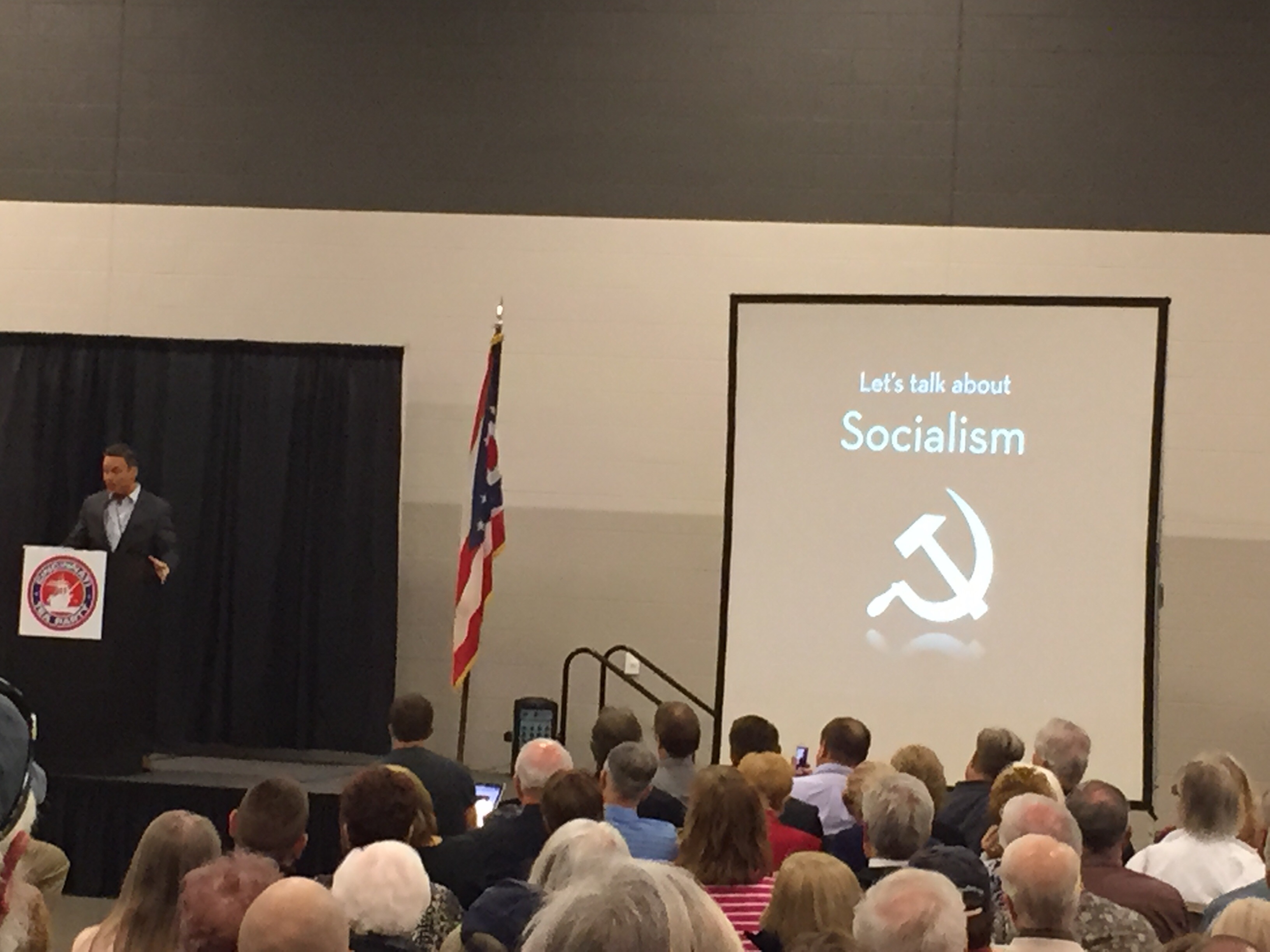
Meet Matt Kibbe Speaking at the Cincinnati Tea Party: Six years of success projecting many more

It says a lot that after six years the Cincinnati Tea Party still draws such huge crowds such as they did during the 2015 Tax Day rally at the Sharonville Convention Center. Ann Becker and her band of righteous rebels have done a very good job of keeping everything together even when the established political party of Republicans has openly sought to destroy the fledgling movement. The Cincinnati Tea Party has so much influence throughout the country that it attracts national personalities like Matt Kibbe to speak at its events such as what can be seen in the following clip from that event.

Matthew B. “Matt” Kibbe is the President and CEO of FreedomWorks, a position he has held since 2004. He originally joined the organization (previously known as Citizens for a Sound Economy) as a policy analyst in 1986. He previously worked as Chief of Staff to U.S. Representative Dan Miller (R-FL), Senior Economist at the Republican National Committee (where he resigned in protest when George H. W. Bush violated his no new taxes pledge),[3] Director of Federal Budget Policy at the U.S. Chamber of Commerce, and Managing Editor of Market Process, an academic economics journal published by the Center for the Study of Market Processes at George Mason University.[4][5]image

Kibbe has been published in publications including The Wall Street Journal,[6] The Washington Times,[7] USA Today, RedState.com, America Spectator and Reason Magazine.[8] On television, Kibbe has appeared on MSNBC’s The Dylan Ratigan Show, MSNBC’s Hardball, FOX News’ Fox & Friends, FOX News’ Glenn Beck, NBC’s The Today Show, FOX News’ America’s Newsroom, CSPAN, FOX News’ Neil Cavuto, FOX Business Network’s Happy Hour, and HBO’s Real Time with Bill Maher[9]

http://en.wikipedia.org/wiki/Matt_Kibbeimage

I enjoyed meeting Kibbe as he’s someone who has done some great national work on behalf of the Tea Party. If not for him, and a few like him, it would have been hard to continue this act of rebellion against big government for such a long period of time. As Kibbe said in his speech, there has been a shift in the power of new media to allow discussions of freedom to rise to the top in spite of attempts from the old world to confine them. Kibbe pointed out that John Boehner should have been in attendance since he lives up the road, but was scared because he knows what the Tea Party means to established Republicans.

Of the upcoming presidential nominees from the Republican Party so far, all are Tea Party candidates. There wasn’t anybody like these guys in 2008 when McCain ran against Obama—so this election of 2016 will naturally have some debate that the rest of America has not heard before. People within the Tea Party of course have been hearing these arguments for quite a long time, but now there will be a national audience that will be cast in competition against the ideas of the past—traditionally regulated to the progressive elements of the two-party systems. The Tea Party has not died, as many hoped, but has remained a force for change from a corrupt system into a more philosophic endeavor poised to provide definitions to economic and social boundaries that have long been ignored.image

Kibbe with all his great experience was very at ease on stage and provided a wonderful talk. I came in behind him as he was registering at the VIP entrance once the crowds had settled inside the auditorium at the beginning. He was extremely unassuming and confident using logic to make his points as opposed to emotion. Even when nobody was looking Matt Kibbe was a solid representative of sound economic policy. I knew who he was but didn’t bother him as he gets hammered by fans everywhere he goes. He was very polite to everyone who tried to engage him and gave him their books hoping to get coverage on his FreedomWorks network. But Kibbe stayed on point and focused until it was time for him to speak.

In contrast was Benn Swan who I have also had some interaction with in the past who gave a speech with a pretension that projected he thought he was the next Glenn Beck. Kibbe has had a lot higher profile than Swan who made a name for himself at Channel 19 in Cincinnati. Swan ducked out as soon as his speech was over shaking hands and behaving like a star wanting to sign all his autographs. Kibbe stood next to me in the back of the room looking like the kind of guy you’d want to have a beer with. We spoke a bit but otherwise he kept his profile low and his attention on the task at hand. He was as much of a class act as I hoped he would be.

imageKibbe’s speech left me thankful that he does all that he does. His contributions are direct, and having a dramatic effect. He is certainly one of the people in my opinion who have helped populate the field of current presidential candidates. His national work has after all these years began showing results–and for those in the Tea Party movement, they are favorable. It is certainly because of people like Ann Becker that the Cincinnati Tea Party is still so respected, but it is because of those like Matt Kibbe that advances in political, and economic philosophy have brought to fruition an option in thought that just wasn’t present in American politics six years ago. It has been a great six years, and the next six will produce advancements unfathomable to the John Boehner types of yesteryear. And the responsibility for many of those advancements will fall directly to the antics of Matt Kibbe and his FreedomWorks network. It is for that reason I enjoyed meeting him so much.

Rich Hoffman

 CLIFFHANGER RESEARCH & DEVELOPMENT

Listen to The Blaze Radio Network by CLICKING HERE.

‘Batman Versus Superman: The Dawn of Justice’ from the lens of Ayn Rand

Essentially the argument in question revolving around the new Batman Versus Superman: The Dawn of Justice movie is a philosophic argument between Plato/Aristotle and Nietzsche/Ayn Rand. Batman represents the old human concept of law and order whereas Superman represents the overman.   It is a compelling argument and one that I didn’t entirely expect to be conveyed so openly in a comic book movie—but here it is.

Of course it should be expected where my sentiments fall. And I’m sure Ayn Rand would be aghast that I compared her to Frederick Nietzsche. She would break things down by stating that she is more like Aristotle whereas Nietzsche is aligned more properly with the sentimental mysticism of Plato—but for this line of thought I’m breaking down philosophic development into the boundaries of western civilization itself. The minds of man have brought us into the modern age on the philosophy established in Greece. Ayn Rand and the concept of the overman is the future—it is the graduation of mankind from the boundaries of intellectual confinement driven by thousands of years of madness.

I have stated my love for both film franchises, of course the Batman films of Christopher Nolan and the Man of Steel film by the same producer. Both Christopher Nolan renditions of the comic legends have heavy doses of Ayn Rand in them—collectivism versus the individual. Yet Hollywood is directly opposed to Ayn Rand currently favoring heavily the Kantian philosophy of collectivism, altruism, and human depravity. The director of the Man of Steel films and the upcoming Dawn of Justice is Zach Snyder who obviously like Christopher Nolan, prefers Ayn Rand and even though Hollywood may not like it—the hot handed director is at the helm and is poised to deliver a powerful money-making franchise to Warner Bros that will compete directly with the wonderful Marvel Avengers films from Disney.

I’m actually going deeper into this line of thought with my Cliffhanger project, but for the masses right now at the start of the 21st century this Batman versus Superman battle needs to happen, and the trailer captured the essence of it very well. All through human history mankind has fallen in love with power and it has corrupted their minds. An overman on the other hand has no such love for power, because they understand the nature of it. Power is not given to other people through democratic measures. Just because one person can command hundreds, perhaps thousands from the lofty perches of a social title of some kind—there is no real power there—just an acknowledgment of collective will. Real power comes from an individual and will remain no matter what circumstances emerge.

In many ways in a modern since the director Ridley Scott surprisingly grasped this concept in his 2000 release of Gladiator, which won best picture that year along with a best actor award for Russel Crowe. Scott isn’t typically an Ayn Rand fan, but he did grasp the power of the individual in that film where Maximus—the protagonist had been the favored general of Marcus Aurelius due to his skill on the battlefield, but once the Emperor died, his son Commodus, deeply jealous of Maximus sought to put the general to death and kill his family. Maximus escaped, but not in time to save his family. The great man lost everything and is captured and toured around as a gladiator—one step always from death. Yet Maximus is so skilled at fighting that he quickly rose back to the top and eventually challenged again the Emperor of Rome as a masterful tactician. It is clearly one of the best films of its kind and is oozing with Ayn Rand strength centering on the individual over the collective. There is a truth in that particular film that Ridley Scott unintentionally released. I have put that truth to test many times and have discovered that it’s immensely accurate. You can take a great man and cast him onto a remote island in the middle of nowhere and he or she—will succeed in spite of the collective efforts to hold them down. Great people are not driven by collective salvation or sacrifice—they are creators of their own fates and can make success out of any situation—because success is an act of creation—not something granted by luck or the “gods.” A great person will always rise back to the top by default and there is a science to it that is predictable.

Zach Snyder seems compelled by this same resiliency and all the characters in his films embody some aspect of this. So it’s no accident that Christopher Nolan put Snyder in charge of the Superman franchise. There really is no better director today who knows how to handle the Man of Steel mythology. Superman is a superior being from another planet who simply wanted to help mankind become greater. He has absolute power, and came from a planet that collapsed under that power—not by his hand, but those of his people. Superman’s job is to ensure that the same thing doesn’t happen to earth. Batman on the other hand is a broken man who lost his parents at a young age and has spent his life righting wrongs essentially out of a vigilante need to rectify justice. But that justice is very terrestrial as it has been formulated around human perception. Batman is a second generation man of wealth meaning he inherited much of what his father made for him, but he is competent enough to sustain that wealth and apply it to fighting crime. Batman is always one step away from falling off the cliff whereas there is never any real danger that Superman would or could fall. Because no matter what happens Superman will always rise back to the top just like Maximus did from the Gladiator. So Snyder in the second film of his Man of Steel series is pitting these two heroes of entirely different philosophies against each other which is essentially the debate of our day.

The essential suspicion is that no man can resist the temptation toward corruption if given the opportunity. So Superman is a threat to the world even though all his efforts have been in trying to save it. But Superman is not a man of this world; he is essentially an alien functioning from an inner self-assurance that is a graduation of mankind’s limits. Yes, he has absolute power, but he also is immune to the desire to abuse it for the sake of social adornment. An overman knows where their power comes from so the appeasement of the masses does nothing for them. The only measure they have is themselves for success. Whereas the traditional western perspective is that if the masses support the power and authority of an individual that power is thus provided to control those people. This ultimately leads to a collapse of the individual ego upon itself because power is not generated from within, but from without.

It was the Fabian socialist George Bernard Shaw who termed the name “overman” or otherwise “superman” in his 1902 play Man and the Superman which would later inspire the comic. In the play established in Act 1 is the concept that the more things a man is ashamed of, the more respectable he is. This of course leads to a disastrous life making men miserable for most of their existence. As Shaw states in his play, “A lifetime of happiness! No man alive could bear it: it would be hell on earth.” This is the world of Batman—he’s never really happy and feels he is a Dark Night that stands in the shade between right and wrong. However Shaw was a socialist who did not believe in the abilities of mankind to overcome such faults so he regulated his sentiments toward collectivism being lead by the elite in charge—which of course took Nietzsche’s work and perverted it into the Nazi regime. A couple of high school kids from Cleveland, Ohio inspired by many science fiction writers from the early 20s—inspired by Shaw’s play—invented the comic Superman to fight for the rights of left-leaning causes during the Red Decade coming out in 1933. The big difference between Nietzsche’s overman and Siegel and Shuster’s “superman” was that one transcended the limitations of society, religion, and conventional morality while still being fundamentally human. The other was alien and gifted with incredible powers choosing honorable human moral codes, holding himself to a higher standard of adherence to them, purposely. Over time Superman has evolved ending up in the middle of those two viewpoints under Zach Snyder’s care. And that is a good and healthy thing.

So Batman versus Superman is more than another popcorn movie about superheroes. It’s a philosophy for our age that needs articulation. A lot of history has passed since Shaw wrote his play but what has come out in the end is a fully fleshed out philosophy that works. That philosophy is what the theme of this upcoming movie is between two of the most well-known and loved superheroes of our modern mythology. Under Zach Snyder’s care I think he’s going to produce something revolutionary and I’m very excited about it. But in that battle I know already who will win. The overman always comes out on top—because it’s in their nature to always do so.

Rich Hoffman

 CLIFFHANGER RESEARCH & DEVELOPMENT

Listen to The Blaze Radio Network by CLICKING HERE.

The Difference Between Good Guys and Bad Guys: Previews for Star Wars ‘Battlefront’ and ‘Force Awakens’

I have been saying it for quiet a while, its coming—quick. Its more important than the 2016 presidential election, it has more emotional power than a whole childhood of public school. For many it’s more meaningful than the relationship they have with their parents and siblings. It has more sustenance than any goals obtained in a commitment to a career. For many—a lot more than it used to be—the next six years will be some of the best and most emotional years of their life, and the direction of human society will be decided not by the religions of the world, or the billions and billions of dollars of money spent on education. It will be defined and implemented by the new Star Wars movies that are coming out between 2015 and 2020. Star Wars is already one of the most important cultural phenomenons that exist to human beings. But what will occur over the next five years will shake the foundations of our society to their bare essence. This week during the 2015 Star Wars Celebration in Anaheim, California the preview to the second trailer for The Force Awakens played to the world, and many grown adults reacted in a similar way as seen in this clever Mathew McConaughey clip shown below.

So why all the excitement?

I was very close to taking my family on vacation to Anaheim this year to attend the Star Wars Celebration. The reason we didn’t go is because we are trying to stay a bit on the fence—we are all fairly invested in the Expanded Universe and want to make sure that the new films are not utterly screwed up continuity wise. If we had known that Jaina Solo would be in the new films, we likely would have dropped $20,000 for a no holds vacation to California. But right now we don’t know much about the future of characters we love as a family, and Disney really didn’t get a huge presence into their theme parks yet—which was the other qualifier. It’s only been three years, but I had hoped that Disney would have had more Star Wars specific attractions by now, especially since they put the Celebration event right next to Disneyland. But they didn’t so given the unknowns, we held onto our money for the time being. However, that didn’t mean we couldn’t see what was going on. The event was live streamed for the entire weekend, which my daughter and I watched religiously trying to see each and every interview shown. We were like many millions around the world scrapping up every bit of Star Wars news coming out of the convention—which from a mythology perspective was quite extraordinary.

The reason for all the fuss is that Star Wars is all about values and the world has in many cases been deliberately starved of them to fulfill various political agendas. Star Wars is really the first global influence which clearly attempts to define good and evil in a way that every culture from every segment of society can relate to. Religion used to be that vehicle, but it no longer works properly for most, and Star Wars is filling that void.

Another massive revelation which came out of the convention the day after the movie preview for The Force Awakens was shown was the new Battlefront video game which features Star Wars scenarios in some of the most intense battlefield action seen to date—themed to the original films. I am currently playing Star Wars: Commander on my iPhone 6 just to fill the time between game platforms. My wife and I just finished playing Star Wars: The Old Republic which we played every day for nearly two years and now we are waiting for Battlefront which can be seen in the following clip. This is a new reality that fans around the world can enjoy playing in real-time against real people at all hours of the day no matter where they reside. When Battlefront comes out, I may retire again and spend most of my days playing that game. Here’s why—I never get enough of this type of activity!

One aspect to Star Wars: Commander that continues to amaze me is how many people chose to play on the side of the Empire. In Star Wars the Empire represents the bad guys and I have been mystified as to why people would or could play the bad guys. There is a segment of the population, and I see this extensively in the table top games from Fantasy Flight, like X-Wing and now Armada that roughly half the human population identifies with the bad guys so much they prefer to use them as representatives to themselves while the other half chooses to play on the side of the good. According to many who prefer the bad guys, the Empire is poorly understood and is on the side of institutional justice. There is a power in the bad guys that is attractive to these people and ironically it does affect their morality in real life—it will affect their decisions at the voting booth in favor of marijuana legalization, immigration strategies and generally the size and scope of government. There is quite a science to the natural appeal of those who love bad guys over those who don’t. In Commander there is never a shortage of bad guys to play against in live combat. No matter what time of day or what part of the week there is an Imperial base to attack because that many people love the bad guys of Star Wars so much that they are willing to invest the massive amount of time it takes to build up to a level 8 base—which is what I have.

A common theme throughout the years 2000 through 2010 among from young men who knew me was that many liked the villains of Star Wars much more than the heroes. I was trying to mentor them, most came from homes where the fathers were terrible. They only identified with the bad guys, whereas young men who had strong fathers that they could look up to tended to agree with me, that the good guys were the ones to cheer for in Star Wars. I would get pretty animated at these young boys who loved Boba Fett and Darth Vader over characters like Han and Luke and tell them that there was harm in liking the bad guys, which I still believe probably more so today than I did even then. Yet I could not convince them otherwise because their foundation thoughts were set in stone from early in their youth. I suspect this is the case for many who love Star Wars from the point of view of the bad guys. Somewhere along the line a mentor of some kind let them down, leaving them to turn toward institutional consensus to behold their values.

Of those young people who argued with me in favor of the bad guys over the good every single one of them has had a rough life a decade later. Often drugs were part of their lives, but also they suffer from relationship issues and generally low self-esteem. I still feel if they had listened to me, they would have been greatly improved as human beings but their desire to identify with the bad guys in Star Wars indicates a much more systemic issue than anything that can be quickly cured with some motivational speaking.   If the wires are crossed during their infancy, there isn’t much anybody can do to fix them later unless they recognize the error of their identification.

As a kid, and still now, I could never play the bad guys—I never felt comfortable flying a TIE fighter against an X-Wing fighter in the video game series X-Wing. I could have never put on a Boba Fett costume—and certainly not a stormtrooper. When the game Force Unleashed came out I did not play it at first because you had to play as an agent of Darth Vader—which I couldn’t do. I literally could not physically show aggression toward what I considered to be the good guys in Star Wars. It actually makes me sick to do so—to play a bad guy. I’ve been like that my whole life—down to my earliest moments. In kids both male and female the love of good guys or bad guys seems to come down to the relationship they have with mentors in their lives. If they are short on proper mentors, they tend to love the Empire. If they have several positive mentors in their lives, they love the good guys. One of my nephews really became angry with me when he tried to justify Darth Maul as a cooler character than Obi-Wan Kenobi. He had a really manipulative father—so no matter how much I tried to inspire him to something better, he always snapped right back into loving Darth Maul over Obi-Wan. After several years of trying I stopped—understanding that the static patterns had already been established and it would take a major crisis in his life to shake him into wanting new heroic archetypes.

But what’s great about Star Wars, even those who love the bad guys, is that the stories from that franchise are about essential values and are some of the most powerful works of philosophy and religion currently being explored anywhere. Star Wars is shaping the tone and values of the 21st century and is defining the next thousand years of humanity. It is becoming our new Bible wither or not people like it or not. In a society that is lacking values—purposely implemented—Star Wars and a few other comic related franchises are all they have. In most cases, parents have failed them, schools have failed them, mentors have failed them, entertainment, religion, economics—etc, have all failed them so they turn to Star Wars for the values uttered in those stories. That is why all the emotion over a simple preview in anticipation for one of the most epic experiences most people will ever have even in relation to the life and death of loved ones—the opening of the next Star Wars movie. It’s much more than a film franchise designed to make money as a capitalist endeavor. It is that—but it’s much, much more. Star Wars is about values, and people weep over just hearing the music because it makes them emotional to have those empty voids filled within their minds where values should be—values that have in some cases deliberately been withdrawn as a means to control the population through political efforts. Star Wars is about recreating those values and the result of that endeavor usually puts people on one side or the other. But whichever side it is, they are at least better off than valueless slugs awaiting the commands of a political class that rules by the void of valueless utterances. Star Wars provides those values, and the world is far better off because of it.

Rich Hoffman

 CLIFFHANGER RESEARCH & DEVELOPMENT

Listen to The Blaze Radio Network by CLICKING HERE.