The 2014 Annie Oakley Western Showcase: Bringing Lash LaRue off the silver screen into reality

As usual it was a marvelous weekend at our annual Annie Oakley event.  What started as a large group that originally met at Las Vegas each year is now just a handful of whip crackers, knife throwers, trick ropers and magicians intent to put a smile on the faces of young people and wow the adults who graced the grounds of the 2014 Annie Oakley Festival in Darke County.  The venue this year was moved from the usual fairgrounds in town to a more remote location just to the north.  It felt a long way out and even deeper into “God’s Country” but a very large crowd turned out and what they found there were shooting contests, fast draw contests from the Single Action Shooting Society, theater drama, and the 12th Annual Annie Oakley Western Arts Showcase accompanied by the many venders selling goods.  Most of the venders very unique with little booths set-up mingling among the trees of York Woods.  For over ten years now some of the best whip crackers in the country have gathered to meet with their own kind at the event and as usual it was a marvelous enterprise.

I said many times during the day which was absolutely perfect for July weather with mild temperatures and occasional rain bursts erupting just to the north and south painting a menacing sky at times across the vast plains of farmland extending out into Indiana—that my love of this event was yearly maintenance; it restored my faith in humanity.  The people who attend are some of the few people left in the entire world who do these kinds of things which used to be common place during Annie Oakley’s time.  A few are in long-term marriages which are inspiring, and most have spouses that they bring with them where they enjoy each other in a healthy way and it is just good to associate with people of that character.  I’ve said it before, but it is applicable, the people in our group are nearly identical to the characters shown in the Clint Eastwood film Bronco Billy—which is a favorite of mine.  They are a small group of people who are all that is keeping a way of life in America alive for the next generation.

There are many in the world who might say good riddance to classic American arts—particularly those residing around large metropolitan areas—which is why attending each year restores my faith in humanity.  It is so refreshing to spend time around genuine people who truly love something rooted in classic Americana.  But to lose these values, the whip cracking, the gun spinning, roping, and knife throwing—with vaudeville type shows conducted from corn fields in the middle of nowhere—U.S.A would be treacherous.  The heart of what it means to be an American is in those shows, I have now known the ring master of the Annie Oakley event—Gery Deer for over ten years and each year he finds new ways to change-up the show to always keep it interesting.  At first there were concerns over moving the Annie Oakley Festival to the outskirts of Greenville—but quickly those worries proved pointless.  Large crowds attended and the celebration was nothing short of inspiring.

It took me a while to get warmed up but by the time we got to the Speed Switch contest which allows bullwhip artists to strike at ten targets as fast as they could–first with one hand then with the other on the way back up the target row, I had hit my stride.  This year it was obvious that everyone was a bit smoother and had been practicing.  The times were faster generally for everyone which made for an exciting show for the people watching from the bleachers.  I had my fastest time ever on the Speed Switch—just a bit over 11 seconds which is fast for even the Speed and Accuracy contest so well-known to seasoned veterans.  I enjoyed the location, the vast open spaces all around the touring bus of the Brother’s and Company set up as a backdrop for the stage as a generator provided all the power needed for the show.  The crowd sat in the beginnings of the York Woods where shade gave them shelter from the sun which peaked out often around menacing storm clouds.  If anything pushed my speed a bit it was a combination of those elements.

Many of the same people who came last year came this time around again traveling from far away destinations to arrive.  Some couldn’t make it, but the beauty of the event is that each year there are opportunities to do it again and recharge their batteries from a punishing year.  It is punishing to stand behind these classic American art forms when the current trend is to run away.  Often the skeptics will stand on the outskirts of the roped off area and watch with curiosity as most of their thoughts were created by pop culture—but after a few moments, they can’t help but smile at the cheesy jokes and purity of the type of Western Showcase that Gery routinely puts on.  There is a playful innocence in it that is unmistakable and it doesn’t take long to reach into the inner child of the typical viewer to touch that part of themselves which has long ago been ignored—and suppressed.

I saw some of that at the end of the day when my wife and I went to the restaurant we normally gather at in Greenville to make reservations for the back half of the dining room.  The rest of our group was on the tour bus coming down from the York Woods location so we wanted to have everything set up for when they arrived.   As the manager arranged tables I saw some of that modern cynicism in the bar where my wife and I waited.  A corner contained a group of young twenty-somethings watching a baseball game and as I stood silhouetted in the doorway between the bar and dining room a young kid with his date looked my way and started texting his friends sitting next to him murmuring—it’s “Crocodile Dundee.”  I stared at the kid just to make him feel uncomfortable and to let him know that I could hear him, which he hadn’t expected.  He wanted anonymity from the security of his reality among his friends so I made a point to not give it to him.  This isn’t the first time this has happened and it won’t be the last.  On more than one occasion in that same bar we’ve encountered worse but quickly converted them over into fans.  One year Chris Camp took a skeptical woman outside and made her into a whip target stand in the parking lot in front of her husband cracking straws from her outstretched hands.  Moments before she had been similar to the kids in the corner, but after about five minutes was gushing all over herself at the coolness of having a weapon break the sound barrier right next to her face.  The only references modern people have toward such things outside of the type of events that Gery puts on, is music, movies, and television which has turned dramatically against the American Western, or any form of rugged individualism.

The clash of cultures is one where the values of two groups of people crash in places like that bar.  At the Annie Oakley Festival the context is already presented.  It is not unusual for members of the Western Arts Showcase to roam around the event in costume.  I typically wear my whips with me, and nobody bats an eye—they expect it because of the context of the show.  When our members used to attend the Fairlawn restaurant in years prior the strip of road separating it from the Darke County Fairgrounds was filled with people attending the festival.   This year there was no late night activity in town, because the Annie Oakley event had moved far to the north—so the Fairlawn was filled with regular people living their regular lives watching baseball games and trying to show how well they fit into the modern world of the big nearby cities like Dayton, Columbus and Cincinnati to the south.  So for the kids in the bar they had no idea there was an Annie Oakley event in town as it had moved.  The boy who made the Crocodile Dundee comment likely hoped that his girl friend would be impressed by his remark and the laughs and giggles among his friends would earn him an honor of some kind, to prove that he was just as much of a douche bag as the next guy.  What kids like that don’t know, because it’s not part of their experience, is that the heroes of old, which the Ohio Western Arts group is dedicated to preserving are people like Lash LaRue, Douglas Fairbanks, and of course Annie Oakley—people they have no experience with.  If they did, they’d have a much more fulfilled life—their marriages would last longer, their lives would be richer, and they’d be generally happy people.  Some of the members of our group travel in trucks and vans that are twenty years old filled with stage props.  Often they sleep in a cramped back seat traveling from gig to gig in a hope that their sheer charisma might improve the lives of just one person with the kind of hopes and dreams born from the mind of America.  Most of the time they get paid decently, but are drained from the experience only to dust off the feeling and do it again weekend after weekend year after year.

I have never seen a young girl who didn’t melt away into butter when a confident whip handler removed a target from her lips.  If the kid wanted to impress his date—and I wanted to tell him this—the best thing he could do for himself is to learn the skills our group brought to the Annie Oakley Festival.  As our group arrived and filled the back of the room, the kid stood in the doorway wondering who all those people were sitting with that same guy in the Australian style outback hat.  His perplexed look was one of realizing that there was a group of people in the world functioning around him who were different from the patterns he had learned—that certain music was popular, certain modes of dress acceptable, and that there were people out there who considered non-conformity to be far superior to social conformity.  It is that trait that the Annual Annie Oakley Festival in Darke County, Ohio appeals to best, and the primary reason that so many make the yearly pilgrimage.

I certainly have a lot of experience with such things measuring public temperament.  Unlike the other attendees I have chosen a more controversial roll using my desire to preserve the Western Arts in a way that I think the real Lash LaRue would have done in his day—I have made it part of my political discourse.    I have fought higher taxes and known political corruption using the skills nurtured along over the years with the bullwhip to have the same effect the young guy in the bar experienced.  When it comes to traditional American art, I feel that the best ground to defend it is outside of the shows where viewers can watch comfortably from behind a roped off area.  I take great pleasure in bringing the show to the safety of the herd because it is there that they need to see it most.

At the end of the night there were jokes about how out-of-fashion we were as a group and pride was taken in being so out of style.  I remarked that all we needed to do was wait another 50 years and there will be hordes of people desiring deeply the traditional American arts displayed yearly at the Annie Oakley Festival—it will at that time become fashionable again.  But right now, especially with the failure of the Lone Ranger at the box office last year, nobody in movies or television is going to produce a film like Zorro or Lash LaRue in the jaded culture we have now.  But for those who still desire such things, the way we do who perform them, the yearly event of Annie Oakley is a real treat.  It recharges my batteries with meaning after a year of typical cynicism in a way nothing else does.  I typically wear my hat year round everywhere from Michigan to Florida and in every possible venue from wealthy to poor—so it is routine to get the kind of reaction I received from the kid in the bar.  But what is unique is that a horde of people dressed similarly who share my values don’t often come walking in behind me.  And while I might want to take Lash LaRue off the silver screen and plop him down into America in 2014 with my real life antics, it is the one and only time a year that I get more from everyone else than I typically give leaving me feeling uncharacteristically fulfilled.  In that regard, I hope that Gery gets the circus tent next year that he’s talking about—because that would be absolutely grand and a good next step to the new venue at York Woods marking of the start of a second decade in a long march toward eternity.

Rich Hoffman   www.OVERMANWARRIOR.com

 

About these ads

Occasionally, some of your visitors may see an advertisement here.

The Nature of Productivity: Lessons learned from the 20th Century Motor Company

The following three videos should be listened to completely—for they contain the secrets to manufacturing success within them.  To understand the effects of positive GDP forecasts, or the growth of a manufacturing sector in a country—the following clips read from the pages of Atlas Shrugged contain the hidden knowledge that is required to comprehend the cause and reasons for any kind of productive growth or decline.  In the fictional 20th Century Motor Company as described in the classic 50+ year novel—an entire company is driven to ruin for some mysterious reason.  That reason would later be confirmed cryptically by the entire  real-life city of Detroit, General Motors, and hundreds of thousands of smaller companies who like the factory in the novel that were once thriving places of industry but soon found their doors closed and overtaken by plant life from abandonment, followed the same path.  The philosophy of productivity for good or bad is contained within these three videos.  Once understood all the books written about modern finance, management, or lean manufacturing techniques will become obsolete as the truth contained is undeniable.  No matter what one’s opinion of Ayn Rand might be—whether or not they agree or disagree with her politics of small government, pure capitalism, and  value based society represented by money—her understanding of economics and business in general is among the greatest minds over the last three hundred years.  Let me explain why.

As a young man I saw on a much smaller scale the same type of things talked about in the 20th Century Motor Company as narrated by a former employee in the presented videos.  One place that I worked at nearly right out of high school while attending college night school was a metal stamping factory full of tough guys born and raised nearly exclusively in unionized households where their parents worked for General Motors or large local paper companies which had gone out of business.  They had deep in their internal workings the same beliefs as the narrator describing the 20th Century Motors situation and I immediately came into direct conflict with them.  Lucky for me, my background included hard-working parents, two sets of grandparents who owned professional farms and my first work experiences where around members of the Chicago Chinese mob.  So I had the opportunity from a very young age without reading Atlas Shrugged to learn about what values money represented about people and learned about the nature of good and evil as related.  My job at the stamping factory was a clash of two worlds, one where a majority of the people thought just like the narrator in the Atlas Shrugged excerpts, and I.  At this factory there was a piece per hour rate that was established by management of 400 parts on average.  The presses had lines of workers who each operated a part of the process in making compressor housings for air conditioners, the first press would press out a rough shape from a sheet of metal, the second would trim the excess away, the third usually involved several workers who had to do a number of punch operations to make connection holes.  Each had a unique challenge to physical labor that had to be done quickly to even think of getting close to 400 parts per hour.

I learned without much time expiring to do well over that 400 part per hour rate and soon found that management put me on the lead at the start of the line to set the pace for everyone else.  Employees downstream on the line when they realized I was pushing to do more than 400 per hour would slow down and let the parts build up on the conveyors leading to their presses.  But having parts backed up would often stress them out forcing them to do more than they wanted anyway so productivity increased and the management was happy.  This of course led to many conflicts and parking lot fights.  However, with my background–some rough characters from my youthful enterprises, and my natural hobby with bullwhips as my primary exercise item, I never had to worry about handling myself against rough-neck employees and their labor union backgrounds.  Through conflict I earned their respect and even though they resented being pushed, came to like me well enough to not resist my wishes.

I never bought into the line of thought that believed workers should only produce 400 parts per hour if they could do more because it seemed wrong to regulate productive enterprise.  I learned quickly that no matter how hard I worked, a majority of the workers would gladly ride my coat tails without putting forth any effort, and if I wanted to produce excess—which to me felt natural, I had to learn to fix the line myself when maintenance issues arose, or other problems presented themselves.  Often I felt that I carried the manufacturing capacity of the place on my back alone by pushing the culture toward productivity. Eventually I would leave that job and they immediately went through a period of struggle.  The next company I went to had very similar manufacturing challenges but instead of metal, it was injection plastic.  Again, it was the same story, a part per hour rate, my desire to exceed it, and a company full of employees who wanted to fight me over it to protect their “rights” against “management.”  In this place I talked the management into letting me work double shifts every day of the week—(16) hours a day, and on the weekends I’d back off only working (8) hour days.  I worked (7) days a week averaging around 96 hours of work per week.  Many in management thought I would keel over but they wanted my efforts which essentially was outpacing around (7) of their hourly workers and I was doing it on 2nd and 3rd shifts which were hard to staff.  This was a big place and my average output alone outpaced much of the totals from their entire first shift because of the amount of time I spent in their building working.

I knew people were mooching off me both in my private life and professional by the droves and my response was to see how much I could carry.  I performed like that for nearly 2 years straight then left there to work at Cincinnati Milacron.  There I ran into extreme levels of the kind of behavior talked about in the 20th Century Motor Company.  There, I was doing a very individually based job which prevented my direct impact on the productive culture.  The jobs perished as a result—not just mine, but everyone’s.  The site where I used to work is now a shopping center.  The large campus of manufacturing at “The Mill” is now gone, and my job with it.  My next place of business to work was a unionized shop doing manufacture for Amazon.com distribution centers.  There I had many conflicts with the employees some of which have been discussed in detail, but I routinely produced 150% efficiencies over the manufacturing rate per day, as opposed to the normal rate of 40% to 60% that the union employees fresh off a strike were producing.  That company like Milacron soon was sold off from a company that was drowning in losses—so I lost that job too along with many others employed there.  The way that the employees were throttling the piece rate was that many of the manufactured units had a 4 to 5 hour time, and most of the union workers would milk out that time to produce one unit per day on an eight-hour shift.  I was routinely producing two which pushed my rate well over 100% on average.  In that shop a forklift had to bring supplies to build with, so I learned that when I was out of material not to trust the forklift operator sitting on his unionized butt to help me achieve my goals, I would grab a forklift on my own and get my own stuff.  Of course this enraged people—but I did it anyway the entire time I worked there.

The long story made short is that there is excessive truth contained in the video clips presented.  The evil talked about is an evil that I have fought without really knowing the definition for years.  I only knew at the time that I wanted to fight that evil, I didn’t understand why until much later.  When I had figured it out, I then read Atlas Shrugged to have that confirmation thought, but that has been within the last decade.  I figured out what made the 20 Century Motor Company fail by experience instead of being told by a book.  I am proud to look back on my life now never yielding to the pressures of the masses to restrict my outputs and thus prevented becoming myself a contributor to that evil described.  I never produced at such levels to get a pat on the back from management, or even to make more money—even though those things did come to me, I did them because there was something inherently right about it.  The culture I grew up with aside from my family, the mob, and the money laundering from a job I had before the metal stamping place (not conducted by me, but discovered), had signed up for the same evil that destroyed the fictional 20th Century Motor Company.  I luckily had learned the value of money from people who naturally possessed great value, and even learned a lot from a criminal class who clearly understood the benefits of capitalism.  Their crimes were against politics, not the morality of money—and this is something I learned very early in my life which was a real gift.  By the time my wife begged me to take up honest hard-working jobs that were clean of criminals, hit men, and money laundering, I had already met the worst that any factory thug could present, and I knew how to deal with them.  In this way I was never beaten down for doing too much, and never stopped from being productive.  And I was able to confirm the validity of Ayn Rand’s work through more than theory.  I saw it firsthand.  The difference between myself and Ayn Rand is that she developed her philosophy around removing her input through a strike—her John Galt quit the world and took the productive with him.  I on the other hand felt the challenge to carry everything on my back the way Hank Reardon did, but without ever breaking.  My life would have been easier if I had done things the way Ayn Rand suggested, but I chose to fight it instead, and I’m glad to this day that I did.  But whatever the position, she was right and the narrator who is speaking her words is spot on.  The thing that is killing our world of productivity is the evil described in these videos.  It is not a fiction; the evil is as real as the sun, stars and moon and cannot be trivialized no matter how much a collective mass of people wishes. Productivity is good when boundaries are pushed beyond their expectations because it is there that creativity resides.  And it is specifically in creativity that production springs forth.  If creativity is embraced, a company flourishes.  If it is stifled even in small ways, the way of the 20th Century Motor Company will spring forth and slowly destroy everything that the company stood for.  Profit isn’t evil; it is the natural by-product of excess achieved through effort, creativity, and honor.  I didn’t work those two years of straight 96 hour work weeks to arrive at any other conclusion—and I didn’t do it for the graces of management.  I did it because it was the right thing to do at the right time because the creativity which put the product before me to make needed that effort to deliver it to a market in need.  And because it was delivered, the owners were paid, and in turn I was rewarded for my efforts—and that is how it is supposed to be.

Rich Hoffman


www.OVERMANWARRIOR.com


A New X-Wing: Capitalism helps a ‘Force for Change’ benefit the world

Charity is only a bad thing when the altruism involved masks other behavior designed to win social favor instead of genuinely using productive excess to help those suffering from stifled freedom.  The Star Wars: Force for Change initiative, linked below, is one of the good ones.  The intent is to bring the benefits of capitalism to the far reaches of planet earth, and that is wonderful.  There are many children suffering under countries with poor political philosophies or economic systems that do not capture the natural innovation of their inhabitants—but instead stifles them needlessly.  Force for Change is intended to use the excess of capitalism created by the mythology of Star Wars into actually making people’s lives better which is something everyone should emphatically support.  And as usual, J.J. Abrams has provided a teaser of the new movie, Episode VII in a final week push to drive up the numbers.


http://forceforchange.starwars.com/

The new ship looks like a classic Z-95 Headhunter from the pre-years of the X-Wing fighter seen in the original trilogy.  But the claims are that it is a new kind of updated X-Wing—whatever the case it looks fantastic and is proof that the crew working on the new Star Wars film is going to extraordinary measures to produce something wonderful.   The clever presentation of the Force for Change material during the production of Star Wars hints at the level of creativity emerging from the endeavor and is truly something to be excited about.

It will be hard to avoid this new Star Wars movie once it is released—so news from it is important to everyone, even those who are not dedicated fans of the series.  Star Wars is a direct creation of capitalism and without it there would not be a Force for Change initiative and a number of other charities which trickle off the mythology that takes place “a long time ago in a galaxy far, far away.”  Certainly under no socialist government could Star Wars have been made, and it is particularly under socialist style governments that many of the children the Force for Change is attempting to help.  England is hardly a bastion of capitalism, but they are also directly benefiting from the production of Star Wars being shot in their country—in England over a billion pounds of wealth was created by production companies filming in and around London—Star Wars among the most notable and Abu Dhabi has seen an increase by 19% in hotel reservations from fans all over the world traveling to the left behind film sites to visit the location of the Episode VII props.  Without a story nothing would be shot in London or Abu Dhabi and without that story meaning anything to anybody, there would be no desire to pay money to buy plane tickets to fly to such places just to take pictures of what was left behind during the creation process.

And that is what J.J. Abrams is doing in his Force for Change videos; he is using the props created for the film—which will be seen by hundreds of millions of people the world over.  The film may generate $1 billion in global revenue just in the first two weeks—which is astonishing.  It will likely go on to make several billion more dollars dwarfing anything previously done by any film anywhere, because the buildup is so intense.  But on top of that Walmart, Target, and anywhere Star Wars toys are sold will see sharp increases in profit.  Fast-food tie-ins will dramatically increase their sales with promotional campaigns.  And the Disney Parks will also see spikes in attendance and interest in their new property from t-shirts to DVD sales.  J.J. Abrams knowing all this is using the props from the film already used to tell the story as a way to help some kids suffering from the lack of creativity their economies have imprisoned them to—and that is a wonderful thing.

Star Wars is capitalism at its best and is something worthy of support not just of the product itself—but the spillover it has which helps feed and clothe many millions who otherwise would not have the opportunity.  Because of Star Wars, there is a Force for Change—and the nature of that change is one of depravity to fulfillment through investment driven by passion for the subject matter.  And in that regard it is very exciting to see a new ship from a future Star Wars film.  I’m sure Fantasy Flight Games is already making plans to have it in their miniatures game which is so much fun.

Rich Hoffman

www.OVERMANWARRIOR.com


“The Serpent Mound Disturbance”: A giant hole opens in Siberia–again

For those living near Cincinnati, Ohio they would likely know of the strange archaeological remains of Serpent Mound off to the east—a mound built by an ancient people several thousand years ago clearly displaying a serpent design visible to the air which has astronomical calculations built into certain points of the large site. The people who built it went to incredible trouble for reasons that are even more mysterious. Thickening the plot the site sits on a significant portion of a crypto explosion which took place over 300 million years ago. There was no way that the ancient people could have at the time known of the explosion as erosion had removed most of the sight references visible without advanced scientific equipment.   Yet out of all the locations that Serpent Mound could have been built—it was on the edge of this gigantic 4 mile wide crater that looks to have come from inside the earth as opposed to a traditional meteor impact from space. The reason this is significant is that modern scientists are mystified–a helicopter spotted a large mysterious hole in Siberia Tuesday July 15th, 2014—and it has left scientists largely perplexed thus far. The first explanation rationed was that gas from deep in the earth exploded due to the mystical global warming phenomena perpetuated by paper-thin intellectuals—a falsehood designed to disguise their ignorance.

The massive hole, about 260 feet wide, is located in the Yamal peninsula and can easily fit several helicopters inside the entrance, according to the U.K.’s Independent. It is believed to be about two years old, RT.com reported.

The area’s name, Yamal, translates to “end of the world” and is home to some of Russia’s largest gas reserves.

http://www.theblaze.com/stories/2014/07/18/a-giant-mysterious-hole-has-opened-up-at-the-end-of-the-world-in-siberia-and-its-left-scientists-baffled/

Yet this wasn’t the first such hole to appear in Siberia.

On June 30,1908, a giant fireball exploded in Siberia’s remote Tunguska region, leveling trees for more than 20 miles around and causing atmospheric shock waves that were detected round the world. At the time, scientists thought that a giant meteorite had crashed into the earth. Later, when they failed to find a major crater or clearly identifiable meteorite fragments at the site, they began to question their earlier theory.

Many scientists have since attributed the phenomenon to a comet head that exploded in the air before hitting the earth. Others suggest that a stray clump of antimatter from elsewhere in the universe was the cause through some dimensional portal—a fold of space and time which is concealing the evidence.

http://content.time.com/time/magazine/article/0,9171,908001,00.html

971521_574480222593899_774166430_nBack at Serpent Mound just outside of Cincinnati, hardly a location at the “end of the world” the same type of thing occurred long ago. The valley beneath the effigy is really the western rim of a mysterious, four-mile-wide, circular crater – the eroded remains of a huge, catastrophic event geologists call “The Serpent Mound Disturbance.” About 300 million years ago, either an asteroid collision or an underground explosion blew apart more than seven cubic miles of rock. The central area was uplifted more than 1000 feet, while an outer rim dropped more than 400 feet.

What we see today results from eons of erosion, although the shattered fragments of the “Central Uplift” remain among the hills above Serpent Mound. The distant ridge tops, visible from the overlooks, stand high today because they are the much harder Ordovician bedrock that was offset by the event.

The strange geology of this spot was first noticed in modern times by Dr. John Locke of Cincinnati, who named it “Sunken Mountain” in 1838. Yet, it’s not hard to imagine that the ancient effigy builders could have recognized the unusual land forms. The serpent looks out from the edge of the Central Uplift zone.

http://mobile.ancientohiotrail.org/sp-5.html

This little recent hole in Siberia is much smaller than the four mile wide one that occurred at Serpent Mound but one thing is for sure about the Serpent Mound crater—it wasn’t caused by global warming and much stronger forces were at work.   At this time the two craters may have been caused by entirely different forces but what is clear is that even with all of our modern equipment and satellite analysis the hole in Siberia wasn’t even noticed for two years.   This confirms that there is very little that modern science really knows about anything as our study into nature is still infantile. The cause and effects of forces known and yet to be discovered are not complete, so static conclusions are impossible at this time.

But what is most mysterious of all is that a so-called primitive people knew enough about the geology of the Ohio area which had filled back in after hundreds of millions of years of erosion to build a tribute to it as if they knew that their monument in the shape of a serpent might appease the forces that created the impact.

Many societies could have risen and fallen over several hundred million years and not all of them may have been terrestrial. Yet by some word of mouth or written documentation which is no longer seen, the ancient people who constructed Serpent Mound likely knew about the strange ancient events that took place on that site. And in our modern times similar holes are opening up right under our feet and we have no explanation for them but to blame the occurrences on our own development and science. That only goes to prove how feeble our modern grasp on reality truly is. The mysteries of the earth are alive and well, and mankind looks upon them with fear of the unknown for which they lack the courage to probe with honesty to an origin that does not reside on this planet—but out into the Milky Way toward one of NASA’s recent proclamations—that within 25 years life will be discovered afar and the answers to some of these mysteries will then become known—and we may not like the answer as it will disturb our religions, mythologies and basic concept of existence.   If history is to be followed when matched up against a superior intellect and culture—it is likely that we might want to build a monument to appease them in the same way that a weak-willed politician licks the boots of those they perceive to be their superiors. In that future time the real answer to the mysterious crypto explosions on earth will then be provided by documents that left long ago only to return by the minds responsible.

The term cryptoexplosion structure (or cryptovolcanic structure) means an explosion of unknown cause. The term is now largely obsolete. It was once commonly used to describe sites where there was geological evidence of a large-scale explosion within the Earth’s crust, but no definitive evidence for the cause such as normal volcanic rocks. These sites are usually circular with signs of anomalous rock deformation contrasting with the surrounding region, and often showing evidence that crustal material had been uplifted and/or blown outwards. The assumption was that some unusual form of volcanism, or a gas explosion originating within the crust, was the cause. The use of the term went away with the rise of the science of impact crater recognition in the late 20th Century. Most structures described as cryptoexplosions turned out to be eroded impact craters, caused by the impact of meteorites. Today geologists discount former cryptoexplosion theories.[1]

http://en.wikipedia.org/wiki/CryptoexplosionSerpent_mound_Crater

Yet, geologists have yet to explain what caused “The Serpent Mound Disturbance” and have relegated their investigation to the back of their desk drawers and left investigations to theorists who must resurrect the term, “cryptoexplosion” once again to properly term the classification.  And such explosions are not regulated to the distant past, but still occur right under the nose of science who believed that just because they stopped using a term, that the need would cease to call attention to itself.  By the evidence of the new hole that has opened in Russia–“cryptoexplosion” would appear to be much more appropriate as a term than “global warming.”

http://magnetic.me/Serpent/crater.htm

Rich Hoffman

www.OVERMANWARRIOR.com


Building The Machine: Why Deming was so wrong for American business

“Think lightly of yourself and deeply of the world” ― Miyamoto Musashi, A Book of Five Rings: The Classic Guide to Strategy

That is the kind of nonsense that is being taught in public schools and has been adopted into general business practices.  It is essentially behind the new Common Core methods of teaching which Glenn Beck so elaborately dismantled in his new book Conform.  That book shows why well-meaning politicians and philanthropists are backing Common Core—which is a complete destruction of the American education system—specifically destroying the individuality inherit in American children—and integrating them into a more global view which embodies that basic quote of Miyamoto Musashi shown above.  As traditionalists cling to the notion that Common Core must be eradicated from public education systems so to preserve the uniqueness that is desired in American children a far more sinister threat can be found behind the politics of the movement.

Most large companies in The United States cling blindly to the management teachings of William Deming—which has proven itself to be a tragedy.  Deming is the man responsible for all the ridiculous attempts at Total Quality Management which has tied the hands of American business by putting engineers essentially in charge of the management of company resources so to hamper proper productivity.  This trend exploded in America through the largest manufacturers in a time when it appeared that the Japanese were dominating all fields of productive endeavor threatening to overtake American methods in the 1980s.  The Japanese in a desperate need to get back on their feet after World War II had embraced Deming, an engineer from America to beat their former rivals at their own game.  Deming found among the Japanese people a collective based society that quickly unified behind his management methods which were essentially old Samurai strategy concepts dressed up behind mathematical formulas to justify himself being a paid consultant.  Deming was perpetrating a scam to justify his celebrity status as he propped up the Japanese.

Deming was a ruse because he essentially disliked management and sought later in his classes to ridicule American executives free of their ego and to force them into collaboration with employees and co-workers through his collective based management methods.  American businessmen listened to Deming as it was believed that the Japanese were dominating manufacturing because of him—which wasn’t true.  The Japanese were dominating because of their sense of selfless dedication to collective causes.  They thought differently than Americans and the result of their labor could be seen in their products.

It must be remembered that American businesses and the Japanese were both struggling with the spread of communism in post World War II global economic concerns, so Deming was delivering a way that management could restrict the impact of labor union quota refusals by offering managers up to laborers as sacrificial victims.  This worked well in Japan who had managed to contain the spread of communism in their society through their selfless dedication to Miyamoto Musashi’s strategy guide The Book of Five Rings.  As they were already functioning as a collective society, labor unions had little to offer them, so they were able to resist the push toward communism.  Labor unions in Japan maintained an unusually close relationship to their companies as their identities were less focused on individual achievement and more concerned over the general health of their company.  This gave Deming fertile ground to develop his management methods.

William Edwards Deming (October 14, 1900 – December 20, 1993) was an American engineer, statistician, professor, author, lecturer, and management consultant. Trained initially as an electrical engineer and later specializing in mathematical physics, he helped develop the sampling techniques still used by the Department of the Census and the Bureau of Labor Statistics, championed the work of Dr. Walter Shewhart, including Statistical Process Control, Operational Definitions, and what he called The Shewhart Cycle[1] which evolved into “PDSA” (Plan-Do-Study-Act) in his book The New Economics for Industry, Government, and Education,[2] as a response to the growing popularity of PDSA, which he viewed as tampering with the meaning of Dr. Shewhart’s original work. [3] He is best known for his work in Japan after WWII, particularly his work with the leaders of Japanese industry which began in August 1950 at the Hakone Convention Center in Tokyo with a now seminal speech on what he called Statistical Product Quality Administration, which many in Japan credit with being the inspiration for what has become known as the Japanese post-war economic miracle of 1950 to 1960, rising from the ashes of war to become the second most powerful economy in the world in less than a decade, founded on the ideas first taught to them by Dr Deming:

  1. That the problems facing manufacturers can be solved through cooperation, despite differences.
  2. Marketing is not “sales,” but the science of knowing what people who buy your product repeatedly think of that product and whether they will buy it again, and why.
  3. That In the initial stages of design, you must conduct market research, applying statistical techniques for experimental and planning and inspection of samples.
  4. And you must perfect the manufacturing process.[4]

He is best known in the United States for his 14 Points (Out of the Crisis, by Dr. W. Edwards Deming, Preface) and his system of thought he called the System of Profound Knowledge, consisting of four components, or “lenses” through which to view the world simultaneously:

  1. An appreciation of a system,
  2. understanding of variation,
  3. psychology
  4. and Epistemology, or a theory of knowledge.[5]

Deming made a significant contribution to Japan’s later reputation for innovative, high-quality products, and for its economic power. He is regarded as having had more impact upon Japanese manufacturing and business than any other individual not of Japanese heritage. Despite being honored in Japan in 1951 with the establishment of the Deming Prize he was only just beginning to win widespread recognition in the U.S. at the time of his death in 1993.[6] President Reagan awarded him the National Medal of Technology in 1987. The following year, Deming also received the Distinguished Career in Science award from the National Academy of Sciences.

The philosophy of W. Edwards Deming has been summarized as follows:

Dr. W. Edwards Deming taught that by adopting appropriate principles of management, organizations can increase quality and simultaneously reduce costs (by reducing waste, rework, staff attrition and litigation while increasing customer loyalty). The key is to practice continual improvement and think of manufacturing as a system, not as bits and pieces.”[26]

In the 1970s, Deming’s philosophy was summarized by some of his Japanese proponents with the following ‘a’-versus-‘b’ comparison:

(a) When people and organizations focus primarily on quality, defined by the following ratio,

quality tends to increase and costs fall over time.

(b) However, when people and organizations focus primarily on costs, costs tend to rise and quality declines over time.

“The prevailing style of management must undergo transformation. A system cannot understand itself. The transformation requires a view from outside. The aim of this chapter is to provide an outside view—a lens—that I call a system of profound knowledge. It provides a map of theory by which to understand the organizations that we work in.

“The first step is transformation of the individual. This transformation is discontinuous. It comes from understanding of the system of profound knowledge. The individual, transformed, will perceive new meaning to his life, to events, to numbers, to interactions between people.

“Once the individual understands the system of profound knowledge, he will apply its principles in every kind of relationship with other people. He will have a basis for judgment of his own decisions and for transformation of the organizations that he belongs to. “

Deming advocated that all managers need to have what he called a System of Profound Knowledge, consisting of four parts:

  1. Appreciation of a system: understanding the overall processes involving suppliers, producers, and customers (or recipients) of goods and services (explained below);
  2. Knowledge of variation: the range and causes of variation in quality, and use of statistical sampling in measurements;
  3. Theory of knowledge: the concepts explaining knowledge and the limits of what can be known.
  4. Knowledge of psychology: concepts of human nature.

He explained, “One need not be eminent in any part nor in all four parts in order to understand it and to apply it. The 14 points for management in industry, education, and government follow naturally as application of this outside knowledge, for transformation from the present style of Western management to one of optimization.”

Key principles

Deming offered fourteen key principles to managers for transforming business effectiveness. The points were first presented in his book Out of the Crisis. (p. 23–24)[28] Although Deming does not use the term in his book, it is credited with launching the Total Quality Management movement.[29]

  1. Create constancy of purpose toward improvement of product and service, with the aim to become competitive, to stay in business and to provide jobs.
  2. Adopt the new philosophy. We are in a new economic age. Western management must awaken to the challenge, must learn their responsibilities, and take on leadership for change.
  3. Cease dependence on inspection to achieve quality. Eliminate the need for massive inspection by building quality into the product in the first place.
  4. End the practice of awarding business on the basis of a price tag. Instead, minimize total cost. Move towards a single supplier for any one item, on a long-term relationship of loyalty and trust.
  5. Improve constantly and forever the system of production and service, to improve quality and productivity, and thus constantly decrease costs.
  6. Institute training on the job.
  7. Institute leadership (see Point 12 and Ch. 8 of “Out of the Crisis”). The aim of supervision should be to help people and machines and gadgets do a better job. Supervision of management is in need of overhaul, as well as supervision of production workers.
  8. Drive out fear, so that everyone may work effectively for the company. (See Ch. 3 of “Out of the Crisis”)
  9. Break down barriers between departments. People in research, design, sales, and production must work as a team, in order to foresee problems of production and usage that may be encountered with the product or service.
  10. Eliminate slogans, exhortations, and targets for the work force asking for zero defects and new levels of productivity. Such exhortations only create adversarial relationships, as the bulk of the causes of low quality and low productivity belong to the system and thus lie beyond the power of the work force.
    1. Eliminate work standards (quotas) on the factory floor. Substitute with leadership.
    2. Eliminate management by objective. Eliminate management by numbers and numerical goals. Instead substitute with leadership.
  11. Remove barriers that rob the hourly worker of his right to pride of workmanship. The responsibility of supervisors must be changed from sheer numbers to quality.
  12. Remove barriers that rob people in management and in engineering of their right to pride of workmanship. This means, inter alia, abolishment of the annual or merit rating and of management by objectives (See Ch. 3 of “Out of the Crisis”).
  13. Institute a vigorous program of education and self-improvement.
  14. Put everybody in the company to work to accomplish the transformation. The transformation is everybody’s job.

“Massive training is required to instill the courage to break with tradition. Every activity and every job is a part of the process.”[30]

http://en.wikipedia.org/wiki/W._Edwards_Deming

Of course there is one essential ingredient that Deming avoided and if his work, lectures and methods are studied properly it will be discovered that Deming was attempting to use mathematic equations to get his mind around leadership—and he never succeeded.  The Japanese succeeded because as a society they are happy to yield their individualities toward collective goals, but in The United States—which is an individually based society—workers are not.  Goals for American workers have to be made to align with the company’s goals—they cannot be bent to subjugate themselves to a system devised by Eastern manufacturing methods. Deming’s methods worked in Japan, but they never have, and never will work in America.  There were initial increases in profit for companies who applied Deming techniques—simply because they began with so much waste to begin with—but most large companies today have simply outsourced their manufacturing to evade the impact of Deming—because once an American worker is broken down from their individuality they become automatons and resist the impulse to innovate.  Their negativity often turns into a corrosive relationship with their company as they psychologically see their employer as the source of crushing their individual will.

All through the 80s and 90s in America there was grave concern that America was somehow inferior to Japan and everyone else in the world who seemed to find success with Deming’s methods. Yet what those same critics ignored was that America produced Deming, and the machinery that won World War II, and had never had any manufacturing issues prior to Deming—so why did they need him?  American executives had lost their incentive to be innovative, and to push themselves as they had been pushed into a collective goo following Deming methods of Total Quality Management that really sought to alleviate their personal input.  Modern managers were discouraged in using their individual gifts to improve productivity, quality, and work environment because Deming had already provided a system that their companies were forcing them to adhere to—leaving them generally uninterested in the manufacturing process.

What Deming never put his finger on and seemed to struggle with all his life was the source of his “concept of human nature.”   Within that was the realization that some people were born leaders and some people were just born followers and this equation did not fit well into the mathematical formulas of an electrical engineer.  The ability to create a leader is what everyone wanted, but they lacked the ability to detect them—so companies used Deming as a second hander to give them a process that would hide their inability—and deficiency in recruiting, staffing, and mid-level leadership.

Yet, America has produced without any help from any college, or management consultant many leaders who have created companies that amassed huge amounts of wealth—Microsoft comes to mind.  Yet Bill Gates who founded Microsoft as a college dropout is the premier instigator of Common Core leaving him to be thought of as the modern Deming.  Politicians and other business leaders think that because Gates created a company that generated so much wealth that he is somehow qualified to provide an education method that would create a generation of children that can compete with the world.  However, Americans are not like other people—there is a reason that American Excepetionalism exists and it isn’t because they can integrate themselves into a Deming process.  Bill Gates with all his genius has been unable to put into any kind of mathematical formula the reason for his success—so has been unable to create an education system that can make more of him—which American companies and state governors are hoping Common Core will do for the youth.

Common Core like Deming’s Total Quality Management ignores human initiative and thus fails to find the best among human populations to instigate innovation and productive enterprise—and to capitalize off of American Excepetionalism.  Instead they are seeking kill it which is why most people are ready to hang themselves in The United States after they take one of Deming’s four-day seminars.  It’s not the extreme boredom of the classes, or the lack of real relevance to manufacturing—it is the destruction of individual initiative yielding toward collective causes that creates the anxiety.

The failure of Deming, and thus of every company that follows his methods is the destruction of internal leadership that was foolishly studied from the East as if such things could have been born there.  Deming was an American creation and had he never went to Japan, he would have remained an obscure engineer that nobody would have listened to if he had not struck it rich bringing together a battered people in the Japanese to resurrect themselves.  For Japan, Deming was like the feather Dumbo carried around making the elephant believe it could fly—Deming was a crutch to rely upon in a time of need.  He didn’t give the Japanese anything they couldn’t have given themselves—because their culture would have achieved those same heights completely on their own.  Deming in the United States appealed to the second-handers who live through others and looked at Japan and wanted to copy what they were doing—ignoring their own propensity toward leadership, because they failed to see who among them had the capacity to rise.   When second handers are in charge and fear being replaced by those who are truly oozing with leadership and human initiative, Deming systems are adopted to protect their social status—which is why Total Quality Management ultimately fails in America.

Those same second handers are behind Common Core and for the same reasons.  Bill Gates became wealthy building operating systems that could interact with machines to usher in the personal computer revolution.  He doesn’t know why he was so different from everyone else—but he was.  Now he hopes to do the same for education through Common Core.  However, like Deming his problem is a complex one because what his methods are achieving is not self initiated leadership among work forces—but rather destroying individuals into simple machines who can function within a system.  Gates is building a machine with Common Core and like Deming before him—the world is eating out of his hand hoping that Gates knows something about human nature that they don’t.

Deming his whole life struggled with the notion he obviously learned from the Japanese of profound knowledge.  As he said, “once the individual understands the system of profound knowledge, he will apply its principles in every kind of relationship with other people. He will have a basis for judgment of his own decisions and for transformation of the organizations that he belongs to. ” But he never figured it out.  He was seeking the basis of leadership which is not produced by any system put in place—it comes from human initiative and creativity and is a by-product of American Excepetionalism—the same Excepetionalism that invented the airplane, the light builb, and built an economy based on capitalism where the exceptional rise to the top and are easy to spot instead of being hidden behind a TQM system obscured from the eyes of the people who could most directly benefit.  Common Core is essentially the same failure applied to American business from Deming—which has all but destroyed manufacturing in the United States, and passed it on to education.  The crime is not that Common Core will destroy the millions of minds who are destined to be simple cogs in a grand machine that will dance willingly to Deming’s processes.  The crime is that Common Core will destroy the few exceptions that will have a vast impact on the development of the human race led by America.  It is for that reason that Common Core must be vanquished.  Deming did enough damage for one lifetime.  The world certainly doesn’t need more of him.

The proper counter to Miyamoto Musashi would be:

“Think greatly of yourself and the world will directly benefit from the fruit that springs forth from a free mind.”

–Rich Hoffman  


www.OVERMANWARRIOR.com


image

Arkham Horror: Thought invoked through mythmaking genius at Fantasy Flight Games

Taking a break from the usual heavy subjects explored at this site I have to say more about a company I have highlighted often in America who I think is having a major impact on world culture.  This is not a movie company, a video game developer or even a traditional television broadcaster—it is Fantasy Flight Games who again appear to be at the absolute top of their field.  I was at my favorite game store—Nostalgic Ink, in Mason, Ohio buying my son-in-law some expansion ships for our X-Wing Miniatures game which is a Fantasy Flight creation which I have raved about often.  I had my grandson with me so he wanted to walk around the store looking at all the other products, which I of course allowed him to do.  While looking elsewhere in the store I ran across the Fantasy Flight Game Arkham Horror which looked fabulous and further impressed me with what Fantasy Flight has been doing in the realm of gaming.

These types of games are a participatory mythology—meaning they allow players to jump into a scenario and live the values of a mythology.  These games unlike everything else in society are all about recognizing value instead of evading it—so there isn’t any escape from the process of assessment.  I wasn’t a fan of these kinds of things until my nephews and son-in-law brought them back into my life last summer while on vacation.  While I don’t enjoy traditional board games like Monopoly and most of the games on the Target gaming shelf dealing with contemporary matters, I do love these mythology based games in that they are like novels lived in the field of time and space which have uncertain outcomes.

The Arkham Horror game attracted my attention because it deals with the Roaring Twenties and involves horror, monsters, and ancient secrets.  Of course it is this time period I love which featured near perfect capitalism and a wonderful President in Calvin Coolidge, so the time period itself is interesting as a backdrop for such a story.  At Nostalgic Ink we were in a time crunch so I didn’t buy the game as of yet, but I will at the next available moment.  It plays up to eight people in a cooperative play which would do well in my family.  We had a birthday party for that same son-in-law who is very skilled with these games.  It’s impressive to watch him.  At the party several groups broke off and played games, some in the house, some outside set up around the pool, some out under a shade tree.  One of the games was Magic the Gathering which I’ve seen quite a lot, the other was my son-in-law’s new Game of Thrones card game again by Fantasy Flight Games.  I watched a bit of that game and again it was another amazing creation by Fantasy Flight with the usual quality in game pieces and such detailed manuals, card design, and even box artwork.

I had been wondering if Fantasy Flight was just freakishly good at game design with their X-Wing series—because it’s Star Wars and thus sells well.   But after seeing what they did with the Game of Thrones card game I’m convinced that it is just the nature of the company.  Any doubts I had about buying The Arkham Horror game evaporated in that instant.  The gaming that night at our house went well into the night well past the time my wife and I went to bed—so my family would love Arkham Horror.

During a typical day when things sometimes seem overwhelmingly difficult—and impossible—I take a minute and visit the Fantasy Flight Games website to see what’s going on new—which every day appears to be something.  I enjoy reading the game forums for X-Wing and it actually relaxes my mind.  This is distinctively different from the typical escapism, evasion tactics of something like a baseball game, or Fantasy Football—which does similar things for a more mainstream audience.  For me, and my love of mythology, these games are just marvelous.

Walking the aisles at Nostalgic Ink the owner does a great job of displaying all his vast collection of games—most of them are like these Arkham Horror, and Game of Throne games.  These are different from traditional board games like Life, Candyland, or card games like Uno.  They have the added element of plot and story to accentuate the randomness of a dice role—and are quite intriguing.  If I had time, I’d like to play one of each kind of game in Nostalgic Ink.  My grandson not yet two years of age already understands that there is something special about the place, he enjoys the colors on the boxes displaying all the bizarre artwork and wanted to look at everything.  It’s a very stimulating atmosphere much like how book stores used to feel minus the references to popular culture—which is often distracting when you need a break from it.

It cannot be ignored that people who play these types of Fantasy Flight Games enjoy thinking.  My son-in-law certainly embodies that trait—he loves to think and in the realm of those games—is a maestro.  But what’s better is the plot and advancement of intrigue that makes the experience like a shared novel.  In a high-tech age such as what we live in now, it is just wonderful to see such a low tech—creative—and traditional format of storytelling that has emerged as powerfully as Fantasy Flight Games has done over these last few years.  I was already a fan because of their X-Wing Miniatures work, but their efforts don’t end there.  It is unlikely that I would have ever stepped into Nostalgic Ink if not to purchase my first B-Wing fighter in the September of 2013.  Since then, I have been there often and now find myself going there to primarily buy gifts for other people.  But for me X-Wing Miniatures has been a gateway to the rest of the Fantasy Flight Games product line.  It is what they are doing now that will still have meaning many years from now when I want to play the same games with my future grandchildren and other family members who will grow up to love those games.  I remember the kind of things I loved growing up and to a large extent, I still love those things.  Video games and tech related entertainment has a dated feel that cheapens those experiences over time as improvements come out in future years.   But these Fantasy Flight Games products will still have the magic of their appeal hundreds of years from now because the root of their effort is in the great presentation of their material– the invocation of thought as their mechanism into story telling.  And it is in the stories of our society that the truths we all seek reside—whether realistic, or fantasy based, it is the process of thought which the human race most seeks.  And Fantasy Flight Games has their pulse on the importance of thought—and that makes them for my money one of the best companies on earth creating one of the most important needs humans have aside from food and clothing—mythology.


Rich Hoffman
 www.OVERMANWARRIOR.com

 

Why Men Crave BDSM: The long twisted road that must stop–self sacrifice and personal abuse

While researching why the movie Cloud Atlas was so bad, I discovered that the director Larry Wachowski had turned himself into a woman named Lana, and that the film was assembled during his/her transition.  So I’m going to say something here that will likely make some people very angry and hurt some feelings—but so what.  These things have to be said.  As I say them consider this—I have spent over twenty years studying the cause of human sacrifice—most notably from the work of Joseph Campbell.  When I was a kid, I wanted to be something between an Archaeologist and a test pilot—but I have no patience for 6 week digs that take place over decades to find a few pots, or academic politics.  And as far as a military career, I have little respect for authority or chains of command so a military career has always been out of the question.  I have over the years however developed quite an extensive talent for handling bullwhips which has naturally led people to assume that I participate in BDSM practices.  Much to their disappointment when they see my reaction is that I don’t have a single cell in my body which desires a passive role in anything I do—and I have absolutely no desire to rule over others as a dominator.  I have met lots of people who wanted to be hit with bullwhips, who wish to be stripped naked in front of perfect strangers and hit the way only an expert whip handler can—with body wraps that make a violent sound but dissipate their energy while wrapping around the body before tearing away flesh.  When I have been approached by these people to have this done to them by me—I have always declined. 
(Yeah, I know that guy, really well). I was in Hollywood once where an unnamed actress wanted to pay me a handsome amount of money to treat her in this fashion and I tried to explain to her why she wanted to have it done and that she needed to correct that desire.  Of course it angered her and she never spoke to me again—but let me be clear—I have a lot of experience in the how and why people desire BDSM, and I have always been against the practice.  Unfortunately, a majority of the people in the world these days desire BDSM in some capacity and this is extremely unhealthy.  The cause I will reveal at the end of this article, but first we need to understand why people do it—or want to have it done to them.  The best example of course is Larry Wachowski who started messing around in the Dungeon in Los Angeles and his experiences there ruined his marriage and made him realize that he desired submissive sex—and that he was really a woman.  No—that is not the reality—he just took it too far and misread his desires.  So below are quotes from an article on the topic by dominatrixs who are paid professionals whose task it is to turn people into sexual submissives—particularly men—and their observations on why their clients came to them.  Larry Wachowski’s story is actually one that too many people have, men and women and there is no way to solve the many riddles in American culture when these silly fantasies occupy the minds of a society the way that it currently does—so some attention must be given to it.  The part where my opinions on it will enrage people is that it is clearly a mental neurosis built on poorly constructed values which causes it and is the direct result of a failed personal philosophy.  If you dear reader are a man and have submissive fantasies—you are fu**ed up and need to be fixed.  Here is why.

Many men who turn to submissive fantasies do so for precisely the sort of vacation from responsibility that Roiphe suggests women are seeking.  Olivia Severine, a transsexual dominatrix living in San Francisco, says most of her clients were “very high-powered” men weighed down by responsibility. “They came to see me as a brief escape when no one was looking at them for direction or leadership,” she says. “The time with me is when they were told what to do, what to feel and how to act … and all the weight of their careers, families, lives, is lifted from them for a cherished few hours.”

Mistress Shae Flanigan, a Los Angeles dominatrix, says her clients are “CEOs, high-ranking managers, lawyers and wonderfully brilliant men from all over the business spectrum.” What they have in common is “that they come to me to create an environment where they don’t need to think,” she says. “Where they can trust me to keep them safe while I weave together an enticing, thrilling, euphoric and painful world where it is literally impossible to think.”

It isn’t that these guys wish they had less real-world power — it’s just, power is stressful, and submission provides a release. “BDSM is a hell of a lot more affordable of a vacation than the Bahamas, I promise you,” says Flanigan.

Melissa Febos, author of “Whip Smart,” a book about her time as a pro-domme, tells me, “As someone who spent nearly four years catering to the submissive fantasies of men, and who eventually had to acknowledge her own submissive fantasies, I can say with some certainty that I think all people experience anxiety about power,” she says. “Aren’t our objects of eroticization often the things we feel unreconciled about?”

Most of Febos’ clients “experienced an imbalance of power in their lives,” she says. For some it was “extreme disempowerment,” like child abuse, racism or poverty; for others, it was “an overwhelming burden of power,” related to everything from wealth to politics. (“During the Republican convention, business at the dungeon boomed,” she says.) All of that is to say that “eroticization stemming from anxiety is not gender-specific,” Febos explains — nor is it specific to the relative power one has in the real world.

“Everyone, regardless of career choice or level of importance, is saddled with the burden of making important decisions about their own lives and the lives of the people around them,” Domina Nyx of New York City points out.

While Natasha Strange, who has worked as a domme for almost 20 years, has had plenty of “men who are powerful and want to give up control for a bit,” she’s also had tons of “musicians, cab drivers, pharmacy reps, teachers and your basic blue-collar workers who are just kinky and want to feel desired for an hour or three.” Interestingly enough, she says, “The very first female client I had was a housewife and a mother of two.”

http://www.alternet.org/story/155087/sex_escape%3A_why_do_men_go_to_dominatrixes

All of my creative written works up until this point have been focused on human sacrifice.  It is a topic I have long been obsessed over.  When I realized that becoming an archaeologist would not answer the questions I was asking I turned to comparative religion and philosophy to understand.  In my 1997 screenplay The Lost Cannibals of Cahokia I directly explored the horror of this topic and the work bounced around Hollywood for a number of years.  When I showed apprehension in joining the Writers Guild when directed by a Wilshire Blvd agent—the story died because with the promise of developing the script was a reworking of the sacrifice plotline and a refocus on the horror aspects.  Well, the point of the story for me was to understand why human beings felt they needed to sacrifice themselves to other people.  So I continue to retain the rights, but development died on the vine.  My 2004 novel The Symposium of Justice was essentially about a vigilante who protects people from the desire of an “evil system” to sacrifice the good for the many at the expense of the individual.   My 2012 novel Tail of the Dragon was essentially about a man who refused to allow himself to be sacrificed in any manner at all socially.  His refusal caused the greatest car chase in American history—it became a kind of Vanishing Point type story except much more intense.  But the central thesis was on sacrifice.  I have had many publishers, agents, actors, financiers and the like convey their appreciation of my works, but there is always something left out of our dialogue which goes unsaid and prevents further interaction and development. 

From 2006 to 2009 I conducted a number of onsite visits to areas known for their human sacrifice to understand better the cause.  I visited the site of Cahokia outside of St. Louis and the subject of my 1997 screenplay.  Based on some new information from that visit The Lost Cannibals of Cahokia screenplay won an award at the Indie Gathering Film Festival in the horror category.  Shortly after my wife and I visited the Chichen Itza archaeological site in the Yucatan Peninsula to study the actual location of many human sacrifice examples.  I had thought that the Mel Gibson film Apocalypto was actually one of the best Anthropological/Archaeological films done on the Mayan culture and on human sacrifice.  So out of all the world’s sacrificial sites—Chichen Itza held the best example of the practice that was the most fully preserved.   I had my thesis which was put into my books and screenplays and ironically, Mel Gibson was destroyed as a filmmaker after that film which came out during this period.  There was something about the subject matter of sacrifice which made people feel uncomfortable.  On one level they agreed—the Mayan practice of human sacrifice was terrible, and barbaric.  On the other, human sacrifice still occurs; it is just much slower and doesn’t necessarily mean that a person must be killed—literally.  Just metaphorically—the cause of most BDSM is to reconcile that metaphorical death within an individual life.

While helping Doc Thompson promote the first Atlas Shrugged film over AM radio, I discovered Ayn Rand and read all her books and found that she had already been down the road I was going in regard to human sacrifice.  She had approached the problem philosophically where mine was archaeological, but the conclusions were similar.   This helped me refine the argument from a big general thesis against sacrifice to a more pointed one backed by her previous work in Objectivism.  So this lead me to establish the proper background in declaring that I have spent a lot of time on this notion of sacrifice and explored its nature as a corrosive social element and am fully capable to speak on the matter with authority.

The reason that men desire to “not think” and to surrender themselves to a dominatrix is because they have been taught that not everyone is a superman—that not everyone can support the world—and that weaknesses are virtuous.  It is inconceivable to me that a “powerful” man responsible for the jobs of many people and the fiscal merits of a company he works for—or owns, would desire to have his pants pulled down like a child and be spanked—harassed, and dominated by another human being because they want a vacation from making hard decisions.  The cause is a failed philosophy at the heart of their very minds.  But the cause of the belief that not everyone can be a superman is that the notion of self-sacrifice has been embedded into such men from the time that they were children.  If a man is too successful, he feels guilt about it and seeks to reconcile that guilt by being dominated—the way he dominates others.  It’s a silly belief that a social balance must be maintained and that it can only be found through masochistic pain.  That is the start, and like Larry Wachowski who went from zero to a 1000 after the success of his Matrix film—he did not have the mental capacity to deal with the success other than his instruction of self-sacrifice by a society still functioning like the now extinct Mayans.

When the actress asked me to beat her with one of my whips, I understood what she wanted.  She sat with me at the catering truck talking about how tough it was to get roles in Hollywood, how relationships were tough to maintain, that everyone expected you to be one way or another and that if you didn’t fit those molds—you didn’t get parts.   She went on and on about her father’s expectations, her mother’s feminist declarations—her agents typecasting—I don’t think I said a word during the entire lunch hour on set.  It was like nobody had listened to this girl for a decade and for whatever reason she felt she could talk to me.  At the end she put a stack of ten $100 dollar bills on the table and asked me to hit her with my whip the way I had been doing on set—only privately.  She talked about the culture of Los Angeles and how much money I could make providing such a service to the frustrated actresses in Beverley Hills, the confused house wives of the studio executives up in the hills around Burbank and the cultural immigrants of Glendale looking for the kind of abuse they received in the countries they came from in the safety of a person they could trust would not hurt them permanently.  She told me about places like the Dungeon where Larry Wachowski lost his mind and manhood.  Apparently this nice clean-cut girl who was married to one of the producers with several of her children on the set spent a lot of time in those kinds of places.  I told her I didn’t do that kind of thing—that my interest in bullwhips was inspired by Douglas Fairbanks and the old serials of the 30s, 40s and 50s.  I hoped that by mentioning old Hollywood, we would find common ground—but instead she went cold and got up embarrassed from feeling so vulnerable in what she revealed to someone who wouldn’t jump to the dark side with her.  “Fu** Douglas Fairbanks” she said as she took her tray back to the truck.  She left the bills on the table, angrily dispensed her tray, then came back to retrieve the money and sat down next to her husband who had been doing his best to avoid my gaze—until his wife sat back down next to him.

These broken thoughts—these desires to be abused don’t just regulate themselves to the bedroom.   They come out in voting booths where voters secretly desire to be dominated by a Barack Obama, or commanded around by a Harry Reid, or lied to by Nancy Pelosi.  Men and women want to be seduced by Bill Clinton—they know he is a scum bag liar, but they have this notion of wanting to be abused by him to satisfy the internal need they have for insult—pain, and suffering.  The more comfortable their lives are, the more they feel they must pay someone or something back to the universe to balance out existence.  And non-thinking pain and abuse accomplishes two things, it does give them a retreat from responsibility, but also it equalizes the guilt they feel from being successful and having the ability to get their nails done, or play a round of golf at 1 PM in the afternoon until 5 PM while most people in the world are working.

Chances are dear reader you have these same thoughts and feelings and they were given to you by a failed society and its ridiculous philosophies built upon crumbled civilizations from the past.  If you desire to be spanked, slapped around, have your hair pulled—to be called disgraceful names, to be handcuffed, raped, or have things clipped to your skin by someone else until it hurts—you are messed up.  You are broken and need to be fixed.  What you are feeling are ancient thoughts that should be eradicated.  They are not healthy thoughts given to you outside of your control by some deity living in the hereafter.   They are screwed up philosophies given to mankind by the past which always lead to failed societies.  In the case of Larry Wachowski he destroyed his life and is seeking justification in the form of being a woman to excuse his mistakes.  It is only because he is a progressive that the studio bosses keep him employed hoping that one of his films will be the next Matrix—which was a fluke—a one shot wonder.  But the entire nation of America is seeking a similar punishment through self-sacrifice and under such a belief system nothing can endure.

Consider the absolutely stupid notion that we are supposed to thank our troops for their service to their country.  The popular phrase—“some gave all” implies that giving one’s life to the freedom of everyone in the country is the noblest thing anyone can do—and that is just stupid.  The sudden appreciation of our troops over the last decade of treacherous debt (nearly $18 trillion and counting) only confirms to individuals everywhere that the state is the highest authority and its continued preservation must be endured at any cost—even if it means death.  Therefore, with that basic premise intact success is believed to be reconciled through pain and suffering.  And because sex is a major part of every adult life, punishment has entered the bedroom to align the minds of warped individuals with the insanity they are being forced to contend with due to massive mismanagement and poor philosophical choices of the world’s governments—particularly America.  It is worse in America not because it is a bad nation, but because there is a pretense of freedom which is assumed, but the old diabolical need for abuse still persists in the human mind forcing the behavior underground on a massive level.  This duality causes many of the problems we are seeing.

In Asian countries where the governments are communist and abusive, the old desires to be abused by an authority figure satisfy their innate impulses so the sexual deviancy does not go underground the way the cultures of Los Angeles or New York conduct their affairs—living one way in the open, another when nobody is looking.  But the causes are all the same—mankind has not grown up and away from the self-sacrificial nature of their ancestors and are still just as primitive.  Until a mind grows up and away from such a desire of sacrifice—the evils of personal destruction through masochistic abuse and internal hatred will continue.  And that will cause more movies like Cloud Atlas to be made instead of films about people who have overcome self-sacrifice—like in Atlas Shrugged.


image
Rich Hoffman www.OVERMANWARRIOR.com

 

Matt Clark and Rich Hoffman Blast The IRS: What ‘Les Misérables’ and a -2.9 GDP drop really mean

The other day when I told the story of Attila and the Witch Doctor, which has been around for quite a long time now as a metaphorical reference to the corrosive tendency contained in governments—and currently polluting the American government, it was the only way to explain the current IRS situation ( CLICK TO REVIEW).  I realized during one of my visits with Matt Clark on WAAM radio in Ann Arbor, Michigan that the only real way to explain the crimes of the IRS was with that Attila comparison, but before I espoused on live radio about aspects of deep-seated philosophy which many AM radio listeners during the day time hours are not interested in—I had to introduce the concept in a way that modern readers and listeners would understand.  This left Matt and I to recollect the previous week’s events in a gear that radio audiences understand which was pecking around the surface of the IRS controversy.  Those broadcasts can be heard below, we did a full hour for his Saturday show which of course captivated audiences with a truth they get few other places.  We recorded it with a video feed from my end, but Matt was having technical issues but made the whole thing work anyway the best he could.

The IRS is guilty of several crimes and they are stuffing the information behind a veil of social masks designed to conceal their actions.  During our talk it hit me that the only way to explain this IRS situation is through the proper context of the history of Attila which was actually a concept Nathaniel Branden provided to Ayn Rand.  Those two archetypes, Attila and the Witch Doctor were constructed during a period of American history where near pure capitalism was seen being snuffed out by regulation and the events which would create The Great Society were being implemented.  The book discussing Branden’s archetypes was For The New Intellectual published by Ayn Rand in 1961 well before any of the current troubles occurred—but the signs were clearly present.  The temperament of talk radio which requires a lot of back and forth as a fluid discussion would not allow for the introduction of the Attila concept without all the back story—so it wouldn’t fit during our one hour talk radio show.  But as Matt played several clips from the IRS hearings—things I had heard, but not in the condensed order that he played them—it was obvious where America was going wrong and how it had to be fixed.

The IRS clearly has become the modern Attila—an entity which rules by force and is controlled by the Witch Doctors in the White House and Supreme Court.  They were hiding their obvious crimes against the American Constitution which was created specifically to protect citizens from future Attila types so that the protection of the Constitution would be eroded away before America realized a crime had taken place.  All of America had been trained to support either Attila or the Witch Doctor through their education systems—provided of course by the government and their metaphorical Witch Doctor lawyers.   That is a mouthful to say on live radio but it was dashing through my mind as Matt and I spoke.  This leaves Americans defenseless to deal with a corrupt IRS because most citizens have either already submitted to Attila the ultimate dominatrix or a committed alliance to a Witch Doctor following the philosophy of Immanuel Kant essentially declaring that reality is anything that the mass collection of people in a democratic government believe it to be.  So if the masses believe that the IRS is innocent of a crime—then this is to be the projected fact in the news media and legal briefs for all time.  When the IRS commissioner revealed to Trey Gowdy—which Matt and I spoke of—that the commissioner did not believe the IRS did anything wrong he was playing the Witch Doctor role.  His assertion was that the government was spending considerable time and money convincing the masses through public relation tricks that a crime at the IRS had not been committed, that evidence had not been destroyed and that there was nothing to see for the inquisitive eye.   The arrogance found on the face of the commissioner was the knowledge that if the government through the Witch Doctor antics of Obama could sway enough American support to believe in their innocence—that the reality of their innocence would follow—therefore leaving the IRS free of conviction.

This obviously was not the case; The IRS is guilty of using its power to harass citizens into a particularly desired political direction—good for the Attila regime represented by the IRS.  The IRS is not serving the needs of the people, and government certainly isn’t serving the tax payers of The United States—they were falsely believing that they were part of an exclusive culture of aristocrats and that the IRS were their personal minions to force compliance protecting that aristocracy.  I blame much of this trouble on the philosophers of the past, people such as Kant, Marx, Descartes, Hume, Hegel—basically the Rationalists, and the Empiricists—or put more simply those who abandoned reality and those who clung to it by abandoning their mind.  Those philosophers shaped the modern world to fit the mold of old world Europe.  Marx was so backward he had no answer for capitalism which he sought to destroy after watching the two primary revolutions in France, particularly the Revolution of 1848.  The workers of the world unite slogan was built up against the Attila aristocracy so affiliated with Europe at the time.  Capitalism freed the minds of man—especially in America.  But for anyone who has seen the play Les Misérables it is clear that it was the Attila of aristocracy that was suppressing the people of France.  Capitalism would have freed them, but Marx had arrived first to their radical minds in the form of the Witch Doctor who wanted to rule over Attila—so the young communists used Attila tactics to overthrow the aristocracy thus catapulting them all not toward freedom, but to continued oppression because they didn’t understand what they were doing—philosophically.  That is why there is a red flag in the play—and the movie—it represents the blank red flag of socialism as proposed by Karl Marx—a fellow Witch Doctor from the philosophic school of Kant.

In America roughly 50 year later the IRS formalized itself in 1918 after first being created during the Civil War in 1862 to raise funds for the effort.  Once the government received a taste of the revenue collection system they became addicted and continued to collect taxes long after the war was over passing law after law not because they needed to—but because they could—the Witch Doctors had the power of Attila and they intended to use it—and did.  As that same European socialism came to America through its universities by way of Marx and Kant the IRS gained more and more Attila like tendencies becoming essentially Javert from Les Misérables the mindless functioning Attila with a terminator like persistence to recapture Valjean at any cost—in spite of him becoming a successful factory owner and caretaker of Cosette.  This was a classic case of cutting off one’s nose to spite its face—but being a non thinking servant of the Witch Doctor aristocracy Javert mindlessly served that order and in the end when he had failed could only commit suicide in self sacrificial obedience to the Witch Doctor oriented “law” which he enforced with brute force and conviction.  The IRS as a government organization became this “Valjean”—the Attila by default and would spend the next hundred years destroying capitalism in America until as Matt and I pointed out during the broadcast America only had a -2.9% GDP in the first quarter of 2014—which apparently shocked everyone—except me.  I’ve only been saying it for four years now.  That drop is a direct result of too many Attila types in American government imposing force upon job makers instead of freeing them up to create jobs and products.  (Why is this so damn hard for people to understand, the hero in Les Misérables was a factory owner.  Fantine suffered because she lost her job at the factory–had to sell her hair, teeth and her body to care for her child—but why—because not enough people built factories for god’s sake.  She was poor because there weren’t enough jobs.  There needed to be more people like Valjean, not less and only capitalism provides such things)  The IRS has spent a century destroying capitalism and now they have been caught as law breakers—and the government instead entrenched itself to protect its Witch Doctors.  Obama got on a plane and flew to the Midwest to rally support seeking protection from a congress that wants to sue him over Executive Order malpractice.  Again, the philosophy Obama exhibits is the one of Immanuel Kant—that if enough people believe something—the reality is subjugated toward that majority belief.  So the facts of the IRS case are ignored in preservation of Attila and the Witch Doctors in Washington.

Matt Clark and I had a great talk as usual—and it was very productive.  Many people who avoid reading, thinking, or taking responsibility for the state of the world were not aware of the Branden/Rand metaphor developed in 1961 because universities are teaching Kant and Marx, not the new philosophies born in America by minds defending capitalism. Instead, the goal has been to return America back into the European fold of Attila and the Witch Doctor through art, like Les Misérables and the persistence of the IRS who is the metaphorical Javert protecting the aristocratic system of government with mindless commitment.  Too much to discuss on AM radio, but it was the essence of the problems covered on Matt’s show.  It is because of Attila and the Witch Doctor that the IRS has been committing so many crimes in the light of day and getting away with it—and why the government itself is powerless to do anything about it—even though justice is crying out for attention—and revenge.


image
Rich Hoffman www.OVERMANWARRIOR.com

 

‘Cloud Atlas’ Possibly the worst movie ever made: Director Larry Wachowski is now a woman named Lana

Yikes, I watched recently what may be the worst movie I have ever seen—which is very embarrassing for the movie.  I mean, Jesus Christ—it was absolutely terrible.  Diabolically ridiculous, lampoonist, flawed, disjointed—it was a wrecked concoction of poor philosophy, disastrously stupid politics, and a sheer waste of the three hours I spent watching it.  Tragically, I hoped it would be good, Tom Hanks was in it, Halle Berry was as well, the Wachowski family was involved who did films like the Matrix and Speed Racer—so even though I thought I would dislike the politics—which were noticeably progressive—I hoped the movie would have its moments.  It didn’t.  It was just terrible and the only reason I am reviewing it is so that I can show readers here that not every movie review is good.  Some people have accused me of working for Warner Brothers because of my glowing reviews of the Batman films, and Eastwood projects—but this—this Cloud Atlas—it was just wretched.  It was like looking at something a dog puked up after eating feces in the yard mixed with freshly cut grass and garbage out of the hamper.  It is unbelievable that anybody ever gave a green light for that movie because if that is what people in Hollywood think is a good movie, we are in big trouble.

I gave the film a chance because Roger Ebert loved it—he said he thought it was one of the most ambitious films ever made and was a complicated riddle that deserved multiple viewings.  And parts of it were very ambitious, the budget was large, the visionary attempt was epic, and it had stars.  Susan Sarandon’s inclusion almost made me not even watch it because of her active progressivism—but I recorded it on my DVR in March and finally got around to watching it in June out of obligation really.   I felt because of what Ebert said that the film deserved attention, but I knew it was a progressive film—so I treated it like a trip to the dentist—something you don’t really enjoy, but is needed from time to time for basic maintenance.  My conclusion was that Roger Ebert lost his mind.  Cloud Atlas was that terrible.

The foundation of Cloud Atlas is deeply flawed making all the interesting interconnected storylines worthless.  The film is about gay love, slavery, feminism, and is clearly against big oil.  It is also about the worthless nature of individual lives and only concerned about how they fit into the larger tapestry of existence.    Considering Ebert died shortly after Cloud Atlas I’ll give him a pass—maybe the idea of resurrection through a future life was something appealing to him in those last moments and he saw in the Cloud Atlas insanity a ray of hope for himself.  The film was released around the same time that Atlas Shrugged Part II hit theaters and I remember well having to defend that film from people who loved Cloud Atlas.  So I made a point to see the film at the first available moment which is why I recorded it.  Being an open supporter of the filmmakers producing the Atlas Shrugged films, I wanted to understand how the other side could make such comparisons, and what I learned was that Cloud Atlas is the exact opposite philosophy of Atlas Shrugged.  The two couldn’t be further apart in values—they have nothing in common other than the word “Atlas” in their titles.

And before anybody says that I didn’t understand the film………………….please, don’t waste the time.  I understood all the metaphors in the film and I get the interaction of the characters and the various time periods.  But to what point—so that the sick guy on the ship trying to get home to his wife who was really the future goddess of civilization could tell her bigoted father that she was running off with her husband?  That was the closing scene and the climax of the picture??????????????????????????????  No, there was another climax, the one with Tom Hanks and Halle Berry married and living happily on another planet well into the future telling the story of Cloud Atlas to his grandchildren who wanted to look up at the stars and know which one was earth.  Really????????????????????  I wasted three hours to come to that stupid revelation?  You can refund money but you can’t refund time—and I am resentful that I lost three hours of my life to Cloud Atlas.

imageHowever, one thing that I did learn is that everything I say about progressives is absolutely 100% correct.  Their world vision was on full display in Cloud Atlas and philosophically, they are like children right out of the womb—yet they believe they are at the height of human knowledge.  Cloud Atlas was presented as an exclamation point and epic triumph toward progressive thought.  Tom Hanks is a smart guy and a great actor—so he consciously took on multiple roles in the film.  It was obviously for him a labor of love—he believed in the project intensely—and that concerns me greatly for his very mental health.  There was nothing profound about Cloud Atlas.  It was like watching the news with a progressive slant.  It was ridiculously simple and anti-climatic.  I mean crap…………..it was just terrible.

I understand that I hate progressive and liberal philosophy.  Those idiots can call me a right-winger all they want—because if Cloud Atlas is what they think merits thought—they are thoughtless.  They do not even have the ability to make a compelling argument if that is the best they can do.  Cloud Atlas is the culmination of that kind of crappy Hollywood politics where screenplays are written by boot lickers at parties where drugs flow freely and everyone thinks they are brilliant from the vantage point of the little flat of land nudged up between the Pacific Ocean and the Nevada desert mountains.  The Wachowski family is not the second coming.  They likely ripped off the concept of the Matrix from another writer and have struggled to make a good film since—even though studios have thrown massive budgets at them.  Larry Wachowski wrecked his life in the Hollywood Dungeon when he started hanging around with Iisa Strix and Buck Angel the transsexual known as “The Dude With a Pussy.”  Worse yet, one of the directors of Cloud Atlas was Lana—who used to be Larry after he went through a sex change operation—so he is one of those LGBT people and that wrecked identity became Cloud Atlas.

It’s not that the many incidences in Cloud Atlas where male characters play females, and females play males was artistically wrong—it was just too simple.  Anyone who bases their identity purely on sexual function is a lost cause—and in essence, this is what was going on in Cloud Atlas.  The premise of the characters is from the vantage point of the kind of person who desires to engage in bondage in the Dungeon which is a huge part of that transsexual community in Los Angeles.  But for the rest of the nation—it’s considered stupid.  So while Cloud Atlas had a 10 minute standing ovation at Sundance and progressives raved about the film—it is only hard-core progressives who enjoyed it.  For everyone else—it is ridiculously simple—and tragically limited in its philosophical outlook.  What makes a person is not the holes they have in their bodies which allow for sexual penetration—it is the content of their minds—and in Cloud Atlas, the minds are disasters who made a film seething with liberal talking points ridiculously displayed as a work of art that belong nowhere else but in a litter box.

Ironically, I didn’t even know that Larry had turned himself into Lana before I watched Cloud Atlas.  I discovered that trying to figure out why the movie was so fu**ed up.  I was trying to understand how and why Warner Brothers distributed the film and discover who put up the money for the project and learn what on earth the directors were thinking.  That’s when I learned that Larry never recovered from his divorce after being caught with the dominatrix Strix in the Dungeon—and had poured way too much mental energy into becoming a woman.  He then directed a film about the quality of a soul regardless of gender roles over a long-span of time to justify his/her terrible decisions in life.

Wow……………………………

Do yourself a favor———never watch Cloud Atlas.  Something’s are better left alone—and that movie is one of them.image

Rich Hoffman

  www.OVERMANWARRIOR.com
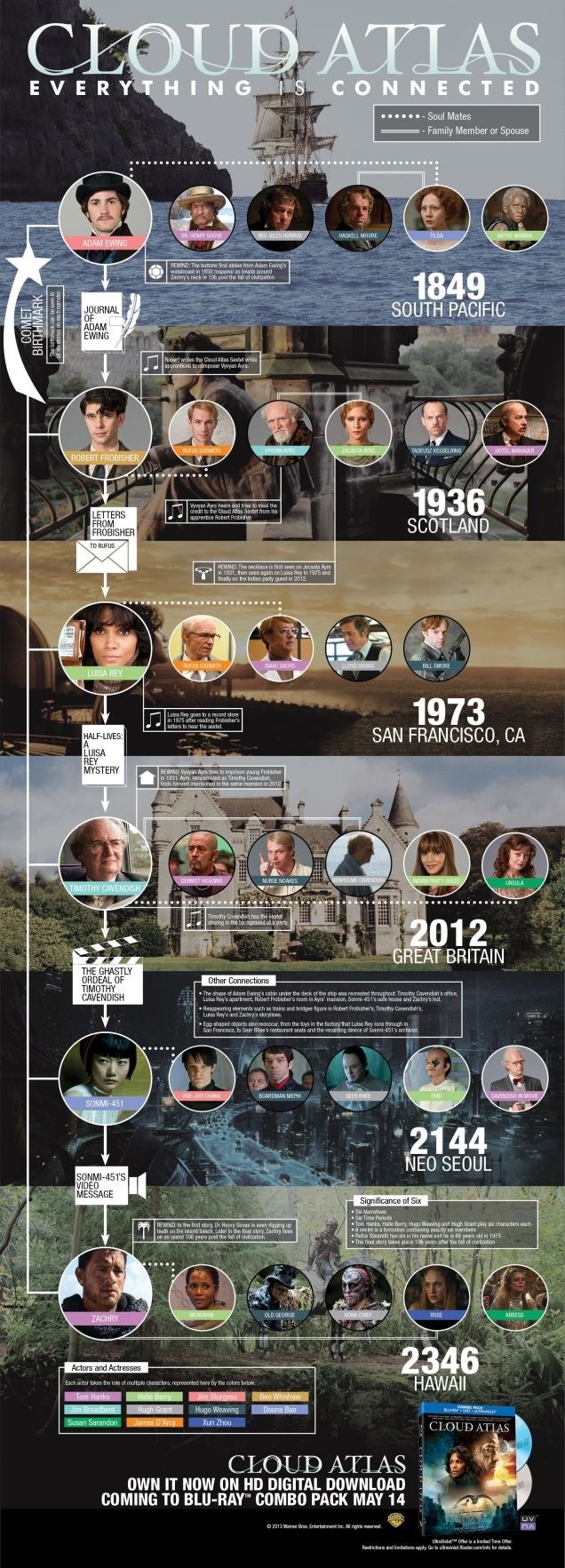
 

Attila and the Witch Doctor: A new education system needed ‘For The New Intellectual’

We know better—America was formed as a philosophy not just another country and it was a direct response to many years of human failure. It was a flash in the pan relatively speaking and is now threatening to fade away back into history because of two primary forces always present in the nations of mankind—Attila and the Witch Doctor. Way back in 1961 Ayn Rand put her finger on these two types of characters in her book, For The New Intellectual. It was and continues to be a revolutionary mode of thinking that is the only path forward—which she identified as the forces of the brute Attila in perpetual conflict with the Witch Doctor—the man of spirit always with a gaze to the ever-after. America was a rejection of the Witch Doctor and a protection against the Attila types which allowed for a new kind of person—the “thinker”–to invent and create a new nation.

However, governments always desire to spring back into the mode of Attila—no matter what type of government it is and they use the Witch Doctor types as their crutches for aggressive action. The Witch Doctor type as well use the Attila types for their ascension and left unchecked will revert back into the old European mode of compete rule of Attila and the Witch Doctor over all of humanity. Presently the fault of this reversion is in the government sponsored education institutions specifically the public school system—capped off by the college system. Those education institutions specifically teach the systems of Attila and the Witch Doctor making them completely useless in the modern world. But before explaining why, please review the excerpts from the Ayn Rand classic below explaining firsthand what these two types of terrible characters are.

  For the New Intellectual

(By Ayn Rand, the foremost philosopher for Capitalism) “When… an entire society is approaching bankruptcy, there are two courses that those involved can follow: they can evade the reality of their situation and act on a frantic, blind, range-of-the-moment expediency—not daring to look ahead, wishing no one would name the truth, yet desperately hoping that something will save them somehow—or they can identify the situation, check their premises, discover their hidden assets and start rebuilding.

“…America’s intellectual leadership has collapsed… America is a country without a voice or defense—a country sold out and abandoned by her intellectual bodyguards.

“The professional businessman and the professional intellectual came into existence together, as brothers born of the same industrial revolution. Both are the sons of capitalism—and if they perish, they will perish together…”

“…with very rare and brief exceptions, pre-capitalist societies had no place for the creative power of man’s mind, neither in the creation of power nor in the creation of wealth… Such societies were ruled by faith and its practical expression: force…”

“…the man of faith and the man of force… they are the actual leaders of most of mankind’s societies, who rise to power whenever men abandon reason…”

“…Attila, the man who rules by brute force… respects nothing but man’s muscles, and regards a fist, a club or a gun as the only answer to any problem—and the Witch Doctor… escapes into his emotions, into visions of some mystic realm where his wishes enjoy supernatural power unlimited by the absolute of nature.

“…Attila feels no need to understand, to explain nor even to ponder, how men manage to produce things he covets—‘somehow’ is a fully satisfactory answer… His view of the universe does not include the power of production. The power of destruction, of brute force, is to him, metaphysically omnipotent. Attila never thinks of creating, only of taking over.

“The Witch Doctor’s method… is the conquest of those who conquer those who conquer nature… With the Witch Doctor, emotions are tools of cognition, and wishes take precedence over facts. …knowledge of the universe will be granted to him by blind, unfocused stare of his eyes turned inward, contemplating the sensations, the feelings, the urgings, the muggy associational twistings projected by the rudderless mechanism of his undirected consciousness. Whatever his mechanism produces is an absolute not to be questioned; and whenever it clashes with reality, it is reality he ignores… The only validation of his consciousness he can obtain on earth is the belief and the obedience of others, when they accept his ‘truth’ as superior to their own perception of reality. While Attila extorts their obedience by means of a club, the Witch Doctor obtains it by means of a much more powerful weapon: he pre-empts the field of morality.

“…they come to need each other. Attila feels that the Witch Doctor can give him what he lacks: a long-range view, and insurance against the dark unknown of tomorrow or next week or next year, a code of moral values to sanction his actions and disarm his victims. The Witch Doctor feels that Attila can give him the material means of survival, can protect him from physical reality, can spare him the necessity of practical action, can enforce his mystic edicts on any recalcitrant who may choose to challenge his authority. Both of them are incomplete parts of a human being, who seek completion in each other…

“…The power of ideas has no reality for either of them, and neither cares to learn that the proof of their power lies in his own chronic sense of guilt and terror.

“Thus Attila and the Witch Doctor form an alliance and divide their respective domains. Attila rules the realm of men’s physical existence—the Witch Doctor rules the realm of men’s consciousness. Attila herds men into armies—the Witch Doctor sets the armies’ goals. Attila conquers empires—the Witch Doctor writes the laws. Attila loots and plunders—the Witch Doctor exhorts the victims to surpass their selfish concern with material property. Attila slaughters—the Witch Doctor proclaims to the survivors that scourges are a retribution for their sins. Attila rules by fear, by keeping men under a constant threat of destruction—the Witch Doctor rules by means of guilt, by keeping men convinced of their innate depravity, impotence and insignificance.

“Against whom is this alliance formed? Against those men whose existence and character both Attila and the Witch Doctor refuse to admit into their view of the universe; the men who produce. In any age or society, there are men who think and work, who discover how to deal with existence, how to produce the intellectual and material values it requires. These are the men who produce the means of survival for the parasites of all varieties: The Attilas and the Witch Doctors and the human ballast. The ballast consists of those who go through life in a state of unfocused stupor, merely repeating the words and the motions they learned from others. But the men from whom they learn, the men who discover any scrap of knowledge, are the men who deal with reality, with the task of conquering nature, and exercising their rational facility.

“A Producer is any man who works and knows what he is doing. He may function on a fully human, conceptual level of awareness only some part of this time, but, to that extent, he is the Atlas who supports the existence of mankind…” (Excerpts from Ayn Rand’s “For the New Intellectual,” copyright 1961.)

http://www.nopc.info/forum/showthread.php?t=20151

When a public school hosts a pep rally for their football team to beat a cross town rival, what is being taught to the students is the mode of Attila—that conquest, force and might rule under the Friday Night Lights and that the entire community—like the nations of the world—will get behind their school sponsoring the team stepping out onto the battlefield. Students at the school must learn where they fit into the pecking order of society in such a system because the power is on full display. Of course the players of the game are at the top of such food chains with school administrators joining their ranks among the socially powerful—because they decide who plays in the battle and who doesn’t. From there society tiers off downward by order of importance—but within those class rooms when the lights are not on for football games, the way of the Witch Doctor is being taught. This would be the climate terrorism that is so prevalent—the avocation of religious tolerance such as the current insurgency of the Muslim faith. Other aspects of the Witch Doctor are the labor unions themselves who control the teachers in these schools—their position is a combination of force and mysticism. They have no idea where the money comes from or where it goes, they just want it—so they take it by force with strikes, public slander, and sheer intimidation. The byproduct of this activity has been an education system ruled by Attila and the Witch Doctors creating several generations of Americans who only understand those two modes of thinking.

There is a third class—for which I am proud to be a part—those are the thinkers. When the thinkers of the world wonder why so many American citizens are so apathetic toward the current scandals in the White House, or seem paralyzed to act against the bizarre notions of the green movement—it is because the modes of thinking that are committing the crimes are due to Attila and the Witch Doctors who are in control of politics, art and entertainment, and the entire intellectual class as it is currently understood. Because most people are taught to be Attila or the Witch Doctor, they are paralyzed to act on what they see is a crime committed right in front of their face. Intellectually, they have been paralyzed into inaction by their education systems leaving them defenseless to make any judgments against.

Saul Alinsky who taught Hillary Clinton and Barack Obama in the methods of eroding away power from those who had it understood this whole Attila and the Witch Doctor mentality and his methods of activism were designed to exploit it—which Obama has done to hide his many crimes. Read below a few excerpts from his “masterpiece” Rules for Radicals which came out ten years after Ayn Rand’s For The New Intellectual to gain an understanding of the way that crimes are committed by radicals but are pardoned by a public respectful of the Attila types who rule over them with force—and are often stuck between the Witch Doctor types who seem to have all the answers. The system that Alinsky is talking about in the following quotes was created by the public education system giving vast numbers of American citizens a complete paralysis in the face of such forces because intellectually they are not equipped to deal with the assault. Modern Americans functioning from respect of Attila have lost the ability to think leaving them vulnerable to Alinsky’s methods of attack—which is destroying the nation presently—and purposely.

Rules for Radicals

by Saul D. Alinsky

“Today’s generation is desperately trying to make some sense out of their lives and out of the world. Most of them are products of the middle class. They have rejected their materialistic backgrounds, the goal of a well-paid job, suburban home, automobile, country club membership, first-class travel, status, security, and everything that meant success to their parents. They have had it. They watched it lead their parents to tranquilizers, alcohol, long-term-endurance marriages, or divorces, high blood pressure, ulcers, frustration and the disillusionment of the “good life,” They have seen the almost unbelievable idiocy of our political leadership – in the past political leaders, ranging from the mayors to governors to the White House, were regarded with respect and almost reverence; today they are viewed with contempt. This negativism now extends to all institutions, from the police and the courts to “the system” itself. We are living in a world of mass media which daily exposes society’s innate hypocrisy, its contradictions and the apparent failure of almost every facet of our social and political life. The young have seen their “activist” participatory democracy turn into its antithesis – nihilistic bombing and murder. The political panaceas of the past, such as the revolutions in Russia and China, have become the same old stuff under a different name. The search for freedom does not seem to have any road or destination. The young are inundated with a barrage of information and facts so overwhelming that the world has come to seem an utter bedlam, which has them spinning in a frenzy, looking for what man has always looked for from the beginning of time, a way of life that has some meaning or sense. A way of life means a certain degree of order where things have some relationship and can be pieced together into a system that at least provides some clues to what life is about. Men have always yearned for and sought direction by setting up religions, inventing political philosophies, creating scientific systems like Newton’s, or formulating ideologies of various kinds. This is what is behind the common cliché, “getting it all together” – despite the realization that all values and factors are relative, fluid, and changing, and that it will be possible to “get it all together” only relatively. The elements will shift and move together just like the changing pattern in a turning kaleidoscope.

For the real radical, doing “his thing” is to do the social thing, for and with people. In a world where everything is so interrelated that one fells helpless to know where or how to grab hold and act, defeat sets in’ for years there have been people who’ve found society too overwhelming and have withdrawn, concentrated on “doing their own thing.” Generally we have put them into mental hospitals and diagnosed them as schizophrenics. If the real radical finds that having long hair sets up psychological barriers to communication and organization, he cuts his hair. If I were organizing in a orthodox Jewish community I would not walk in there eating a ham sandwich, unless I wanted to be rejected so I could have an excuse to cop out. My “thing,” if I want to organize, is solid communication with the people in the community. Lacking communication I am in reality silent; throughout history silence has been regarded as assent – in this case assent to the system.

As an organizer I start from where the world is, as it is, not as I would like it to be. That we accept the world as it is does not in any sense weaken our desire to change it into what we believe it should be – it is necessary to begin where the world is if we are going to change it to what we think it should be. That means working in the system.”

http://latter-rain.com/ltrain/alinski.htm

Alinsky here has set himself up as the Witch Doctor and Obama and Clinton have come to suckle from his nectar and are presently using it to destroy the world in much the way that the same Witch Doctors destroyed the world after the fall of the Roman Empire and ushered in the Dark Ages. During that period in human history, it was religion that held down the minds of man. Today, it is another religion—this time worship of Mother Earth as the deity of highlight. Society must then fall in behind the Witch Doctor because they are intellectually incapable to reason through the problem because their efforts have been placed into the role of Attila—the conqueror.

The way out of this whole scandal literally and intellectually is to discard Attila and eradicate the Witch Doctor from the language of human activity. It is those two forces which destroy advancement of civilizations and currently brings much misery to the world. And it is specifically those two ways of thinking that are the primary topics taught in modern education no matter where in the world things are taught. And for the human mind—there really isn’t anything worse than learning to be like Attila or the Witch Doctor. Both are ancient evils meant to be surpassed and leave the lives of mankind vulnerable to real threats such as Saul Alinsky who wish to build empires on the backs of human slaves shackled not with literal chains, but intellectual ineptitude.

In this way the education systems of present must be completely dismantled and rebuilt to create thinkers. The focus should be on that brief moment in human history where America invented The New Intellectual and gave birth to a nation that ended slavery, invented new economical means, and freed the minds of mankind wherever the philosophy of America touched. Those who hate America hate it because they wish to be either Attila or the Witch Doctor. Their cries against imperialism are not the rule of Attila which typically belongs to a brute force, but in the ability to stand up against such force—and they don’t like it. This is why so many in the world who wish to rule by either force or religious mystics desire to see American dismantled and destroyed. Because the Attila types in the world wish to rule over mankind and the Witch Doctors wish to rule over Attila. They can only do that if Attila first conquers the world. This is why those who hate America desire the brute force of Islam to have their caliphate—because then Attila will have won leaving the Witch Doctors open to place shackles on the minds of the entire world. All this begins so innocently in the public education institutions sponsored by government desiring not to build minds, but compliant servants to Attila and the Witch Doctor.image

Rich Hoffman www.OVERMANWARRIOR.com